Tag: Janet Suzman

A Dry White Season (1989)

A Dry White Season (1989)

A passionate, clear-eyed and largely unsentimental denunciation of Apartheid, the best of its kind

Director: Euzhan Palcy

Cast: Donald Sutherland (Ben du Toit), Janet Suzman (Susan du Toit), Zakes Mokae (Stanley), Jürgen Prochnow (Captain Stolz), Susan Sarandon (Melanie Bruwer), Marlon Brando (McKenzie), Winston Ntshona (Gordon), Thoko Ntshinga (Emily), Leonard Maguire (Professor Bruwer), Gerard Thoolen (Colonel Viljoen), Susannah Harker (Suzette de Toit), Andrew Whaley (Chris du Toit), John Kani (Julius), Richard Wilson (Cloete), Michael Gambon (Magistrate), Ronald Pickup (Louw)

The late 1980s saw a small wave of films denouncing the horrors of Apartheid in South Africa, a racist system founded on cruelty and injustice. Many of these films struggled with either being overly earnest or turning their (inevitably) white lead character into a saviour figure. A Dry White Season is perhaps the best of trend, perhaps because it focuses on a fictional story rather than real history (instantly gaining it the sort of dramatic latitude drained out of Cry Freedom) and directed by Euzhan Palcy, the first Black woman (then aged only 32) hired by a major studio, with a cast of the cream of Black South African actors, who knew all too well this world. A Dry White Season is also notable for its critical view of white South Africans who, bar a few exceptions, are presented as tribalist blind-eye-turners, furious at anyone who shakes their world view.

Ben du Toit (Donald Sutherland) is the epitome of smugly complacent Afrikaner (Sutherland even has a plump false belly, to hammer home his cosy self-satisfaction). A former rugby star, teaching white history in a private school, to him the system is always fair and if a Black man is arrested he must have done something wrong. That’s shaken when school gardener Gordon (Winston Ntshona) asks him for help, first after his barely-a-teenager son is beaten by police then again when the same son dies in custody after a protest. Ben’s first reaction is to shrug and say nothing can be done: the scales fall from his eyes when Gordon asks the wrong questions and is in turn murdered in custody by brutal Captain Stolz (Jürgen Prochnow). Working with campaigner Stanley (Zakes Mokae), Ben finds his entire world view falling apart as he is compelled to uncover the truth – to the fury of his wife, daughter, in-laws and colleagues who increasingly see him as a traitorous boat-rocker.

A Dry White Season doesn’t shirk on the violence of Apartheid. It says a lot that an early truncheon-wielding police assault on a township, and the scarred backside of Gordon’s son soon feels everyday. The student protest – many of its attendees literally no more than children – is met with lethal force from white soldiers carrying machine guns, indiscriminately shooting down children at point-blank range. Gordon is waterboarded and brutally tortured. Anyone who crosses the security forces faces violent assassination or fatal beatings. Palcy unflinchingly shows this horror – and frequently cuts away from atrocities to shots of the du Toit’s enjoying their wealthy, contented life of sports and garden parties. The impression is clear: underneath this contented life for the whites is a brutal, violent, repressive system supressing all rights for the many.

Palcy brings the sort of perspective perhaps only a Black film-maker could. There is no attempt in A Dry White Season to shelter the audience. Instead, we are exposed to the worst the system has to offer. Palcy adds impact with her casting of several extraordinary South African actors. Ntshona, Mokes and Kani among others had all experienced this themselves (Kani lost an eye in a police beating). Their performances are superb. Ntshona’s simple, honest bravery is deeply moving while Ntshinga is heart-breaking as his wife. Kani drips moral authority as a solicitor. Best of all Mokae’s activist Stanley is a superb portrait of warm, world-weary wit barely covering a life of fury.

What’s really refreshing is we expect the white characters to feel shame or guilt as the truth edges into their lives. This doesn’t occur: in fact, bar Sutherland’s du Toit and his young son (the same age as Gordon’s child – the film opens with the two of them playing together) all the white characters furiously protect the system. Sides are firmly picked and no blurring of the lines is tolerated. His daughter (Susannah Harker at her most Aryan looking) just wants him to shut up and stop spoiling things. Richard Wilson’s avuncular headmaster can’t hide his anger at du Toit’s ‘treason’. The police’s deference evaporates the second du Toit asks the wrong questions about the wrong people.

Even du Toit’s wife – memorably played with a raw harshness by Janet Suzman – progresses through irritation, horror to outright disgust at du Toit. Suzman – a South African who fled the country and long campaigned against Apartheid – pours all her anger into a show-stoppingly racist speech where she claims Black people are dangerous and don’t deserve any rights, that the Afrikan’s own South Africa and any violence against Black people doesn’t matter so long as the whites continue to live well. She represents a system supporting a boot stamping on Black faces for the rest of time.

It takes time for du Toit to realise there is no justice. Even after Gordon is murdered, he is convinced a trial will reveal the truth. He is of course, fantastically wrong – the trial being rigged from the start to produce a ludicrous suicide verdict. The trial is conducted by human rights lawyer McKenzie, played in a show-stopping cameo by Marlon Brando. Coming out of retirement to support the project (and working at union rate), Brando flexes his muscles one last time to deliver a charismatic, witty turn as a shambling Rumpole-like barrister who knows from the start his only result will be making the powers-that-be faintly embarrassed at their blatant injustice. If Brando’s support didn’t extend to learning his lines – he’s blatantly reading them from off cue cards or having them funnelled to him through a visible ear-piece – he’s still a stand-out in a sequence that makes abundantly clear just how complicit the whole system is in murder.

Sutherland – a fine performance of stunned, sad-eyed bemusement – makes du Toit a well-meaning men who realises he can never go back to his old life after peaking behind the curtain. It’s a nice touch in A Dry White Season that he never becomes a conventional white saviour: most of his actions lead to disaster, he’s reliant on Mokes’ Stanley and (other than his son) he fails to persuade anyone. But what chance does he have? Placy even shows many Black people have given up. At least one of Gordon’s torturers is a Black police officer and Gordon’s son and his friends open the film berating Black workers in a boozer that their apathy only props up the system. After Gordon’s death, a Black priest counsels turning the other cheek. But then the courage needed to protest is immense: Stanley smilingly states he long-ago accepted he was a dead man and it’s that which keeps him going.

A Dry White Season ends with a touch too much melodrama and a slightly too ‘Hollywood’ ending – but then it’s so relentlessly depressing that even a small victory is a relief. But, in the main, while sometimes rough and ready, it actually presents an important message with real dramatic force, stuffed with fine performances and a brutally realistic view of South Africa. It does give us some hope for the future: the only other white persuaded is du Toit’s young son: and it’s the young who are only hope for long-term change.
The Draughtsman’s Contract (1982)

The Draughtsman’s Contract (1982)

Cryptic puzzles abound in Greenaway’s debut, a striking, oblique country house murder mystery (with bodily fluids)

Director: Peter Greenaway

Cast: Anthony Higgins (Robert Neville), Janet Suzman (Virginia Herbert), Anne-Louise Lambert (Sarah Talmann), Hugh Fraser (Mr Talmann), Neil Cunningham (Thomas Noyes), Dave Hill (Mr Herbert), Michael Feast (Living statue), David Meyer & Tony Meyer (Poulenc brothers), Nicholas Amer (Parkes), Susan Crowley (Mrs Pierpont), Lynda La Plante (Mrs Clement)

Peter Greenaway’s work often feels more like complex, intellectual art projects than films. They are dizzying, mystifying morasses of symbolism, veiled hints, numerical games, puzzles and oblique references, all wrapped up in a stunning visual originality that speaks volumes for Greenaway’s instincts as an artist. All of which means to say, don’t come to a Greenaway film expecting such comforting things as plot or characters. The Draughtsman’s Contract was his first ‘narrative’ feature film and is still (perhaps) the finest example of his complex, challenging (and often, let’s be honest, frustrating) style. Constantly keeping you in your toes, there are few films like it out there.

Its 1694 and famed draughtsman Mr Neville (Anthony Higgins) is approached by country lady Mrs Hebert (Janet Suzman) to create twelve drawings of her husband’s expansive house and gardens, while her husband is away in London. Neville is less than interested in the commission – until Mrs Herbert agrees to his unusual terms that he will have complete control over the house and access to her person at any time that he wishes to “take his pleasure”. Neville sets about his drawings with the detailed fanaticism of a man determined to capture reality exactly as it is: but strange items and objects keep appearing in his panoramas, dutifully reproduced in his drawings. Mrs Herbert’s daughter Mrs Talmann (Anne-Louise Lambert) inveigles Neville into her own ‘contract’ for ‘taking her pleasure’. Is there is something going on in this house that Neville is unaware of?

Greenaway described the film as, in part, an Agatha Christie style murder mystery, with the unloved, bullying husband Mr Herbert as the victim. But then, in true Greenaway style, he also stated any explanation of the identity of the killers, their motives or indeed anything that could explain the crime was unnecessary because the clues were all there and any half-way intelligent viewer could figure them out. In many ways it’s a huge pleasure to have a director who treats his audience with such respect. It’s also an indication, perhaps, that plot was also the thing he was least interested in.

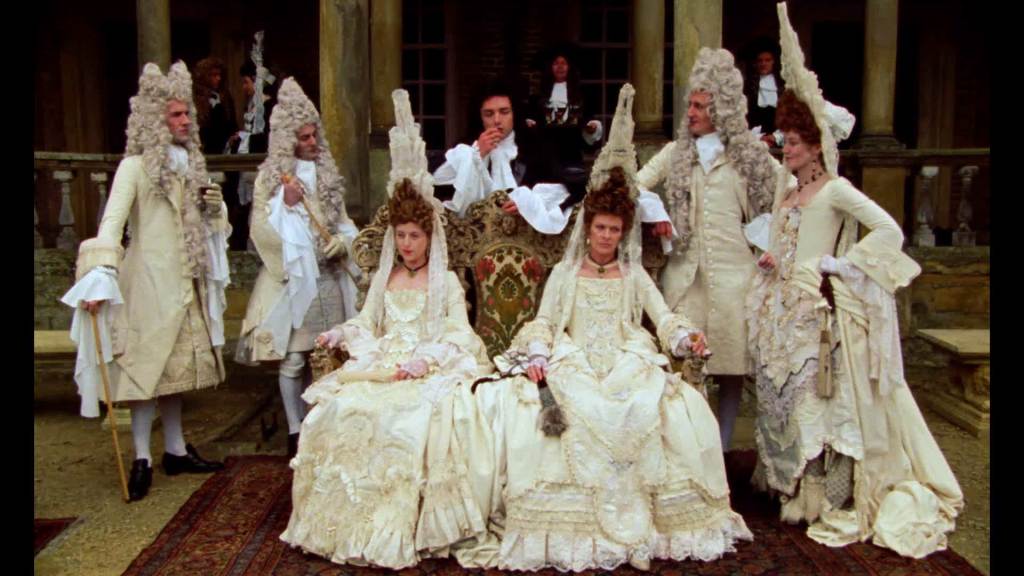
The Draughtsman’s Contract is a fascinating, immersive, coldly intellectual but endlessly puzzling film. Visually it’s like an art-history banquet. Images inspired by a host of the greats (and some lesser knowns) abound. From the film’s opening with its Caravaggio candle-lit interiors to its Hogathian interior shots, it comments throughout on the differences in art between representation and imagination. Neville believes art to be defined by its ability to capture reality: the idea of creation and invention is almost anathema to him, his art a careful preserving of events. It’s why he controls the conditions he paints in so absolutely and why he powerlessly includes the random pieces of clothing (among other things) that appear in his tableaus.

What is happening here? It’s clear something is going on. What slowly becomes clear to us as well is, that for all his slightly repellent arrogant and confidence, Neville has no idea what it is, or even perhaps that anything is happening at all. For all his bragging of his magnificent eye and ability to immediately perceive the smallest change he pretty much misses everything of consequence in the film. He detects no real ulterior mystery here because he seems to lack the imagination to grasp one, so preoccupied is he with his arrogant enjoyment of his commission’s benefits.

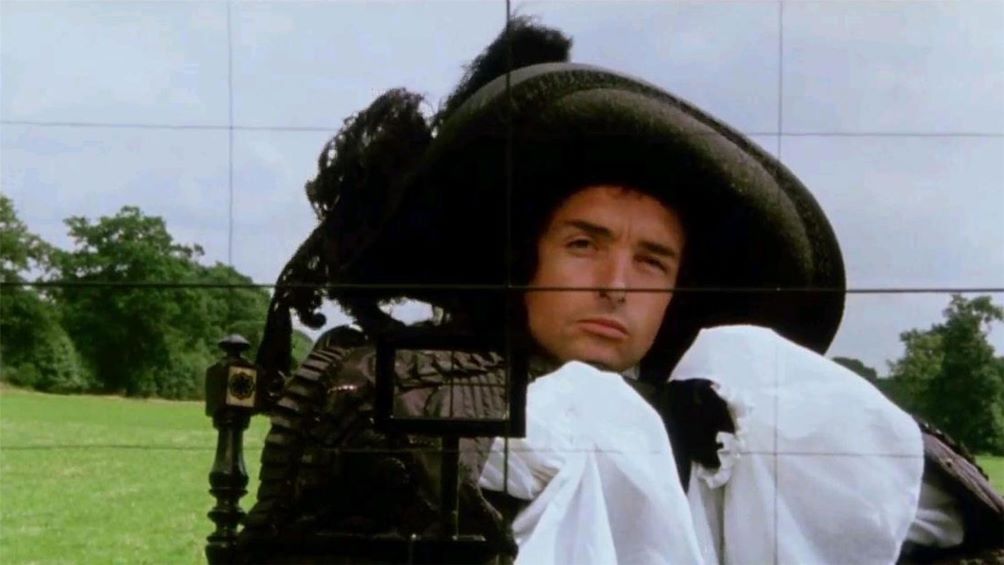
Greenaway presents Neville as the sort of pedestrian, camera-obsessed film-maker I imagine he scorns. Neville sets up his easels and perspective device (which even has a viewfinder) like a movie camera, obsessively fiddling with its set-up with never a thought for the deeper truth behind his striking images. Is this a comment on the lack of imagination in film-makers? Is Greenaway saying they are as bluntly obsessed with the beautiful cross-hatching of details stops them from creating something truly visually striking, or discovering the “spiritual truth” behind the details?

It’s that failure to pick up the spiritual truth that is Neville’s downfall. Slowly we realise the house’s owner is unlikely to return alive. The curiously artificial behaviour of everyone in the house, their sterile, detailed lives and obsessions with form, becomes overwhelming sinister. Neville however, charges about, aggressively pushing Mrs Herbert through sexual encounters (she even vomits after their first one – no Greenaway film is complete without every excretion the human body can produce), provoking her impotent son-in-law Mr Talmann (a vilely aristocratic Hugh Fraser) and endearing himself to no-one. It never occurs to him he might be being used.

Very few answers are spoken in the film. It’s left to us to figure out who might have committed the murder, and largely to surmise why two childless women allow Neville to take such liberties with them at a time of strict inheritance laws that denies rights to childless women. An elaborate trick is being played on Neville, dependent on his arrogant assumption that he is in charge. In fact, in his black clothes, loud voice and lack of over-elaborate hair and make-up, he is an out-of-his-depth outsider, even as he behaves with the rumbunctious confidence of a man at the top of the hierarchy.

Greenaway’s film is full of small curiosities that largely go unnoticed. Small details in the house are clearly out of period. A small boy sketches what looks like spaceships. Above all, the house’s grounds are populated by a nude living statue (played in a performance of physical dexterity by Michael Feast), painted grey, who seems to see and hear everything but is invisible to all. As to what this means, who can really say (Greenaway ain’t telling), although in true Greenaway style we get to watch him piss. Is it perhaps a comment on the increasingly obvious things Neville is missing? Or a sort of holy fool or Puck-figure, observing the mayhem with fascination?

This is a film that can get frustrating as its oblique conversations work overtime to obscure their meaning and intent. But it’s so marvellously, and intricately, assembled it just about gives you enough to fascinate to balance. The painterly shooting style – often with a static camera – is visually striking, as is the overblown grandeur of costume and design. Michael Nyman’s score – a remix of Purcell – is astoundingly good, subtle themes accompanying each action. The film descends into a bleakly terrible ending, that could sit comfortably in the worst kind of folk horror, as Neville discovers just how little he really saw while he was looking.

But it’s really an experience more than a film. Like a slice of recorded life carrying a deep allegorical message of mankind’s darkness in a way Greenaway, bless him, has the confidence we will get. There is a magnetic performance from Anthony Higgins, whose bombast and pride still somehow makes him just-about-sympathetic. An oblique commentary on art and life, The Draughtsman’s Contract offers no easy answers (or any answers at all really) but is full of images, moments and concept that will fascinate, appal and certainly stick with you long after it’s blackly nihilistic ending.

Nicholas and Alexandria (1971)

nicholas-and-alexandra-1971
Michael Jayston and Janet Suzman bring the Romanovs to life in Nicholas and Alexandra

Director: Franklin J Schaffner

Cast: Michael Jayston (Nicholas II), Janet Suzman (Empress Alexandra), Harry Andrews (Grand Duke Nicholas), Tom Baker (Rasputin), Jack Hawkins (Count Vladimir), Ian Holm (Yakovlev), Curt Jurgens (Germany consul), John McEnery (Kerensky), Laurence Olivier (Count Witte), Eric Porter (Stolypin), Michael Redgrave (Sazonov), Irene Worth (Queen Marie Fedorovna), Roderic Noble (Prince Alexei), Ania Mason (Olga), Lynne Frederick (Tatiana), Candace Glendenning (Marie), Fiona Fullerton (Anastasia), Michael Bryant (Lenin), Brian Cox (Trotsky), Maurice Denham (Kokovtsov), Roy Dotrice (General Alexeiev), Julian Glover (Georgy Gapon), John Hallam (Nagorny), James Hazeldine (Stalin), Alexander Knox (US Ambassador), Vivian Pickles (Krupskaya), Diana Quick (Sonya), John Shrapnel (Petya), Timothy West (Dr Botkin), Alan Webb (Yurovsky), John Wood (Colonel Kobylinsky)

When I was growing up, Nicholas and Alexandra was a popular movies in our house. And, as a history buff, I can’t help but be sucked into it’s grand-scale epic scope (a cast of stars play out the beginnings of the Russian Revolution!). You can certainly look at Nicholas and Alexandra and see a film that at times is bloated and lacking flair. But as a representative of a particular type of genre, with grand scale production values covering decades of earth-shattering events in a three hours, it’s a thoughtful and at times even rather moving picture.

Nicholas II (Michael Jayston) is Tsar of all the Russias. With the film starting with his (typically) disastrous decision to fight the Japanese in 1905 (a war that literally sunk Russian naval dominance) we see a parade of misguided, poor and short-sighted-but-well-meaning decisions by Nicholas – encouraged by his strong-minded but politically naïve Tsarina Alexandra (Janet Suzman) – eventually lead to the First World War and a revolution that will overthrow him. On a personal level, the couple also deal with the heartbreaking haemophilia of their son Alexei (Roderic Noble) and Alexandra’s dependence on the destructive Rasputin (Tom Baker). As their lives go from supreme power to imprisonment and eventual murder, the film also covers a host of Russian politicians from statesmen to socialists, all of them wanting to build Russia in their own image.

Franklin J Schaffner’s epic sometimes gets a bit overwhelmed by its impressive reconstruction of Imperialist Russia – the set design and photography is wonderful and the film marshals the inevitable cast of thousands with skilful effect. What the film does very well is marry up the epic with the personal. Because this is both a chronicle of the reasons for the outbreak of the Russian revolution, but also a domestic tragedy of a royal family horrendously ill-suited to the high position birth has called them to.

The film’s vast scope does mean it has to make a frequent resort – particularly in its first half – of feted stage actors explaining events at each other. Particularly rushed are scenes featuring the socialist revolutionaries, where actors like Michael Bryant, Vivian Pickles and Brian Cox have to contend with bullet point dialogue and lines of the “Trotsky, let me introduce you to Stalin, he’s just back from Siberia” variety. Nicholas attends frequent meetings where the likes of Laurence Olivier, Eric Porter, Harry Andrews and Michael Redgrave carefully fill him in on what’s happened and the likely (invariably historically correct) outcomes. At times it does make the film a rushed pageant.

The film however makes it work by continually bringing itself back to the personal story of Nicholas and Alexandra themselves. The film is expertly carried by relative newcomers (at the time) Michael Jayston and Janet Suzman. Jayston – an astonishingly close physical match for Nicholas II – gives a perfectly judged characterisation of the Tsar. He’s a decent, well-meaning, dedicated and hard-working man who would make an excellent bank manager. As a supreme leader he’s a disaster – stubborn and so convinced that it is his holy duty to be father of the nation, while with a weary smile he short-sightedly vetoes any social or political progress what-so-ever. As one character tells him late in the film, he lacks any imagination: he can’t reinvent an absolute monarchy in the modern age, because it’s fundamentally beyond him to picture how anything can be done differently from hundreds of years of precedent.

Rational and calm he’s strangely almost more content out of power, focusing on his family and tending his garden. Not that his flaws depart – he remains an appalling short-sighted judge of character and situations to the very end (nearly every statement he makes is wrong). Jayston tackles a difficult role with ease and assurance – he carries most of the film and I think it’s only that Nicholas remains such a reactive character that Jayston doesn’t get more credit for his work here.

Much of the “nominations” attention went to Suzman, who has the more electric (but in some ways simpler role) as Alexandra. She brings to the marriage all the qualities Nicholas lacks – defiance, determination, ambition – and those are just as destructive. Just like her husband she’s stubborn and a terrible judge of people and situations, who clings loyally to terrible influences (like Rasputin) and puts her family and personal concerns above the preoccupations of the throne and the people. She’s prickly and harder to like than Nicholas (who she clearly dominates with her stronger personality) – but Suzman grounds her confrontationalism in a genuine love for her family.

The film’s second half, which largely focuses on the end of the regime and the last few months of the families lives being shuttled from one inhospitable safe house to another, makes a successful contrast with the grander scope of the first half. With the focus now more intently on the family themselves, particularly quietly contrasting their former supreme power with their new helplessness, it helps to bring out the heart. Schaffner’s film is very good at quietly building the dread as we head towards the inevitable end (the final few moments of the film are almost unbearably tense). In the whole family, only Prince Alexei seems able to comprehend that they are doomed. But removed from supreme power, Nicholas and Alexandra relax into what they would have been happier being: decent, kind, middle-class homebuilders.

Schaffner’s direction may not bring the burst of poetry that he managed with Patton – but he’s very good at building our empathy for these misguided and foolish autocrats. So much so, you’ll be screaming at Nicholas “Of course you should give the people a parliament!” while never actually hating him – because, stubborn and misguided as he is, he means well. However the film doesn’t let us forget what Nicholas is a figurehead of. Sequences demonstrating the sour, resentful poverty of most Russians are common – not just the 1905 march on the palace (that ends in a panicked officer ordering a massacre), but the grim faces of average Russians greeting the celebrations of the centenary of the Romanovs, while pissed aristocrats and Cossacks barrel about throwing empty of bottles of booze around. The tensions of Russia, and the inevitability of disaster, is never forgotten.

The all-star cast throws up several fine performances, backing the quietly assured leads. Olivier brings moral force as Count Witte – with an impassioned speech on the eve of the breakout of the first world war, all but breaking the fourth wall as the rest of the court continue their work around him. Hawkins demonstrates he has one of the most emotive faces in cinema as retainer Vladimir, while Andrews is bluff and loyal as Grand Duke “Nikolasha”. Irene Worth brings a sanctimonious pride to the Queen Mother’s talking truth to power.

There’s also some great work from less recognisable names. John McEnery (who should have become a bigger star) is fabulous as an impassioned Kerensky who finds himself stuck in the same mistakes as the Tsar. John Wood is very good as a Colonel feeling increasingly morally conflicted. Alan Webb is chillingly affable as their final warden. Later to take on the mantle of Doctor Who, Tom Baker gives Rasputin a mixture of restraint tinged with madness (as well as having the most prolonged death scene on film).

Nicholas and Alexandra is, in some ways, grandly old-fashioned. But it’s got a surprisingly strong heart and sense of empathy in it. It acknowledges the dreadful mistakes and stubborn lack of imagination of the Romanovs – and the many that their misguided principles led to poverty and death – but it also acknowledges both their well-meaning intentions as well as presenting their tragic ends. At times it’s a run-down of events of the final years of Tsarist Russia, but it also manages to tell an affecting family story of flawed people. It’s what makes it work.

A Day in the Death of Joe Egg (1971)

Janet Suzman and Alan Bates balance the pressure of bringing up a paralysed daughter in A Day in the Death of Joe Egg

Director: Peter Medak

Cast: Alan Bates (Bri), Janet Suzman (Shelia), Peter Bowles (Freddie), Shelia Gish (Pam), Joan Hickson (Grace), Elizabeth Robillard (Jo), Murray Melvyn (Doctor), Constance Chapman (Moonrocket lady)

The playwright Peter Nichols’ daughter Abigail was born in 1960, suffering from severe physical and mental disabilities, requiring 24-hour care from her parents. Nichols transformed the experience into a play about two parents who struggle to care for their daughter, and spin out little fantasy conversations with their child, indulging in flights of fancy even while her father wonders if it is even worth carrying on with looking after a child who will never experience any improvement or independent life.

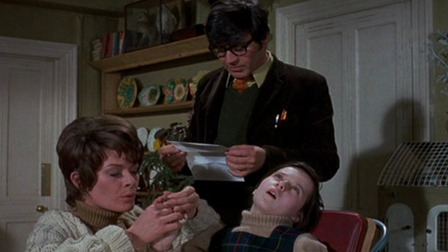
Alan Bates plays the husband Bri, a put-upon teacher at a boys’ school, prone to flights of comic fantasy. Bri feels increasingly frustrated about the unacknowledged strain their handicapped daughter Jo is placing on his marriage to Shelia (Janet Suzman), whose focus is almost exclusively on looking after their daughter. The couple use often surreal black humour to cope with the constant pressure of caring for the child.

The excellent Indicator blu-ray contains a fascinating interview with Peter Nichols, who clearly didn’t care for the film. He found it off-balance, too emotionally overwrought, too realist and essentially too depressing. He’s probably right. The play is a finely balanced mixture of near stand-up comedy and marital grief. Bri’s comic moments are vaudeville fantasy sequences, with funny accents and larger-than-life characters pulled together. This toying with the fourth-wall just can’t be translated in to cinema here, instead the film downplays the dark humour and humanity of the piece, and instead makes it a rather heavy-handed and glum watch.

Bates still has many of the essentially comic funny voices and character-based routines – there are sequences where he acts out the roles of various doctors and priests who have consulted on Jo in the past. But his performance is just a little too eccentric, a little too out-there, a little too twitchy – frankly it makes him hard to engage and empathise with. Maybe it’s the changing times that haven’t helped, but Bri’s constant whining that his sex life has been destroyed just doesn’t sound right.

Of course, Nichols is using this whining to touch upon the damage done by the pressure of constantly caring for a daughter who will never show any signs of improvement and never be capable of communicating with her parents. Nichols knows of what he speaks: he and his wife eventually hospitalised their daughter (and had two other children) – and he believes the parents should have done the same in his play. By making the entire focus of their life a child who is, essentially, an object (twice at opposite ends of the film she is pushed into a room slumped over a wheelchair), it’s clear the couple are causing no end of damage to their emotional lives. Maybe it’s just heavier going as well because the film features a real child – while the play used theatrical invention to represent the child.

The film slightly unbalances itself by moving away from black humour to emotional impact. Maybe part of this is due to Janet Suzman’s astonishingly strong performance as Shelia, a part she invests with great layers of emotion and hope, constantly refusing to give up hope that one day Jo may respond. Suzman has one extremely emotional speech, recounting a moment where Jo pushed over some play blocks, which she delivers with a teary, earnest, simplicity to the camera which is profoundly moving. It probably makes Bates’ performance seem a little more irritating than it actually is, because she is strong.

And that is a problem with the film, because in order for it to work you need to bond with both parents. You need to share and be inspired by Shelia’s hope, while at the same time see that Bri’s more realistic perceptive, and his dark longings to end Jo’s life of suffering, are in many ways just as legitimate. The film is all about this issue of euthanasia – conversations dance around it constantly – and it largely manages not to fall either side of the issue. There are points on both sides – and the real issue is should the parents find some other way to get support and help with caring for their daughter? Instead you don’t quite bond with both parents the way you need too. You feel Bri is a bit too sharp, and that Shelia is a bit too unrealistic in what she believes in.

The second half of the film introduces most of the secondary characters, particular Freddie and Pam (expertly played by Freddie Bowles and Shelia Gish), giving us a fresh perspective on the events. Freddie is bluntly concerned in a jolly way with doing what he can to help and urges the couple to consider hospitalisation. Pam, however, behaves with the awkward embarrassment many of us are ashamed to admit we feel when confronted with the seriously paralysed. We also get to see more of Joan Hickson (the only cast member from the original stage production) as Bri’s brassy and difficult mother, whose attempts to help largely only serve to increase tensions.

It slowly becomes clear though that this is a film about the collapse of a marriage under pressure, even more than about caring for a disabled child. But shorn of much of its humour – the fantasy sequences don’t really work, because they feel a little too heightened and overplayed – the film turns the play into something really quite bleak. It’s frankly a little too depressing and overbearing to really enjoy. It has plenty of good performances, but doesn’t really open up the play and instead turns it into an intense, rather overbearing chamber piece. A film that loses its balance from the stage version, and instead becomes something quite glum, in which Bates’ Bri doesn’t really win our sympathy as you feel he should do. It’s a tougher watch than Nichols intended – surely why he wasn’t really happy with it.