Tag: Japanese cinema

Drive My Car (2021)

Drive My Car (2021)

Time struggles to heal wounds in Hamaguchi’s meditative, carefully paced and exquisite film

Director: Ryûsuke Hamaguchi

Cast: Hidetoshi Nishijima (Yūsuke Kafuku), Tōko Miura (Misaki Watari), Masaki Okada (Kōji Takatsuki), Reika Kirishima (Oto Kafuku), Park Yoo-rim (Lee Yoo-na), Satoko Abe (Yuhara), Jin Dae-yeon (Gong Yoon-soo), Sonia Yuan (Janice Chang)
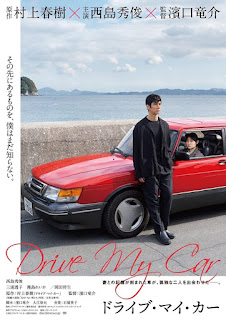
They say time heals all wounds: that’s not always the case. It’s certainly something you begin to appreciate in Hamaguchi’s beautiful elaboration of Ozu-style classicism, Drive My Car. Grief and loss do not adjust and correct themselves after the elapse of many months and years. Instead, they can allow pain to fester, ferment and bubble with further questions, regrets, resentments and sorrows. The world becomes a loop, we drive endlessly through, hoping to maintain some semblance of control over ourselves and our feelings.

That echoes the loops through Hiroshima the car of the title drives in this delicate, throught-provoking and mesmerising film, that expands a Murakami short story into three hours of meditative screentime. Yūsuke Kafuku (Hidetoshi Nishijima) is a celebrated theatre director, specialising in multi-lingual productions of classic Western plays. One day when his flight is delayed, he returns home unannounced to find his wife, screenwriter Oto (Reika Kirishima), making love to an unseen man. Unnoticed, Kafuku quietly leaves and says nothing. Their relationship seems to continue unchanged for a few weeks, with Oto clearly distressed and concerned when Kafuku is in an accident. But she seems to notice a new reticence in Kafuku and, one day, asks that they have a conversation when he returns home for work. When he does, he finds Oto has died from a sudden brain haemorrhage. What was she going to say to him?

Marking the leisurely pace of Hamaguchi’s film, this takes up the opening 40 minutes at which point the opening credits roll. It’s sprinkled with the details of an elaborate backstory: we discover the couple lost a child aged 5 several years ago and decided to not have another (though Kafuku may regret this). There is a suspicion her lover may have been young actor Takatsuki (Masaki Okada). Two years later, Kafuku agrees to direct a production of Uncle Vanya at a Hiroshima theatre festival. Events there will lead him to confront his conflicted feelings about the loss of his wife he both still adores and also, on some level, resents.

Kafuku has carefully constructed his life to maximise his control. He seems to have abandoned acting his signature role of Vanya. Later in the film Kafuku states that Chekhov’s words reveal our true selves – and its clear, from the snatch we see of his performance shortly after Oto’s death, that true self is one Kafuku is in no position to face. Vanya’s grief, resentment, pain at his lost love, anger at the chances in life he has missed – all of these bring to the surface Kafuku’s feelings about his own life. Hamaguchi’s choice of play is a masterstroke: as we listen to Chekhov’s words they shade and deepen the themes in the film: Chekhov’s autumnal sadness is a perfect reflection of the film.

We hear a lot of Uncle Vanya, as Kafuku’s last link to his wife is a cassette recording she made of the dialogue for Kafuku to play in the car (there are gaps for Vanya’s lines, which he fills with a monotonous flatness). He plays this constantly in his car, an aged Saab he has kept beautifully conditioned for fifteen years (meaning he purchased it at the time of his child’s death, adding to its emotional importance). A key part of his sense of control over his life, is the driving and reciting of these lines: hence his request for a hotel an hour’s drive from the theatre.

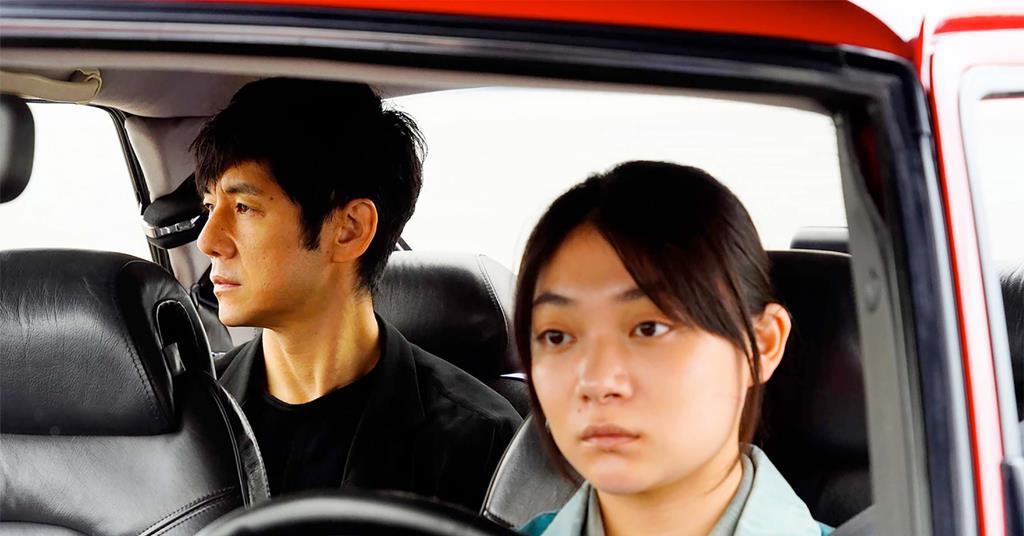
The isolation and control of driving the car is so important, that it’s a major shock for Kafuku to discover that, for insurance reasons, he has to have a driver for the duration of the production. This is a young woman, Misaki Watari (Tōko Miura), who prides herself on her driving skills (she states it is the only thing she can do well) and who Kafuku reluctantly agrees to hand the keys over to. She wins his eventual trust by her competence and skill – she cares for the car just as he does – and her willingness to sit in silence and let Kafuku continue his ritual of reciting the lines from Vanya.

The growing closeness of these two characters becomes the engine (if you can call it that for a film that luxuriates so much in taking its time) of this thought-provoking and eventually very affecting masterpiece. Both characters find similarities and contrasts in each other: both are dealing with processing the loss of a loved one and, most painfully of all, the questions about who they truly were and what they truly felt that can now never be answered. This plays out in almost the exact opposite of heartfelt conversations: instead long, patient scenes as trust grows not always through words but through mutual comfort, the sharing of a cigarette, discussion of other issues and the impact of time spent in each other’s company.

Time is vital to this. The barriers both these characters have built in themselves to process their feelings would never come down quickly. Hamaguchi’s patience is vital for us to understand how tightly they have wound up their emotions. Kafuku directs with a rigid control, his multi-lingual technique (with at least five languages in the company) demands clarity and long sessions of reading around a table so that actors absorb the flow of the play. It does not allow for flexibility and improvisation. Similarly, Misaki’s driving follows pre-ordained routes and a schedule, that seems to prevent her thinking about other things.
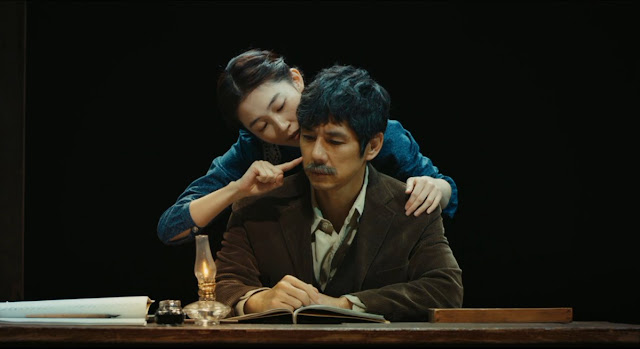
Throughout Hamaguchi avoids sign-posting. Kafuku’s feelings about his wife seem confused and conflicting from scene-to-scene – the Chekov dialogue reflects this, sometimes tinged with intense sorrow and regret, at others bitterness and fury. Kafuku recruits the man he thinks his wife’s lover for the play – casting him in his signature role of Vanya. But why? Does he even know? It could be to accuse him, to control him, to destroy him, to get closer to his wife – or it could be parts of all of them. Definitive answers are kept to a minimum – but then that reflects life.

The relationship between the two comes to a head (such as it is in a film where long conversations slowly reveal buried emotional truth) in a long, late-night car journey shot by Hamaguchi in a carefully controlled one-shot/two-shot that has a classic simplicity that lets the emotion and acting come to the fore. Drive My Car is as unflashy a film as you can get, but its restraint, beautiful but serene imagery and gentle pace add to its slow-burn effect. The moments of emotional catharsis, when they come, are all the more affecting for it – and truly carry a sense of life-changing impact.

The performances are beautiful. Nishijima is quiet, reserved but conveys oceans of conflicted emotion below the surface which he keeps patiently bottled-up. It’s a low-key, highly expressive and tenderly gentle performance. He plays exquisitely with Tōko Miura who at first makes Misaki seem like any number of slightly-surly hirelings, but in turn unveils emotional depths and pain that constantly surprise. Reika Kirishima is both radiant, tender and unknowable as Oto. Masaki Okada is perfect as the lost Takatsuki. Park Yoo-rim is a stand-out among the ensemble as a mute Korean actress communicating through sign language (her acting in the play-within-the-play is stunning).

Originally intended to be filmed in Korea, there is a beautiful serendipity about the pandemic forcing a location change to Hiroshima. No other city on Earth carries such an association with pain and the slow recovery over time. Drive My Car takes the time it needs to explore how grief seeps into us and is only addressed through great care and strength. It’s profoundly engrossing and moving for all of its length – you wouldn’t want to change a thing about it.

Tokyo Story (1953)

Family life is troubled in post-war Japan in Yasujiro Ozu’s masterpiece Tokyo Story

Director: Yasujirō Ozu

Cast: Chishū Ryū (Shūkichi Hirayama), Chieko Higashiyama (Tomi Hirayama), Setsuko Hara (Noriko Hirayama), Haruko Sugimura (Shige Kaneko), So Yamamura (Kōichi Hirayama), Kuniko Miyake (Fumiko Hirayama), Kyōko Kagawa (Kyōko Hirayama), Eijirō Tōno (Sanpei Numata), Nobuo Nakamura (Kurazō Kaneko), Shirō Ōsaka (Keizō Hirayama)

When you think about Japanese cinema, many people’s minds turn to the work of Kurosawa, or high tempo manga animations. But there is another side to Japanese cinema – a more careful, meditative, almost lyrical side – and few directors express that better than Yasujirō Ozu. Tokyo Story is his masterpiece, a film so masterfully put together – but also so restrained and simple in its telling – its reputation has grown until it is considered a contender for the greatest film ever made. 

Ozu’s trick with Tokyo Story is to tell a story that is focused on a very particular time and place, but also brings with it a universal relevance. Elderly married couple Shūkichi (Chishū Ryū) and Tomi (Chieko Higashiyama) travel to Tokyo to visit their grown-up children, doctor Kōichi (So Yamamura) and hairdresser Shige (Haruko Sugimura). But their children now have their own work and life pressures – living in small, crowded homes in Tokyo that double as business places – and they just don’t have the space or time to spend with their parents. The only person who makes their time for them is their daughter-in-law Noriko (Setsuko Hara), the probable-widow of their son who went missing during the war and has not been seen in over eight years. 

Ozu’s film is about a transition in Japanese culture, as the country modernises in the post-war environment and the natural deference and familial links that had previously powered much of its way of life began to fade in importance. Families are now distant, patience and respect between the generations is fading, and many in the elderly generation struggle to understand their children. In the same way, the younger generation forge their own lives and see their priorities change from those of their parents. This is an acute issue at this post-war era of Japan – but who hasn’t experienced some level of this inter-generational confusion?

That’s perhaps why Tokyo Story carries as much impact as it does. A quiet, reflective and gently paced film, it’s striking that it doesn’t place blame or cast characters as heroes or villains. Instead, everyone is, by-and-large, trying their best, struggling with pressures of their own. While it’s easy to see the children as uncaring – it’s also clear that their own lives are hugely busy, with demanding workloads and the homes they live in are small, cramped and difficult for them to live in. Shige and her husband effectively sleep on the floor of their hairdressing parlour. Kōichi struggles to fit himself, his wife, two children and a doctor’s surgery into what looks like a pretty simple two-up-two-down home. While the children are frequently thoughtless – or quick to persuade themselves that what’s easy for them is also easy for the parents – the film makes clear that there are reasons for this.

Nevertheless our sympathies are clearly meant to lie more with the parents rather than their children. Polite, quiet and determined to think the best of their children, the parents are reserved, dutiful relics of a very different Japan. They fall over themselves to thank their children for any time or patience shared with them, and feign enjoyment of the spa (packed full of young party people) their children send them to as a treat (it takes one night of no sleep for them to decide, quietly, to leave). These are people determined not to rock the boat, resolved that everyone is acting for the best. 

However, it is clear the emotional impact of these events is greater than they might expect. Shūkichi, it emerges, has a history of too much drinking – and a few days in Tokyo is enough for him to hook-up with some old drinking buddies and stumble into Shige’s home late at night, drunk as a skunk. But the emotional impact is also clear in their growing closeness and regard for their daughter-in-law Noriko, the only person in Tokyo who seems to make an effort to spend time with them, rather than their own children.

Superbly played by Setsuko Hara, with a gentleness, slight timidity and genuine sense of kindness that makes her the warmest character in the film, Noriko thinks the best of everyone and desires all to be happy. For her adopted parents, however, her good treatment slowly awakens to them to the way Noriko has put her own life on hold since the disappearance of their son. His photo still hangs like a shrine in her home, and she shows no interest in moving her life on. Warm and kind as she is, she is as lonely as the parents. Tomi in particular becomes overwhelmingly concerned for this vulnerable person – perhaps a child that needs her protection in a way her own children no longer do. Staying the night at Noriko’s, their conversation touches – in a very reserved way – on deep emotional trouble. Tomi stresses her desire for Noriko to be happy – and as they go to sleep seems to be overcome with tears and emotion. But she won’t speak openly of her worries for Noriko.

It takes later events, and Tomi’s later illness, for Shūkichi to broach the subject openly, kindly telling Noriko that both of them worry about her future happiness and her waiting for a man who will never come back from the war.  They urge her to restart her life – a suggestion Noriko meets with an emotional out-pouring of tears, but also perhaps a sense of being given permission to re-start her life.

This emotional content plays out with all the more power due to Ozu’s restrained and quiet shooting style. A huge majority of the film is shot in mid-shot, with the camera positioned at the height of someone kneeling on a tatami mat (Ozu called them his “tatami shots”). This has the impact of making events play out gently in front of the viewer, a bit like a play, but giving things a strangely intimate stillness. The sort of cinema language we are used to – cross-cutting and over-the-shoulder shots for conversation – is completely absent. Ozu rarely cuts, keeps the camera more-or-less stationary and only occasionally throws in shots where the characters deliver dialogue effectively straight at the camera. This effect in particular adds to the intimacy, making us part of the scene with the characters expressing their thoughts or concerns directly to us.

In addition, Ozu beautifully allows scenes to both gradually play in and out. The cutting of most scenes allows an establishing shot of a location, followed by a prolonged series of tatami shots that start before the scene proper begins and then frequently continues for a few moments after the scenes finish. Again this makes the film all the more personal, as the characters expand and live beyond the confines of the requirements of the scenes. Watching characters silently continue to pack – or quietly sitting having run out of things to say – in some way carries as much power as dialogue, and really immerses you in the world of the film.This quiet, meditative effect becomes increasingly engrossing, as Ozu’s slow-paced, gentle filming style lets this small-scale story play out very effectively. Although not much really happens in the story, this story of miscommunication between the generations gains a universal strength the more you let yourself get lost in it. The acting is excellent, with Chishū Ryū (playing a character twenty years older than him) and, in particular, Chieko Higashiyama extremely moving and heartbreakingly real as the parents. But what really gives the film its heart – and its sense of hope – is the beauty of Setsuko Hara’s Noriko. It’s this character that provides the hope for a warmer, stronger, more understanding future for all. As Noriko returns to Tokyo at the film’s end – cradling a gift – we hope that a cross-generational understanding is in our grasp. 

Ozu’s final shot features the sounds of traditional children’s singing being drowned out by a train. It’s a sign of how progress has changed our society – but the film carries enough hope for us to promise ourselves that things will get better.

The Last Samurai (2003)


Ken Watanabe and Tom Cruise. I’ll leave you to guess which one turns out to be The Last Samurai…

Director: Edward Zwick

Cast: Tom Cruise (Nathan Algren), Ken Watanabe (Moritsugo Katsumoto), Timothy Spall (Simon Graham), Tony Goldwyn (Colonel Bagley), Billy Connolly (Zebulon Gant), Hiroyuki Sanada (Ujio), Shin Koyamada (Nobutada), Masato Harada (Omura), Shichinosuke Nakamura (Emperor Meiji), Koyuki (Taka), Seizo Fukumoto (Silent Samurai)

Nathan Algren (Tom Cruise) is a legendary but traumatised veteran of the US’s war against the Native Americans. In 1877 he is recruited by the Japanese government to train their new modern army. Japan is a country split between the old and the new, with the samurai leading a revolt against modernisation. After the army is defeated by the samurai, Algren is taken captive. He quickly finds himself enamoured with Samurai culture, not least because of the inspiring charisma and nobility of the samurai leader Lord Katsumoto (Ken Watanabe).

The white man in the noble warrior culture: it’s a narrative structure that never fails. The Last Samurai fits very neatly into a familiar pattern: a story about an exotic non-Western culture, with a white Western character placed at the forefront. Of course the samurai culture is portrayed with a romantic longing, with the charms of its honourable life impossible to resist for our hero, all too familiar with the corruption of our culture. It’s been a pretty standard structure ever since Dances with Wolves. And of course, the white man is left standing as the only witness to the brave sacrifices of the noble-savages-who–weren’t-as-savage-as-we-first-thought.

What this structure does is minimise the entire point of the story. This is supposedly a story about a major shift in Japanese culture – from the old feudal world of the samurai to a more mechanised, modern society. In this cultural shift, some people got left behind, unable to let go of the old ways. It’s a tragedy for that old way of life, but this film muddies that water with its redemption structure for Algren. So by the end of the film, we may be looking at the destruction of the samurai culture and the deaths of most of the characters we’ve spent the film (sort of) getting to know – but hey at least the American lead has found peace and contentment.

So the nominal “last samurai” himself, Katsumoto, becomes a supporting character in his own film, a spirit animal to guide Algren towards a better understanding of himself and of the world. Katsumoto is presented romantically, a noble, kindly, principled man who mixes a love of poetry and flowers and a wry wit with a fanatical ruthlessness in battle. It’s the quintessential “noble savage” of Hollywood lore. All of which is not a criticism of Ken Watanabe, who is excellent – a guy whom you find yourself falling in love with, totally believable as the sort of man others would follow to the death. It’s a standard Hollywood cliché, albeit one presented with commitment.

Having said all that, the film does treat Japanese culture with an immense respect, even if it does so through a romantic lens. It’s also pretty unflinching at the more brutal side of the samurai culture – its expectations of suicide on failure, its pride and unwillingness to compromise. Of course, these are also later embraced as part of its nobility, but at least they are there. The film does also touch on some points of disagreement between East and West – Algren has nothing but contempt for Custer’s ego-driven suicidal last stand, while Katsumoto finds the story enchantingly inspired – but doesn’t allow these to get in the way of the romance. And by the end of the film, there is certainly no criticism for the suicidal charge Algren and Katsumoto lead the samurai into.

The modernising Japanese forces are given far less understanding. Of course, historically, if Japan wished to engage with the modern world and trade, it needed to undergo a certain level of progression from its feudal background. Historically this shift may have been too drastic – a rejection of the past rather than a development – but needless to say, here the modernising Japanese characters are uniformly presented as cowardly, selfish and greedy. Not to be outdone, it also introduces a racist American colonel, with a career of brutal campaigns against Native Americans, to serve as Algren’s nemesis (and to provide a small, audience-pleasing victory when he is killed off in the final battle).

I’m being very hard on The Last Samurai, which, within the confines of the Hollywood predictability it inhabits, is in fact a fairly decent film. Cruise is rather good as Algren, even if his drunken self-loathing is sometimes over played. He’s perhaps not completely convincing as a bitter ex-soldier, but he nails the depression and lost-soul nature of Algren. The Japanese actors are all excellent – there is barely a weak link in the cast, with Koyuki particularly soulful as the widow of a man killed by Algren.

The film is brilliantly shot by John Toll and looks wonderful, and even if it is slightly predictable and directed with a mundane lack of imagination (Edward Zwick is a competent but uninspired director and he creates an epic here in that image) it’s still fine and entertaining viewing. Cruise and especially Watanabe create heroes you care for. The final battle sequence does move, with its final triumph of mechanisation over blind courage. Zwick does have an eye for capturing the warmth and simplicity of the samurai village life, and he and screenwriter John Logan deserve a lot of credit for their research, respect and understanding of Japanese culture (the film was well received in Japan). The Last Samuraiis a clichéd and slightly flawed epic, but it has a nobility and honesty to it. With some excellent performances, it is more than entertaining enough.

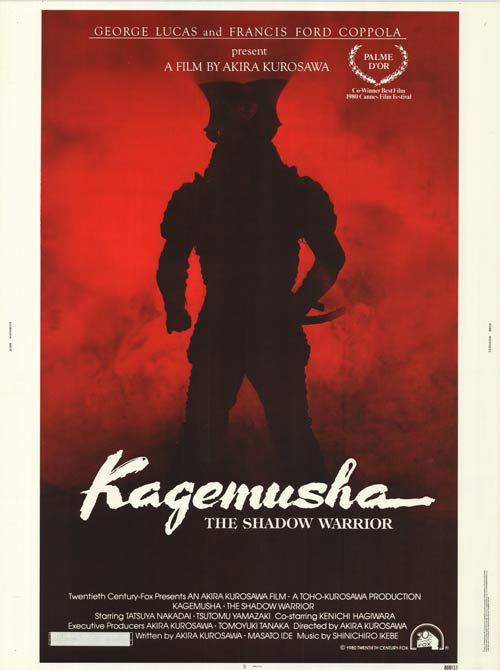
Kagemusha (1980)


Identity, honour and duty all combine in Kurosawa’s samurai epic

Director: Akira Kurosawa

Cast: Tatsuya Nakadai (Takeda Shingen/The Kagemusha), Tsutomu Yamazaki (Takeda Nobukado), Kenichi Hagiwara (Takeda Katsuyori), Jinpachi Nezu (Tsuchiya Sohachiro), Hideji Ōtaki (Yamagata Masakage), Daisuke Ryu (Oda Nobunaga), Masayuki Yui (Tokugawa Ieyasu)

In his late career, Kurosawa made two epic “samurai” films, both sweeping broad canvas stories, crammed with epic visuals and tackling big themes. Kagemusha was the first of these – and Kurosawa himself claimed that the film was a dry run for his real aim: to make an epic Japan-set version of King Lear, which would become Ran. How does it hold up as film in itself?

Kagemusha means Shadow Warrior, and the film follows the life of a convicted criminal (Nakada) saved from crucifixion because of his uncanny resemblance to warlord Shingen (also Nadada). When Shingen is mortally wounded on campaign, the Kagemusha is recruited to pretend to be the warlord, to guarantee the peace and security of the Takeda tribe – whose enemies are kept in check by their fear of Shingen’s reputation. The Kagemusha struggles at first to fill the role, but gradually becomes more and more consumed by the identity of the warlord.

Kagemusha is a beautiful film to look at. It’s totally visually stunning. Kurosawa had spent years planning the film, struggling to raise the cash, he had even attempted suicide when it looked like he would never make another film again. Kurosawa had painted many of the scenes in advance, and his film captures this effect brilliantly in a swirling, breathtaking display of colour and imagery.

Battle scenes take place against blood red or pitch black skies. Armies march in silhouette past a burning sun. The colours of the sects of the Takeda army contrast and dance together. Foliage and bodies intermingle on deserted battlefields, with the camera taking in the destruction of battles with a cool, imposing stillness. A marvellous tracking shot early in the film follows a soldier running through a sleeping army in a castle, each group of soldiers waking and rising behind him as he proceed. Even the still (one shot held for seven minutes) opening shot is brilliantly framed and strangely compelling.

The final battle sequences have a strange, dream-like quality. Kurosawa films charging horses and men, gunshots, but no coming together of these things – we see waves of men going forward, see the guns firing, cut to the shocked reactions of the Takeda generals – we never see men mown down. The imagination alone presents what the generals are seeing – and makes us share their helpless horror. The final image of a body floating past Shingen’s personal banner, abandoned in a blood-stained lake, as the camera pans up and away is brilliant – hammering home the tragic loss of lives for the hubris and pride of a clan leader.

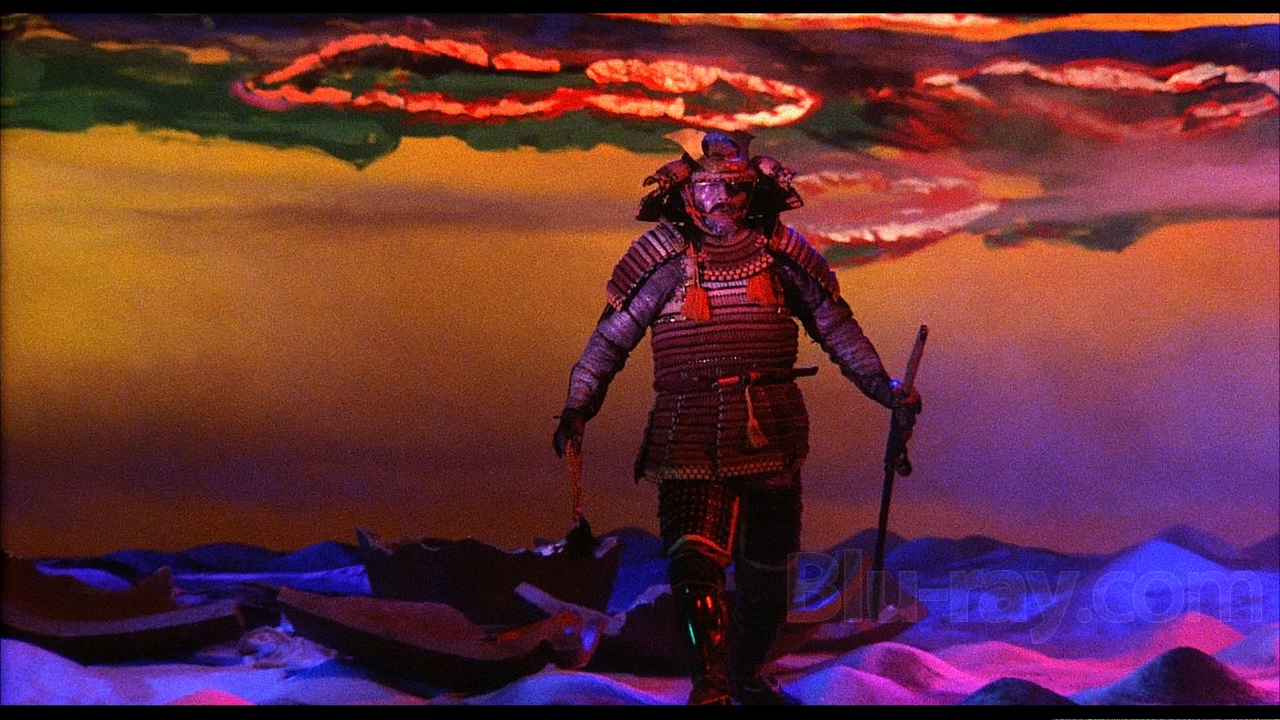
Of course, the most extraordinary use of colour is the Kagemusha’s dream, where he sees himself chased by the embalmed corpse of Shingen. The dream takes place in an explosion of painterly colours, a huge backdrop completely unrelated to anything real. This really ties into your unworldly memory of dreams – while Shingen’s relentless movement forward and his meaningless, unclear emotions (is he angry? Is he looking to take possession of the Kagemusha?) have the terror of a nightmare. The scene ends with the Kagemusha trapped in a pool of water, the motions of the waves breaking his reflection, a neat commentary on his own lack of identity. You’ve not really seen anything like it before.

The Kagemusha’s dream – the colours are beyond striking

In terms of storytelling, Kurosawa also uses some interesting techniques. I was surprised how many key events happen off-screen. Along with the two major battles (the one described above and the one fought under the Kagemusha’s “leadership”, which occurs mostly at night in confusion a distance away) we never see the Kagemusha’s training, Shingen being wounded (instead we see a sniper tell his master how he did it), never see the Kagemusha’s ill-fated attempt to ride a horse. Time seems to slide unclearly throughout the film – years seem to go by in minutes. The whole structure of the film flows in slight fits and starts – it feels rather like (guess what!) a dream, where the logic of events and time never quite holds together. Perhaps fitting in with Kurosawa’s love of visual language, it’s like looking at a series of canvasses by a master-painter – a series of snapshots or moments, or comments on moments, with the viewer left to fill in the gaps.

The film’s visuals are its real strength, but it touches on questions of identity and of leadership. As the Kagemusha, Nakada’s acting style has much of the expressionistic wildness of many of Kurosawa’s leading men, but married with a subtler quietness, making the Kagemusha a lost, gentler soul struggling to define himself within the role of Shingen. Nakada’s Kagemusha is a conflicted contrast to the ramrod certainty of his Shingen – a humanist, who grows to love his position – who perhaps even grows to believe he is Shingen – but has an ease with Shingen’s grandson the warlord never had (“He’s not so scary now!” the boy exclaims – and he is the only character who suspects a change). Is he a better man than the warlord but a worse leader? When unmasked, does he haunt the court because he has grown to care or because he can’t let go of the illusion of being Shingen? 

Kurosawa also explores the Kagemusha’s success as Shingen – expressly linked to his ability to voice key slogans with commitment (“The mountain does not move!”) and sit calmly during battle. Kurosawa seems to be criticising implicitly the deference inherent in much of Japan’s past. These soldiers are devoted to the Kagemusha, but he says and does nothing. When revealed, they reject the same man totally and instead follow with the same dedication the orders of Shingen’s inadequate son (many even while believing it will doom them). Identity is a theme we cling to in the West, but I think for Kurosawa it’s the blankness of our leaders that interests him – the idea that we follow people because of what they represent, rather than what they necessarily are. It’s an idea that feels subservient to the mood of the film, but it’s there.

Kagemusha is a film of wonderful visual style and accomplished cinematic grace. However, the main blockage to calling it a masterpiece (as opposed to just a very, very good movie) is the slight sense of intellectual emptiness at its core. Despite touching some of the monumental themes I’ve mentioned, I’m not sure the film really has that much to say about any of them in. Questions of personal identity and the function of leaders in our society are skirted around but never truly tackled. Considering the epic runtime of the film, its story and ideas are surprisingly simple and transparent, its focus split between those and the inspired visuals. To be fair, Kurosawa never lectures us, which is a comforting change from many mundane filmmakers, but he also doesn’t strike me as having much original to say on his themes – or that he aspires to do so.

That’s always the clash of priorities with Kurosawa: he is at heart a painter and a visualist rather than an analyst, a director telling large stories in broad, beautiful brushstrokes. The Kagemusha always remains a cipher: of course this is part of the point, but the character’s internal struggle and clash still seem rather glossed over, as if mentioning them was the same as actually exploring them. Some of this is intentional, and I suppose could say the film is inviting us to reach our own conclusions without prompting, but it’s hard to shake the feeling that this is a film that hangs out with ideas rather than really getting to grips with them.

Kagemusha, like Rashomon, is a film I’ve have been hard on – and Kurosawa is a director I expect so much from, because he is so overwhelmingly talented. Visually he is up there with Lean, but I feel Lean gets a better balance of depth and images. Kurosawa’s visual language is sublime, but this film is also strangely empty in places, a mighty epic and beautiful piece of cinema that saysthings but isn’t really about things. I don’t feel it truly explores its points, or gives us anything to really think about after.

Saying that, this is a vital and impressive piece of cinema and one of the most beautiful films you are going to see. Kurosawa is not the most profound film maker, but he is more than thoughtful enough compared to most and while he doesn’t claim the potential of some of his ideas, what he offers us is a true artist’s vision, a graceful mastery of the camera and enough feeling to immerse you in the story. He also – and I feel sorry for not dwelling on this earlier – brings out some wonderful performances from his actors: Nakada is superb and there is wonderful work from Yamazaki, Hagiwara, and in particular Ōtaki who is marvellously genial but imposing as Shingen’s closest general. Kagemusha isn’t his masterpiece, but for the vast majority of film-makers it would be.

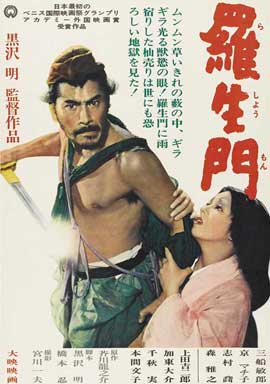
Rashomon (1950)


Rashomon: “Everybody Lies” – Gregory House would love this film

Director: Akira Kurosawa

Cast: Toshiro Mifune (Tajōmaru, the Bandit), Machiko Kyō (The Samurai’s Wife), Masayuki Mori (The Samurai), Takashi Shimura (Woodcutter), Minoru Chiaki (Priest), Kichijiro Ueda (Commoner), Noriko Honma (Miko), Daisuke Katō (Policeman)

Rashomon is one of those films that Stuart Galbraith described everyone as “knowing it even if they haven’t seen it”. Its structure of unreliable narrators telling different versions of the same story has been employed on almost every single recurring drama that has been screened since its making. You’ve seen the Rashomon story, even if you’ve never seen the film.

In the rainy (no-one works with rain visually better than Kurosawa by the way) countryside, at an abandoned house (it’s called Rashomon, so even the title doesn’t really mean anything to the story) a Priest, a Woodcutter and a Commoner discuss a recent crime in the forest. A bandit, a samurai and his wife all met in the forest. The Samurai was killed. In the investigation, the Bandit, the Wife and the Samurai (via the Medium, imagine if Morse could call on her!) all tell different versions of the story, as does a surprise witness to the crime. Which story was true? Or were they all lies?

One of the main differences watching the original Rashomon now is that we have become so used to the concept of multiple versions of the same story being told that we expect a final answer to be presented. Most often now, the final version of the story is the true version and it allows us to understand for ourselves what was true and what was not in the other versions in the story. This is not the case here: there is no answer. The viewer will never know what happened in the glade: we are in the same position as a jury at a trial – we are presented with four compromised, conflicting stories and we need to select for ourselves what (and who) we choose to believe. The camera is as much of an unreliable narrator as the actual storytellers in the film.

Imagine what a, for want of a better word, head-f*ck this must have been back in the 1950s. They’d never seen anything like it before in a film. Characters might lie, but generally the camera never did. This was the time of Hays Code America, where criminals never got away with it, murderers were always revealed in the final frame and justice prevailed. Rashomon is nothing like this: there is no truth, just a series of lies or obfuscations, with the final story potentially as compromised as the rest. In a world where even a character as likeable as Alec Guinness’ in The Lavender Hill Mob has to end the film being hauled off to jail in chains, it must have been unsettling. People must have felt like the Priest does in the film: “Who can I trust? Where is goodness in this world?”

Of course, many theories have sprung up about what is going on here and what the actual story is – some theories place a lot of emphasis on the importance of the knife (Kurosawa indeed lets the camera linger strikingly on this knife, embedded in the ground, in version 1). Even the actors on set allegedly bugged Kurosawa for the solution – but the film isn’t about this. It’s about the lies we tell, and maybe why we tell them, not about the truth. The camera doesn’t even allow us to see the body (except from its POV) so we can’t even make a decision ourselves on the nature of the wounds to help us choose between the two possible murder weapons. The truth is effectively not even a character.

So Rashomon is a revolution in narrative terms – but is it good? David Thomson, in writing on Rashomon, pointed out that the device would work better in a story where everyone believed they were telling the truth. I have to say I think he is right. In fact, that is what I had expected – subtle variations in telling, or in delivery of lines, slight twists from story to story. Each story through is actually pretty much completely different (versions 1 and 4 are the closest to each other, but 2 and 3 are totally different) and that does rather rob the story of some depth. If everyone is just lying because they need or want to, that robs the idea of some strength. Anyone can make something up – but none of us can recall perfectly a moment and what everyone involved in that moment could be doing. A film that reflected on that would really have something to say – by removing this idea, I felt a little bit cheated. This might be tied into the modern expectation of there being some sort of mystery to solve here, but I genuinely think that’s a structure that works better and is more satisfying narratively – probably why that way of telling the story is more common today.

Away from the narrative through, Rashomon is the sort of technically assured, inventive film that’s technique has now been so absorbed into our visual language that we actually don’t notice it any more. But before this film, the sort of revolving tracking shots following the characters around the forest had never been attempted before. The shots looking up towards the sun, showing the light breaking through the leaves, had been thought impossible. Even the fact that the whole thing is shot outside is ambitious. The effect of the rain thundering down on the ruined house throughout the framing device is brilliantly done (apparently the water was dyed black so it showed up on the camera), perfectly reflecting the ambivalent mood of the men discussing the case.

Throughout the film, Kurosawa directs with a visual flair that roots the camera as a key player in the telling of the stories. Shots are cunningly arranged between versions to allow contrast and comparison, with the camera placed in subjective positions rather than objective ones, meaning we “see” in the stories only what the person telling the story would choose us to see. It feels very modern – and watching it you can see why many Japanese cinema aficionados moan about Kurosawa being acclaimed in the West primarily because he has had the most influence on Western film making because in turn he was very culturally influenced by Western film making in the first place. I’m no expert on Japanese film-making (like most people I’m largely limited to Kurosawa), but heck it’s pretty clear that he’s a master film maker.

The performances in the film have a high blown intensity about them that should totter the film into silliness but somehow don’t. Toshiro Mifune, objectively, overacts wildly but he’s such a gifted performer that it becomes a magnetic animalism, a sort of eyeball-searing dynamism. Kyō’s performance is perhaps a little too much, but its wildness and nerveless intensity gradually work within the story. Shimura, Chiaki and Ueda are terrific as the homespun average-Joes discussing the case.

Kurosawa’s Rashomon is an impressive technical and narrative accomplishment of its time, but it can never have the same impact when we watch it today, because it’s been integrated so completely into our story-telling and visual language, that watching it now you find it slightly hard to see what all the fuss was about in 1951. Watching it from a modern perspective, you can see elements of the film’s narrative that could have been done more effectively, and you wonder if it’s perhaps more of a short con played on the audience that works very well than a classic – but it is the first time anything like it was ever attempted, and for that reason, if for no other, it will live on in film history.