
 |
Timothée Chalamet and Rebecca Ferguson excel in Denis Villeneuve’s marvellous Dune |
Director: Denis Villeneuve
Cast: Timothée Chalamet (Paul Atreides), Rebecca Ferguson (Lady Jessica), Oscar Isaac (Duke Leto Atreides), Josh Brolin (Gurney Halleck), Stellan Skarsgard (Baron Valdimir Harkonnen), Dave Bautista (Glossu Rabban), Charlotte Rampling (Gaius Helen Mohiam), Jason Momoa (Duncan Idaho), Javier Bardem (Stilgar), Stephen McKinley Henderson (Thufir Hawat), Zendaya (Chani), Sharon Duncan-Brewster (Dr Liet-Kynes), David Dastmalchian (Piter De Vries), Chang Chen (Dr Wellington Yueh)

In the history of “unfilmable novels”, few are perhaps as “unfilmable” as Frank Herbert’s epic science-fiction novel Dune. In fact, in case we were in any doubt, we even have the evidence with David Lynch’s curiosity Dune (either a noble attempt or an egregious mess, depending on who you talk to – I fall between the two camps depending on the time of day). Denis Villeneuve – fresh from his glorious reinvention of Blade Runner – is one of the few directors with the vision and the clout needed to bring this fictional universe to the screen. He delivers a visually stunning slice of cinematic story-telling, that remains faithful to the novel while carefully calculating how much of the story to focus on. It makes for a sweeping, spectacular film.
The set-up in Herbert’s books is labyrinthine, but one of the film’s great skills is to boil it down to something digestible and understandable. It helps as well that, unlike Lynch’s film, this focuses on roughly the first half of the novel only. 10,000 years in the future, mankind travels through space – but space travel is dependent on a spice that can only be mined on a sand-covered planet called Arrakis, populated by colossal worms and a race of mysterious sand-dwellers called the Fremen. Control of the mining operation of the planet is taken from the brutal House Harkonnen, and its patriarch (Stellan Skarsgard), and granted to the more moderate House Atreides and its head Duke Leto (Oscar Isaac). However, this is just a ruse to trap and destroy House Atreides, whose popularity endangers the Emperor. On arrival on the planet, Leto’s son Paul (Timothée Chalamet) is believed by the Fremen to be a long-promised messiah – and Paul is plagued with strange visions of his future. Can he, and his mother Jessica (Rebecca Ferguson), survive and fulfil their destinies?
Dune is a complex, sprawling piece of world-building – the sort of book so stuffed with unique words, concepts and language that it includes a full glossary to help the reader work out what’s going on. Villeneuve’s genius here is to work out exactly how much of that world building to build into the script, and how much to leave out. Where the Lynch Dune tried to cover everything in this universe and seemed to introduce new characters and concepts in every scene (right up to the end), Villeneuve’s Dune is far more focused. It gives enough tips of the hat to readers of the book to be faithful, but doesn’t bother the more casual viewer with what, say, a mentat is or who the Space Guild exactly are. The overload of information that crushed Lynch’s Dune is skilfully avoided here.
What we get instead is a wonderfully focused, coming-of-age story that places the young hero front-and-centre – and filters our experience through his eyes. This not only helps give us a very clear human engagement with this world, it also makes for a highly relatable central arc to build the rest of the world building around. After all, we understand the “chosen-one-finds-his-destiny” story: using that as a very clear framework, allows the wider universe to be slowly and carefully drip-fed around that. It also plays very well to the reader (who will know the unspoken detail and enjoy subtle references to it on screen) and to the initiate (who won’t need to know every last detail of every last character’s background and won’t be overwhelmed by those references).
On top of which, Dune is, in itself, a sumptuous and visually beautiful example of expansive world-building. Fitting a series that has spawned dozens of novels and an entire universe of expanded storylines, endless care and loving attention has gone into creating every inch of this world. Jacqueline West’s costumes brilliantly capture the mix of medieval and space-punk futurism in the world’s design (this is after all a universe which is effectively Game of Thrones in space – one of many franchises to owe a huge debt to Dune) and Patrice Vermette’s set design superbly contrasts the different planets aesthetics. The imagery carefully contrasts the greens and blues (and water!) of the other worlds with the striking yellows and dryness of Arrakis – it’s beautifully filmed by Grieg Fraser – and the scale is epic, re-enforced by Zimmer’s gothic choir inspired music.
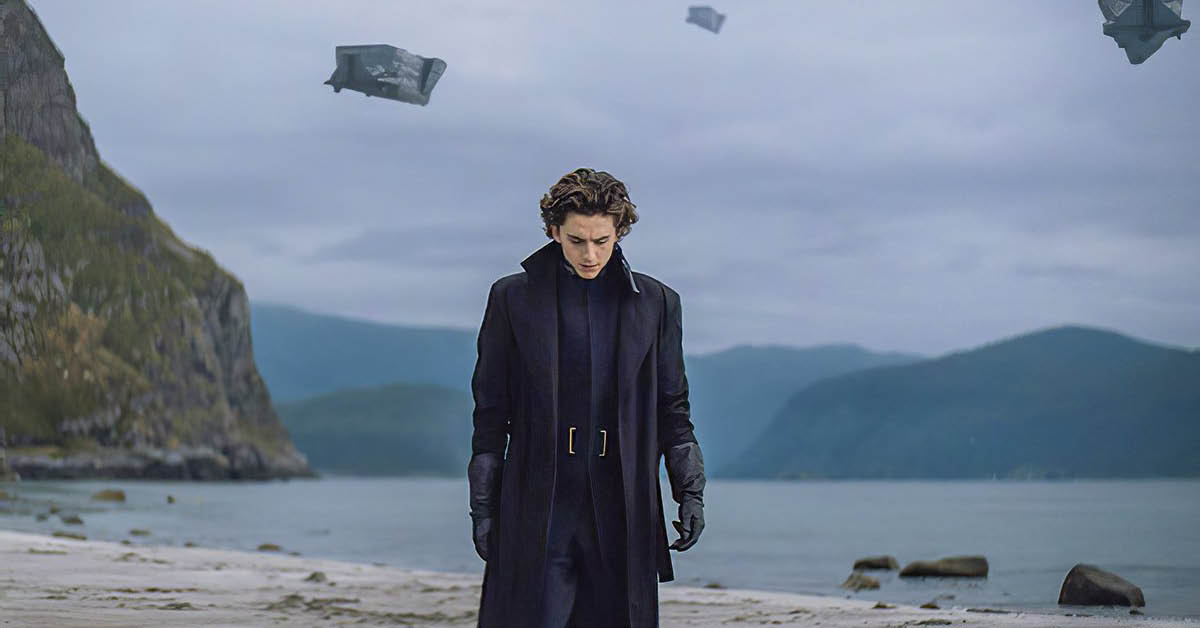
Villeneuve marshals this all into a story that is part world-building set-up, part conspiracy thriller and eventually becomes a full-on chase movie. Each shift in story-telling style flows naturally into the next, and Villeneuve keeps the pace and sense of intrigue up highly effectively. He also understands that films like this need a touch of wit and human warmth: Herbert’s book, for all its strengths, is also a po-faced and slightly pretentious read, with every event and character consciously carrying a massive sense of importance. Dune recognises this, and makes sure to mix lightness and touches of humour to avoid the operatic seriousness tipping into being a little silly (as it did in Lynch’s version).
Villeneuve is helped in this by a well-chosen cast. Chalamet is perfectly cast as the naïve Paul, growing in statue and wisdom as the film progresses: he is effectively vulnerable but also a determined and mentally strong hero, one we can have faith in but still feel concerned about. Ferguson is the film’s stand-out performance as his conflicted mother, determined to protect her family. Isaac is perfect as the charismatic and noble Leto, as is Skarsgard as the viciously bloated Vladimir. Sharon Duncan-Brewster is terrific as an official with split loyalties. Charlotte Rampling has a highly effective cameo as a mysterious priest while Jason Momoa gives possibly his finest performance (certainly his warmest and wittiest) as a larger-than-life warrior.
The film glosses over certain elements – in particular the plot against House Artreides, and Leto’s suspicions of it are wisely simplified and stream-lined – and wisely revises or avoids elements of the book that have dated (most notably the slight stench of homophobia around the bloated, predatory Vladimir). In some ways it’s a beautiful coffee-table version of the story, but it’s careful enough to suggest anything we are not seeing from the book is still happening, just off-camera (I await the inevitable Director’s Cut with even more Mentats, Conditioning and Weirding!). However – based on the cinema I sat in – this has worked a treat to win converts over to the story.
A sweeping, impressive and epic version of a huge novel, it’s a triumph of directorial vision and skilful compression and adaptation. By trying to make Dune work for a larger audience, without sacrificing its heart, rather than laboriously include everything and everyone, it successfully makes it into a crowd-pleasing space opera with depth. Catch it on the big screen!

 Movie Musings