
Tag: Jason Patric

Speed 2: Cruise Control (1997)

Speed 2: Cruise Control (1997)

It seemed like such a good idea at the time… Keanu Reeves wisely passed on Speed 2 – so should you

Director: Jan de Bont

Cast: Sandra Bullock (Annie Porter), Jason Patric (Alex Shaw), Willem Dafoe (John Geiger), Temuera Morrison (Officer Juliano), Glenn Plummer (Maurice), Brian McCardie (Merced), Christine Firkins (Drew), Mike Hagerty (Harvey), Colleen Camp (Debbie), Lois Chiles (Celeste), Royale Watkins (Dante)
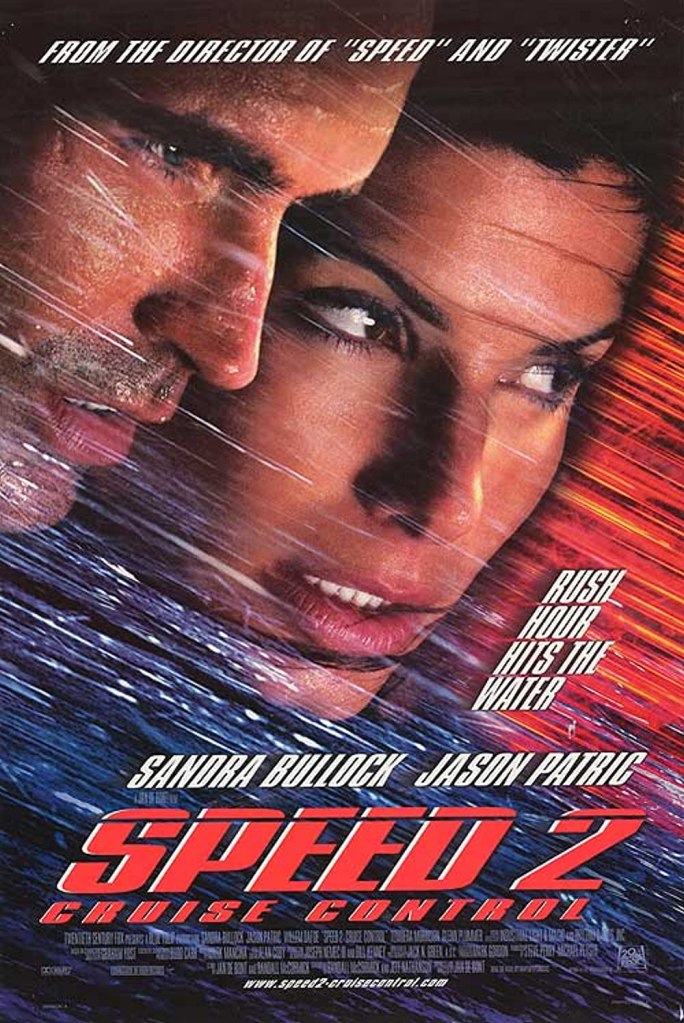
In 1996 Keanu Reeves turned down a huge salary for Speed 2. Everyone in Hollywood thought he was mad. On June 13th 1997, Speed 2 was released. On June 14th everyone thought Keanu Reeves was a genius. It’s quite something when one of your best ever career moves was not doing a movie. But God almighty Keanu was right: time has not been kind to Speed 2 – and even when it was released it was hailed as one of the worst sequels ever made. It’s like de Bont and co sold their souls for Speed and in 1997 the Devil came to collect.

Keanu’s Jack Traven is clumsily replaced by Jason Patric’s Alex Shaw – although the dialogue has clearly only had the mildest tweak as Shaw has inherited Traven’s job, friends, personality and girlfriend Annie (Sandra Bullock – elevated to top billing but even more of a damsel-in-distress than in the original). Alex and Annie are wrestling with making a long-term commitment – see what I mean about this script only be mildly tweaked? – when they decide to take an all-or-nothing cruise. Shame the cruise liner is hijacked by deranged computer programmer turned bomber Geiger (Willem Dafoe). With the boat powering through the water towards a collision on shore, can Alex save the day?

You’ve probably noticed the disparity between the title Speed and the setting: a slow-moving cruise liner. At one point, Alex asks how long it would take an oil tanker to move out of a collision course with the liner – “At least half hour – that’s not enough time!” he’s told. The very fact that a debate whether 30 minutes will be enough time in a flipping film about speed shows how far this sequel has fallen. How did anyone not notice this?

Pace is missing from the whole thing. The script is truly dreadful. Paper-thin characters populate the cruise liner, none of whom make even the slightest impression. At one point a character breaks an arm and then immediately shrugs off the injury to steer the ship. The script is crammed with deeply, desperately unfunny “comedy” beats. Bullock’s character seems to have transformed into a ditzy rom-com wisecracker – with a “hilarious” running joke that she’s a terrible driver (geddit!??!) – and, instead of the charming pluck she showed in the first film, is now an irritating egotist. She still fares better than poor Patric, who completely lacks the movie star charisma of Reeves and utterly fails to find anything that doesn’t feel like a low-rent McClane rip-off in his character.

It’s like de Bont forgot everything he knew about directing in the three years between the two films. If anything, this feels like a well below average effort from a novice director. The humour is dialled up with feeble sight gags and the film takes a turgid 45 minutes to really get going (most of which is given over to derivative romantic will-they-commit banter between Patric and Bullock).

de Bont basically flunks everything. He fails the basic directing test of confined-spaces thrillers like this by never making the geography clear to the viewer. I challenge anyone to really understand how characters get from A to C on this boat. The long introductions are supposed to establish these basics (see Die Hard for a masterclass in this), but here you haven’t got a clue about what’s where or why some locations are more risky than others. There is a spectacular lack of tension about the whole thing – it’s not really clear what Dafeo’s lip-smacking, giggling, leech-using (yes seriously) villain actually wants or how his scheme works, and the momentum of the boat towards unspecified destruction is (a) hard to see on the open water with no fixed point to compare the speed with and (b) even when we get that, not exactly adrenalin fuelled anyway.

de Bont’s comedic approach to much of the material might have worked if he had any sense of wit or comic timing in his direction. Or if Patric had been more comfortable with the wit the part requires. Bullock instead feels like she has to joke for all three of them, to disastrous effect. There are a couple of semi-comic sidekicks sprinkled among the supporting players, but none of them raises so much as a grin. The film can’t resist implausible in-jokes, like bringing back Glenn Plummer’s luckless character to have his boat swiped by Alex (they even leave in a mildly altered “what are you doing here?” line, as if they didn’t realise until shooting it that Keanu wasn’t going to be there).

It ends with a loud crash of a boat into the shore which cost tens of millions of dollars (at the time one of the most costly stunts ever) but just looks like a fake boat ripping through a load of backlot buildings. It’s a big, loud, dull, slow ending to a film that looks like it was made by people who had no idea what they were doing but enough power to ignore anyone who might have been able to point out what they were doing wrong. Speed 2 remains the worst sequel ever. Reeves went off to make The Matrix. Who’s the idiot?

The Alamo (2004)

“Remember The Alamo!” Problem was the movie going public didn’t

Director: John Lee Hancock
Cast: Dennis Quaid (Sam Houston), Billy Bob Thornton (Davy Crockett), Jason Patric (James Bowie), Patrick Wilson (William Barret Travis), Emilio Echevarría (Antonio López de Santa Anna), Jordi Mollà (Juan Seguin), Leon Rippy (Sergeant William Ward)

“Remember the Alamo!” was the famous war cry of the Texan rebels fighting to make Texas an independent state from Mexican rule. Problem was, fast forward 90 odd years and it seems not enough people did. This lovingly reconstructed re-telling of the doomed attempt to defend The Alamo (a sort of Western Zulu with a downer ending) was a box-office disaster.

In 1836, a civil war raged in Mexico, which then included Texas. American immigrants and other groups fought to make Texas an independent state, with an eye on later joining the United States. A small force is sent to garrison the Alamo, a key fort recently captured from the Mexicans. But the Mexicans and their President Santa Anna are descending on the Alamo in full military force…

The Alamo is a pretty decent film. It’s not a classic and at times it’s a rather staid and straight-laced history lesson, po-facedly cramming in as much as it can within its running time. But it’s got many merits, not least the fact that it’s willing to focus on character rather than action, and embraces the fact that sieges tend to be rather long, dull affairs punctuated by moments of sheer terror.

Billy Bob Thornton gives a sharply intelligent and thought-provoking reading of Davey Crockett, playing him as man painfully aware that he is a legend, and wearily trying to balance this with also being a “normal” person, with the same fears and desires as other men. He plays Crockett as a gentle, even rather sensitive soul, a good listener, sharply self-critical and scared that he can’t live up to the reputation he has. As he says at one point: “If it was just me, simple old David from Tennessee, I might drop over that wall some night, take my chances. But that Davy Crockett feller… they’re all watchin’ him.” At one moment (in a scene that the film overplays by returning to at least twice in flashback), Crockett plays the violin on the ramparts to battle the Mexican drums, giving a brief Shawshank-like moment of freedom through the power of art.

The two main leads don’t disappoint alongside him. I enjoyed Patrick Wilson’s stiff-necked William Travis, whose cold and formal manner slowly reveals a decent man and a brave leader (though no master tactician). Jason Patric also manages to land just the right side of rogueish as a drunken James Bowie, the men’s leader of choice. Dennis Quaid has the dullest, least developed part as a larger-than-life Sam Houston. Impressive as these characterisations are, the film doesn’t really have time for anyone else to make an impression – while Emilo Echevarria’s Santa Anna is little more than cardboard cut-out of villainy.

The film’s main problem is its reverent regard for the moment in history that it is covering. For starters, its makers assume everyone shares this: there is no opening crawl, or scene setting voiceover, to tell us where we are, what’s going on and when. The filmmakers assume us to be as au fait with Texan independence as they are. I had to literally stop the film for a good ten minutes and read some quick timelines of Texan independence, as well as skim a few Wikipedia pages on Texan history, so I could follow the storyline.

Secondly, it’s so keen to cover all the major historical events, that at points it’s more than a little dry. Its slow pace has the upside of really allowing us to get to know the characters at its centre (the original run time was closer to 3 hours, which would have allowed many of the background characters to come to life as well). But with the runtime cut down, combined with the assumptions made about the viewer’s historical knowledge, it sometimes becomes a little tricky to either engage with the drama fully or to completely understand what’s going on.

The recut of the film after disastrous test screenings also means that the film has what feels like a tacked on “happy ending”, with the last twenty minutes given over to the (very shortened) Houston campaign against the Mexicans and Santa Anna’s capture. The film rockets through this, barely pausing to explain tactics or events, seemingly wanting to give meaning to the sacrifice at the Alamo. Some half-hearted attempts are made to contrast slaughter of the Mexican soldiers with that of the Alamo defenders, but not much.

But this is not a bad film by any means, just a fatally compromised one. It’s trying to be an intelligent, grown-up piece of film making – a character study out west – but it’s also trying to be an action film. It doesn’t quite succeed in being either, but it’s at its best as a character study, helped by some really strong, thoughtful performances. Hancock isn’t, to be honest, an original enough director to bring to life the epic scope and sweep that the film needs, but it’s clear he cares about this a lot. In fact that’s the best thing about this film: it’s clear that everyone in the film cared deeply about this story and desperately wanted this film to be a classic.

It’s a shame that this story is one that seems to have less relevance to the masses today, and that this film can’t quite coalesce all the efforts of everyone involved into something really memorable.