
Greed is Good? Scorsese’s masterpiece is a heady deconstruction of the excess of white collar criminals
Director: Martin Scorsese
Cast: Leonardo DiCaprio (Jordon Belfort), Jonah Hill (Donnie Azoff), Margot Robbie (Naomi Lapaglia), Kyle Chandler (FBI Agent Patrick Denham), Rob Reiner (Max Belfort), Jon Bernthal (Brad Brodnick), Matthew McConaughey (Mark Hanna), Jon Favreau (Manny Riskin), Jean Dujardin (Jean-Jacques Saurel), Joanna Lumley (Aunt Emma), Cristin Milioti (Teresa Patrillo), Christine Eberle (Leah Belfort), Kenneth Choi (Chester Ming), Brian Sacca (Robbie Feinberg), Henry Zebrowski (Alden Kupferberg)

All The Wolf of Wall Street is really missing is an early freeze frame of a coke-fuelled banker slamming the phone down on a closed deal and a wistful voiceover from Jordan Belfort: “As far back as I can remember, I always wanted to be Wall Street trader”. If Goodfellas was Scorsese’s exploration of the attractions – and dangers – of a life in blue collar crime, then The Wolf of Wall Street is its white collar companion piece. The fact that so many viewers find the behaviour of Belfort morally outrageous in a way that no one ever objects about Henry Hill is, for me, an indication of how much we loath these masters-of-the-universe. For all their faults, we’d still rather see a violent criminal as one of us.
Based on Jordan Belfort’s (Leonardo DiCaprio) autobiography, The Wolf of Wall Street follows his time building a dodgy trading empire and a large fortune. Not that he can remember most of it, as he seems to be on a permanent intoxicated binge of drinks, hookers and every drug you can ever imagine (and some you can’t). The FBI catches up with him eventually, but Belfort learns precious little from his experiences. Other than, perhaps, that so long as you are rich and white in America, you can basically get away with anything.
That’s perhaps the key to Wolf of Wall Street. Scorsese may not shy away from the delicious dark comedy of Belfort’s life of excess, but it doesn’t blind him to the shallow awfulness of the man or his unthinking, instinctive greed and self-obsession. You would need to be a pretty shallow person to look at Belfort’s greed, moral emptiness and self-destructive binges and want to ape him. If you think watching DiCaprio literally paralytic on quaaludes is the life you want, frankly there is something wrong with you.
What perhaps made some feel Wolf of Wall Street was oddly in love with Belfort is its electric pace. The film is a brilliant reminder of Scorsese’s faultless understanding of pace. Or one who matches unparalleled cinematic skill with the rambunctious energy of a first-timer allowed to play with his movie toys for the first time. Brilliantly assembled, this is a superb collection of cinematic techniques, from jump cuts to fluid transitions that power through a series of increasingly bacchanalian parties and isn’t afraid to admit that, in the moment, this stuff can be fun (rather like getting the best table in Goodfellas) but ultimately self-destructive. (After all, few know the dangers of drugs like Scorsese.)
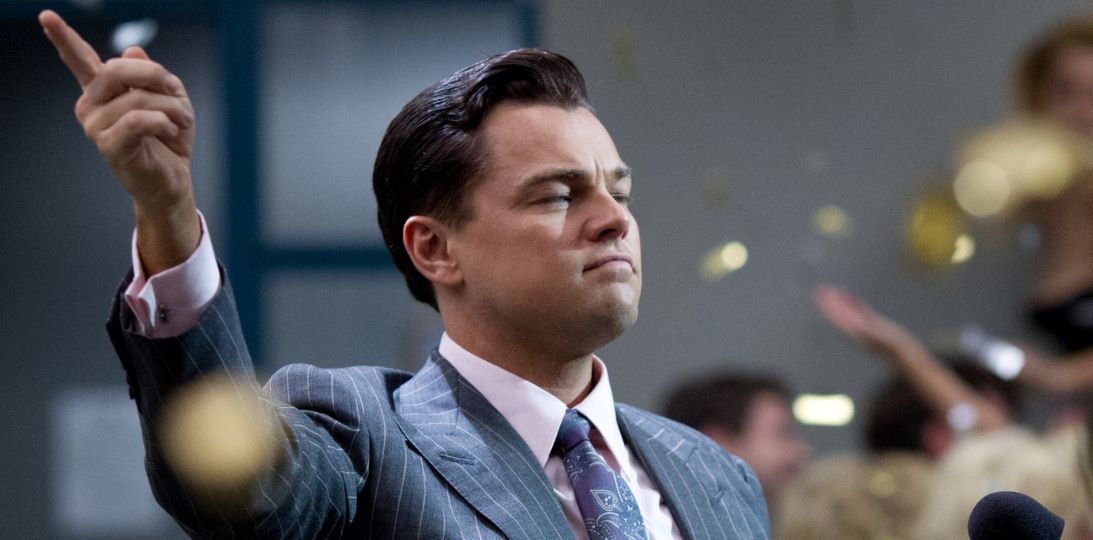
At the centre of this whirlwind is a stunning performance from Leonardo DiCaprio. With his still youthful, charismatic handsomeness, DiCaprio only needed to tweak his screen persona to provoke the sort of perverted idolatry Belfort receives from his co-workers. But he goes above and beyond in his transformation in this role. He makes Belfort simultaneously oddly childlike and revoltingly corrupted, someone whom we enjoy spending time with while finding repulsive. He rips through Belfort’s trademark, drug-fuelled motivational speeches, monologues of insanely eye-popping intensity, explosions of off-the-chain wildness. At other times he’ll sulk and whine like a spoilt child. DiCaprio struts across the screen with an unpredictable physicality – his embodying of the physical effects of mind-altering drugs is hilarious and horrifying –in possibly his finest ever performance.
DiCaprio is the raw energy source that helps power the rest of the film. Scorsese matches him blow-by-blow with this dynamic expose of white-collar corruption. Using Belfort as a narrator – which serves to further expose his shallowness, greed and utter inability to learn any sustained messages from the depths he plummets to – the entire film is all about how the flip side of the American Dream tacitly promotes and encourages this sort of behaviour.
Belfort is the rash the system has come out as. In a highly effective early cameo, McConaughey plays Belfort’s first mentor, a coke-fuelled hedonist hooked on the buzz of closing deals, who pushes Belfort towards a career of success (including introducing a brilliant breathing exercise – improvised by McConaughey based on his own warm-up exercises – that becomes a mantra in the film). DiCaprio’s eyes have already lit up at watching a deal closing. Drugs and sex are just an attempt for Belfort to replicate the buzz of the real addiction: money.
Scorsese recognises that we don’t need to know the details of Belfort’s illegal dealings. (In his voiceover Belfort literally tells us it doesn’t matter, all that does is the shitload of cash they were bringing in.) We learn enough about the huge mark-ups (50% of the deal’s value) he can make from selling penny stocks (trades of small public companies) and “pump and dump” tactics to know it’s wrong. I will admit the film does little to show the victims – but then Belfort never cares either, proudly stating at one point he has no guilt fleecing his clients out of cash, because he knows how to spend it, better than they do.
It all pours into a hedonistic, alpha-male environment where the air is as littered with fucks (the film held a record for most use of the word) as the floors and desks of Belfort’s offices are during his hooker-filled end-of-week parties. Wolf of Wall Street is also an expose of toxic alpha-maledom. Bullying, abuse and screaming are ripe, women are basically commodities traded as easily as shares. The only exceptions are those allowed into the boys’ club as either surrogate-male fellow traders or trophies to adorn the arm. Margot Robbie (superb in a star-making role) plays Belfort’s glamourous wife, who knows she needs to use her physical assets to make her way in this world.
The film rips along through a party-deal-party structure. Belfort goes from wowing his fellow penny stock traders by making $2k in two minutes to wrapping the trading floor of his fake-old-school Wall Street firm around his finger in excess filled speeches. He also goes from a charming party animal to an incoherent, rambling, deeply unpleasant and dangerous drunk and drug addict. But crucially, he learns nothing . There is no life-and-soul shattering payback like Henry Hill undergoes. Fault, guilt and consequences roll off his rich, spoilt back. He ends the film still winning the adulation of would-be millionaires, his conscience (if it exists) untroubled by any impact his actions have had on others.
Perhaps Scorsese could have allowed more space to victims – and to Kyle Chandler’s dutiful and dedicated FBI agent who brings him down (our final shot of this character stresses his humble, low-paid status – echoing back to his confession to at times regretting leaving a trading career for a law one). But that’s to criticise the film for not being obvious enough. Of course parties are fun. But each party becomes wilder, more orgiastic and uncomfortable as the film goes on. But if we didn’t understand the fun, we couldn’t understand how people get hooked on this adrenalin fuelled life.
Wolf of Wall Street though is a warning to the curious – if you are smart enough to look. Belfort’s soulless, horrible life is not one to aspire to, and his moral emptiness not one to wish to have. It’s a funny film, but it’s also a dark one. DiCaprio is brilliant beyond belief, Jonah Hill funny and pathetic as his best friend, Margot Robbie becomes a star and Scorsese rips through the film with the energy, passion and dynamism of a much younger director. An outstanding tentpole film in his CV.

 Movie Musings