Tag: Jean Hagen

Adam's Rib (1949)

Spencer Tracy and Katharine Hepburn go toe-to-toe in court and marriage in Adam’s Rib

Director: George Cukor

Cast: Spencer Tracy (Adam Bonner), Katharine Hepburn (Amanda Bonner), Judy Holliday (Doris Attinger), Tom Ewell (Warren Attinger), David Wayne (Kip Lurie), Jean Hagen (Beryl Caighn), Hope Emerson (Olympia La Pere)

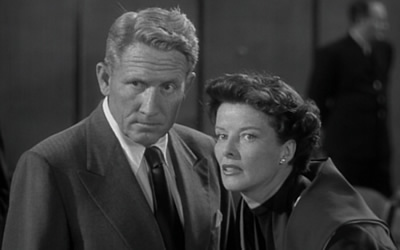
He’s a tough-on-crime DA. She’s a top liberal lawyer with a feminist agenda. So when Doris Attinger (Judy Holliday) is arrested for firing a gun at her philandering husband Warren (Tom Ewell) and his lover Beryl (Jean Hagen), naturally Adam (Spencer Tracy) and Amanda Bonner (Katharine Hepburn) end up on opposite sides of the court case in this witty “battle of the sexes” married life comedy.

Directed with unfussy calmness by George Cukor who, as he often does, hires the best actors, points the camera and lets them get on with it, Adam’s Rib is an enjoyable and fascinating watch, partly ahead of its time in its gender politics, partly relic of another era. It completely accepts the idea that a woman can be a successful, skilful lawyer – the idea isn’t even questioned – while still bemoaning the march of militant feminism. After all even the title is a humourous little reminder of where Eve came from.

The plot revolves around Amanda’s belief that a man firing a gun at a cheating wife would get very different treatment from a woman doing the same: that he would be seen as a man protecting his home, while the woman is a neurotic danger. Adam disagrees strongly with this – a crime is a crime – and to be honest he’s probably right (today Doris would almost certainly go down for actual bodily harm, if not attempted murder). But in the 1940s, this issue gets tied up with women starting to push against the idea that their role was just to follow the man’s lead and not threaten to shake up his existence. And that’s exactly contrary to what happens in this film.

Amanda is played by force-of-nature Katharine Hepburn at her most quick-witted and sharp, a lawyer more successful in many ways than her husband (and by being in private practice, probably the main bread winner as well, although that is never stated). Her place in the court is never questioned, which is interesting in itself in the post-war era where the idea of women in the professional world was just beginning to be seen as a possibility (although lord knows there was still decades to go until it was to be seen as completely normal).

It’s not a position that Adam questions. His main problems are more with the law being used as a tool for a very specific agenda, rather than a feeling that women are crowding into his realm. Played with brusque stuffiness and uncomfortable formality that tips over into moral outrage by Spencer Tracy (again showing his natural gift for both acting and reacting), Adam feels that his belief in the law is being damaged by Amanda’s use of Judy’s case as a political tool for women’s rights, rather than being judged on its actual merits. 

So this becomes the spring board for a series of extremely well-acted (and frequently funny) arguments between this tempestuous couple as the court case turns from a flirtatious rivalry into an increasingly bitter one. These ding-dong battles work so well on screen because of the immense chemistry between Tracy and Hepburn, a couple so devoted in real life that they convey this even when really going at each other on screen. 

Mix that in with an obvious sexual chemistry between them (and this film is remarkably open about sex, by my count the camera cuts to black to imply sex at least three times in this movie – and the couple have separate beds in their bedroom as per the Hays Code, but only one sees the sheets disturbed by sleeping!) and you’ve got an entertaining show. The courtroom antics are frequently both dynamic and entertaining, and the perspectives of both Adam and Amanda carry force – yes women are treated differently by the law, but you surely can’t deny that Doris broke that law.

There isn’t much room for the rest of the cast apart from the barnstorming Tracy-Hepburn show, with the two seasoned performers tearing through the screen. Judy Holliday comes off best in the second-string as the woman on trial, suggesting enough hypocrisy and two-facedness under the surface of her butter-wouldn’t-melt sweetness. Holliday was also helped by Hepburn’s generous insistence that she be made the focus of their scenes together – Hepburn being keen to help Holliday land the leading role in the film Born Yesterday, the play of which made Holliday’s name on Broadway (it worked and Holliday won the Oscar the next year). 

Of the rest, there is a neat, naughty little cameo from Jean Hagen as the other woman, though Tom Ewell mugs as the husband. David Wayne meanwhile plays the Bonners’ next door neighbour, a supremely irritating musician, smug and trying, but whom we’re meant to think of as a witty, eccentric “character”.

The latter half of the film starts to tip a little bit, as Adam has of course to end with the upper hand (he is after all the man!) which he does using underhand tactics and an actually rather unpleasant business with a fake gun (the sort of trick that you imagine if Tracy had pulled in real life, Hepburn would have walked out of the door and never come back). But this is still a film with plenty of top gags and a refreshing look at a marriage where both participants are professional equals and which goes quietly some way in arguing for greater rights for women, before retreating back to its more conservative resolution. Still great entertainment – and Tracy and Hepburn are both at the top of their games here.
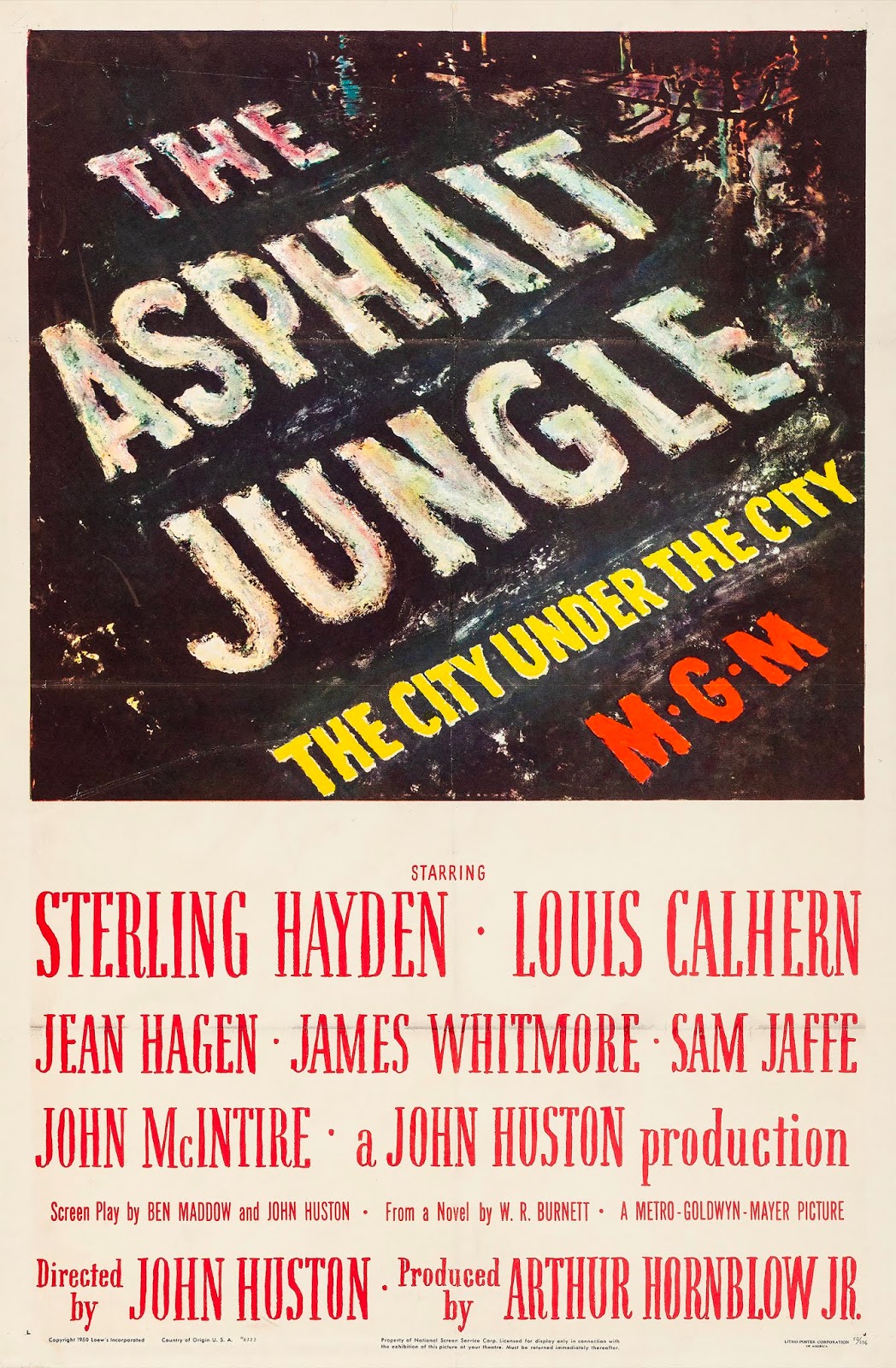
The Asphalt Jungle (1950)

A masterplan goes wrong in John Huston’s crime drama The Asphalt Jungle

Director: John Huston

Cast: Sterling Hayden (Dix Handley), Louis Calhern (Alonzo D Emmerich), Jean Hagen (“Doll” Conovan), James Whitmore (Gus Minissi), Sam Jaffe (“Doc” Erwin Riedenschneider), John McIntire (Police Commissioner Hardy), Marc Lawrence (Cobby), Barry Kelley (Lt. Ditrich), Marilyn Monroe (Angela Phinlay), Brad Dexter (Bob Brannom)

“Doc” Erwin Riedenschneider (Sam Jaffe) is out of the slammer after seven years, and the self-proclaimed “Professor” of criminal plans has a scheme for one final job. But rather than sell it to the highest bidder, Doc approaches crooked lawyer Alonzo Emmerich (Louis Calhern) to fund the crime and then split the proceeds with Doc. To carry out his robbery on a jewellery safe in a bank, he’ll need a gang including get-away driver Gus (James Whitmore) and Gus’ pal and “hooligan” Dix Handley (Sterling Hayden). But even the best laid plans of criminals can fall foul of events and the basic untrustworthiness of criminals themselves.

John Huston surprised some by turning his attention – Oscar in hand from The Treasure of the Sierra Madre – to noir cops and robber’s thrillers, but that was to forget he had made his name with his masterful adaptation of Dashell Hammett’s The Maltese Falcon. And in The Asphalt Jungle he created a small scale but almost perfect slice of criminalise noir, a brilliantly paced and acted film beautifully assembled that effortlessly chronicles the disastrous fall out of a robbery where it seemed everything was going perfectly.

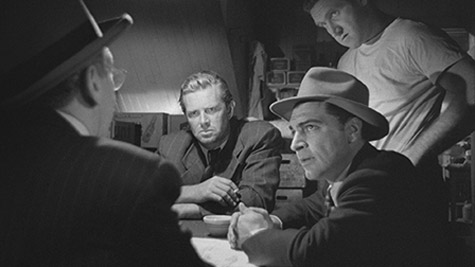
Huston’s direction of the piece is, as nearly always, superlative. His painterly framing of scenes is dead on the money here, his framing of the actors within the scene absolutely without fault. Huston has an uncanny scene for arranging his actors in the minimum number of shots necessary, reducing dramatically the need for clumsy cut aways. Instead multiple actors are often artfully arranged in the frame, allowing the performers to react in the moment and the camera itself to capture the complete story in one smooth shot. It also allows for some great character intros, not least a shot of the Police commissioner in the background of the frame while foregrounded are the hands of his subordinate Dietrich, nervously fondling his hat. Straight away we get the mood of the scene.

This is all part of the brilliant noirish construction of a film that largely features sympathetic criminals – and it’s clear that the film’s sympathy is with the robbers here, the cops either incompetent, bureaucrats or corrupt themselves – either turning on each other, crumbling under pressure, making rudimentary errors that wind up getting them caught or failing into tragic fates that are left questioning what the point of it all was. This is all superbly caught in the moody darkness and shadows that soak over the picture, and highlighted further by the superb script, that packs some excellent lines and beautiful thematic points throughout the film.

It’s also helped by some great performances. Sam Jaffe (Oscar-nominated) is terrific as the cunning calm and businesslike “Doc” who seems unable to understand why things are not quite panning out as he planned, but is heartily sorry that it’s the case. He at least has honour among thieves, refusing to abandon his fellow criminals and quietly disappointed when betrayal raises its head. I love as well his screamish apology that the crime will involve one “hooligan” – or heavy – since he’s not the sort of guy who likes to resort to messy crimes (no matter that things quickly slide out of hand). He’s the sort of professional who expects everyone to play by the same rules, but that doesn’t stop him having his own private passions, particularly for the fairer sex, that will wind up catching him out.

He’s especially proved wrong since Sterling Hayden’s ‘hooligan’ Dix turns out to be the moral force of the gang, despite his down-on-his-luck scruffiness. Hitting crime as a way to finance his dream of buying back his family’s horse farm – and sadly losing most of that finance on the horses – Hayden is gloomy faced and gruff but has his own clear moral code in an affectingly gentle performance of vulnerability beneath the toughness. Debts and betrayal are anathema to him, and he winds up far more of the decent crook than any of the rest – he’s also the only one of the lot who can hold down a loving relationship, forging a genuinely sweet relationship with Jean Hagen’s Doll. Huston’s sympathies are clearly with the down-on-his-luck Dix, a decent guy who has just lost at life.

Of course the crook they can’t trust is the lawyer, a fine performance of snivelling weasliness under a veneer of culture from Louis Calhern. Puffed up, arrogant but desperate for the money and fundamentally weak and easily led, Calhern is excellent as the money man who only adds to the gang’s troubles, led on by Brad Dexter’s wonderfully impatient and ruthless hired gun. Calhern’s sad air of corrupted authority is only enhanced by his lecherous delight in his lusciously young mistress, a radiant early performance from Marilyn Monroe (shot like a classic painting by Huston).

Huston’s film throws this gang together flies together into a superbly detailed and gripping drama of the planning, execution and dreadful fall out of a robbery that clearly inspired the (perhaps even better) Rififi (so much so that it practically has the same story and structure), The Asphalt Jungle is a fabulously made and written pleasure, unpretentious but wonderful story telling marshalled expertly by a director at the top of his game.

Singin' in the Rain (1952)

Singin' in the Rain (1952)

The most beloved of all musicals gives you a burst of pure enjoyment no matter when it plays

Director: Stanley Donen, Gene Kelly

Cast: Gene Kelly (Don Lockwood), Debbie Reynolds (Kathy Selden), Donald O’Connor (Cosmo Brown), Jean Hagen (Lina Lamont), Millard Mitchell (RF Simpson), Cyd Charisse (Woman in the green dress), Douglas Fawley (Roscoe Dexter), Rita Moreno (Zelda Zanders)

Is there a more loved musical than Singin’ in the Rain? Is there a more famous musical from Hollywood’s golden age? That second point is particularly interesting, as this was possibly the last of the big Hollywood song-and-dance films – most of the rest that followed were film versions of Broadway hits. Singin’ in the Rain also has that “late discovery” quality: inexplicably not nominated for Best Picture (or hardly any other Oscars), it was for many years considered a second tier musical behind works like An American in Paris. Now it stands tall over the lot of them.

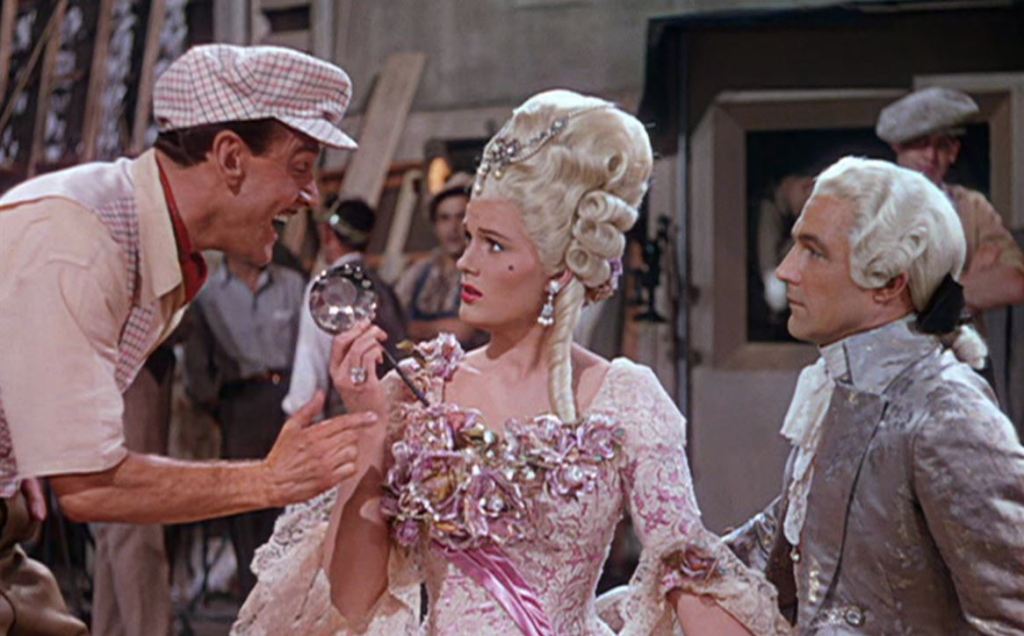
Singin’ is a film assembled from a collection of songs MGM held the rights to. The songs were given to Kelly, Donen and the screenwriters with the instruction to “come up with a movie”. What they came up with was this delightful film-about-films. Don Lockwood (Gene Kelly) and Lina Lamont (Jean Hagen) are the biggest stars of the silent screen in Hollywood, whose careers are in trouble overnight when sound is introduced. He can’t really act and she has a voice like nails on a blackboard. But Lockwood can sing and dance – so why not make their latest film a musical? Especially since the talented Kathy Selden (Debbie Reynolds), who Lockwood has fallen in love with, can sing and act and can dub Lina’s voice. What could go wrong?

There are few more purely enjoyable films than Singin’ in the Rain. Nearly every scene has a moment designed to make you burst out in a smile, be it a cracking line of dialogue, a piece of prodigious dancing skill or the simple warmth and joy of the leading actors. Every second something delightful seems to happen. The entire film is an explosion of gleeful joy in the sheer exuberance of singing and dancing. Kelly’s choreography brilliantly uses everyday props and pieces of furniture to give the numbers an exciting everyday charm. It gives the songs an immediate “gotta dance” energy. How could you not like it?

Threading these songs around a structure of Hollywood taking on sound for the first time was a brilliant idea. The recreation of the acting styles and technology of Hollywood is brilliant. Lockwood is a hopelessly stagy actor, hideously artificial in his gestures, while poor old Lina Lamont is horrendously wooden with an awful voice, and a complete lack of any talent. Jean Hagen as Lina Lamont is in many ways the butt – but she’s so demanding, bullying and selfish we don’t mind that most of the jokes are on her.

The shift towards sound in Hollywood is actually interesting as well as hilarious. Where do we place the mikes? How should the actors get used to speaking into a mike? How do we cancel out the background sound? What do we do with loud props? One of the highlights is the screening of this film-within-a-film to an audience for the first time. All the terribleness Lockwood and Lamont gets revealed. In a particularly genius moment, the sound of the picture gets out sync with the picture, with the voices seeming to come out of the young actors’ mouths to hilarious effect.

Alongside this we get some of the finest song-and-dance routines in the history of the movies. Donald O’Connor is electric as Cosmo and his dance routine for “Make ‘em Laugh” is an astounding early pace-setter in the film: how does he do what he does here? O’Connor goes bouncing off walls, swirling in circles on the floor, springing from place to place without a single pause for breath. Most of this number (like many of the others) is done in one take with electric pace. And that’s the film just warming up.

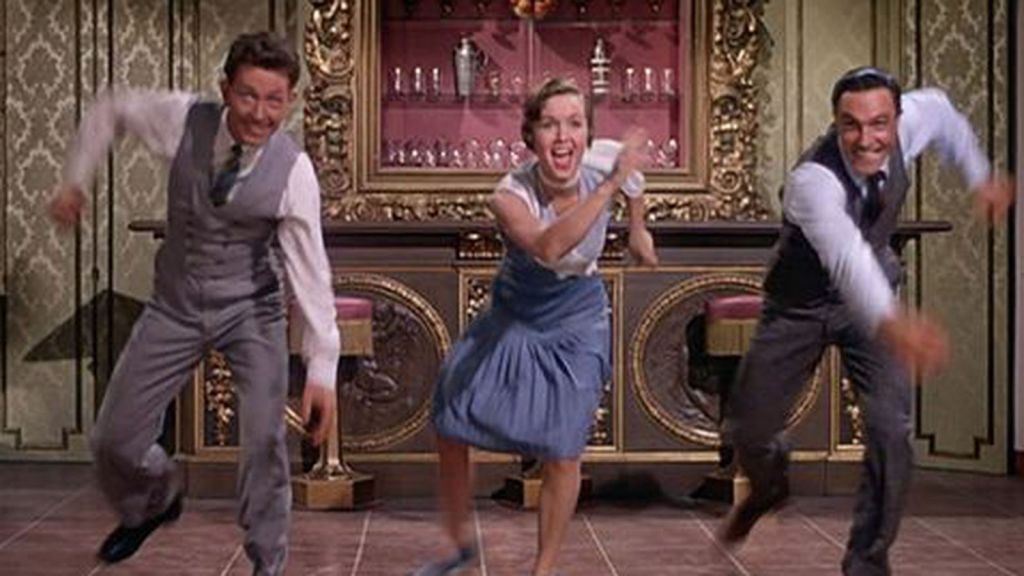
Debbie Reynolds famously described doing Singin’ as being (along with childbirth) one of the hardest things she’d ever done in her life. You can see that in ‘Good Morning’, another electric three-way number with herself, Kelly and O’Connor – she is pounding the floor to keep up with these two masters (and does a brilliant job). She was pushed to the extremes by Kelly who privately considered her a not quite strong enough dancer. Kelly dropped her from Broadway Ballet Medley, a complex ballet-heavy (as per all Kelly films from On the Town onwards – a sequence that I must confess I find a little dull). She’s still excellent – charming, sprightly, light, glorious fun – but it did mean Kelly re-worked the main number to showcase just himself.

Ah yes. ‘Singin’ in the Rain’. This sequence of the film is probably wedged in everyone’s mind. Even if they’ve never seen the film, people are familiar with Gene Kelly, soaked to the skin, dancing through puddles and swinging around lampposts. Kelly is of course marvellous in this sequence (hard to believe he was apparently suffering from the flu at the time) and the number has complete charm to it – that carefree vibrancy of realising you are falling in love. Especially as Lockwood’s ego is finally being put to one side in order to celebrate feelings he’s having for another person. But the whole scene is just sheer cinematic magic. And for something so famous, you never get tired of it. 

But then Kelly has pure star-quality here. Lockwood is a charming, handsome and smooth film star – but the film is happy to puncture his pomposity, or demonstrate in its opening sequence the self-aggrandising version of his early career (“Always dignity!”) with the reality of faintly embarrassing and dignity-free stage and stuntman work. Kelly is so charming you don’t mind that the film gives him an easy ride, considering Lockwood is actually quite selfish.

Singin’ in the Rain is pretty close to perfect. Even though I find some of the ballet stuff a little boring myself, it’s still filmed and shot with skill. It’s a pet discussion between film experts to ask how much of the film was directed by Kelly and how much of it was done by Donen. I guess it doesn’t really matter except to cinephiles, as the film is just beautifully directed: light, frothy, fun and with real technical expertise – the slow crane shot at the end of the famous number is justly famous. The pace is spot on, and the film is hilarious. Its understanding of filmmaking really pays off in the sequences that chronicle early film making.

So why did this film not get recognised at the time? Well to be honest, there were probably too many movies like this out at the time. It was a lot easier to miss in the crush of mega-MGM movies. It followed on the coat-tails of An American in Paris which had worn a huge number of Oscars (and was pushed back into cinemas in place of Singin’ in the Rain). Singin’ was still a big hit – but it perhaps needed film-fans to embrace it because it so perfectly married a love of Hollywood with the technicolour delight of 1950s musicals. Either way, Singin’ in the Rain is a delightful masterpiece which is guaranteed to pop a smile on your face. No matter the weather.