
 |
Sean Connery taps into his inner Sherlock Holmes in The Name of the Rose |
Director: Jean-Jacques Annaud
Cast: Sean Connery (William of Baskerville), F. Murray Abraham (Bernardo Gui), Christian Slater (Adso of Melk), Michael Lonsdale (The Abbot), Helmut Qualtinger (Remigio de Varagine), Elya Baskin (Severinus), Volker Prechtel (Malachia), Feodor Chaliapin Jnr (Jorge), William Hickey (Ubertino de Casale), Michael Habeck (Berengar), Urs Althaus (Venantius), Valentina Vargas (The Girl), Ron Perlman (Salvatore)
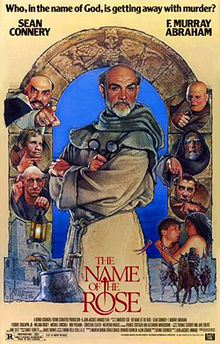
Umberto Eco’s erudite medieval murder-mystery was about the wonderful power of books, as much as murder mayhem in a medieval abbey. A surprise bestseller, the story is a perfect mix of intellectual playfulness and Agatha Christie whodunit, with suspects left, right and centre and bodies piling up faster than you can count. Jean-Jacques Annaud fought for years to bring the book to the screen, and his vision of it might well sacrifice much of the depth of the original (it even cheekily refers to itself as a “palimpsest” of the original novel – something reused but still bearing traces of the original) but brings enough to the table to have its own life.
In 1327, monks and high churchmen assemble at a Benedictine abbey in Northern Italy, famed for its voluminous library. However, all is not well at the Abbey with one monk already dead in mysterious circumstances, and soon many others join him in death, each of the later victims with mysteriously blackened fingers and tongues. The Abbot (Michael Lonsdale) asks renowned Franciscan monk William of Baskerville (Sean Connery) to investigate – and his efforts will reveal the dark truths at the heart of the abbey and place him and his novice Adso (Christian Slater) on a collision course with Inquisitor Bernardo Gui (F. Murray Abraham) who sees not a human hand, but the hand of Satan, in the murders.
Annaud’s film perfectly captures the mud and grime of the medieval world, with its murky visuals of the cold and damp in a building like this in winter. To be fair, the film is helped in its sense of oppressive medievalism by its frequently choppy editing and less-than-obvious camera angles (at times making it hard to tell what is happening), while James Horner’s score may hit its notes hard at points, but does sound like a successful pastiche of choral music of the time and creates an ominous air.
Annaud searched far-and-wide for his ideal cast to populate the monastery – and he seems to have assembled actors based on the closeness of their resemblance to Holbein, Bosch and Brugel grotesques. The monks are a distinctive set of oddball weirdos, often pale of face (non-more so than obese albino Beringar, whose effete campness tips a little uncomfortably into homophobia today), with oddly tonsued facial hair, and prominent facial features. To be honest it makes the movie-stardom of Connery (and Slater) stand out even more, as practically the only members of the cast who don’t look like they could audition for the Addams family. Ron Perlman in particular labours under such carefully applied make-up, matched with a faultlessly committed performance of physical and verbal childishness mixed with animal instinct, it was a shock to find out from other films that he was not hideously deformed!

William of Baskerville, as imagined by Eco, was a mix of William of Occam (him of Occam’s razor) and Sherlock Holmes (hence the Baskerville) – the book even matched almost word for word, Watson’s first description of Holmes from A Study with Scarlet with Adso’s first description of William. (Adso himself is also basically W-atso-n). The film is at its strongest when focused in William’s deductions, his lightening intellectualism and his ability to bring even the smallest fact or note to bear in order to shape a conclusion. The film front-and-centres William’s investigation over and above the other themes of the book (around faith, books and intellectual freedom), but this works for the requirements of a film’s narrative.
t also helps that William is played by Sean Connery in one of his finest performances. Heading into the film, Connery’s career was in a seemingly terminal decline (indeed the Great Scotsman was seen as such box-office poison, a Hollywood Studio pulled their funding after he was cast). Connery had to work hard to persuade Annaud – but thank god he did, as he plays on his fatherly and intellectual strengths here. In real life a committed autodidact, Connery perfectly captures the curiosity and love-of-learning of William, and also invests him with a profound moral sense, shaded by his guilt at past failings and playful understanding of how the moments when we fail to live up to expectations do not mean we are damned. It’s one of Connery’s finest performance – and unarguably changed his career, as he headed into a five year purple patch of increasingly impressive performances.
Connery’s compelling performance is the real meat of the film, and he creates a character who feels warm, rounded and a perfect mix of contemporary and of-the-period. He’s also well supported by a young Christian Slater as his sidekick novice, who also gets a surprisingly raunchy sex scene. It’s unfortunate the rest of the cast don’t get as much to play with. The rest of the monks are oddballs, or drift out of the film as the plot requires (Michael Lonsdale’s abbot simply disappears, despite hints of a darker role in the plot early in the film).
In particular F Murray Abraham devours most of the impressive set as a lip-smackingly cruel inquisitor who delights in handing out the judgement of God. The film repositions him as a hissable villain, and reduces his impact accordingly, including placing him in an “you’re off the case William!” role. The final, murkily done sequence (featuring fires, heretics punished and a couple of nasty accidents) does tip into the sort of Grand Guignol gothicness that the book itself more or less avoids. But then it’s part of the general boiling down of the novel – making it that palimpsest – and also part of Annaud’s Euro-epic style, with its melting pot of accents and touches of clumsy editing and filming.
The balance of the original novel between ideas and sensation gets more or lost in sensation here – indeed the book that all this murderous behaviour is all about gets rushed over and its impact poorly explained, as are the motives of the eventual killer – but it all still kind of works because it looks more or less perfect and because of that Connery performance. Annaud was probably not quite the director to successfully marry the two parts of the book – and his direction is adequate in many places rather than inspired, with too many awkward handbrake turns – but this is still a film I have enjoyed many times over and will do so again.

 Movie Musings