Tag: Jean Seberg

Airport (1970)

Airport (1970)

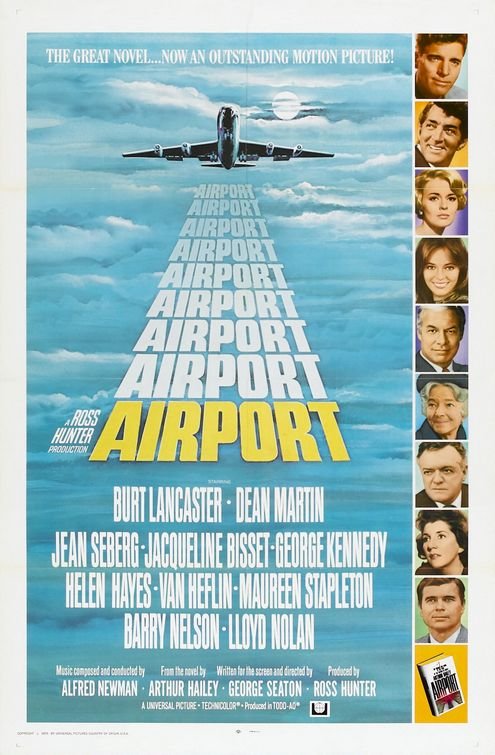
Disaster awaits in the sky in this ridiculous soap that is less exciting than Airplane!

Director: George Seaton

Cast: Burt Lancaster (Mel Bakersfied), Dean Martin (Captain Vernon Demerest), Jean Seberg (Tanya Livingston), Jacqueline Bisset (Gwen Meighen), George Kennedy (Joe Patroni), Helen Hayes (Ada Quonsett), Van Heflin (DO Guerrero), Maureen Stapleton (Inez Guerrero), Barry Nelson (Captain Anson Harris), Dana Wynter (Cindy Bakersfeld), Lloyd Nolan (Harry Standish), Barbara Hale (Sarah Demarest), Gary Collins (Cy Jordan)
A busy Chicago airport in the middle of a snowstorm. Workaholic Mel Bakersfeld (Burt Lancaster) doesn’t have time to prop up his failing marriage to his humourless wife: he’s got to keep the flights moving, clear the runways and solve the problems other people can’t. He’s not dissimilar to his brother-in-law Vernon Demerest (Dean Martin), who hasn’t got time for his plain-Jane wife at home when he’s got a flight to Rome to run and a saintly pregnant air hostess girlfriend Gwen (Jacqueline Bisset), to deal with. Tensions will come to a head when depressed former construction worker Guerrero (Van Heflin) joins Demerest’s flight, planning to blow himself up so his wife can profit from his life insurance. Disaster awaits!

“A piece of junk”. That was Burt Lancaster’s pithy review of this box-office smash that was garlanded with no fewer than ten Oscar nominations. He’s pretty much spot on. Airport is a dreadful picture, a puffed-up, wooden soap opera that never takes flight, stapled together with a brief disaster plotline that only really kicks in during the final act of the film and is solved with relative ease. Other than that, it’s all hands to the pumps to coat the film in soapy suds, which can be stirred up by the strips of wooden dialogue that fall from the actors’ mouths.

Seaton adapted the script from a popular low-brow novel, though it feels as if precious little effort went into it. It’s corny, predictable dialogue does very little to freshen up the bog-standard domestic drama we’re watching in a novel setting. Both lead actors juggle loveless marriages with far prettier (and much younger) girlfriends. Those girlfriends – Jean Seberg for Burt and Jacqueline Bisset for Dean – play thankless roles, happily accepting of their place as no more than a potential bit-on-the-side and very respectful of the fact that the job damn it is the most important thing.

The film bends over backwards so that we find Burt and Dean admirable, despite the fact that objectively their behaviour is awful. Burt treats his home like a stopover, barely sees his kids and seems affronted that his wife objects he doesn’t attend her important charity functions and doesn’t want the cushy job he’s being offered by her father. Just in case we sympathise with her, she’s a cold, frigid, mean and demanding shrew who – just to put the tin lid on it – is carrying on behind Burt’s back. We, meanwhile, applaud Burt for showing restraint around the besotted Jean Seberg, merely kissing, hugging and chatting with her about how he’d love to but he can’t because of the kids at home damn it!

He looks like a prince though compared to Dean. Only in the 1970s surely would we be expected to find it admirable that a pregnant girlfriend happily takes all the blame – the contraceptive pills made her fat and she knows the deal – begs her boyfriend not to leave his wife and then urges him to not worry about her. Dean’s wife doesn’t even seem that bad, other than the fact she’s a mumsy type who can’t hold a candle to Bisset’s sensuality. That sensuality is overpowering for Dean, who at one point pleads with her to stay in their hotel room because the taxi “can wait another 15 minutes”. Like a gentleman his reaction to finding out Bisset is pregnant, is to offer to fly her to Norway for a classy abortion (rather than the backstreet offerings at home?).

This soapy nonsense, with its stink of Mad Men-ish sexual politics (where men are hard-working, hard-playing types, and women accept that when they age out, he has the right to look elsewhere) is counterbalanced by some laboriously-pleased-with-itself looks at airport operations. Baggage handling. Customer check-in. Customs control checks. Airport maintenance. All get trotted through with a curious eye by Seaton. Just enough to make parts of the film feel briefly like a dull fly-on-the-wall drama rather than a turgid soap.

Soap is where its heart is though. Helen Hayes won an Oscar for a crowd-pleasing turn (from which she wrings the maximum amount of charm) as a seemingly sweet old woman who is in fact an expert stowaway. Van Heflin and Maureen Stapleton play with maximum commitment (Stapleton in particular goes for it as if this was an O’Neil play rather than trash) a married couple whose finances are in the doldrums, leading the husband to take drastic steps.

It’s all marshalled together with a personality-free lack of pizzaz by Seaton, who simply points the camera and lets the actors go through their paces, with a few shots of humour here and there. There are some interesting split-screen effects, but that’s about the last touch of invention in the piece. It’s mostly played with po-faced seriousness – something that feels almost impossible to take seriously today, seeing as the structure, tone and airport observational style of the film was spoofed so successfully in Airplane (a much better film than this on every single level, from humour, to drama even to tension – how damning is that, that a pisstake is a more exciting disaster thriller?)

It smashed the box office in 1970 and got nominated for Best Picture. But its dryness, dullness and lack of pace mean it has hardly been watched since. Although it can claim to be the first all-star disaster movie, it’s not even fit to lace the flippers of The Poseidon Adventure, which far more successfully kickstarted the cliches that would become standard for the genre (and is a tonne more fun as well as being a disaster movie – this has a disaster epilogue at best). An overlong, soapy, dull mess.

Lilith (1964)

Jean Seberg lures Warren Beatty and Peter Fonda into a psychologically dangerous web in Lilith

Director: Robert Rossen

Cast: Warren Beatty (Vincent Bruce), Jean Seberg (Lilith Arthur), Peter Fonda (Stephen Evshevsky), Kim Hunter (Dr Bea Brice), Anne Meacham (Mrs Meaghan), Jessica Walter (Laura), Gene Hackman (Norman), James Patterson (De Lavrier), Robert Reilly (Bob Clayfield)

Movies have long had a fascination with mental illness – in particular the impact of mental illness on women. Lilith is an intriguing, elliptical, somewhat cold but intriguing film that looks at the impact isolation, loneliness and seclusion can have on people and how these damaged psyches can sprawl out and cause further pain and suffering for others. However, it’s also a difficult, unclear and occasionally hard to like film, that deliberately clouds so many of its points in a veil of doubt and uncertainty that it’s difficult to really embrace it.

Returning from an undisclosed war (possibly Korea), Vincent Bruce (Warren Beatty), a lonely, slightly troubled young man, drifts into a job as a counsellor at a private mental hospital, under the supervision of Dr Brice (Kim Hunter). Bruce is empathetic and keen to understand and help the patients, but he finds himself slowly drawn towards Lilith Arthur (Jean Seberg), a sensual and seductive patient at the institute. Encouraged to spend more time with Lilith – as only Vincent seems able to draw her out of a fantasy world to engage with the real one – he increasingly finds himself infatuated with her, increasingly bending any personal or professional ethics to fuel his emotional and sexual need for her.

Just in case you are in any doubt from reading that, it’s pretty clear from early on in the film that the real person in need of help is Vincent. Played with a methody introspection and brooding insecurity by Beatty (he impassively and wordlessly drifts through several scenes or merely watches, and only rarely shows any emotional engagement), Vincent is frequently framed by Rossen alone, lost in the centre and sides of frames, or walking seemingly aimlessly forward. The camera often drifts towards him, if only to stress his lack of real engagement with the things he is seeing in front of him. His obsessive qualities are there from the very start, with his fixations switching between his mother, a former girlfriend (played with a flirtatious seductiveness by Jessica Walter) and finally settling, overwhelmingly, on Lilith whom he follows with the glazed eyes of a potential killer. Beatty struggled with the part – and I can see why, as our central character is such a distant cipher that he becomes someone very hard for the audience to invest any interest in.

Lilith herself is an intriguing if, it seems, unknowable character – almost impossible to tell if she is a truly destructive force or someone who simply behaves as she feels in the moment with no understanding of the impact her actions have. She is frequently callous and cruel, and then will revert to sadness, vulnerability and insecurity. She looks for love – or at least affection and loyalty – at every turn, but then also seems unable to understand any personal relationship except through the filter of sex. Starting the film placing an erotic spell around sensitive fellow patient Steve (Peter Fonda, vulnerable and rather sweet) she quickly switches all her efforts to wrapping Vincent in a web of enchantment (as the film rather clumsily stresses to us in a scene where a doctor explicitly compares her to a spider).

Lilith is increasingly seen as an unsettling, indiscriminate figure. No sooner does Vincent become her lover, than she begins flaunting a sexual relationship she is having with another female patient. (Lesbianism was quite radical for a film at the time). Even more surprisingly the patient is a staid, rather imperious middle-aged woman (played imposingly by Anne Meacham), and the relationship seems to be partly conducted to get a rise (of one sort or another) out of Vincent. Earlier, Lilith flirts disturbingly and erotically with a very young child (who seems disturbed) – although the viewer is perhaps even more disturbed by Vincent’s blank watching of the whole scene. At every point we are reminded of Lilith’s erotic allure – and the framing of the film, and its beautiful photography by Eugene Schufftan helps to create this mystic image. Lilith is often shown behind grills and bars earlier on, before she emerges into the outside world and one enchanting image sees her kissing her reflection in a lake, the very act reducing the reflection to shimmering ripples on the surface: can anyone know her?

The part leans on being borderline sexist, the idea of the enchanting, liberated woman as somehow being a dangerous (almost evil) threat to the safety and mental security of the men around her, deliberately endangering the decent world with her sexual openness. It largely manages to avoid this due to the performance of Jean Seberg, who gives Lilith a vulnerability and suggestions of deep psychological trauma that underpin her surface sexuality, flirtation and predatory nature. It’s no surprise that she is so completely able to overwhelm the repressed, inverted Vincent, or that he becomes such a willing slave to her whims and spur-of-the-moment suggestions.

Much of this disintegration of Vincent underpins the second half of the film, as he and Lilith engage in a dance that ends up having overwhelmingly negative consequences for each of them and for many of those around them. Intriguingly, Rossen’s vision of this mental institute as a more bohemian organisation suggests that the staff all seem aware of (and even tacitly encourage) the relationship – although whether this is part of a treatment or some sort of bizarre other motive is unclear. However, all this doesn’t help to make either character one we really care about, or make the story crystallise into something that carries real impact.

That captures the central problem of the film – Rossen deliberately builds the story with an elliptical sense of mystery in which the actions and motives of characters remain deliberately unclear, and the world they live in takes on elements of the dreamlike fantasy world that Lilith herself sometimes lives in (complete with her own language). Events seems to move with little sense of time. There are surreal interludes, not least an extended sequence where Vincent takes Lilith to a jousting competition (yes you read that right). It’s perhaps all a part of understanding how the personalities of the two lead characters slowly collapse over time into themselves, but it also serves to keep a distance between the film and the viewer. The final tragic outcomes are predictable from the very start of the film, but there is still a certain power to them. As a study of what slow mental disintegration may look like, Lilith is an intriguing little picture, but basically a little too hard to invest in emotionally to carry real impact.

À Bout de Souffle (1960)

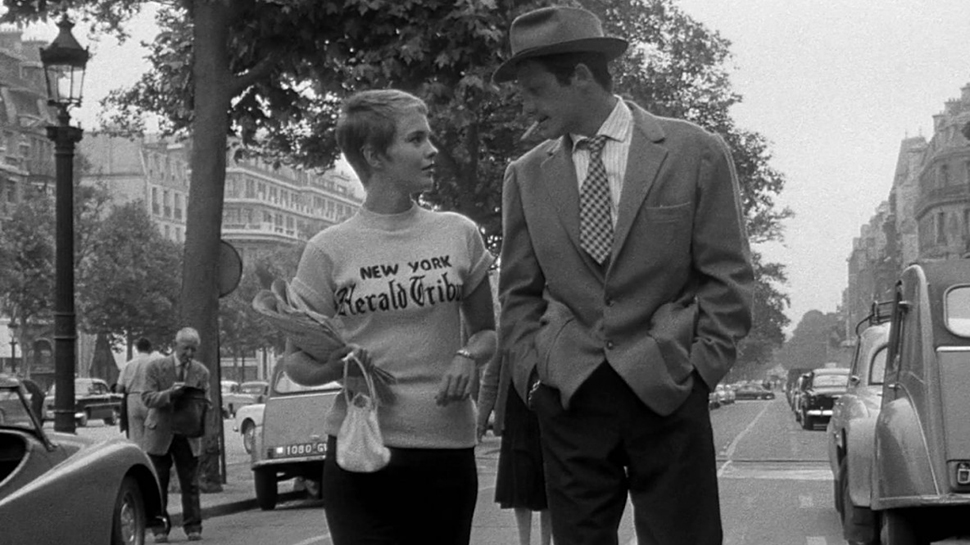
Jean Seberg and Jean-Paul Belmondo get obsessed with their own images in À Bout de Souffle

Director: Jean-Luc Godard

Cast: Jean-Paul Belmondo (Michael Poiccard), Jean Seberg (Patricia Franchini), Daniel Boulanger (Police Inspector Vital), Henri-Jacques Huet (Antonio Berruti), Roger Hanin (Carl Zumbach), Jean-Pierre Melville (Parvulesco), Liliane David (Lilane)

The French New Wave emerged from a group of film critics from influential magazine Cahiers du cinema in the 1960s, led by Francois Truffaut (who contributed a four page story outline to this film, although Godard later minimised his contribution as much as possible). The movement believed the director was the “author” of the film, stamping their personality on it. Packed with references to classic Hollywood movies, the films were shot with an improvisational lack of formality (that often hid brilliant cinematic technique) inspired by Italian neo-realism.

Breathless, Jean-luc Godard’s revolutionary masterpiece, was one of the central films in this school of filmmaking. It followed the last few days of Michael Poiccard (Jean-Paul Belmondo). A young man drifting through a life of petty crime, who idealises Humphrey Bogart’s style, he one day steals a car; it happens to have a gun in it, and in a moment of casual indifference he shoots a policeman trying to arrest him and flees. In Paris, while being hunted by the police, he reunites with his girlfriend, American student Patricia Franchini (Jean Seberg), and their self-absorbed relationship plays out under the shadow of the police net getting tighter and tighter.

Jean-Luc Godard’s film was hugely influential, as it seemed to re-write the rules of how films were to be made. Godard’s film is down and dirty, it’s almost guerrilla, but filmed with a wonderful, improvisational beauty. Shots are hand-held and dynamic, the action is all filmed on location, the framing is rough and ready, the camera gets up close and personal with the actors, throwing us in with them with an overwhelming sense of realism. The whole film feels irreverent, casual and cool, and gets a wonderful sense of urban Paris. It magnifies and reflects the very qualities the lead characters believe they have themselves.

Godard’s most influential touch was the use of jump cuts within scenes, with action jumping from moment to moment within a scene seemingly spontaneously, giving an impression of constant movement and ripping out the sense of time between actions. It also gives a sense of the film always driving forward, bouncing from beat to beat. According to rumour, this influential use of editing was a happy accident. The original cut of the film was well over two hours, and the distributors wanted something less than 90 minutes. Rather than cut whole scenes, Godard cut the small moments of movement or peace in scenes, giving the film a jagged freshness.

The whole film is full of these moments, the jumps over silences and conversational gaps, jumps in time lags between walking from point A to point B. It really works as well. The exterior scenes buzz with an exciting freshness. The long second act, basically nothing more than a conversation in a bedroom between the two leads, is edited almost like an action scene in a modern film – perfect for the self-dramatising energy the two characters are leading their lives with.

It’s those two leads who really help to make the film. Seberg picked up a quarter of the film’s budget to be the “name” lead, and she brings the film a soulful but distant sense of coolness. Belmondo was the real find, turning himself overnight into a mega star. In the sixties these were the people that your cool student wanted to be. Belmondo nailed his sense of iconoclastic cool in the opening moments – particularly when turning casually to the camera while driving his stolen car, to involve us personally in the story of his own life that he is constructing.

You can see how the performances (and characters) of the two leads had such impact on filmmaking. Energetic but also listless, contemptuous of authority and certain that whatever the world has in store for them it is definitely something more, self-absorbed and selfish, immature and convinced that their lives are more important that the average people around them – they are the predecessors of Bonnie and Clyde, of the young killers in Badlands. And nothing seemed to capture the counter-culture cool than Belmondo with a cigarette dangling from this mouth, apeing Bogart. 

But both lovers are equally selfish and obsessed with their own stories. Or rather, self-consciously living their lives like they are in a narrative – in fact you could say that the film predicts the self-obsession of the social media age. Michael lives a life that is all an entirely constructed front. He’s a would-be gangster, with a carefully studied front of gritty cool. He spends endless time making sure that his look, his clothes, his postures, his manners are always spot-on. He constantly keeps up a stream of consciousness narrative about his own life and situation, positioning himself as the sort of representative of modern American hip.

And Patricia is the same. Although at first she seems the more natural and grounded of the two, it’s clear her self-obsession is just as profound (if not more so) than Michael’s. Patricia constantly reviews and rebuilds the narrative of her own life, discussing her romantic life like it was a carefully constructed fiction, or some sort of hyper-cool Mills and Boon. “Do I love you? Should I love you? Can I make myself not love you?” Patricia’s construction of her own narrative – and her desire to shape and control it completely – makes her as completely artificial as Michael is. 

She’s so determined to construct her own narrative, that she shrugs off a string of revelations about Michael as if they didn’t exist. He’s a killer? Okay. He’s got at least two names? Hardly matters. He’s married? Nobody’s perfect. When deciding to betray Michael to the authorities, the action seems almost motiveless, but it quickly becomes clear that it is led by her latest review of the life situation and deciding it’s not what she wanted. Surrendering Michael to the law is her chance to say “No, I shape the story here – and I get to control who I feel love for, no one else”. By betraying Michael she is cutting a part of a life narrative out like she was removing a tattoo, something that she is not sure she wants any more but finds hard to remove.

One area where I do struggle with the film now is the attitude it has to its heroes. I think it wants us to kind of admire Michael – for all his faults – as some sort of unconventional hero looking to lead his life. I struggle to feel the engagement with a guy who is literally a murderer as much as the film wants me to – but I think this is the result of a major change from the more rebellious 1960s, to our changed times today. But then I’m also not sure that the film has as much heart as it wants to have – its characters are so consciously artificial that you never really get a sense of them as human beings. They are always characters, never people – and the film is always focused on their constructed images rather than anything real for you to invest in. There is much to admire, and not much to love.

And that doesn’t change the influential nature of the film. While it’s easier to admire the film than to love it – for all the strength of the performances, the characters are selfish fantasists – and its technical achievements sometimes distance as much as they throw us into the action, it’s still brilliantly put together. It’s masterfully made, and while I’m not sure it really has any heart, it’s got enough energy, force and urgency to make dozens of films.