
Tag: Jeff Corey

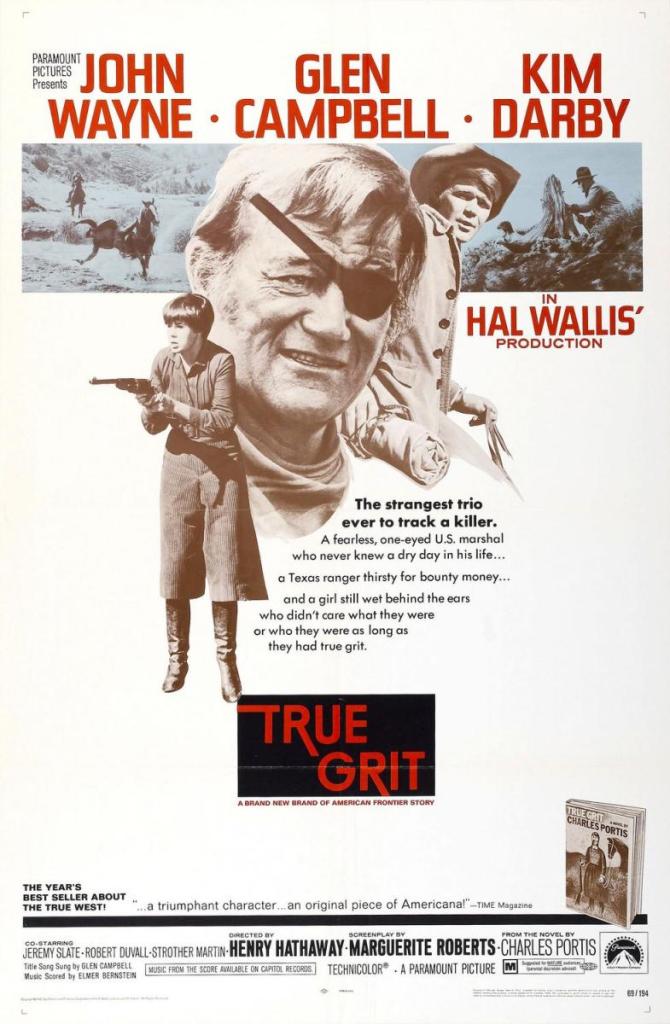
True Grit (1969)

True Grit (1969)

The Duke wins an Oscar in this solid Western (already old-fashioned in 1969) put together with a professional solidity

Director: Henry Hathaway

Cast: John Wayne (Reuben “Rooster” Cogburn), Glen Campbell (La Boeuf), Kim Darby (Mattie Ross), Jeremy Slate (Emmett Quincy), Robert Duvall (Lucky Ned Pepper), Dennis Hopper (Moon), Alfred Ryder (Goudy), Strother Martin (Colonel Stonehill), Jeff Corey (Tom Chaney), John Fiedler (Daggett)
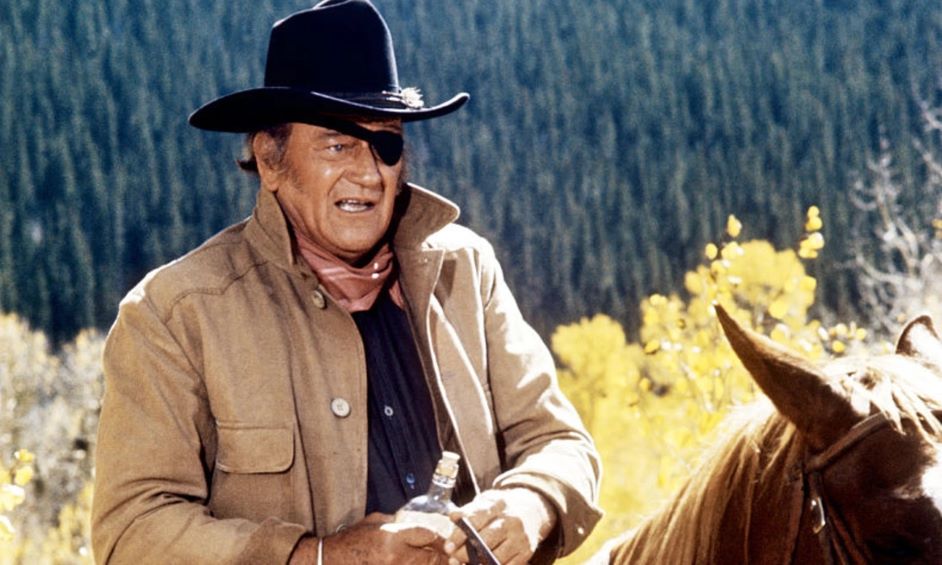
By 1969 John Wayne had been pulling his six shooters against rascals and rapscallions for thirty years, ever since making one of the all-time great entries in Stagecoach. He’d been an American icon, box-office gold and practically the Mount Rushmore of Hollywood. What he never really had was recognition that, underneath the drawl, he was a fine actor who knew his business. He’d only had the single Oscar nomination in 1949, so by 1969 there was a sentimental urge to correct that – especially since illness had already seen the Duke (one of the first major stars to be open and frank about his cancer and urge others to get checks) lose a lung a few years previously.

And correct that they did, as Wayne beat out two respected thespians (the perennially unlucky Burton and O’Toole) as well as the whipper-snapper stars of Midnight Cowboy (the sort of cowboy film the Duke would never even consider making!) to scoop the Best Actor prize for taking a character-role lead (all Wayne roles are lead roles) in True Grit. Wayne was “Rooster” Cogburn, a hard-drinking but hard-riding, always-gets-his-man US Marshal, hired by Mattie Ross (Kim Darby) the teenager daughter of a murdered father to track down his killer Tom Chaney (Jeff Corey). Rooster develops an avuncular relationship with Mattie, despite his penchant to get pissed and (of course!) eventually proves he has the ‘true grit’ that made Mattie hire him in the first place.

True Grit is a traditional yarn, directed with a smooth competence (but lack of inspiration) by Henry Hathaway. It must have felt quite a throwback in 1969: you could imagine it pretty much would have been shot-for-shot identical if it had been filmed in 1949 (especially since Wayne had been playing the veteran since at least Fort Apache). Compared to other major Westerns made that year – Butch Cassidy and the Sundance Kid and, especially, the grim nihilism of The Wild BunchTrue Grit looks like the cosiest film imaginable. It even shies away from the book’s ending where Mattie loses an arm after a snake bite (something the, frankly superior, Coen Brother’s remake would not do 40 years later).

It does feel odd to see Wayne, that bastion of old-school Hollywood, sharing the screen with New Hollywood icons like Dennis Hopper (playing a yellow-bellied squealer at the baddies hideout) and Robert Duvall (a belated villain, looking uncomfortable in this genre saddle-flick as a bad-to-the-bone gang leader). But Hathaway makes sure it’s The Duke’s show. Which it is from start-to-finish.

Rooster isn’t really a stretch for Wayne. Compared to his work in The Searchers and Red River, Cogburn is a cosy and straight-forward hero, a straight-shooter who always holds to his word. But it’s a perfect showpiece for his charisma. Wayne shows a decent comic-timing (he has a nice line in deadpan reactions, particularly when he meets Mattie’s famed lawyer Daggett for the first time, discovering far from the imposing figure he imagined he’s actually the mousy John Fiedler) and there’s just a little hint of lonely sadness in Rooster as he talks about the family who left him or the homes he’s never known.

Wayne also has a lovely chemistry with Kim Darby, the relationship flourishing in a rather sweet big-brother-“little sister” (as Rooster calls her) way. Although of course it takes time to form: Rooster spends most of the first half of the film trying his best to shrug her off so he can hunt down the gang Tom Chaney runs with (and collect the bounty for them) unencumbered. The two of them form a tenuous alliance with Texas Ranger La Bouef, who is far keener to deliver Chaney to another state for a higher bounty than that offered for the killing of Mattie’s father.

La Bouef is played with try-hard gameliness by singer Glen Campbell, largely hired to commit him to singing the film’s best-selling theme tune. To be honest, he makes for a weak third wheel – but it’s hard not to hold it against Campbell when he charmingly later said he’d “never acted in a movie…and every time I see True Grit I think my record’s still clean!”. Far better is Kim Darby, who gives a spunky tom-boyish charm to the shrewd and persistent Mattie who is far too-smart to either by cheated by short-changing landlords or to be ditched from the trail by Rooster and La Bouef.

It’s Wayne’s film though, and a final act face-off with the villains shows that there were few people better with a gun on screen (his one-handed shotgun twirling reload while riding a horse is surely the envy of Schwarzenegger’s similar move in Terminator 2). The whole enterprise is carefully framed to showcase Wayne and he rises to the occasion. Think of it like that, and it hardly matters that Hathaway offers uninspired work behind the camera and fails to provide either any moments of visual interest or dynamism (or work effectively with the weaker actors).

True Grit is an entertaining, second-tier Wayne film, lifted by his charisma and enjoyment for playing a larger-than-life gravelly cool-old-timer and cemented in history by his reward with that sparkling gold bald man. Compared to other Westerns – both before and at the time – it’s traditional, straight-forward and unchallenging. But it’s fun, has some good jokes and offers decent action. And it’s a reminder that no one did this sort of thing better than the Duke.
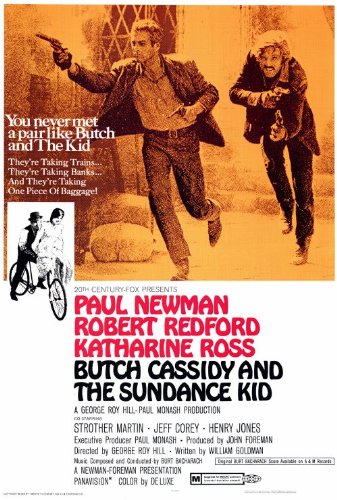
Butch Cassidy and the Sundance Kid (1969)

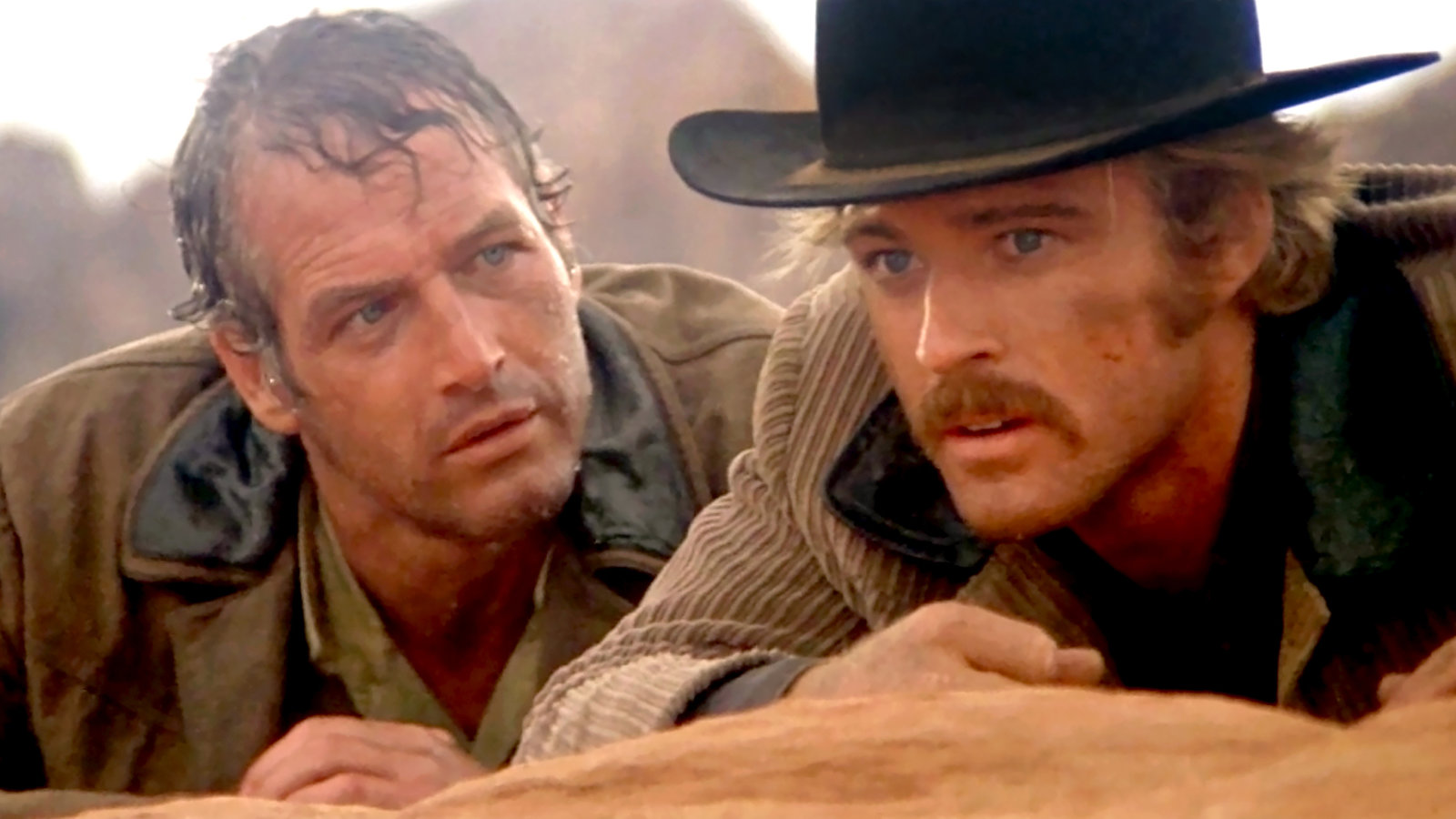
Paul Newman and Robert Redford in the perfect partnership in Butch Cassidy and the Sundance Kid

Director: George Roy Hill

Cast: Paul Newman (Butch Cassidy), Robert Redford (The Sundance Kid), Katharine Ross (Etta Place), Strother Martin (Percy Garris), Henry Jones (Bike Salesman), Jeff Corey (Sheriff Bledsoe), George Furth (Woodcock), Cloris Leachman (Agnes), Ted Cassidy (Harvey Logan), Kenneth Mars (Marshal)

Butch Cassidy and the Sundance Kid was a monster hit in 1969. It struck cinematic gold by combining Newman (originally first choice for the Sundance Kid) and Redford (fourth choice at best after Jack Lemmon – and what a different film that would have been! – Warren Beatty and Steve McQueen) and got the tone just about spot on between old school charm and hit 1960’s chic. It reinvents no wheels, but it’s a prime slice of classic Hollywood entertainment.

In the dying days of the Old West, the Hole in the Wall Gang is finding trade tough. The banks are wising up to how easy they are to rob, and the new idea of holding up trains is fraught with danger. Not least from the powerful backers who don’t like to see their money and goods being half-inched off the tracks by a gang of desperados. The leader of the gang, affable, fun-loving Butch Cassidy (Paul Newman) and his sidekick sardonic ace-shot the Sundance Kid (Robert Redford) continue to ply their trade of stealing, but they are fighting a losing battle. Hounded out of the states by a crack squad of lawman they make their way to Bolivia – but find the life of crime isn’t easier there either, what with no one speaking English and the Bolivian army being even more trigger happy than the American law and order forces. What’s a couple of guys to do?

Butch Cassidy and the Sundance Kid is really a celebration of nostalgia, repackaged with a wry sense of 60s cool that merrily seizes on its lead characters as the sort of anti-authoritarian, free-spirited, jokers who were bucking the rules of Vietnam-era America. But fundamentally at heart, it’s a joke filled sad reflection on a lost America and a lost sense of freedom – even if it was the freedom for two basically decent guys to make a living from robbing banks – that even shoots most of its opening segment in a romantic sepia. 

Because this is all about Butch and Sundance being two guys left behind by progress. Their way of life is dying out around them – the opening sequence sees Butch walk around a new bank, with its impressive new security measures. What happened to the beautiful old bank? Asks Butch: “People kept robbing it” comes the cold response. This follows on from a recreation of old sepia newsreal footage that states that the entire membership of the Hole in the Wall Gang is now dead – meaning that we know where the film is heading from day one. It’s a world where the train and modern communications are leaving our heroes behind. Even the humble bicycle is a sign of the future – “the horse is dead!” crows a bike salesman to a crowd of red necks.

The film may be cool and whipper-sharp in its style and the characterisation of its lead characters, but it’s a firmly nostalgic film that sentimentalises the Wild West and our heroes. No wonder at its conclusion it freeze frames (famously) as the heroes charge out to certain death in a shoot-out with the Bolivian army. It’s like Hill can’t bear seeing these guys torn apart ala Bonnie and Clyde or The Wild Bunch by the cold hard truth of a bullet. 

The film makes an interesting comparison with The Wild Bunch released the same year. In many ways the latter is a more traditional western, both in its style and its content. But in every other way it’s a far more radical piece, really embracing the lack of rules, the cruelty and the lack of glamour of life in the west – and ending with its heroes being shot to pieces on screen in a prolonged bloody shoot out that set a new record for use of squibs. Compared to this, Butch Cassidy is very light stuff, with its final image almost hopeful in its sepia toned romanticism.

Not that it’s not entertaining for all that. Its sense of sixties defiance is perfectly captured in the film’s lightness and playfulness – and in the fine lines and gags in William Goldman’s well structured (and Oscar winning) script. From its opening lines “Most of what follows is true” through the offbeat wisecracks of its lead, it’s a lot of fun. Newman and Redford are both just about perfect. Newman is the very picture of relaxed, casual cool while Redford’s style of handsame smartness works perfectly for the more plugged in Sundance. The two of them also form a very swinging sixties sexfree-Thruple with Katharine Ross as Sundance’s girlfriend, but essentially a companion to both men.

Not that Etta isn’t aware that the good times are coming to end. She makes it clear she won’t stick around to watch them die, and when (late in the film) she announces she will return to the US, it’s a clear sign to everyone that things are near the end. But then Butch and Sundance have already faced the cold realities, as an attempt to go straight protecting bank money from robbers see them gun down a group of bandits (the first real bloodshed in the film), an action that leaves them both slightly stunned.

It’s very different from the hijinks of the film’s first three quarters. The two of them spend a chunk of the film trying to evade the lawmen chasing them, each attempt failing, ending in them making a desperate jump off a cliff into water (because no one would follow unless they had to) and even their early career robbing banks in Bolivia is hampered by their inability to speak Spanish (cue a series of lessons from Eta on the rudiments of larceny in Spanish). The film’s lightness and warmth early on lies behind its popularity.

Butch Cassidy is a film that is designed to please and for you to love it. It has two fine actors giving superbly entertaining performances. It has some wonderful scenes, not least the introduction of each character, two superb scenes (Butch’s facing down of a challenge against his leadership of the gang is a scene so good I don’t think the film bests it). But Hill’s film is also a cosy and safe picture, that drips with sentimentality towards its leads and nostalgia for its era. It’s successful because it’s such an unchallenging and safe film.

Seconds (1966)

Trauma abounds in dull, self-important conspiracy thriller Seconds

Director: John Frankenheimer

Cast: Rock Hudson (Tony Wilson), Salome Jens (Nora Marcus), John Randolph (Arthur Hamilton), Will Geer (Old Man), Jeff Corey (Mr Ruby), Richard Anderson (Dr Innes), Murray Hamilton (Charlie Evans), Karl Swenson (Dr Morris), Khigh Dhiegh (Davalo), Frances Reid (Emily Hamilton), Wesley Addy (John)

In the 1960s, John Frankenheimer directed a string of conspiracy and paranoia thrillers, the most famous of which was The Manchurian Candidate. Seconds follows on in that genre, but where The Manchurian Candidate is first-and-foremost an adventure story with a deeper soul, Seconds is a self-important piece of overt arty cinema that quickly outstays its welcome.

This is particularly annoying as, on paper, this is a great story. A business makes its living from selling new, younger bodies (and new carefree lives), known as “seconds”, to old, rich people so they can start afresh. One such man is depressed banker Arthur Hamilton (John Randolph), who is reborn as artist Tony Wilson (Rock Hudson). The one rule? They can’t tell anyone about the procedure or about their old lives, and must leave everything behind. Needless to say, the prospect of a new life is a hell of a lot better than actually getting it.

Seconds really should go from there into a fascinating exploration of truth and identity: instead it swiftly gets bogged down in arty camera shots, self-important philosophising about the nature of identity, and tediously over-extended sequences of Hamilton/Wilson trying (and failing) to come to terms with his new life. The entire film never shakes the feeling that it believes it is stunningly important and everything it does is making crucially important, profound points, and it quickly loses the audience. 

The basic problem with it, above all others, is that we are given no reason at all to care about Hamilton/Wilson in either of his two personae. John Randolph is so effectively beige as the original Hamilton, you genuinely end up not caring what happens to him. Nothing in either his life or personality sparks any interest, or any sense of loss. Pile onto that the fact that it seems to take an age for him to commit to having the operation in the first place and you have a rather slow, dragging half-hour opening with a character you care very little about. And that’s just the first act.

The point the film wants to make is that changing your face and your life cannot always change the man inside: that the basic unhappy discontent of Hamilton/Wilson isn’t going to be fixed by giving him Rock Hudson’s face. Sad people are going to be sad whatever. The fact that I have summed up all the ideas of the film in a few short lines tells you everything. The film takes over an hour to make the same statements, with Wilson as tedious a lead as Hamilton was. In fact, one of the main problems is that the most interesting characters by far are those on the edge of the film – from Will Geer’s seemingly benign, but deeply sinister exec running the business to Wesley Addy’s scarily omniscient butler, these side characters all offer a lot more interest than our lead.

Wilson ends up in a beach community, filled with a host of suspicious-looking people and staffed by company representatives determined to make sure Wilson doesn’t disgrace himself or blow the gaff. Hudson makes a decent fist of the job – many commentators have made the rather clumsy point that the famously closeted Hudson probably had more understanding of what it was like hiding your real identity than any other Hollywood star around at the time – but it can’t change the fact that he’s basically not that strong or compelling a performer. Or that, even in the new body, Hamilton/Wilson is still a pompous and dull stick-in-the-mud.

So even in a new skin the character is not one you can feel any investment in. The community sequences are as slow and overplayed as the opening half hour. We are never really clear what exactly Wilson/Hamilton finds so terrifying and unsatisfying about the community, or why he finds the idea of other “seconds” so deeply traumatising. The sequence is also cursed with a bizarre “grape crushing” ceremony, that plays out like a sort of Woodstocky orgy. I imagine it is meant to convey the sudden appeal of free living – but it’s so skin-crawlingly awkward and embarrassing in its staging that it makes Frankenheimer feel like a stuffy dad attempting to relate to the sexy young kids. 

Seconds is basically too dry and empty the majority of the time to really care about or enjoy. Frankenheimer – and in particular his cinematographer James Wong Howe – shoot the film with an inspiring and trippy inventiveness as well as a disconcerting surreality. The woozy black-and-white photography constantly mixes unsettling angles, disconcerting zooms and intense POV framing to leave you uncomfortable and on-edge while watching the film. While this artiness and theatricality does sometimes make the film feel like it’s trying too hard (and makes it feel very of its time) it does at least offer most (if not all) of the interest in the film.

Maybe part of the problem as well is that Seconds is an almost unbearably depressing film, with possibly the most horrifyingly grim ending you can imagine, shot with intense horror by Frankenheimer (I’ll also say that Hudson’s desperation and fear as he realises the final fate the company has in mind for him is brilliant). It’s not exactly fun viewing, but it’s so intense you have to admire it even while finding it terrifying. It’s one of the few moments where the film’s pretensions, and pride in itself, really pay off with the final product. 

It’s the problem all over with Seconds. There are moments in there you can admire – and you can totally see why it has been reclaimed by many now as a lost classic. However, it’s also really easy to understand why the film was a box office bomb, unloved by the cinemagoers and why it’s not very well known today. There is so little in there for you to feel an emotional connection to – its lead character is a bore and a cold fish, his love interest sinister, and huge chunks of the story are delivered with a puffed up pride at how clever the whole thing is. It’s a huge disappointment, considering its potential.