Tag: Jeffrey Lynn

The Roaring Twenties (1939)

The Roaring Twenties (1939)

Superb gangster film, that sums up a whole era of film-making with a fast-paced grit

Director: Raoul Walsh

Cast: James Cagney (Eddie Bartlett), Priscilla Lane (Jean Sherman), Humphrey Bogart (George Hally), Gladys George (Panama Smith), Jeffrey Lynn (Lloyd Hart), Frank McHugh (Danny Green), George Meeker (Harold Masters), Paul Kelly (Nick Brown), Elizabeth Risdon (Mrs Sherman), Joseph Sawyer (Sgt Pete Jones)

Three guys fall in a foxhole, might sound like the beginning of an odd wartime joke but it’s the encounter that begins The Roaring Twenties. Framed as both a period piece, looking back to a time already a decade away from the contemporary audience, and a sort of memorial piece to a whole cycle of bootlegger gangster films. It’s also a film far too regularly overlooked when discussing that cycle: in my opinion it’s one of the finest and possibly Cagney’s most complex gangster role (with apologies to White Heat). It’s a fast-paced, hugely entertaining slice of crime drama, with fascinating, multi-faceted characters and an intriguing level of social depth.

Those three foxhole guys are Eddie Bennett (James Cagney), destined to run a bootlegging empire in Chicago; George Hally (Humphrey Bogart), destined to become his sociopathic ruthless partner; and Lloyd Hart (Jeffrey Lynn), destined to become a lawyer walking an awkward line. Returning from World War One, Eddie finds little welcome for returning servicemen, but his pluck and sense of personal loyalty eventually see him stumble into, and then embrace, the bootlegging business with glamourous hostess Panama Smith (Gladys George). Problem is danger abounds in the crime-ridden city and its impossible to work in this business without getting your hands dirty. Throw-in Eddie’s candle-holding love for the quietly uninterested Jean Sherman (Priscilla Lane) and you have a recipe for long-term disaster.

The Roaring Twenties is a punchy, well-cut, overlooked gem. From its opening montage that rolls back over newsreel from 1940 to the trenches of World War One to its closing tracking shot that culminates in Eddie’s fatal tumble on the steps of a church (as always in the gangster film, no-one escape death’s moral judgement no matter how psychologically complex they are) it’s a feast of fast-moving entertainment. Along the way Walsh throws in everything, from gun battles to musical numbers, by way of comedy, obsessive love and social commentary. The Roaring Twenties is arguably a nostalgic cocktail with a dim view of its decade: one of crime, hedonism and hypocrisy.

And it’s corrupted Eddie. This is Cagney firing on all cylinders: and it’s remarkable how skilfully he creates a complex, sympathetic character out of similar material to his despicable hood in Public Enemy or the flat-out psychopath he forged in White Heat. Eddie is in many ways a decent man who finds all the dreams he’s been clinging too are fantasies. He can’t land the mechanic job he dreamed of, his uniform is the subject of mockery, the woman he’s been corresponding with turns out to be a teenager (Cagney’s disappointment, discomfort and faint attraction when he first meets Jean Sherman’s skipping late-teens Priscilla is beautifully done). Eddie is left bumming around town desperate for any opportunity.

Cagney’s performance really works, because Eddie – even with an angry streak that means he can knock out two chucking goons with one punch – is fundamentally a decent bloke, corrupted by circumstances. He sees the liquor-brewing game as a short-term fast buck, which he stumbles into because he’s too chivalrous to allow Panama to take the wrap for a bootlegging delivery he’s made. He’s loyal to his friends and tries to solve problems amicably. He’s got a charming, barrow-boy entrepreneurship to him, brewing booze in his bath and selling it as a high-quality import. Cagney shows how desperately Eddie clings to his self-image that crime isn’t a lifestyle choice, but a short-term necessity he’ll jack in one day for the peace and quiet of running a taxi company.

But Cagney never stops letting us see the corruption soaking in: Eddie is learning to heartlessly take what he can get, to forget the consequences of his actions and when violence comes he’ll shrug off deaths as ‘not his fault’ or respond with an increasing ease viciousness (in a nice call back, he even shoves a cigar into a goons face, an echo of his famous grapefruit scene from Public Enemy). When he faces news, he doesn’t like, or is denied the things he wants, lashing out is his first option – and once he starts necking his own product, his downfall is only a matter of time as he falls prey to the sort of ‘World is Yours!’ attitude that doomed Scarface.

From grasping ever more business opportunities to grooming (in more ways that one) the now adult Priscilla into his ideal girl (he can’t watch her perform without grasping the pained hand of Panama, his eyes locked in monomania desire that he’s clearly convincing himself is a sort of pure, brotherly concern). Eddie clearly sees her as his ‘reward’ for his hardwork, a fantasy that doesn’t have any place for her liking him but not loving him. But there is a neat touch throughout The Roaring Twenties – a momentum packed film that races through years in minutes – that Eddie fundamentally isn’t ruthless enough for this game.

Certainly not compared to Humphrey Bogart’s study in shallow, selfish cruelty. Shown early on grinningly shooting a fifteen-year old German soldier in the dying minutes of the war (“He won’t be 16!”), George Hally is the monster Eddie can’t be. A guy who doesn’t care for anyone, who betrays and kills at the drop of a hat, who doesn’t stop for any sense of form and decency. For all Eddie tells George that time has moved on and people like them don’t have a place in the Thirties, Bogart’s cold-eyed George feels like the sort of man who would flourish in the era to come.
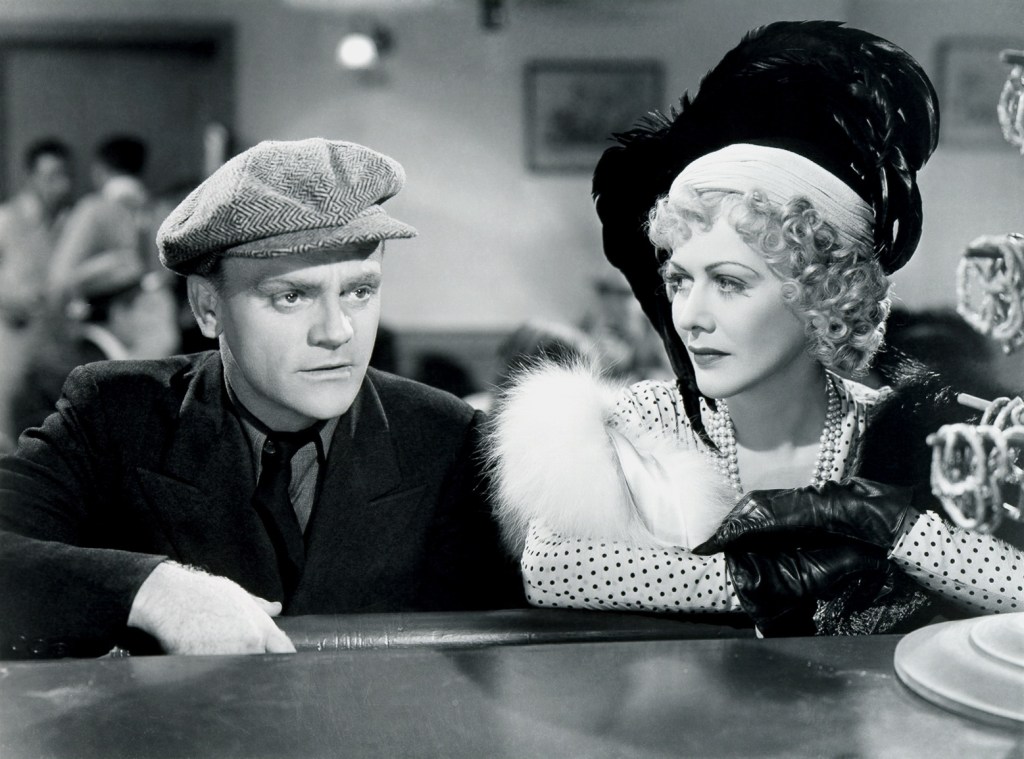
Compared to him, Eddie and Panama are romantics. Gladys George gives a fascinating performance as Panama, one of the most complex gangster dames of all. George brilliantly walks a narrow line, clearly loving Eddie but accepting he doesn’t feel the same way – and (reading between the censor lines) entering a relationship with him anyway. Panama is half-partner, half-mother to Eddie giving him a sort of matronly support and tenderness and, when his fortunes drop off a cliff in the thirties, looking after the slubby, drunken figure Eddie becomes (Cagney looks more bashed up, scruffy and pathetic in the final act than almost any other star would dare).

Fascinating character relationships like this underpin a film that feels like a summation of years of Warner Bros gangster films. Walsh’s direction is pin-point sharp, from his montage construction (including a surprisingly surreal Wall Street Crash sequence with melting buildings), through the shoot-outs. The Roaring Twenties script – by Robert Rossen and Jerry Wald among others – offers characters who are complex, flawed and don’t quite seem to realise at times how terrible their world is.

When the end comes, and Eddie’s body slumps on the steps – after an inspired, sustained tracking shot that follows his teetering bullet-ridden body, the sort of athleticism Cagney was a natural at – it seems fitting the famous closing words are “He used to be a big shot”. That sums up not only the character, but an entire era of film-making being confined (temporarily) to the dustbin of history. It’s a melancholic note to end an extraordinarily good film, one of the great gangster films, in which Cagney, Bogart and George bring life to fascinatingly complex characters.

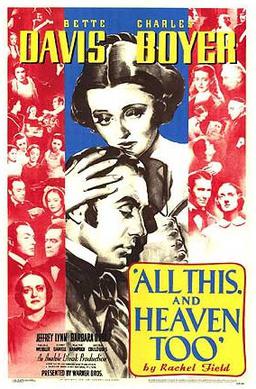
All This and Heaven Too (1940)

All This and Heaven Too (1940)

Illicit romance, murder, scandal… it should all be so much more exciting than this film makes it

Director: Anatole Litvak

Cast: Bette Davis (Henriette Deluzy-Desportes), Charles Boyer (Duke Charles de-Praslin), Barbara O’Neil (Fanny Sebastiani de-Praslin), June Lockhart (Isabelle de Choiseul-Praslin), Virginia Weidler (Louise de Choiseul-Praslin), Jeffrey Lynn (Reverend Henry Martin Field), George Coulouris (Charpentier, Harry Davenport (Pierre), Montagu Love (Army General Horace Sebastiani), Helen Westley (Mme LeMarie), Henry Daniell (Broussais)

In the 1840s, Henriette (Bette Davis) arrives as governess at the home of the Count de-Praslin (Charles Boyer). She’s calm, collected, patient and caring: in short she’s everything that the count’s wife Fanny (Barbara O’Neil) is not, and it doesn’t take the count long to work it out. With Henriette swiftly becoming a second mother to his four children, the count and Henriette find themselves falling, unspokenly, in love. But Fanny isn’t fooled – and neither is the gutter press – and as scandal brews, the count takes drastic action to stop his wife, leading to a legal case that will shock France.

All This, and Heaven Too was conceived as a sweeping romance to rival Gone with the Wind. Money was lavishly splashed on sets and costumes (Bette Davis has no fewer than 37 costumes in the film, averaging at one every five minutes). Based on a famous murder case – that some felt had contributed towards the anti-monarchy atmosphere that led to the revolution of 1848 – All This, and Heaven Too had everything on paper to challenge Gone with the Wind in romance stakes. So why doesn’t it?

There is something too restrained, too slow and controlled about the film. It’s overlong – the original cut was over three hours, reduced to 2 hours 20 minutes – and takes a very long time to get going. The two stars underplay very effectively – with Davis cast very successfully against type as a mousey, rather timid Jane Eyre-ish figure – but it also means that the sort of grand romance the film is aiming for never quite takes fire, for all the careful shots of burning flames between the two lovers as they discuss their romantic predicaments in roundabout terms.

Litvak’s film saddles itself with a framing device that, while accurate to the real-life story, adds very little. The film opens with Henriette teaching children in America – children who have no respect for her, having heard whispers of her scandalous past – which leads into her telling the story to them (and us) about her past. The film returns to this framing device at the end, but as a whole it provides very little insight or interest to the core thrust of the film’s action. The film also wastes time on Jeffrey Lynn’s Reverend (Heinrette’s future husband), a relationship that seems largely in there to absolve Henriette of any possible indirect responsibility for the murder (she can’t be a hussy, she marries a man of the cloth!).

A large chunk of the film is designed to minimise what was a major scandal that rocked French society. This was a (possible) sexual affair between an unhappily married aristocrat and the governess to his children. It culminated in the countess being stabbed and beaten to death and her blood-stained husband found on the scene, claiming he had fought and chased away an intruder (which, writing it down, is basically the plot of The Fugitive). He never confessed, but committed suicide via arsenic in prison a few months later. Henriette was arrested as an accessory (presumably for encouraging the count to kill his wife) but released.

This should have been racy, racy stuff – but the film shies away from it. It’s probably linked to the expectation that the Hays Code would never accept the idea of Henriette as an adulteress who never goes unpunished. The possible Therese Raquin style set-up is instead translated into a more Jane Eyre model, with the employer in love but the servant too noble to act on her feelings and expose herself to disgrace. The film does pull no punches in making clear that the count committed the crime (the camera zooming in on Boyer’s starring eyes as he advances on his pleading wife) but since he was always destined to meet a historical punishment (he helpfully absolves Henriette on his deathbed) there were no concerns there.

All This, and Heaven Too can’t have a passionate, lusty drama so it avoids any overt spark between Boyer and Davis. Both actors play this unspoken attraction extremely well, but the film has to work overtime to get drama out of their several scenes of standing carefully apart or side-by-side, talking about everything except their own feelings. Boyer, as ever, is first class: his expressive eyes and beautiful ability to listen and react is as perfect for an unspoken romance, as it is for a man who becomes convinced murder is his only escape. Davis’ meeker, Joan Fontainesque role suits her extremely well, even if it disappoints those expecting fireworks.

Those fireworks come from Barbara O’Neil instead, raving and unreasonable as a woman driven to the edge by this semi-imagined affair, in an energetic performance that gained one of the film’s three Oscar nominations. But the film’s strange momentum affects her too: she is left to repeatedly hit the same notes over again, as the film repeats its established set-up over and over for 90 minutes before she is murdered (then squashes everything connected to the historical scandal and the murder trial into the final 40 minutes).

It’s productions standards are high and it’s well shot by Gone with the Wind cameraman Ernest Haller. There is some beautiful use of shadows and several ball scenes are expanded with some gorgeous use of mirrors. It ticks many of the boxes you expect a period romance to have, but is fatally hampered by its caution and by its restrictive narrative choices. It ends up feeling long and drifts too often through its build-up, forcing it to rush its pay-off. All of this contributes to its lack of challenge to GWTW in the romance stakes.

A Letter to Three Wives (1949)

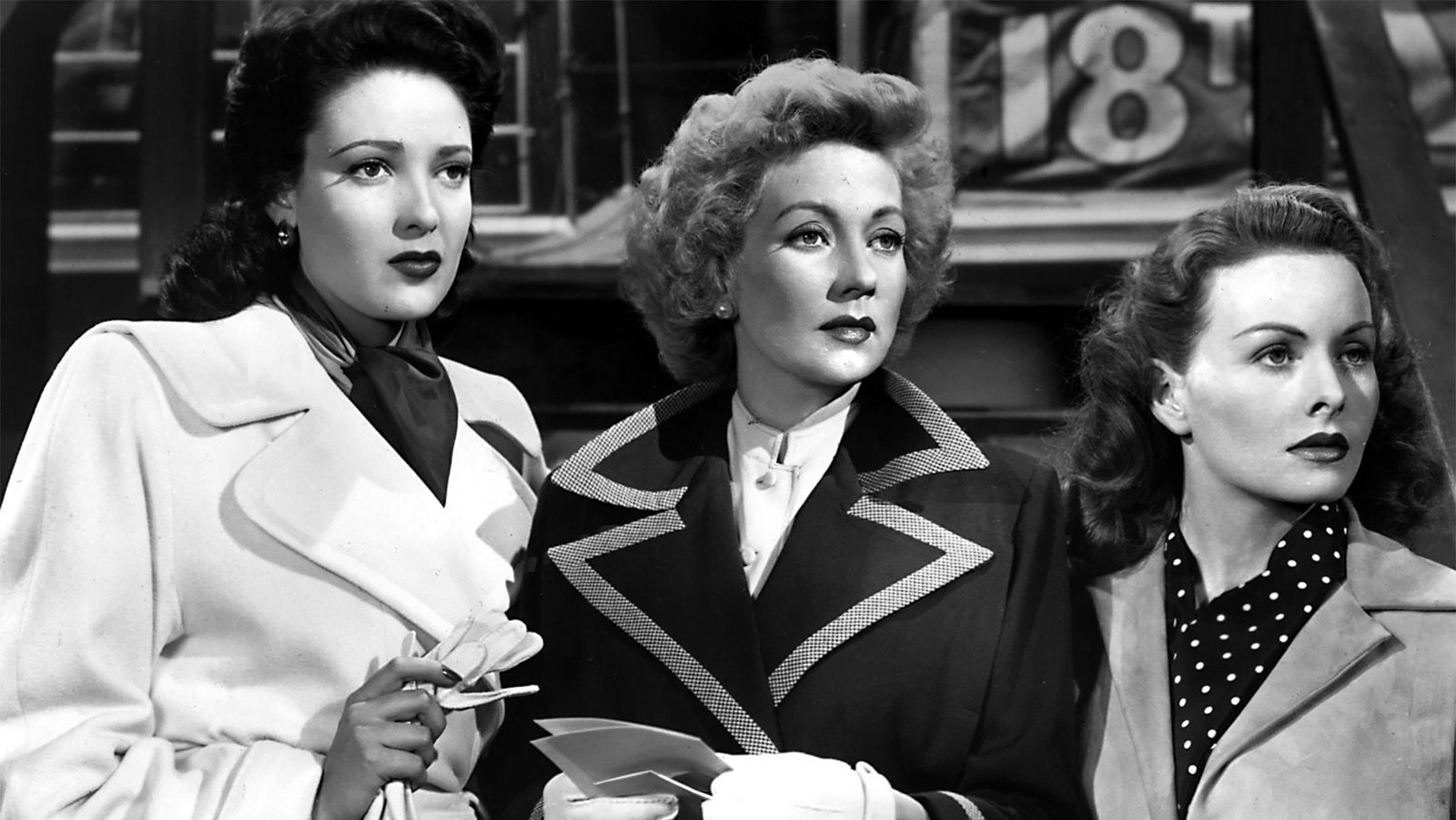
Linda Darnell, Ann Sothern and Jeanne Crain read over the eponymous Letter to Three Wives

Director: Joseph L. Mankiewicz

Cast: Jeanne Crain (Deborah Bishop), Linda Darnell (Lora Mae Hollingsway), Ann Sothern (Rita Phipps), Jeffrey Lynn (Brad Bishop), Paul Douglas (Porter Hollingsway), Kirk Douglas (George Phipps), Thelma Ritter (Sadie), Barbara Lawrence (Babe Finney), Connie Gilchrist (Ruby Finney), Florence Bates (Mrs Manleigh), Hobart Cavanaugh (Mr Manleigh), Celeste Holm (voice of Addie Ross)

It’s strange to think that, back in 1949, this slight story of three women one of whose husbands might have run off with another woman (the film’s narrator, the omnipresent Addie Ross, coolly voiced by Celeste Holm) was garlanded with multiple Oscars. It’s the sort of material you half expect would make an episode of Desperate Housewives– although of course today the whole thing would have been sorted out in a few minutes with mobile phones (A WhatsApp to Three Wives?). What makes it work so well is Mankiewicz’s dialogue, which lifts this slight melodrama of suburban couples into something that feels like it has more weight and intelligence than it really does.

Anyway, our wives are a mixed bag living in a commuter town “just outside the city”, all from middle-class or lower upper-class backgrounds. Seconds before taking some underprivileged children for a boat trip and picnic, insecure Deborah Bishop (Jeanne Crain), blowsy Lora Mae Hollingsway (Linda Darnell) and ambitious Rita Phipps (Ann Sothern) receive a goodbye letter from their “friend” Addie Ross, who announces she has left town with one of their husbands. But which one? Is it Addie’s ex-boyfriend, privileged Brad Bishop (Jeffrey Lynn), her school-yard sweetheart, academic George (Kirk Douglas), or her admirer, businessman Porter Hollingsway (Paul Douglas)? As the poster says, “While they wondered, one of them wandered”!

If that sounds to you like a rather small-scale storm in a teacup – well you’d probably be right. To be honest, it’s pretty hard to care which of these husbands might have headed into the sunset with the arch Addie Ross, since most of the characters seem at first rather smug, self-centred or tiresome. It takes time to warm up to these guys, but eventually Mankiewicz’s sparkling dialogue starts to work some magic and you invest in a clichéd little story (based, bizarrely, on a glassy magazine short story).

At one point the film was entitled A Letter to Four Wives – until studio executives decided that was one too many (bad news for Anne Baxter who had been cast as the final wife). That speaks to the episodic nature of the film. It has a clear five act structure – the set up, an act establishing the backgrounds of each of the marriages, and a final act that reveals who went where and wrapping the plot up. It’s a simple structure, and today it’s hard to see what all the fuss was about.

Mankiewicz’s framing device for his flashbacks may be a bit contrived, but he puts it together with skill. Each flashback is cleverly introduced with an intriguing device where various mechanical items near the women slowly take on a voice of their own, echoing their inner dread back to them. It sounds a bit odd – and it is at first – but it sort of works as an unsettling reflection of the unease of the central characters.

Once we get into the flashbacks themselves they are a mixed bag. The weakest by far is the first, focusing on Jeannie Crain’s Deborah Bishop. Rather plodding and dated – and forced to also introduce all the characters – it’s a shapeless section of reflection in which Deborah comes across unengaging, sulky, insecure and tiresome. Mind you that’s as nothing compared to her husband Brad, played with utter forgettability by Jeffrey Lynn, who is nothing more than a self-important idiot. Frankly, you end up thinking Deborah might be better off without him. The sequence focuses on the possibility that Brad might think Deborah is a little beneath him – compared to his old love Addie – but basically serves as a teaser for the next two flashbacks and an intro to the more interesting couples we are going to spend time with.

Our second sequence offers several comic highlights as it follows Ann Southern and Kirk Douglas (both very good) as the Phipps, middle-class intellectuals. George is an academic, Rita a writer for radio soaps, and the flashback revolves around their dinner party for Rita’s bosses, two radio-and-advert obsessed moneybags who demand the meal is interrupted so they can listen to episodes of assorted radio shows (accompanied by a long discussion of their advertising slots). Plenty of comic mileage comes out of George’s irritation at their vulgarity, but also serves to demonstrate the tensions in the Phipps marriage – George believes his wife is wasting her talent, Rita thinks her husband isn’t taking her career seriously. But underneath that is a nice little commentary on the insecurity of men returning from the war to find their wives have made professional lives of their own – and in this case, even become the main breadwinner in the household.

Our final flashback is probably the finest, around white-goods factory owner Porter Hollingsway (a bombastic Paul Douglas, with a touch of self-loathing) and his secretary turned wife Lora Mae (Linda Darnell, brassy self-confidence hiding vulnerability). Largely set in Lora Mae’s family home, a house on the wrong end of the tracks which hilariously has a train track running past its window (which at frequent occurrences leads to the whole house shaking, an action the family responds to with a casual familiarity). The drama here revolves around the couple’s feelings for each other – Porter can’t believe Lora Mae isn’t a gold digger, Lora Mae can’t believe her husband genuinely loves her for herself – but it’s told with a real sense of comic vibe laced with emotional truth. It’s the finest – and funniest – sequence and leads to a pay-off that really works.

A Letter to Three Wives maybe a little too soapy and frothy to be much more than an entertainment, but it is at least a very entertaining one. At all times this is due to Mankiewicz’s witty, sparkling and truthful dialogue that hums in every scene and gives all the actors some of the best opportunities of their career. Linda Darnell in particular is outstanding – warm, witty, fragile – but each wife has her moments, and Kirk Douglas is charm itself as George with Paul Douglas’ fragility under the surface eventually quite moving despite his bullying exterior. There is also fine support from Thelma Ritter among others. It’s a fine film, handsomely mounted and offers more than enough laugh-out-loud moments and moments of sweetness to make it really work.