Tag: Jeffrey Tambor

Hellboy II: The Golden Army (2008)

Ron Perlman faces larger problems than ever in Hellboy II: The Golden Army

Director: Guillermo del Toro

Cast: Ron Perlman (Hellboy), Selma Blair (Liz Sherman), Doug Jones (Abe Sapien/Angel of Death/Chamberlain), Seth MacFarlane (Johann Krauss), Luke Goss (Prince Nuada), Anna Walton (Princess Nuala), Jeffrey Tambor (Tom Manning), John Hurt (Professor Trevor Bruttenholm), Roy Dotrice (King Balor)

There is something quite sweet about the Guillermo del Toro taking all the chips won for directing Pan’s Labyrinth and cashed them in for this comic book sequel. There you have the distillation of the man’s career right there: one for the artist and then one for the teenage boy he used to be. But Hellboy II is a marvellous creation, a gorgeous to look at, magical, rather funny comic book film crammed with amazing images, ingenious creatures and sparkling moments of action and adventure.

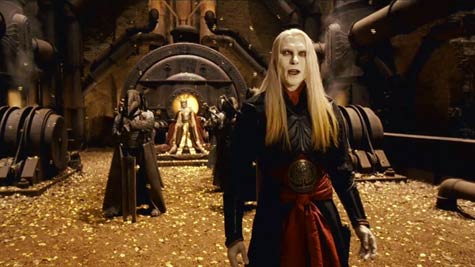
Thousands of years ago, the magical creatures of the world, led by the elves, fought a war against mankind. To win a desperate victory, goblins created the dreaded Golden Army, an indestructible mechanical army. Horrified at the slaughter, Elven King Balor (Roy Dotrice) offered a truce. His son Prince Nuala (Luke Goss) disagreed. In the present day, Nuala goes about to collect the three pieces of the crown needed to control the Golden Army – and only Hellboy (Ron Perlman) and his friends from the BPRD can stop him. 

Hellboy II is immensely imaginative and wonderful to look at. Perhaps inspired by Pan’s Labyrinth, the film plays like a cross between the most brain-twisting magic depths of that film and a traditional comic book. So we get dozens of creatures, each pulled from the pages of some sort of acid tripped Tolkien novel: with extended hands, distorted heads and steam-punkish extremities, the creatures on show are masterpieces of design and character. The juxtaposition between this ethereal, magical world of elves and goblins and mankind’s expansion brings home the danger this world is in: the Elven King’s palace in the modern day is in a sort of converted sewer, while Nuala’s base is an abandoned underground line. With some performers (often del Toro’s muse Doug Jones) under layers of make-up and prosthetics, it’s extraordinary the amount of personality each of these creatures gets. When the film takes a turn down a Diagon Alley-style market, you regret Del Toro never got to make a Harry Potter film.
Hellboy looks both part of this world and also like a muscular bull in a china shop. Ron Perlman continues to be perfect in the part, and captures the wry, cynical, slightly teenagerish humour of the part. Del Toro does a wonderful job of showing the sense of family between Hellboy, his lover pyrokinetic Liz (a decent performance by Selma Blair, although she is too often relegated to the “woman” role), and his surrogate brother, amphibious empath Abe (Doug Jones getting to provide the voice as well this time, and getting a fine display of growing emotional expression). The quiet character moments between the action really ring true – a very funny sequence sees Hellboy and Abe bemoan their romantic entanglements by getting drunk while singing Can’t Smile Without You.

It’s scenes like that which add the heart alongside the throbbing action and colourful character weirdness of del Toro’s vision. It’s also part of the distinctiveness of the whole vision of the film. Everything is seen with as fresh an eye as possible, and makes for some really striking images and scenes. The steam-punk aesthetic of the Golden Army seems to fit together perfectly with the more organic world of the Elves. There’s a sense at all times that the design and pacing of the film have been carefully thought through so everything fits logically together. Starting the film with a wonderfully animated Golden Army backstory (voiced by a briefly returning John Hurt for maximum impact) is just another reflection of the artistry at work here.

There is a nice vein of humour running through the film – there are some funny sight gags as characters walk nonchalantly through bizarre goings-on in BDRP HQ – and the more gory moments of the action are shot with a certain black comedy. The film also gets a decent few points in about how humanity rejects things that are different, which are not surprising but still hit home.

Hellboy II does start to become a bit more generic as it heads towards its final denouement. Most of the events of the final few scenes are pretty predictable from the outset, and offer little in the way of surprises. For all the chemistry she has with Perlman, Blair is more or less relegated to the sidelines for large chunks of the film (usually the action). But for most of the run time, it’s inventive, imaginative fun with a director bringing a distinctive vision to the genre while also kicking back his heels and having fun. And fun is what it wants the viewer to have as well – don’t try too hard, sit back, relax and enjoy yourself.
Hellboy (2004)

Ron Perlman fights the darkness in curio del Toro comic book flick Hellboy

Director: Guillermo del Toro

Cast: Ron Perlman (Hellboy), Selma Blair (Liz Sherman), Rupert Evans (John Thaddeus), John Hurt (Dr Trevor Bruttenholm), Karel Roden (Rasputin), Jeffrey Tambor (Tom Manning), Doug Jones (Abe Sapien), Brian Steele (Sammael), Ladislav Beran (Karl Ruprecht Kroenen), Bridget Hodson (Ilsa Haupstein), Corey Johnson (Agent Clay)

As little as 10 years ago, outside a few core characters like Batman, the X-Men or Spiderman, comic book movies were an odd curio hard to place in the mass market. Today of course, you can virtually get any character who has appeared in a cartoon strip up on the screen with a budget of millions. But back in 2004, Guillermo del Toro had to squeeze this project out on a smaller budget in order to get the studio to agree to make the film.

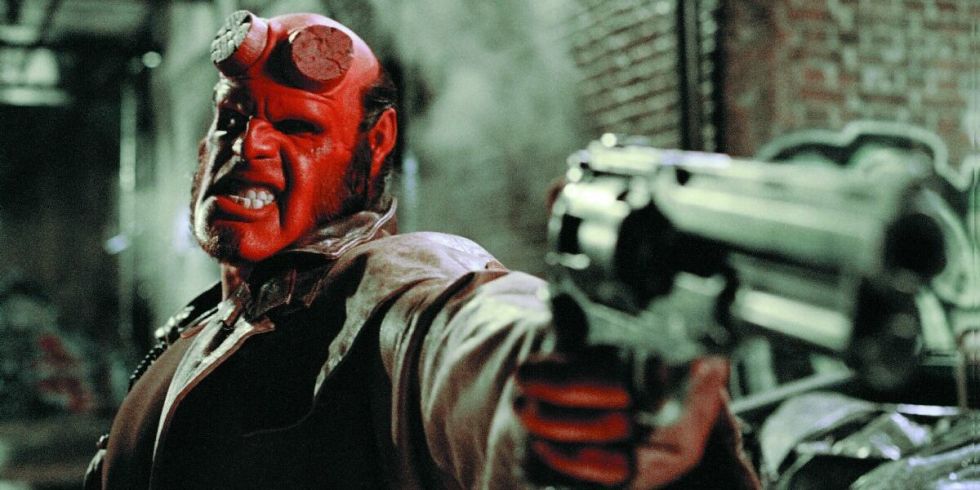
Hellboy has a particularly demented story. In 1945, the Nazis, working in partnership with Rasputin (Karel Roden) – yes thatRasputin, don’t even ask – attempt to open a portal to hell to, well I’m not quite sure what they want to do, but it probably involves the destruction of the world. Anyway, some humble GIs stop them and the only thing that comes through the portal is a little demon with an enormous stone fist. Raised by paranormal expert Dr Trevor Bruttenholm (John Hurt), this creature grows up into cigar-chomping secret-agent-for-the-FBI Hellboy (Ron Perlman), working on paranormal investigations. But when Rasputin returns from the dead it looks like all hell (literally) is about to break out.

Okay it should be pretty clear to you from that that Hellboy is an odd film. It’s very much from del Toro’s B-movie heart, and he invests this nonsense material with a great deal of directorial style and heart – a real “geek-boy-artist” job. Del Toro has a great deal of imagination and is able to strike a happy balance between enjoying the material and not taking it all too seriously. So he lets the film barrel along, throwing plenty of nonsense at the screen without worrying about trying to make it make real-world sense. In fact Del Toro is clearly so fond of the material that he basically shoots the whole thing like a comic book come to life. 

So the film is crammed with bright primary colours mixed with murky blacks, and Del Toro frames many key moments like comic book panels. It’s a film packed with striking images and scenes built around stuff that feels like it should teeter over into ridiculous camp all the time but never quite does. Its steam-punky styling instead manages to feel somehow both strikingly original visually and also strangely packed with integrity – like Del Toro made a very personal big-budget movie for his childhood, the sort of bizarro cult film that’s actually-quite-good and it’s going to win a huge following once people can find it for themselves (which is indeed what happened).

Del Toro’s other great principled stand was to ensure that Ron Perlman played the lead. Hellboy is a bizarre character – over six feet, red, horns, a tail – but what Perlman and Del Toro do so well is to make him some sort of Brooklynish chippy blue-collar worker with a kitchen-sink earthy wit. Perlman is clearly having a whale of a time playing this temperamental demon like some sort of longshoreman Han Solo, a brattish teenager and rebel with a world-weary cynicism. He’s crammed with contradictions (the demon who fights for good!) that Del Toro is keen to explore – and makes consistently interesting.

Because he’s such a different character, he energises a fairly traditional story and his character’s pretty standard personal-struggle-plotline (will he do the right or the wrong thing?). Perlman juggles all this really well, and gives a performance that is both dry and funny but also has moments of real heart and emotion. He even manages to sell his rather possessive love for Selma Blair’s (also pretty good) fellow orphan with pyrotechnical abilities as something heartfelt and caring, despite the fact that at one point he basically stalks her. It’s a rather wonderful performance.

The rest of the cast are a bit more of a mixed bag. Rupert Evans is saddled with the audience surrogate role – asking the questions we can’t ask – while Karel Roden’s lipsmacking performance as Rasputin never quite engages as a villain. Stronger roles come from Jeffrey Tambor as an officious FBI director and especially from John Hurt as Hellboy’s father-figure, the kind of quintessential ageing mentor that you can imagine his wards adoring. 

The rather silly plot doesn’t really matter. The importance here is the gothic chill of Del Toro’s style, mixed with his crazy “larger-than-life” dark comic book tone. And it works really well: the film is fun and witty, and if the storyline never really feels like it earns the “end of the world” threat (and builds towards an uninvolving duking out with a giant CGI monster), there are enough enjoyments along the way to make you want to make the journey.

The Death of Stalin (2017)


Hilarious hi-jinks in Soviet Russia as the politburo struggle to deal with The Death of Stalin

Director: Armando Iannucci

Cast: Steve Buscemi (Nikita Khrushchev), Simon Russell Beale (Lavrenti Beria), Paddy Considine (Comrade Andreyev), Dermot Crowley (Lazar Kaganovich), Rupert Friend (Vasily Stalin), Jason Isaacs (Georgy Zhukov), Olga Kurylenko (Maria Yudina), Michael Palin (Vyacheslav Molotov), Andrea Riseborough (Svetlana Stalin), Jeffrey Tambor (Georgy Malenkov), Paul Whitehouse (Anastas Mikoyan), Paul Chahidi (Nikolai Bulganin), Adrian Mcloughlin (Joseph Stalin)

Armando Iannucci is a brilliant television satirist, who spring to wider fame with the success of foul mouthed political satire The Thick of It (re-imagined as Veep in the USA). His sweaty, sweary, fly-on-the-wall style, and characters who embody the panicked agitation of the nakedly ambitious but not-too-bright, was a perfect match for our modern world. Does the style work for the past? You betcha.

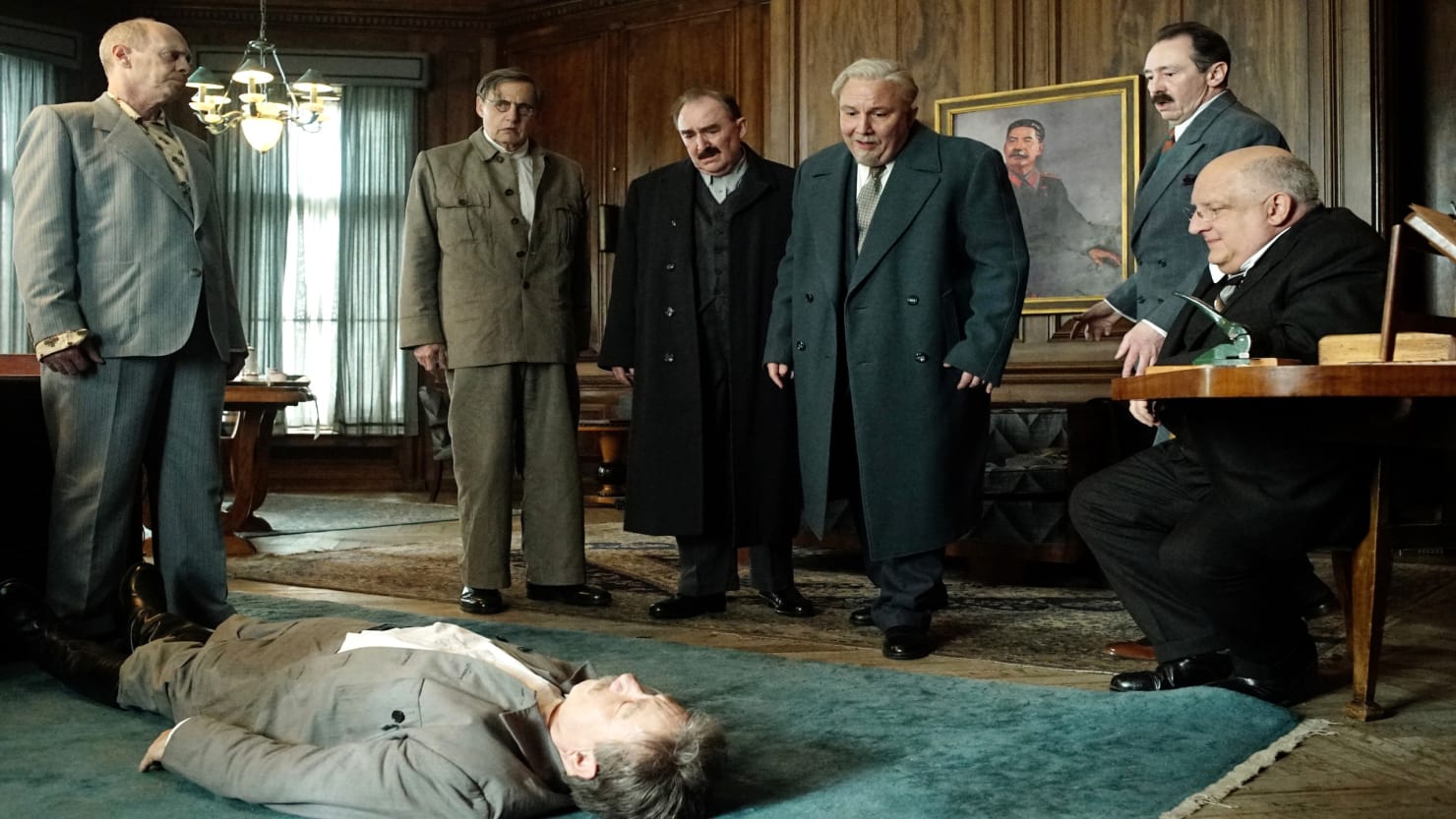
In Soviet Russia, a country near paralysed with terror, the ruthless dictator Stalin dies. This starts an immediate scramble to succeed him, with the leading candidates being weak-willed, vain and foolish deputy Malenkov (Jeffrey Tambor), vaguely principled but fiercely ambitious opportunist Khrushchev (Steve Buscemi) and sinisterly sadistic police chief Beria (Simon Russell Beale). Soviet Russia though is a pretty ruthless place for political manoeuvring, with retirement usually coming in the form of a single bullet to the back of the head.

First off the bat, The Death of Stalin is a blisteringly funny film, a real laugh-out loud riot. Why does it work so well? Because it understands that, hand-in-hand with the horror, Stalinist Russia was so completely barking mad that it lends itself completely to black comedy. Imagine The Thick of It, but with Malcolm Tucker executing rather than dismissing terrified ministers. Welcome to the madness. Events that seem crazy are pretty much true: although time has been telescoped, the struggle for the succession did more or less play out like this (with less swearing).

Every scene of this dark farce has a memorable, stand-out line or moment. The sweaty panic of these over-promoted yes-men is brilliantly reminiscent of the sort of panic you can imagine seeing in your office, with the exception that it probably isn’t literally life-and-death. Iannucci completely understands the wild improvisation of the fiercely ambitious in high-stress situations. If you think the ministers of The Thick of It were adrift when confronted with parliamentary enquiries, imagine how their counterparts struggle when faced with the threats of a bullet in the head.

Because that’s the great thing about this film – while still being hilariously foul-mouthed, it actually gives a pretty good idea of what it might have been like to live in Soviet Russia. The characters are constantly having to adjust to who is in favour and who isn’t, what it is permissible to think and say and what isn’t, who is “dead and who isn’t”. Iannucci totally understands human nature doesn’t change – those left alive around Stalin are just the sort of shallow, selfish, weaklings he’s been lampooning in The Thick of It. Most of the ordinary people we see are just desperate to keep their heads down – getting noticed for regular joes in this film is basically a death sentence. 

The opening sequence really gets this idea across. Paddy Considine is hilariously nervy and terrified as a radio producer ordered to send a recording of the live concert they’ve just broadcast (unrecorded) to Stalin. The frantic rush to reassemble the orchestra, fill the audience up again with people from the street, replace the conductor (the original having passed out in terror at the possibility that he may have been bugged questioning Stalin’s musical knowledge) is brilliantly funny – but works because the genuine expectation that doing the slightest thing wrong could lead to immediate execution is completely clear. Especially as the scene is intercut with Beria’s heavies rounding up innocent civilians to disappear into a gulag. 

Iannucci doesn’t dodge the ruthlessness. The film is punctured throughout by executions, often carried out with a black farcical desperation. It doesn’t shy away from the brutality of Beria, whose violence, sadism and pathological rape addiction we are constantly reminded of (and which are even more effectively sinister as he’s played by the cuddly Simon Russell Beale). In turn, a frantic Beria berates the rest of the politburo for their participation in the orgy of killings and show trials Stalin organised. We see people about to be taken to their deaths hurriedly offering terrified goodbyes to their loved ones. The final sequence of the film, as the battle for the succession reaches its end-game, tones down the jokes to give us an alarmingly realistic picture of a coup. Black farce ending in death: it’s as legitimate a picture as any of living in Stalinist Russia.

All of this is presented in a razor-sharp and witty script, and the cast who deliver it are brilliant. In a fantastic touch, the actors (with the exception of Isaacs) use their own accents, which only adds to the crazy fun. The acting is, across the board, fabulous. Russell Beale gives his greatest ever film performance as a grubby, ambitious, not-quite-as-smart-as-he-thinks Beria, with bonhomie only lightly hiding his chilling sadism and cruelty. Buscemi is equally brilliant as Khrushchev, who has the ego and self-delusion to convince himself that he is the only hope for a reformed USSR, while actually being a weaselly political player with naked ambition.

Around these two central players there is a gallery of supporting roles. Tambor gives a brilliant moral and intellectual shallowness to the hapless Malenkov. Friend is hysterical as Stalin’s drunken son, a deluded man-child barely tolerated by those around him. Palin’s cuddliness works perfectly as fanatical Stalinist Molotov. Whitehouse, Crowley and Chadihi are also excellent, while Riseborough does well with a thankless role as Stalin’s daughter. The film may be hijacked though by Isaacs as a swaggeringly blunt General Zhukov, re-imagined as a bombastic, plain spoken Yorkshireman, literally entering the film with a bang half-way through and bagging most of the best lines.

The Death of Stalin is not just a brilliantly hilarious comedy, it also feels like a film that completely understands both the terror and the confused ineptitude of dictatorship. In a world where it is death to question the supreme leader, is it any surprise that his underlings are all such clueless, ambitious idiots? Has anyone else understood the black comedy of dictatorship before? I’m not sure they have. You’ll laugh dozens and dozens of times in this film. And then you’ll remember at the end that when this shit happens, people die. This might be the best thing Iannucci has ever made.