
Tag: Jenny Slate

Venom (2018)

Venom (2018)

Totally unoriginal and standard comic book caper, saved only by its inventive lead performance

Director: Ruben Flesicher

Cast: Tom Hardy (Eddie Brock/Venom), Michelle Williams (Anne Weying), Riz Ahmed (Carlton Drake/Riot), Scott Haze (Roland Treece), Reid Scott (Dan Lewis), Jenny Slate (Dora Skirth)

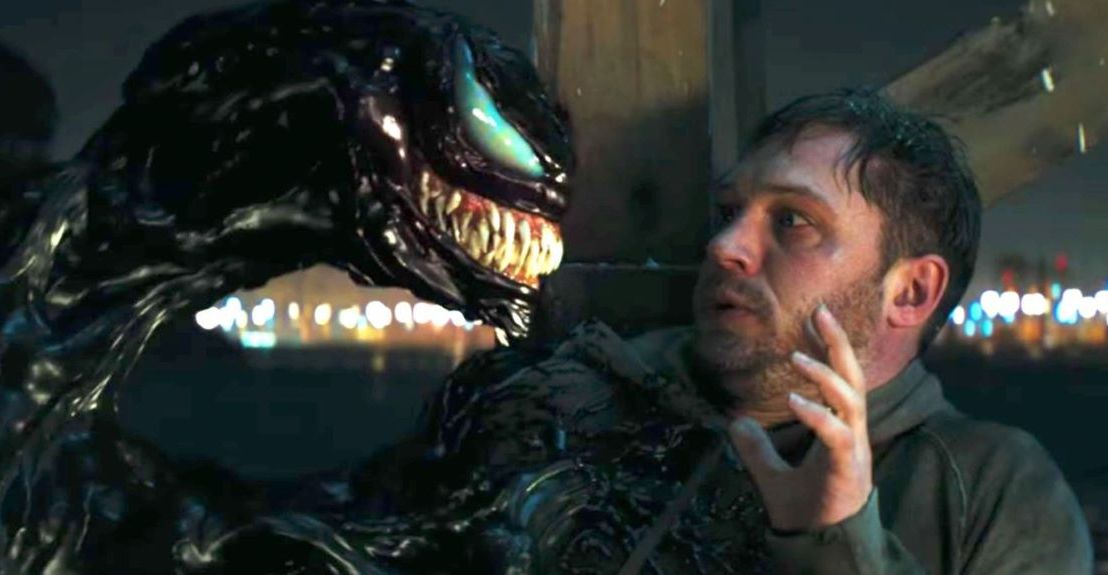
Did this film catch me in a good mood? Much to my surprise I rather enjoyed this dopey attempt to bring fanboy-fav villain Venom to the big screen. Last seen adding to the silliness in the utter mess that was Spider Man 3, the outer-space slime who possess its host returns as an anti-hero. Sure, he likes to eat people and suchlike, but when push-comes-to-shove he’s on our side helping to keep our world safe. Safe sums up Venom, which offers a series of set-pieces none of which are troubled with originality. What makes it stand out is the delight Tom Hardy brings to the role.

Hardy is Eddie Brock an investigative journalist framed by the film as a success who gets unlucky, but embodied by Hardy as a loser (it’s the first sign of Hardy’s originality butting up against the film’s obviousness). Fired after his investigation into shady goings-on at Biotech company Life Foundation – run by charismatically cold billionaire Carlton Drake (Riz Ahmed) – Brock goes from hero-to-zero and his fiancée, lawyer Anne Weying (Michelle Williams) leaves him after finding out he stole from her to gain access to Life Foundation. Brock continues his investigation after homeless people start to go missing. They were unwilling test subjects in Drake’s attempt to bond human beings to mysterious alien symbionts. Eddie is infected with one of the symbionts, Venom, the two of them forming an uneasy partnership in their body share. Will they work together to save the Earth?

Most of the success in Venom is exclusively down to Hardy. Where the film zigs, Hardy zags. Venom clearly wants a traditional, handsome, charismatic journalist hero, the sort of guy who puts the greater good first and only fails when he’s let down. Hardy plays him as a grungy odd-ball with a whiny voice, frames most of his decisions as taking the easy path and is happy to show him backing down from challenges. Hardy then pounces on the chance to counter-balance this with Venom, a gravelly id-machine that ends up playing like the dark underbelly of Brock’s hidden desires.

The most interesting parts of the film by far is the internal conversation between these two Hardy performances. Venom is the foul-mouthed monster who wants to indulge himself, Brock is the passive timid figure forever asking Venom to behave himself. Hardy gives the film a sort of gay subtext as frenemies Brock and Venom settle into an odd-couple life partnership. At one point Venom infects a second character: how does he “re-enter” Eddie? Through a passionate kiss between the Venomised second host and Brock. The two of them spark off each other like a feuding married couple, with Venom’s decision to protect the Earth based eventually on ‘liking’ Eddie.

It’s the main original beat in the film that Hardy seizes upon to make its heart. His performance is droll, playful, physically committed, strangely funny and rather sweet. It’s a heck of a lot better than the film deserves and its leaning into making its personality-split lead a weakling and a monster who effectively, unspokenly, fall-in-love feels very different from things we’ve seen elsewhere.

Which is good because almost everything else has been seen and done elsewhere. Fleischer largely fails to make any of the action sequences particularly new or interesting. There is a punch-up in an apartment (which does see Hardy bouncing around the room with a symbiote induced athleticism), a traditional car chase full of car smash-ups that Flesicher is so excited about he presents the smash-ups occurring multiple times from different angles. A SWAT team chases Venom around a building before a Terminator 2 style tear-gas filled foyer smackdown – with the hero imploring the killing machine he’s working with not to hurt anyone. (The humanising of Venom does have echoes of the taming of Arnie’s Terminator).

As in multiple Marvel films the villain is a dark echo of the hero. Riz Ahmed coasts through a barely written role of an egotistical Steve Jobs type, before merging with a-properly-Evil symbiote intent on loosely defined global destruction. This inevitably leads to a prolonged film-closing CGI-smackdown, as two opponents with the same skills face-off to control the launch of a rocket. No interesting comparisons or contrasts are drawn between Brock and Drake who gets only a whiff of motivation.

There are more interesting beats – though again not quite original – with Michelle Williams’ former fiancée who is given both a few proactive beats and a highly likeable and sympathetic new boyfriend in Reid Scott’s Dan Lewis (playing against the sort of smug roles he is often cast in). These fine actors bounce well off Hardy – and share in his delight in dopey humour and slapstick, noticeably in a posh restaurant sequence that sees Hardy sink himself in a lobster tank and eat the inhabitants.

Away from this though Venom is nothing special. So why did I enjoy it? Because I suppose in its derivativeness it at least offers brain-relaxing fun and it’s lifted to a slightly higher level by Hardy’s inventive approach. Aside from him there is almost nothing original, interesting or different here – but yet I enjoyed it while it passed the time.

Everything Everywhere All At Once (2022)

Everything Everywhere All At Once (2022)

The multi-verse is at risk of ending – and only a disenchanted woman running a laundromat can save the day in this inventive science-fiction

Director: Dan Kwan, Daniel Scheinert

Cast: Michelle Yeoh (Evelyn Quan Wang), Stephanie Hsu (Joy Wang), Ke Huy Quan (Waymond Wang), James Hong (Gong Gong), Jamie Lee Curtis (Dierdre Beaubeirdre), Tallie Medel (Becky Sregor), Jenny Slate (Debbie), Harry Shum Jnr (Chad), Biff Wiff (Rick)

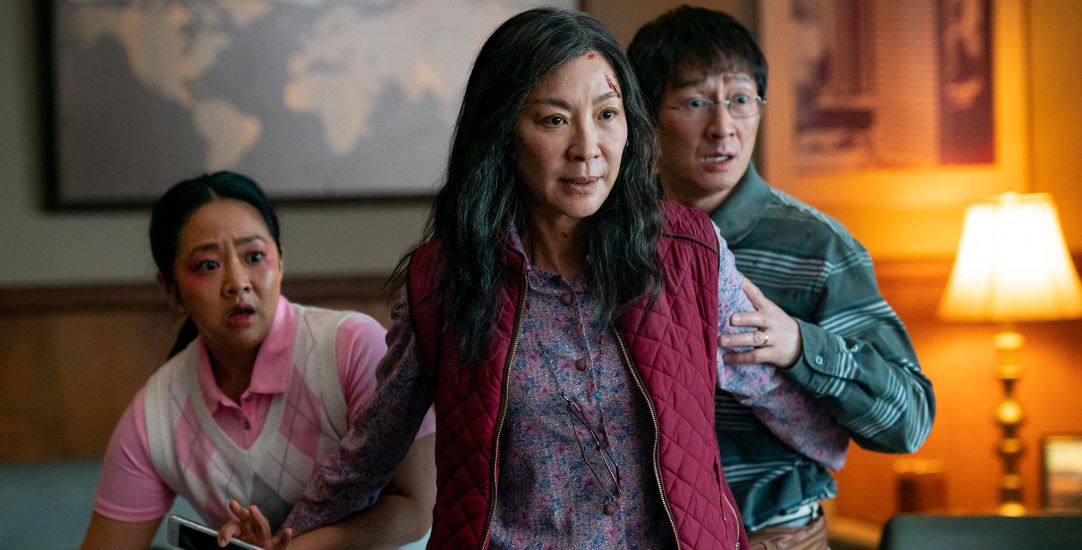
Evelyn Wang (Michelle Yeoh) has lots on her plate: running her laundromat, completing tax returns for a demanding IRS agent (Jamie Lee Curtis), her waning marriage to goofy husband Waymond (Ke Huy Quan) and drifting relationship with lesbian daughter Joy (Stephanie Hsu), not to mention her fear of the disapproval of her demanding father (James Hong) – its Everything Everywhere All at Once as it is: no wonder she struggles to cope when discovering from an alternate version of her husband that she, and she alone, is the key to saving the entire multi-verse from destruction.

Everything Everywhere All at Once is an endlessly inventive, imaginative and unique spin on everything from science fiction to philosophy, via the struggles of an immigrant family, familial dynamics and love, death and the universe itself. Did I mention it’s got jokes as well? There isn’t anything quite like EEAAO out there, and if the film does lose energy at an inflated runtime of 145 minutes, at least that’s because it must have been a struggle knowing what to cut.

In the mythology of EEAAO, Evelyn lives in just one of a myriad different realities. Every time a decision is taken, a new reality branches off, spawning innumerable different realities. If Evelyn can imagine it, then somewhere in another universe it happened. She should be a film star, a martial artiste, a chef, a blind singer, a pizza sign spinner…there are realities where mankind never evolved or where they evolved with hot dogs for fingers (a joke the film is a way too pleased with and seriously outstays its welcome).

With some technology from the “Alpha” universe – the first universe to discover alternate realities, where Evelyn and Waymond were pioneering scientists – Evelyn can access the memories and skills of her alternates. All she – and others with the right training and equipment – need to do to become experts at anything in seconds is to build a mental link to that reality by performing a highly improbable act. Whether that’s getting four consecutive papercuts, eating a lipstick, swallowing a model frog or – in a comic highlight – Evelyn fighting to stop an opponent shoving an “Employee of the month” award shaped like a dildo up their bottom in public (you’re not going to see that in many movies) – it’s a brilliant comic device that raises belly laughs a plenty.

EEAAO knocks spots off the recent Doctor Strange sequel (that made almost nothing of its parallel universe concept) by not only presenting radically different worlds (in this universe Evelyn is a pinata! Here she’s a rock!), but also exploring how the path-not-taken can have a mesmerising and inspiring/depressing impact. Evelyn – a woman who (justifiably?) believes she has achieved nothing, is both fascinated or heart-broken to see realities where her accomplishments are titanic. EEAO is superbly thought-provoking when it explores the emotional impact of questioning your choices, when you see turning right rather than left could have been the first step on a path of astonishing glory and success and, even, a completely different personality.

This leads into the film’s second half which, after the comic energy of the first, dives into a philosophical debate about the nature of choice. The villain attempting to destroy reality is motivated not by rage or power-lust – but simply by the fact that jumping to a billion realities has persuaded them it all means nothing. Everything is basically a combination of atoms that, with a few pushes and pulls, can turn from one thing to anything else. This nihilistic view of the world – what does it matter killing one person when there are billions of other versions of them, many of them ‘better’ – and balancing it with a more humanitarian view, becomes the film’s key debate.

It’s also rooted in the film’s opening, which is does a marvellous job of exploring universal family questions, while still grounded in the experience of an immigrant family. Evelyn and Waymond, having moved to America in search of their dreams as youngsters – and wound up running a laundromat – struggle to balance their relationship (her growing irritation at his perpetual optimism, his alienation from her cynicism) and, particularly in Evelyn’s case, understanding her more Westernised daughter. Two generations with very different experiences, struggling to understand each other.

On top of which, many of these problems are universal. Generational conflicts: the grandpa who can’t be told his granddaughter is gay, because her mother isn’t sure how he will react. The mother and daughter who have lost the ability to communicate and reduced to saying increasingly cruel things to each other (there is a shocking moment when Evelyn tries to tell her daughter she loves her but instead chastises her for getting fat). Waymond tries to hold things together but is too gentle and ineffective to do anything.

All of this is bundled together in a film stuffed with inventive and hilarious sequences. There are kick-ass fights (one involving Alpha-Waymond and a fanny-pack – bum-bag to us Brits – which has to be seen to be believed), hilarious segues, brilliant parodies of other films (2001, Ratatouille and In the Mood for Love for starters): and then the film will hit you for six with a genuinely heart-breaking moment. I will say there is almost too much good stuff here – ten minutes trimmed from the film would work wonders, and the continued trips back to Hot Dog Hands reality is a joke stretched to absolute breaking point – but better too much than too little.

At the heart of this fabulous work from The Daniels are superb performances, none more so than a career best turn from Michelle Yeoh. Channelling everything Yeoh has ever done in her career into a single film, she of course can handle the astonishing action but also displays an emotional depth and complexity that will break your heart. She’s bitter and trapped, then will shift on a sixpence to agonised guilt and longing. She’s astonishingly good. There is brilliant support from Hsu as her trapped and troubled daughter and Ke Huy Quan (last seen in The Goonies) is heart-breakingly endearing, funny and wonderfully sweet as her good-natured husband (like Yeoh he also plays multiple variants – from confident to cold and distant). James Hong is wonderful as her austere father and Jamie Lee Curtis is having a ball as a bullying IRS agent turned villain’s heavy.

When the major flaw in the film is that it is too damn long, you know you are onto a good thing. There are more ideas in a few minutes here than in the entire runtime of such things as the Doctor Strange sequel. Superbly directed with wit, energy and compassion by the Daniels and with a career-defining role for Michelle Yeoh, Everything Everywhere All At Once is destined to take its place as a year defining cult hit.