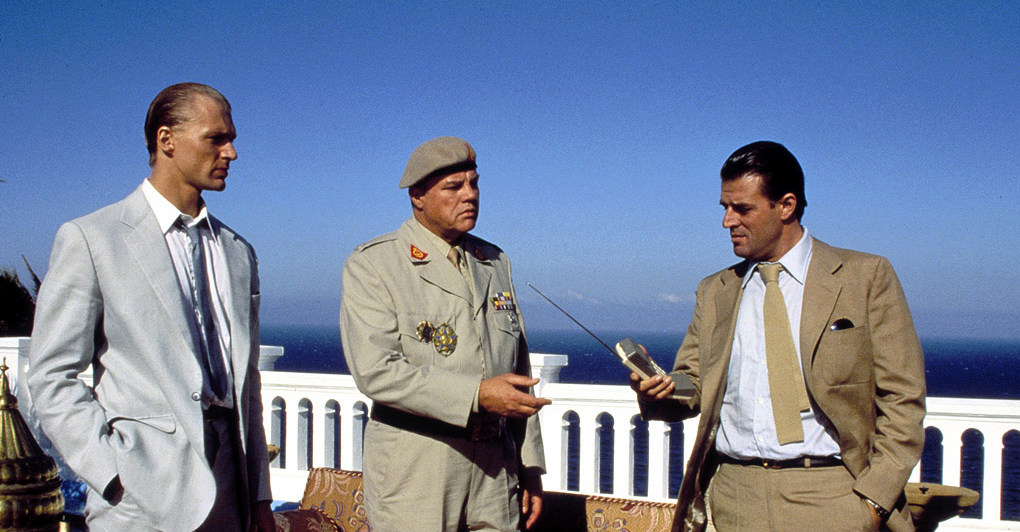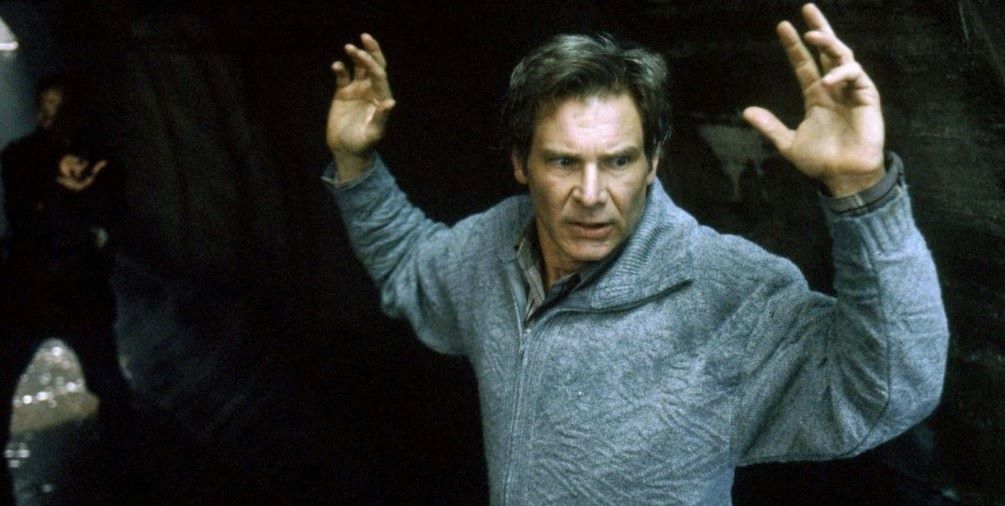
Tag: Jeroen Krabbé

The Fugitive (1993)

The Fugitive (1993)

An innocent man goes on the run in the one of the finest thrillers of the 90s

Director: Andrew Davis

Cast: Harrison Ford (Dr Richard Kimble), Tommy Lee Jones (US Marshal Sam Gerard), Sela Ward (Helen Kimble), Joe Pantoliano (US Marshal Cosmo Renfro), Jereon Krabbé (Dr Charles Nichols),Andreas Katsulas (Fredrick Sykes), Daniel Roebuck (US Marshal Bobby Biggs), Tom Wood (US Marshal Noah Newman), L Scott Caldwell (US Marshall Erin Poole), Johny Lee Davenport (US Marshall Henry), Julianne Moore (Dr Anne Eastman), Ron Dean (Detective Kelly), Joseph Kosala (Detective Rosetti), Jane Lunch (Dr Kathy Wahlund)
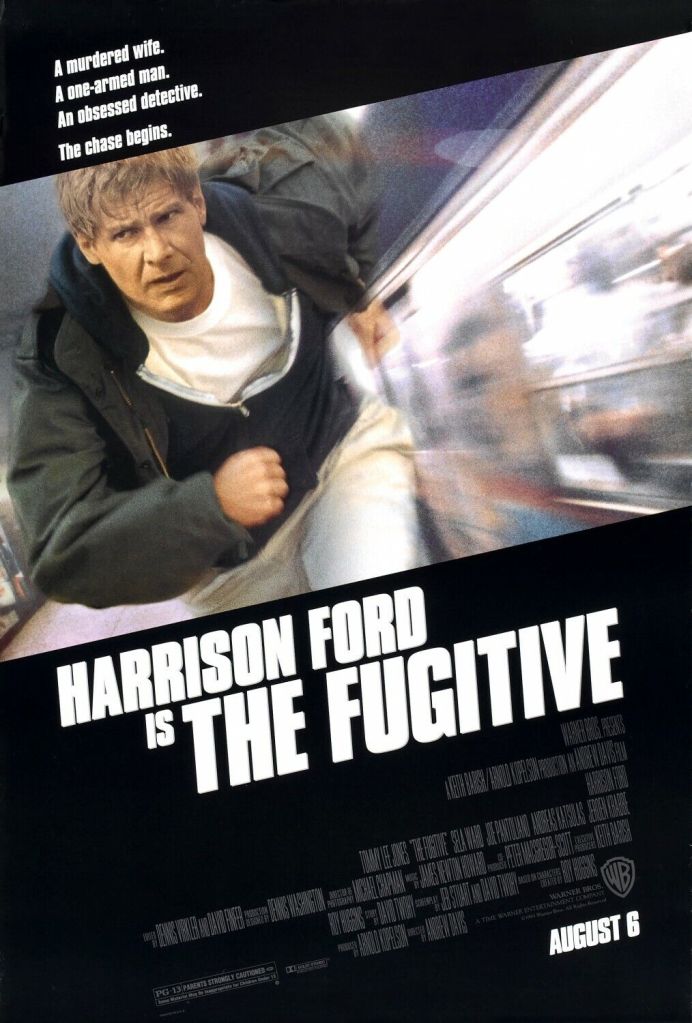
I think there are few things more terrifying than being accused of something you didn’t do. How can you hope to prove your innocence, when no one listens and there isn’t a scrap of evidence to back up your story? How dreadful again if the crime you are accused of, that everyone thinks you are guilty of, is the brutal murder of your wife? The double blow of everyone thinking you guilty, while the real killer walks free. What would you do to clear your name? And how much harder would that be, if you were also on the run from the law who are eager to prep you for the electric chair?

It’s the key idea of The Fugitive, adapted from a hit 60s TV show, and undoubtedly one of the best thrillers of the 90s. Harrison Ford is Dr Richard Kimble, on death row for the murder of his wife Helen (Sela Ward). In transit to prison, an accident caused by a convict’s escape attempt gives him a chance to escape. Returning to Chicago, Kimble is determined to hunt down the mysterious one-armed man he knows murdered his wife and work out why. Problem is, he’s being chased down by a team of US Marshals led by the relentless Sam Gerard (Tommy Lee Jones), who’s not interested in Kimble’s guilt or innocence, only in catching him.

The Fugitive is propulsive, involving and almost stress-inducing in its edge-of-the-seat excitement. It’s a smart, humane and gripping thriller, both a chase movie and an excellent whodunnit conspiracy thriller. It’s one of those examples of Hollywood alchemy: a group of people coming together at the right time and delivering their best work. It’s comfortably the finest work of Andrew Davis, a journeyman action director, who delivers work of flawless intensity, perfectly judging every moment. It’s shot with an immediacy that throws us into the city of Chicago and its surroundings (Davis was a resident of the city and worked with photographer Michael Chapman to bring the real city to life on screen) and the film never lets up for a moment.

It gains hugely from the casting of the two leads. No actor can look as relatably harassed as Harrison Ford. Determined but vulnerable – there is a marvellous moment when Ford squirms with suppressed fear rising in an elevator filled with cops – Ford makes Kimble someone we immediately sympathise with. He’s smart – evading police, forging IDs, inveigling himself into hospitals to access amputee records – but constantly aware of the danger he’s in, brow furrowed with worry, narrow escapes met with near-tearful relief. Ford excels at making righteousness fury un-grating – the film makes a lot of his boy-scout decency – and never forgets Kimble is a humanitarian doctor, putting himself frequently at risk to save lives, from pulling a wounded guard from wreckage during his escape or saving a boy from a missed diagnosis in the hospital where he is working as a cleaner.

You need a heavyweight opposite him, which the film definitely has with Tommy Lee Jones. Jones won an Oscar for his hugely skilful performance. It would have been easy to play Gerard as an obsessed, fixated antagonist. Jones turns him into virtually a dual protagonist. Much as we want Kimble to stay one step ahead of the law, we respect and become bizarrely invested in Gerard’s hunt for him. Jones is charismatic as the focused Gerard, but also a man far more complex than he lets on. He genuinely cares for his team, takes full responsibility for their actions and finds himself becoming increasingly respectful of Kimble, even entertaining the idea of his innocence.

Not that an unspoken sympathy will stop him doing his job. When Kimble pleads his innocence at their first meeting his (iconic) response is “I don’t care”. Later, he doesn’t hesitate to fire three kill-shot bullets at Kimble when nearly capturing him in a government building – Kimble saved only by the bullet-proof glass between them. Jones never loses track of Gerard’s dedication above all to doing his job (the investigation he starts into Kimble’s case is motivated primarily by it being the most efficient way to work out where Kimble might go). But the edgy humour and pretend indifference hide a man passionate about justice and with a firm sense of right and wrong.

These two stars make such perfect foils for each other, it’s amazing to think they spend so little time opposite each other. Davis makes sure those few meetings have real impact, starting with their iconic early face-off at the top of a dam. A gripping chase through the bowels of this concrete monster, it’s also a brilliant establishing moment for how far both men will go: Gerard will continue the hunt, even after losing his gun to Kimble in a fall – because he has another concealed, ready to hand; Kimble won’t even think about using a gun and will go to the same never-ending lengths to preserve his chance at proving his innocence, by jumping off that dam.

The film implies they recognise these similarities in each other. Perhaps that’s why Kimble even eventually bizarrely trusts Gerard as a disinterested party – even while he remains terrified of Gerard catching up with him. The unpicking of (what turns out to be) the conspiracy behind Helen’s death is carefully outlined and surprisingly involving (considering it rotates around sketchily explained corporate shenanigans) – largely because Davis has so invested us in Kimble’s plight.

That’s the film’s greatest strength. Everything draws us into sharing Kimble’s sense of paranoia: that one misspoken word or bad turn could lead to his capture. Scored with lyrical intensity by James Newton Howard, it’s tightly edited and only gives us information when Kimble gets it. We only learn information about the night of the murder as he remembers or uncovers it. Davis twice pulls brilliant “wrong door” routines, where both editing and the careful delivery of information to us at the same time as Kimble makes us convinced that raids are focused on him, when they are in fact looking at someone else entirely.

This sort of stuff makes us nervous, worried for Kimble – and hugely entertained. I’ve seen The Fugitive countless times, and its relentless pace, constant sense of a never-ending chase and the brilliance of its lead performers never make it anything less than utterly engrossing. There is barely a foot wrong in its taut direction and editing and it’s crammed with set-pieces (the dam face-off, a chase through a St Patrick’s Day parade, a breathless fight on an elevated train) that never fail to deliver. It’s a humane but sweat-inducing thriller, a near perfect example of its genre.

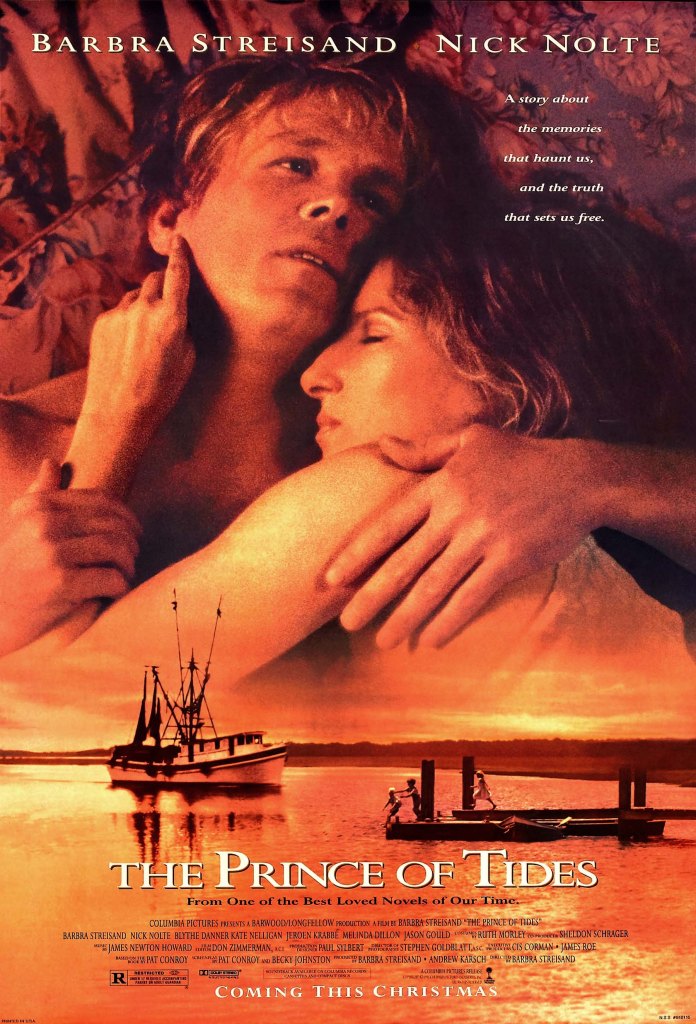
The Prince of Tides (1991)

The Prince of Tides (1991)

Past traumas are uncovered and a gentle love story unfolds in Streisand’s extremely effective relationship drama

Director: Barbra Streisand

Cast: Nick Nolte (Tom Wingo), Barbra Streisand (Dr Susan Lowenstein), Blythe Danner (Sally Wingo), Kate Nelligan (Lila Ward Newbury), Jeroen Krabbé (Herbert Woodruff), Melinda Dillon (Savannah Wingo), George Carlin (Eddie Detreville), Jason Gould (Bernard Woodruff)

For many, La Streisand is easy to knock. She developed a reputation as difficult: controlling, demanding and perfectionist. But don’t we praise these qualities in men? Perhaps she has more than a point when she claims complaints against her are grounded in sexism. Her snubbing by the Academy – The Prince of Tides got seven nominations including Best Picture, but none for Streisand bar as Producer – certainly feels like a crusty boys’ club deciding there is no place at their big night for a strong-minded woman. Doubly unfair since Streisand deserves plenty of praise for a film as rich, heartfelt, moving and surprisingly funny as The Prince of Tides.

Tom Wingo (Nick Nolte) is a football coach in South Carolina, where his marriage to Sally (Blythe Danner) is drifting towards the rocks, largely thanks to Tom’s jovial inability to be emotionally open. He’s called to New York when his poet sister Savannah (Melinda Dillon) attempts suicide. To aid her recovery, Tom must talk to her psychiatrist about the traumas of their childhood. But Tom himself is far, far away from putting bottled-up pain behind him. Streisand plays the psychiatrist, Dr Susan Lowenstein, struggling in an unhappy marriage with an arrogant violinist (Jeroen Krabbé, being Euro-smug as only he can) and with a troubled relationship with her son Bernard (played by Streisand’s real-life son Jason Gould). Despite initial uncertainty, will a spark of romance flair up between Wingo and Lowenstein?

Well, if you listen to the luscious score by James Newton Howard for a few seconds, you can be pretty confident the answer will be “yes”. (But it’s fine – Lowenstein’s husband is an arrogant tosser and Wingo’s wife tearfully confesses her own affair; no need to worry about betrayal here.) Officially adapted from his own huge novel by Pat Conroy,working with Becky Johnston (though it was an open secret Conroy frequently confirmed that Streisand wrote the script), it distils a massive novel into a tightly paced, extremely well-made romance that feels, in many ways, a throwback to the “women’s pictures” of the 1940s. (Conroy was thrilled.)

The big difference is that the typical Bette Davis role is here played by Nick Nolte. This is an extraordinarily superb performance by Nolte: never before had I appreciated what a deeply soulful, sensitive performer he is, especially when he is called to play the “gruff” card so frequently. Nolte’s Wingo is a Southern, gentlemanly good-old-boy, a man’s man who laughs off trouble and moves with the physicality of a rough-and-tumble sportsman. But, under the surface, he’s a sensitive, vulnerable a man tortured by past traumas he can barely bring himself to think about and consumed with guilt, self-loathing and the inability to express his feelings.

In nearly every frame of the film, Nolte is sensational: endearing, funny, joyful (his dancing at a house party has a hilarious self-mockery to it) but also stand-offish and self-contained. The film revolves around key meetings between him and Streisand’s Lowenstein, which grow increasingly intense as the taciturn joker Tom, almost against his will, has his carefully mounted defences stripped away. We see nothing, by the way, of Lowenstein’s treatment of Savannah, so tightly focused is the drama on Tom’s story. While narratively sensible, this does mean that Savannah is reduced to little more than a narrative device.

It makes for effective drama, well directed by Streisand. It’s a film that mixes moments of shock – Tom seeing his sister’s bloodstains on her apartment floor or deflate into mumbling incoherence when pushed on his past – with moments of genuine warmth and sweetness. Heck even a heated argument between the two of them segues suddenly into something comic when Lowenstein impulsively throws an Oxford English Dictionary at him, damn near breaking his nose. It should also be noted Streisand unselfishly casts herself in the less showy role – essentially a feed for Nolte – and cedes the finest moments and meat of the film to him.

Perhaps that’s also partly why Streisand’s doctor is the least convincing part of the film. With her diva nails and famous features, no amount of dome-like-glasses ever really makes you forget you are watching one of the world’s icons pretend to be a psychiatrist. (Particularly as the film relies on the magic therapist trope so beloved of Hollywood, where gentle probing and quiet “what do you think” lines lead to huge emotional revelation.) If anything, she’s more convincing and comfortable as the socialite mum struggling with her dreadful husband and resentful son.

Why the son is quite as resentful as he is to his mother, is left a bit of a mystery. Nevertheless, Jason Gould does a decent job as a young man torn between playing the football he loves and fulfilling the musical promise his father expects. (He also has a great father-son chemistry with Nolte, who coaches him in football skills.) Much clearer is why Lowenstein is struggling with her ghastly husband. Jeroen Krabbé is beautifully, smackably, smug and condescending. So much so that I laughed heartedly at the film’s most crowd-pleasing moment, as Tom punishes him for his rudeness over a dinner party by juggling his priceless Stradivarius over the edge of a penthouse balcony.

It makes it easy for us to accept Streisand’s eventual affair – much as Blythe Danner’s Sally regretfully confessing that Tom’s emotional closed-offness has driven her into the arms of another man. Despite the poster’s impression though, this is far from a steamy romance, waiting almost four fifths of its runtime before the two confess their feelings for a cathartic affair. For the bulk of the film, it’s an unspoken mutual affection, driven by Tom’s Southern flirtatious manner and Susan’s half-smiles. Again, it’s a slow-build, carefully paced romance that feels real.

Also because the film’s real build is not towards the two stars converting flirting to grinding, but in uncovering the exact trauma Tom is suppressing and has made him resent his mother (Kate Nelligan very good as an aspirant social-climber, refusing to invest love in her children) almost as much as his violent father (a surly Brad Sullivan). The reveal is, in some ways, expected – but also shockingly unexpected, particularly due to the visceral rawness which Streisand shoots the Nolte-narrated flashback with (Nolte is, needless to say, wonderful in this scene).

It’s part of the surprisingly effectiveness of a film that, in other hands, could have been a sentimental family drama, but is lifted by excellent, committed performances (Streisand is clearly a whizz with actors) and sensitive, patient direction. Streisand resists attention-grabbing flash, carefully letting scenes and emotions build, using subtle but effective camera movements. It comes together into a film that surprised me greatly with its richness. It eventually has a heart-warming message to tell of the power and importance of having the courage to admit your pain and emotions and, in its portrait of a man’s man engaging with his vulnerability, projects a message still powerful today. If Redford or Eastwood had directed it, they would have won an Oscar.

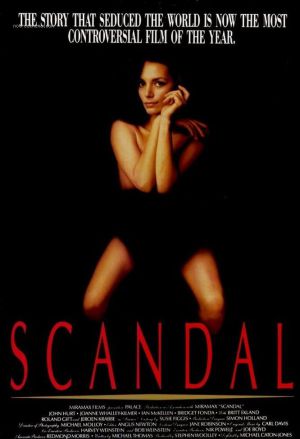
Scandal (1989)

Joanne Whalley and John Hurt get unwisely wrapped up in the Profumo affair in Scandal

Director: Michael Caton-Jones

Cast: John Hurt (Stephen Ward), Joanne Whalley (Christine Keeler), Bridget Fonda (Mandy Rice-Davies), Ian McKellen (John Profumo), Leslie Phillips (Lord Astor), Britt Ekland (Mariella Novotny), Jeroen Krabbé (Eugene Ivanov), Daniel Massey (Mervyn Griffith-Jones), Roland Gift (Johnny Edgecombe), Jean Alexander (Mrs Keeler), Deborah Grant (Valerie Hobson), Alex Norton (Inspector), Ronald Fraser (Justice Marshall), Paul Brooke (Sergeant), Keith Allen (Reporter)

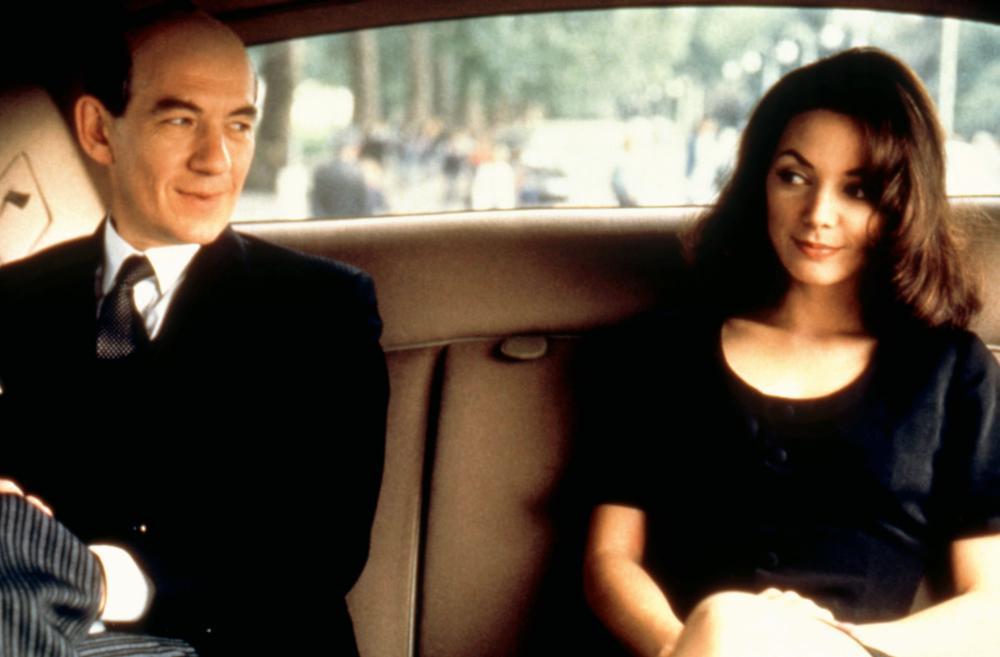
In 1963 the British Government was nearly destroyed by a sex scandal. John Profumo, Minister for War, was widely suspected of conducting an affair with Christine Keeler (a former show girl turned society figure) at the same time as she was sleeping with Russian naval attaché Eugene Ivanov. Profumo denied it to the House of Commons. A few weeks later he confessed he had lied and resigned from Parliament. The scandal shook the country to the core, and led to an exhausted Harold MacMillan’s resignation as PM. As the scandal span out to reveal sex parties in country homes, the country couldn’t get enough of the discovery that large numbers of the upper classes enjoyed nothing more than swinging, orgies and indiscriminate sex laced with sado-masochism. 

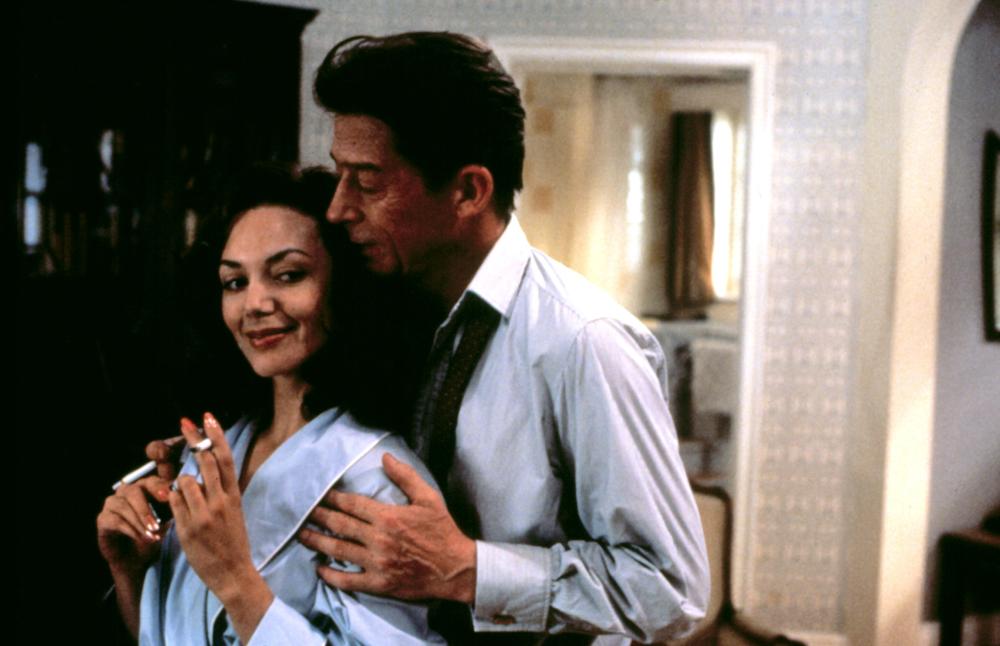
Scandal reconstructs the build-up to and eventual explosion of controversy around this affair, focusing on Keeler (Joanne Whalley) and Stephen Ward (John Hurt), the society osteopath and friend to the rich and famous who had worked out that if he found and coached attractive young girls, Henry Higgins-style, into engaging and fun companions, he could swiftly move up the social ladder by giving the rich and powerful people they could sleep with. When the Profumo affair blew up, it was Ward who was left holding the parcel: abandoned by his rich and powerful friends, Ward was placed on trial as a pimp, vilified in court and in the press, and eventually committed suicide the night before the court case finished (which convicted him in absentia of living off immoral earnings).

It’s this miscarriage of justice that Scandal zeroes in on – and the film does a good job of showing that Ward basically didn’t really do anything that wrong. He didn’t mistreat the girls, he thought he was helping them improve their lives and he didn’t attempt to blackmail his friends. His own sex drive seems curiously disconnected (he was clearly more of voyeur) and if anything, John Hurt (excellent as always) plays him as a slightly sad social-climber. A sort of Horace Slughorn of sex, far more excited by his bulging address book, access to the exclusive clubs of London and calling lords of the land by their matey nicknames, than by all the nooky.

Scandal however is a rather unemotional, unengaging and distant film. It’s hard to get too wrapped up in, as it too often goes for documentary checklist rather than real character engagement. On top of that, it’s often rather unclear – it’s tricky to tell the exact timelines, it’s hard to see often how some events relate to others, it’s unclear in particular how Christine Keeler’s relationship with jazz promoter and drug dealer Johnny Edgecombe led to exposure. It’s a film that’s both in love with telling the facts and so blinded by them that it doesn’t turn them into an engaging story.

But then perhaps part of this is because looking back today, it’s hard to see what all the fuss was about with the Profumo affair. After generations where government ministers have been accused of everything from toe-sucking to performing a sex act on a dead pig, it’s hard not to look at the Granddaddy of all government sex scandals and not think it rather quaint. Today it would barely merit more than few news cycles: and Profumo would certainly have been back in the cabinet within two years. Even the spy angle (was Profumo leaking secrets to Keeler, who in turn leaked them to Ivanov?) was widely (and almost immediately) discredited at the time. 

Not that the seismic impact really comes across anyway in the film. This is partly because the film focuses on Ward and Keeler in particular. For the two of them, there wasn’t much at stake – until their lives were destroyed. In fact, for most of these people at the various dodgy parties – other than embarrassing tittle-tattle – there wasn’t much at stake. A film that gave more space to Profumo – and really made-clear what he was running the risk of losing here, particularly after he lied to Parliament – might have made it clearer the dangers that all involved were inadvertently running.

But that would have been to dent the film’s purpose of showing Ward and Keeler as essentially innocents abroad. Joanne Whalley has a particularly difficult job as a Keeler so thoughtless, short-sighted and self-obsessed, she verges on the dim. Whalley makes her bright, engaging and fun-loving, but never with a whiff of sense. By the time Keeler is blurting out totally unconnected Profumo facts when speaking to the police about her relationship with Edgecombe, you can tell she doesn’t have a chance.

The film’s real strength though is John Hurt’s masterful performance as Stephen Ward. Hurt’s pock-marked face and ruddy complexion (going through a difficult divorce he allegedly spent most of the filming struggling with alcoholism) and slightly sweaty desperation are perfect for the role. A natural victim as an actor, he makes Ward always slightly desperate, always trying too hard, always the grammar-school boy pushing his nose up against society’s window. He’s a super creepy Henry Higgins grooming girls for a “better life” (his genuine belief!) and getting himself an entrée into posh society at the same time.  

Ward, the film argues, didn’t feel he was ever doing anything wrong – and he realises far too late that society, his posh friends and the government don’t agree. “It’ll blow over” he reassures Ivanov: totally wrong. Ward basically was a hedonist who wanted people to have a good time – and was thrilled to be invited to the party. When the shit hit the fan, he was dumped with the blame. It’s an angry note that the film – with its obsession with covering so much ground – fumbles slightly: it wants to be a searing indictment of the hypocrisy of the upper classes, but it fudges the emotional connection so much that you can’t feel it as much as you should.

Instead Scandal just sort of simmers rather than boils. It doesn’t communicate what a sea change this was in how Britain viewed its politicians and upper classes – from hereon they were always seen as men with feet of clay – and it doesn’t get the audience feeling as angry or engaged with things as you might expect. It has a lot of sex in it but (perhaps deliberately) it’s not sexy – the orgy scenes would make a great mood killer – and it seems to miss the hedonistic tone that dominated the class at the time. 

There is some decent directing – a scene of Mandy Rice-Davies and Christine Keeler preparing for a night on the town is particularly well done – and some strong acting, not least from Ian McKellen is a slimy Profumo (rumour has it a recently de-closted McKellen was keen on the role as it was the most hetrosexual role he could imagine playing!). But it never quite clicks together into something really emotionally engaging. And it isn’t quite as clear and easy to follow as you need. Structuring the story as a kind of love story between virtually the only people in the story who don’t have sex together is interesting – and Hurt and Whalley are good – but it’s just not quite a good enough film for what it wants to do.

The Living Daylights (1987)


Timothy Dalton’s meaner Bond takes aim in top Bond Film The Living Daylights

Director: John Glen

Cast: Timothy Dalton (James Bond), Maryam D’Abo (Kara Milovy), Jeroen Krabbé (General Georgi Koskov), Joe Don Baker (Brad Whitaker), John Rhys-Davies (General Leonid Pushkin), Art Malik (Kamran Shah), Andreas Wisniewski (Necros), Thomas Wheatley (Saunders), Robert Brown (M), Demons Llewellyn (Q), Geoffrey Keen (Minister of Defence), Caroline Bliss (Miss Moneypenny), John Terry (Felix Leiter), Walter Gotell (General Gogol)

After A View to a Kill,even the Bond producers realised something had to change. Roger Moore at 60, was definitely too long in the tooth to still be the debonair super spy. The producers were quick to land their first choice – TV’s Remington Steele star, Pierce Brosnan. But a last-minute renewal of the cancelled show meant Brosnan was out – and the producers turned to one of the first choices when Connery left: Timothy Dalton. Dalton had considered himself too young in 1969, but the stars aligned now. So we had a new Bond – a younger, sleeker, meaner model. To quote that other franchise with a revolving lead: Change my dear, and it seems not a moment too soon…

James Bond (Timothy Dalton) is tasked to protect a defecting Russian general, Georgi Koskov (Jeroen Krabbé), but during the mission he refuses to take the life of Kara Milovy (Maryam D’Abo), a cello player from the Viennese orchestra turned sniper, whom he believes to be nothing but an amateur. When Koskov is snatched by mysterious forces, Bond must trace his only link to Koskov: Kara Milovy, who he quickly discovers is Koskov’s lover. Soon he questions the legitimacy of the defection – and the links to sinister American arms dealer Brad Whittaker (Joe Don Baker).

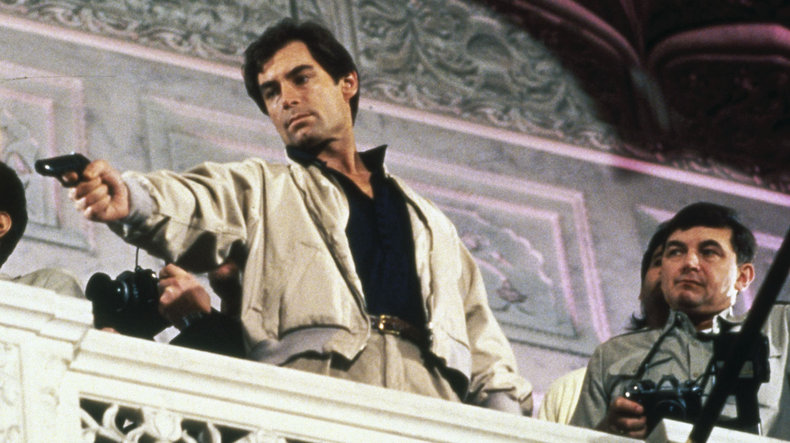
First and foremost, this is Timothy Dalton’s film. His Bond was something so radically different from Moore that, to a certain extent, the public wasn’t ready for it. Dalton went right back to Fleming’s books, and brought to the screen for the first time a Bond who actually feels like the character of the novel: world-weary, cynical, reluctant (even bitter), a man on the edge of anger with a darkness behind the charm. When Bond is threatened by being reported to M by his colleague Saunders (an excellent Thomas Wheatley), he snaps in response: “If he fires me, I’ll thank him for it”. Can anyone imagine Moore or Connery saying that?

He’s also a man capable of genuine emotion and loyalty, who forms friendships and relationships throughout the film that we haven’t really seen before. Sure some of the comic elements feel shaped more for Moore’s lips than Dalton’s, but Dalton’s Bond made everything feel more grounded than the overblown later Moore movies. To put it bluntly, Dalton makes Bond feel like a human being, not just a super-hero. There’s a reason he’s been called the best actor to take on the role. He treats it like an acting job. He might be the best Bond.

This works particularly interestingly as this film is a sort of half-way-house between a Moore film and an early Connery film. The tone of the film is kept relatively light (a key chain that works via a wolf whistle! Skiing down a slope on a cello case!), but the villains of the piece are relatively low key (they want to make a killing on drug deals) and there is a nice mix between some exciting (but not over the top) stunts and an almost Hitchcockian feel.

This Hitchcock feel is not least in the (rather sweet) romance between Bond and Kara, with its Notorious feel of a man manipulating a woman while genuinely growing to care for her. Setting most of these scenes in a romantically shot Vienna also helps enormously, with its noirish Third Man feel. Unlike many other Bonds, the relationship here between Bond and the girl feels like a genuine romance. Kara may be a bit of a damsel in distress, but she feels like a warm-hearted, decent person wrapped up in events beyond her experience. And although audiences at the time, accustomed to Moore and Connery’s unending conquests, were critical of the reduction in Bond’s sexual adventures, making him less promiscuous results in Bond feeling like much more of a jaded romantic than a casual philanderer, and makes his relationship with Kara much more resonant.

The whole film feels much more grounded in reality, without losing a sense of fun. The film does its action sequences extraordinarily well. The car chase through snowy Austria is brilliantly done (the car gets a series of stand out gadgets), with Dalton delivering each new revelation of the car with a winning dryness. This sequence develops into the brilliantly funny cello-case skiing sequence (“We’ve nothing to declare!”/”Except a cello!”). Again, the sequence works so well because it is skilfully counterbalanced with the almost Le Carre-ish piece of spycraft Bond uses first to get Kara out from the under noses of her KGB watchers.

Interestingly, one of its most striking sequences doesn’t even involve Bond: that plaudit has to go to the thrilling one-man assault by unstoppable ubermensch Necros on the MI6 house where Koskov is being held. A particular showcase here is the brutal kitchen fight between Necros and an MI6 officer, surely the greatest fight in the series not to feature Bond (and all the more exciting as you don’t know what could happen to these characters), plus it’s great to see someone in MI6 other than Bond being able to handle themselves.

The final major sequence of the film, with Necros and Bond fighting while clinging for their lives to a net, dangling out the back of a plane, is a truly striking action set-piece, a real vertigo inducing stand-out. If you can put to one side in your head the fact that Bond’s key allies during the whole Afghanistan sequence of this film are basically Al-Qaida in an earlier form (with Art Malik’s charming Kamran Shah basically exactly the sort of man who went on to become Osama Bin-Laden), and you can enjoy the sequence for its terrific excitement.

The weaknesses of the film are in its structure. Both villains (and their plot) are underwhelming. Koskov is something very different – charming, feckless, manipulative (he’s quite well played by Krabbé) – but hardly much of a threat, and he drops out of the film for a chunk in the middle. Joe Don Baker’s Whittaker is too distant from the central plot for him to earn his role as Bond’s final antagonist. It feels like the writers have split one character into two – a Koskov who hid Whittaker’s ruthlessness and bullying under a charming, foolish veneer might have really worked. Their plan is grounded in a reassuring reality, but it never feels like that big a deal. Its complexity is also probably a little too great for the narrow focus the film gives it. The final Whittaker-Bond confrontation is underwhelming considering what we’ve seen before.

But that is because this is Dalton’s film – or, if you like, a Bond film focused on Bond. From the stirring introduction on a training mission parachuting into Gibraltar, Dalton seizes the film by the scruff of the neck. Unlike nearly any other Bond film before now, this feels like one about the type of man Bond is – the killer with a well-hidden heart, the cynic who believes in his cause. He has great chemistry with his fellow actors – not least John Rhys-Davies, excellent as General Pushkin – and above all romantic chemistry with Maryam d’Abo.

The humour allows us to warm to Bond, while the darkness Dalton brings to the role helps us invest emotionally in his more tortured interpretation. All else aside, TLD is damn good fun with some excellent action sequences and a terrific score. It’s very much in the upper echelon of Bond films.