Tag: Jerry Orbach

Crimes and Misdemeanors (1989)

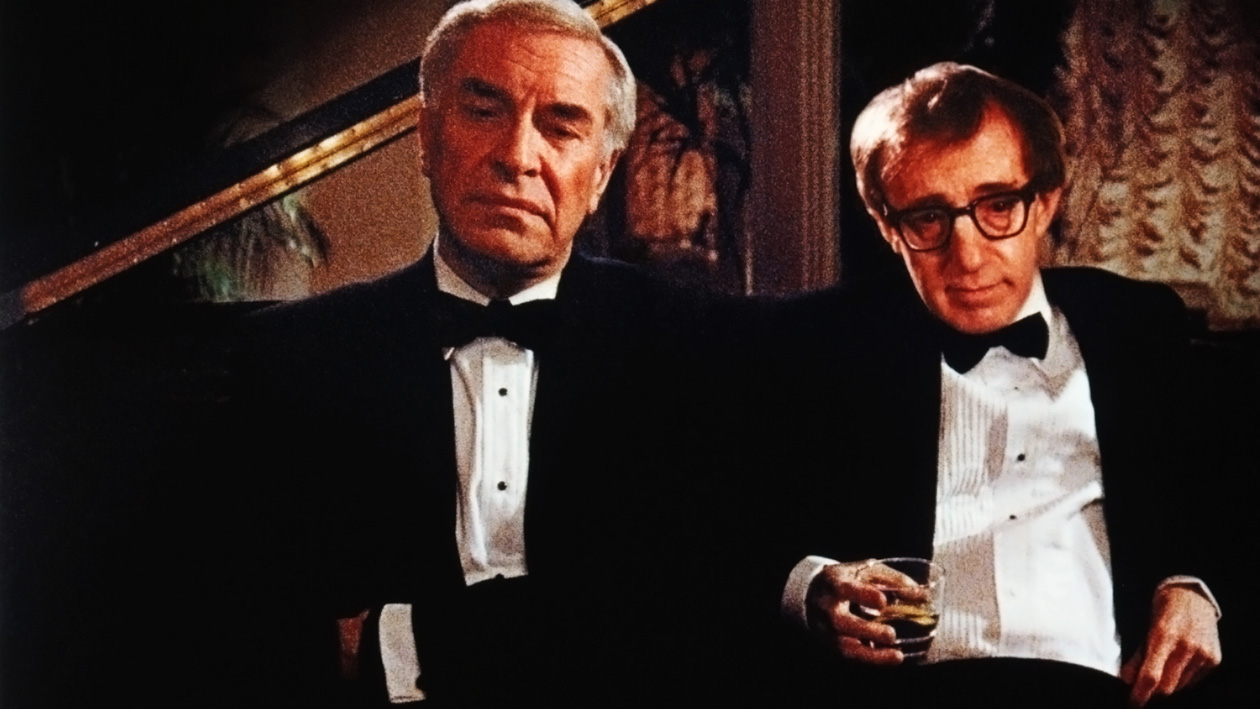
Martin Landau and Woody Allen reflect on Crimes and Misdemeanors

Director: Woody Allen

Cast: Caroline Aaron (Barbara), Alan Alda (Lester), Woody Allen (Cliff Stern), Claire Bloom (Miriam Rosenthal), Mia Farrow (Halley Reed), Joanna Gleason (Wendy Stern), Anjelica Huston (Dolores Paley), Martin Landau (Judah Rosenthal), Jerry Orbach (Jack Rosenthal), Sam Waterston (Ben)

Successful ophthalmologist Judah Rosenthal (Martin Landau) has it all: respect, fortune, a loving family…and a mistress. That mistress, Dolores (Anjelica Huston), won’t play ball and disappear but actually wants Judah to deliver on his half promises of leaving his wife. Should Judah confess all, as his rabbi friend Ben (Sam Waterston) suggests? Or should he follow the advice of his gangster brother Jack (Jerry Orbach) and remove Dolores permanently? Meanwhile, documentary film-maker Cliff (Woody Allen) has been hired by his brother-in-law, pompously successful TV producer Lester (Alan Alda), to shoot a film celebrating Lester’s life. During the shooting, Cliff can barely hide his irritation – or his growing attraction to Halley (Mia Farrow), the associate producer both he and Lester are romancing. Who will she end up with?

Dostoyevsky – could you live with a murder? – gets the Woody Allen treatment in one of Allen’s most highly respected, but troubling films. To be honest, I didn’t much care for Crimes and Misdemeanors. I have moral qualms about it – and, I will hasten to add, these qualms have nothing to do with the lack of punishment for Judah. Crimes and Misdemeanors hides its blatant cynicism and loathing for people, underneath some fine acting and good jokes. But its possibly one of Allen’s most unlikeable works, where his sympathies seem hideously astray.

It wants to be an exploration of the guilt that follows a crime. But to be honest, aside from some expert furrowing of brow and distressed line deliveries from Landau, I’m not sure Woody has much to say about guilt. Furthermore, I think he is inviting us to sympathise with Judah not because he feels bad (and even then, so what?), but for various extenuating circumstances. Namely, he’s a good man (he has all but funded a new hospital wing by himself) with a loving family and is a dedicated doctor. Furthermore, his mistress is presented almost exclusively as a demanding and difficult floozy (Anjelica Huston in an unflattering part – although at least she gets more to do than Claire Bloom in the thankless part of Judah’s wife, an almost non-existent role).

Frankly, the film suggests Judah’s motives are more complex than just removing a self-caused problem and since he feels shock (sorrow for Dolores or the crime seems noticeable absent, and it feels like Allen mistakes the one for the other) and is a nice guy, we should think again about our knee-jerk reactions of right and wrong. Problem is, Judah is not a nice guy – he’s shallow, self-pitying and self-justifying – and watching a character with, it turns out, no real morals go through a moral quandary doesn’t make for engaging viewing.

Judah’s moral reaction to the murder is insubstantial. Essentially guilt makes him wonder where there is in fact a God after all – before deciding that, on balance, the probability is that the universe will not punish him. Other than that, I’m not sure Allen has much more to add to the discussions of right and wrong. Dostoyevsky made hundreds of pages of conscious and guilt shattering a man’s equilibrium. Allen can’t manage more than about ten minutes of screen time, let alone 90 minutes.

Perhaps that’s why Crimes and Misdemeanors is padded out with a second, almost as long, unconnected secondary plot. It’s a one-sided rivalry between Allen’s film-maker and Alda’s pompous producer, with Mia Farrow as an artistic waif who serves as the prize for this unspoken competition. (This is perhaps one of the worst Allen films for female characters: we have two cold, personality-free wives for the main characters, a shrill mistress, a bland artistic waif and Woody’s character has a sister who is tied to a bed and defecated on. How did the same guy write Hannah and Her Sisters?)

Again, Allen’s sympathies lie with the idealistic, uncompromising Cliff, even more so because his interest in making films people don’t want to see makes him, in Allen’s eyes, noble. Compare and contrast with the film’s loathing for Lester – hilariously played by Alan Alda as a neat self-parody. Lester is everything Cliff isn’t, but secretly wants to be (though I’m not sure Allen realises this): successful, well-regarded, admired, rich and gets all the girls. No wonder the film hates him – even though, to be honest, he doesn’t seem the bad. After all, the sort of drive and ambition that Lester has is exactly what makes a man successful.

It wouldn’t matter so much if Cliff wasn’t remarkably similar to him, but considerably less charming. Just like Lester, Cliff is a self-important bore, cuddling his lack of success as proof of his genuineness. Cliff has no problem with effectively creepily stalking Halley (despite being married – fine though as Allen thinks she’s a bitch). Cliff’s passive aggressive assertions that Halley deserves someone like him rather than someone like Lester aren’t romantic, they’re creepy. (Needless to say, Halley ends up with Lester, to Cliff’s shock, horror and disappointment – while his wife plans to leave him).

Now I get it, there are people reading this who will think “well yes you just don’t like it because you want a simple ending where the baddies are punished – well life isn’t like that”. That’s not the case: I’m fine with films where murderers escape scot-free: but I generally want the film to know they are bad people. Crimes and Misdemeanors doesn’t. And it doesn’t really have anything of interest to say. It’s one of Allen’s films where his cynicism about humanity is exposed too heavily. You long for a bit more critical insight into Cliff, or for a more acute exposing of Judah’s self-interested excuses. You get neither, instead Allen ending on the note that the universe is dark and indifferent and only love can change things. There’s lots of the first two and precious little of the third here.
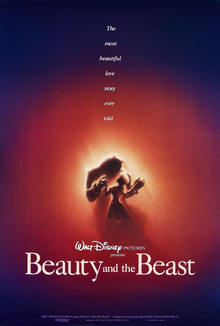
Beauty and the Beast (1991)


The original and the best: Disney’s animated classic Beauty and the Beast

Directors: Gary Trousdale, Kirk Wise

Cast: Paige O’Hara (Belle), Robby Benson (The Beast), Richard White (Gaston), Jerry Orbach (Lumière), David Ogden Stiers (Cogsworth), Angela Lansbury (Mrs Potts), Bradley Pierce (Chip), Rex Everhart (Maurice), Jesse Conti (Le Fou)

After decades of average or forgettable films, in the early 90s Disney had a sudden renaissance. From 1989 to 1998, the studio was a veritable hit factory, with films from The Little Mermaid to Mulan, via classics like The Lion King and new ideas like Hercules all being lapped up by audiences. Perhaps the most widely loved (and maybe even the best!) of this era was Beauty and the Beast.

Like all the best Disney films, the story is traditional with a modern twist. Belle (wonderfully voiced by Paige O’Hara) is a young woman in a small provincial town who wants so much more than spending her time dodging the unwanted attentions of handsome local hero Gaston. When her eccentric father Maurice is imprisoned in a mystical castle by a terrifying Beast (Robby Benson, who combines sensitivity and ferocity), she agrees to take his place, while the Beast (and his enchanted servants) all hope she might break the spell placed on them by falling in love with him.

This was the first animated film to ever be nominated for Best Picture, back in the days of only five nominees and it was hard to sneak onto the list if you weren’t a heavy-going “important” piece of film-making. If that’s not a testament to its greatness, I’m not sure what is. It’s one of the best mixes of Disney magic: charming, delightful, sweet, funny and exciting. It has a heroine who feels real, independent and relatable and a hero you empathise with, even while he behaves badly. It’s got a villain who first seems an arrogant blow-hard before his real brutishness is revealed. All this in a very romantic, engrossing storyline, with a host of supporting characters it’s impossible not to like.

So why does this work so well? It’s sweepingly, lusciously drawn and it drips romance and humanity. Everything stems from those central characters, and the amount of empathy we feel for them. Like all great films, this knows without characters we invest in, nothing else works – no matter how many great numbers and funny lines there are (and there are plenty of both!).

Belle could have easily been either a flighty romantic or an aloof autodidact, but the film crafts her into a grounded romantic, dreaming of more but knuckling down and dealing with the hand life has dealt her. Facing a life of captivity she resolves to do what she can to make her life bearable. She’s determined and independent and exhibits genuine intellectual curiosity alongside her empathy. She feels real, and you invest in her reactions to things because those reactions feel normal.

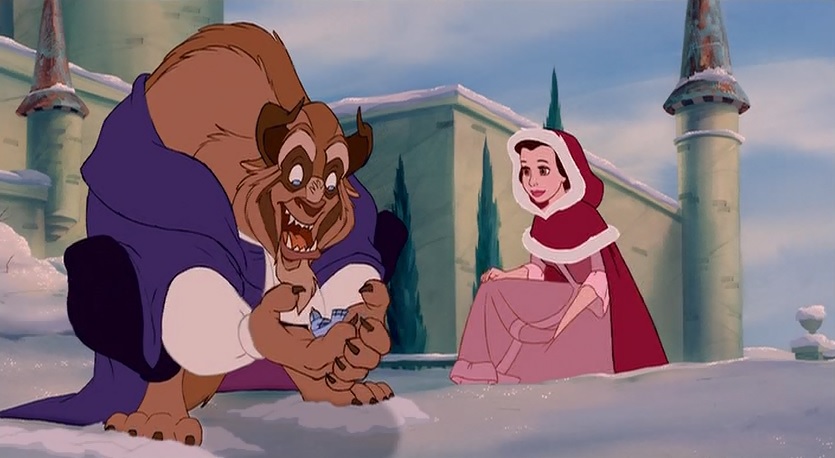
An even bigger challenge is the Beast, but it’s triumphant in the handling of this tricky character. He is ferocious, but the film quickly and efficiently makes clear his anger is based in pain and vulnerability, and intense isolation. Careful shots establish his self-loathing – his slashing of a painting of his pre-transformation face couldn’t be much clearer. Even at his most furious, we gets quiet moments of vulnerability. The animation of the Beast is perfect – his face is fierce, but his eyes are wonderfully expressive. His facial features at key moments relax and fold in to show someone far more gentle. He’s like everyone on a first date, scared to express his deeper feelings. The animators marvellously capture both his power and surprising delicacy. His boyish enthusiasm is infectious – his excitement in gifting Belle the library is heartwarming. In fact he’s so endearing and engaging a character, I think everyone feels a twinge of disappointment when he is replaced by a human being in the final scenes!

Revolving around these two is a wonderful cast of engaging characters. The primary servants in the plot – Lumière, Cogsworth and Mrs Potts – are all strong, unique and three-dimensional characters with more than enough depth to eschew their basic character traits (Cogsworth’s name even rhymes with jobsworth, Lumière is a charming rogue and Mrs Potts a motherly matron) to become characters we end up caring deeply for, that feel real.

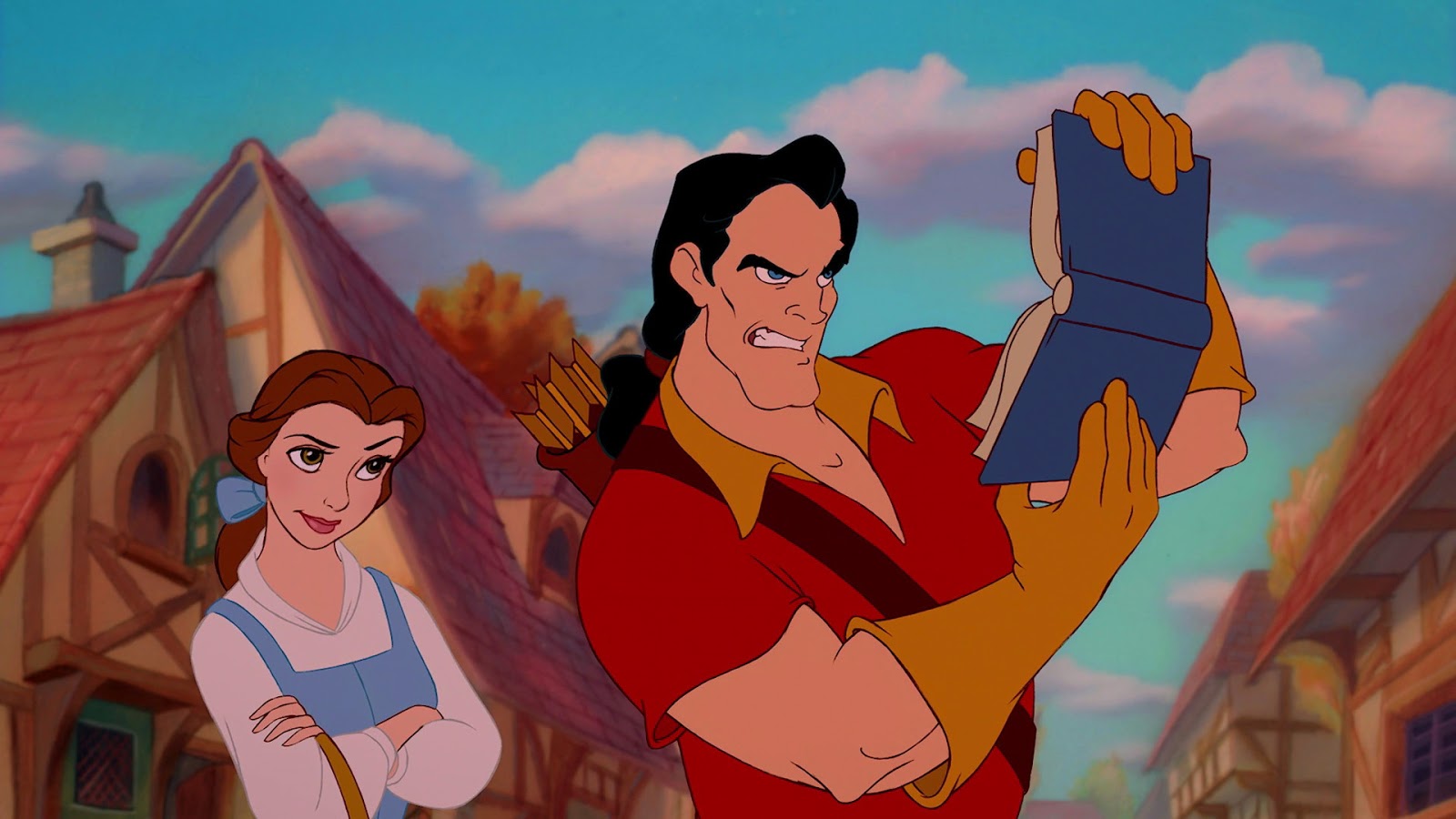
The film also borrows from Jean Cocteau’s La Belle et la Bete to create the character of Gaston, possibly one of the most interesting villains in Disney. Drawn with a certain conventional handsomeness (although he looks smug enough for you know he’s a wrong ‘un from the start), Gaston is a character who questions many of the assumptions made linking popularity and handsomeness with goodness. He’s also a character who grows measurably darker through the film due to his own choices, rather than being inherently villainous from the start.

It’s all part of the richness of the world the film creates – everything feels natural and all the characters real and understandable. Maybe that’s partly why it works so well – it’s a film that is animated, rather than a cartoon. With a tight plot, good pacing and a clear focus, it’s focus is on emotion and characterisation, and it avoids cheap laughs, with comedy growing organically. Because the characters themselves are so compelling, the events carry huge dramatic force – when Belle is threatened by wolves, we genuinely fear for her; when the heartbroken Beast can barely rouse himself to fight Gaston we are overwhelmed with pity and concern.

Warmth and humanity in the drawing of the characters, makes their stories so affecting

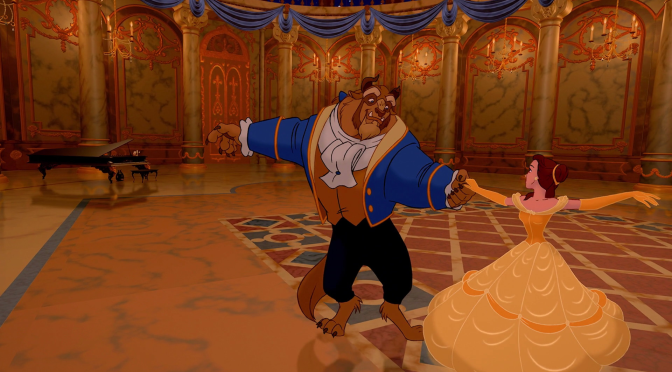
Of course it is also a cartoon, and much of the triumph of it is based in the animators’ successes. The imagery is gorgeous, the detail in each frame is wonderful, the design of the castle is fantastic (we’ve already talked about the influences of Cocteau’s film, but it’s clear again here). The famous ballroom scene is wonderful – the “camera work” marvellous, the creation of the ballroom awe inspiring (genuinely we all thought it was real at the time!). Time and again the filmmakers use inspired framing and composition that conveys the emotion. The performances they draw from their characters is exceptional – the expressiveness given to all of the characters, from Belle and the Beast to the faceless tankards in the castle, is brilliant. You can freeze-frame any single scene from the movie and be able to instantly identify how every character feels.

The famous ballroom, a sweeping series of camera shots and a landmark in computer illustration

This is the true Disney magic: this world is real, because everyone in it feels so alive. It captures your heart, from its marvellous stained-glass opening telling the backstory, to the triumphant swelling score that meets the ending. I’ve barely mentioned the songs, but each one is brilliant, an instantly recognisable, pleasurable earworm – in fact, this film may have the best songs of any Disney film in the canon. Beauty and the Beast is so good that, never mind being nominated for best picture, it arguably would have won in many years (it lost to The Silence of the Lambs: it’s hard to imagine a film more tonally different!). Endlessly enchanting, charming, warm, funny, moving and exciting, this is a masterpiece and a landmark in Disney animation.