
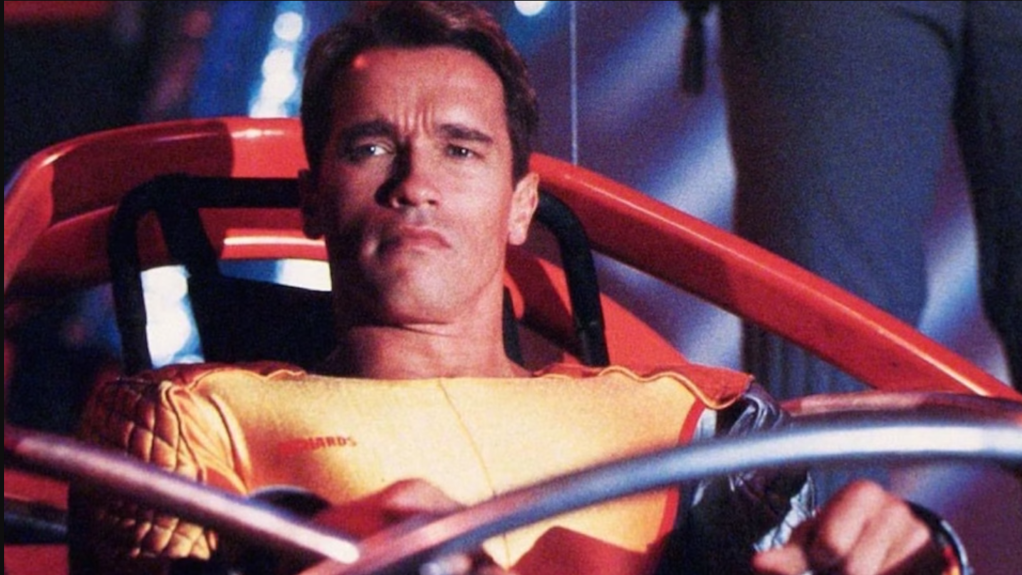
Gloriously stupid Arnie vehicle, sort of satire but really a chance for violence and wise-cracks
Director: Paul Michael Glaser
Cast: Arnold Schwarzenegger (Ben Richards), María Conchita Alonso (Amber Mendez), Richard Dawson (Damon Killian), Yaphet Kotto (William Laughlin), Jesse Ventura (Captain Freedom), Jim Brown (Fireball), Erland Van Lidth (Dynamo), Marvin J. McIntyre (Harold Weiss), Gus Rethwisch (Buzzsaw), Professor Toru Tanaka (Professor Subzero), Mick Fleetwood (Mick)

It’s 2017 and the USA has fallen apart (they were more right than they thought…) with a dictatorial government keeping the population in their place and distracting them from their lost freedoms with the violent TV show The Running Man, where criminals fight to the death in gladiatorial contests. The latest contestant? Ben Richards (Arnold Schwarzenegger), a former cop who everyone believes massacred civilians from his helicopter gunship but who we know is actually the hero who tried to stop it. Running Man host Dawson (Damon Killian) thinks Richards is the guy for a ratings slamdunk. But guess what? Arnie is as tough as he looks and might just bring down the system in prime time.
The Running Man makes an interesting contrast with Rollerball. In fact, it’s really just a souped-up 80s version of the same idea, of corporations using violent entertainment to keep the masses in line. The main difference being Rollerball is a sort-of lingering existentialist character study which mixes ambiguity with high-octane sports action, played out with Kubrick-inspired classical music and lingering slow-mo. The Running Man is a loud, brash, hyper-violent film that allows Arnie to flex both his muscles and his wise-cracking wit. Leaving its roots as a Stephen King adaptation far behind, it’s both a lot more stupid and a whole lot more fun than Rollerball.
The Running Man is a bizarre mix of Cronenbergish media satire and ludicrous camp comedy. It’s in-universe TV show has a parade of killers on it, laughable in their cartoonish violent silliness, with methods of killing so elaborate that they would put Bond villains to shame. Subzero is an ice-skating wrestler with a razor-sharp hockey stick! Buzzsaw dispatches opponents using (you guessed it) a chainsaw that can cut through anything! Dynamo dresses up in an electric suit, sings opera and electrocutes people! Fireball burns everything with his gas-filled flame-thrower!
You think that sounds silly? Well don’t worry because Arnie will (surprise, surprise) send them all to their maker with a karmic death (you have one guess as to how they all die) and an apt pun (“He had to split!” he grins slicing Buzzsaw in half with his own chainsaw). This is Arnie at his eighties height, expanding his brand and transforming The Running Man into his very own star vehicle. (He even squeezes in his “I’ll be back!” catchphrase). Ben is the perfect Arnie character: he’s noble but cool, muscular but witty, makes bad-ass threats and delivers on them, smokes stogies like they’re going out of fashion and waltzes off with the girl at the end after saving the world.
Arnie is sort of working alongside a resistance movement, but they don’t get in the way of his manly independence. The principle function of his resistance movement buddies Laughlin (Yaphet Kotto) and Weiss (Michael J McIntyre) is to symbolically lay down their lives to give Arnie even more moral high-ground – The Running Man makes very clear he doesn’t enter this sadistic blood-sport to protect himself (oddly in this totalitarian dictatorship, criminals still have enough rights to choose not to sacrificed on national television) but to save the lives of his Red Shirt pals. Their deaths also serve to justify the ruthless violence Arnie hands out (though of course he refuses to kill an unarmed, injured opponent just so we know all the other bodies he dropped must have deserved it).
It’s all set in a charmingly quaint 80s view of the future: power-suits for the rich and jump-suits for the convicts, with clunky TVs and worn-out urban environments. The Running Man throws in its odd surreal, camp and bizarre touch, not least the sight of Mick Fleetwood (buried under prosthetics) playing himself as the resistance leader. Its pumped-up TV show is packaged like a hyper-violent 80s mega-smash, hosted by real-life actor-turned-quiz-show-host Richard Dawson, gleefully embracing self-parody as a venal, heartless bully full of two-faced smarm with the audience while treating his staff like dirt.
Dawson, in all his larger-than-life awfulness, actually makes a pretty good foil for the muscle-bound Arnie, not least because he understands exactly what the Austrian Oak wanted from this film. Because Arnie knew people didn’t really want social commentary or satire – they wanted a black-and-white world where the ex-Terminator could smack, punch and shoot things with gleeful abandon while testing out a host of potentially quotable catch-phrases. Essentially The Running Man is a sort of Tom-and-Jerry cartoon with a sheen of social commentary, that panders shamelessly for our love of watching outré villains suffer grim and painful ironic deaths.
And you know what? Arnie was right. Because, however stupid (and its very, very stupid) The Running Man is, no matter how cookie-cutter, uninspired and predictable every single second of it is – it’s perfect, brain-dead, beer-in-hand, Friday night fun. And while the progression of Rollerball to this is a perfect example of how lobotomized Hollywood had become, at least this is fun.


 Movie Musings