

Swimming biopic relies on strong performances as it delivers expected strokes
Director: Elizabeth Chair Vasarhelyi, Jimmy Chin
Cast: Annette Bening (Diana Nyad), Jodie Foster (Bonnie Stoll), Rhys Ifans (John Bartlett), Karly Rothenberg (Dee Brady), Jeena Yi (Angel Yanagihara), Luke Cosgrove (Luke Tipple), Eric T Miller (Jack Nelson)
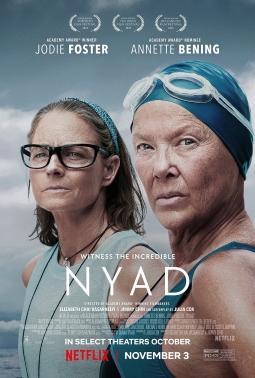
Diana Nyad was a champion endurance swimmer in the 1970s, but one major achievement eluded her: the 110-mile swim from Cuba to the tip of Florida at Key West. Estimated to take about 60 hours, it involves wild currents, difficult weather conditions and wild sea creatures with a support crew who can do nothing to help other than advise, keep her on course and provide food. The swim must be completed unassisted and without rest. A failed attempt in 1978 aged 28 was one of her last swimming feats for almost 30 years. Turning 60, Diana decides to dive back into the water and attempt it once again.
Nyad brings this story to the screen, refashioned into a comfortably feel-good sports biopic that presents Diana’s story within the expected framework of the cliches of the genre. There is almost nothing in Nyad that you haven’t seen before. Lessons are learned, people walk from the swimming campaign only to return for “one more adventure”, we discover there is no I in team and no solitary athlete ever truly works alone. Settle down for seeing the same sort of material you’ve seen in many other films before, and you won’t be disappointed.
The thing that makes Nyad different is the performances at its heart. Annette Bening (Oscar-nominated) trained for a year in preparation for this role, large chunks of which are spent watching Nyad charge forward through choppy open waters. On land, Bening skilfully balances Nyad’s prickly self-obsession with a vulnerability and fear of defeat. A demanding perfectionist who accepts no compromise, Nyad frequently rubs her team up the wrong way, but Bening never makes her unsympathetic. She’s a woman keen to prove something to the world and to herself, not least that age doesn’t define our horizons.
Our warmth to the tunnel-focused Nyad largely comes from the delightful chemistry between Nyad and her coach, ex-girlfriend and best friend Bonnie Stoll, delightfully played by the Oscar-nominated Jodie Foster. This is some of Foster’s finest work in years, an exuberant, playful, incredibly natural performance of a woman who is, in her way, as driven as Nyad, determined to protect her charge. It’s Bonnie who frequently needs to salve the wounds left by Nyad, hold the team together and make the difficult calls to continue or abort Nyad’s attempts. Foster’s performance is a burst of life in the film, providing its real heart.
The two dominate much of the film, although there is a room for a fine performance of curmudgeonly decency from Rhys Ifans as late navigator John Bartlett. But this is film that works best when focused on the two leads, be it Bonnie surprising Nyad with a birthday party, the two unashamedly celebrating watching a competitor’s attempt fail on television, Bonnie tending Nyad’s injuries, or the two arguing with the honesty that platonic life partners have. All of the film’s most memorable moments feature Foster and Bening bouncing off each other on land.
So, it’s a bit of a shame that a large part of the film takes place in the water. One of Nyad’s major failings is that it never really finds a way to make the act of swimming either truly dramatic of visually interesting. It is a tough challenge – after all, marathon solo swimming is (by its very nature) silent, monotonous, and in long stretches not exactly compelling to watch. But Nyad falls back too often into sequences that feel either artificial – look out there are sharks in the water! – or reliant on Life of Pi style visuals (no coincidence surely that film’s Claudio Miranda also shoots this one) to try and bring to life the hallucinations long-distance swimmers can suffer from after over 50 hours of non-stop physical effort. We get Bening swimming through magical light shows and an underwater Taj Mahal, but this feels like an attempt to give us something to look at rather than a flourish that gives insight into theme or character.
It’s a common theme of the film. Nyad often has watery-framed flashbacks to her younger self, pushed to achieve great things at an early age and suffering sexual abuse from her coach as a teenager. But, again, these revelations feel unconnected with the drama we are watching, making the repeated flashbacks to it feel unnecessary. The only time the subject comes up in the main plot line, Nyad brusquely closes the conversation down, insisting she has not been made into a victim and briskly moving on. The film concurs in wanting to avoid defining Nyad in any way by this abuse. But it does leave you wondering why in that case the film so frequently returns to the issue.
At times it feels like Nyad has struggled to turn the act of someone swimming into drama. Instead, it relies on those standard sporting movie events. The initial success, the struggle, the break-up, the lessons, the heart-warming triumph. Nyad doesn’t find any time to explore the on-going debate around Nyad’s achievement (her poor record-keeping led to Guinness Book of Records refusing to recognise it) but that would get in the way of the triumphant ending. It’s a middlebrow film that relies pretty much exclusively on its actors for spark: fortunately, especially in Foster’s case, they provide it.
 Movie Musings