
Tag: Joan Bennett

Father of the Bride (1950)

Father of the Bride (1950)

Gentle, well-made comedy is elevated by a star turn from Spencer Tracy

Director: Vincente Minnelli

Cast: Spencer Tracy (Stanley Banks), Joan Bennett (Ellie Banks), Elizabeth Taylor (Kay Banks), Don Taylor (Buckley Dunstan), Billie Burke (Doris Dunstan), Leo G. Carroll (Mr Massoula), Moroni Olsen (Herbert Dunstan), Melville Cooper (Mr Tringle)
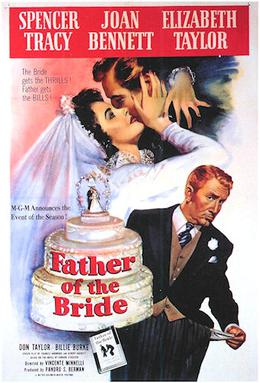
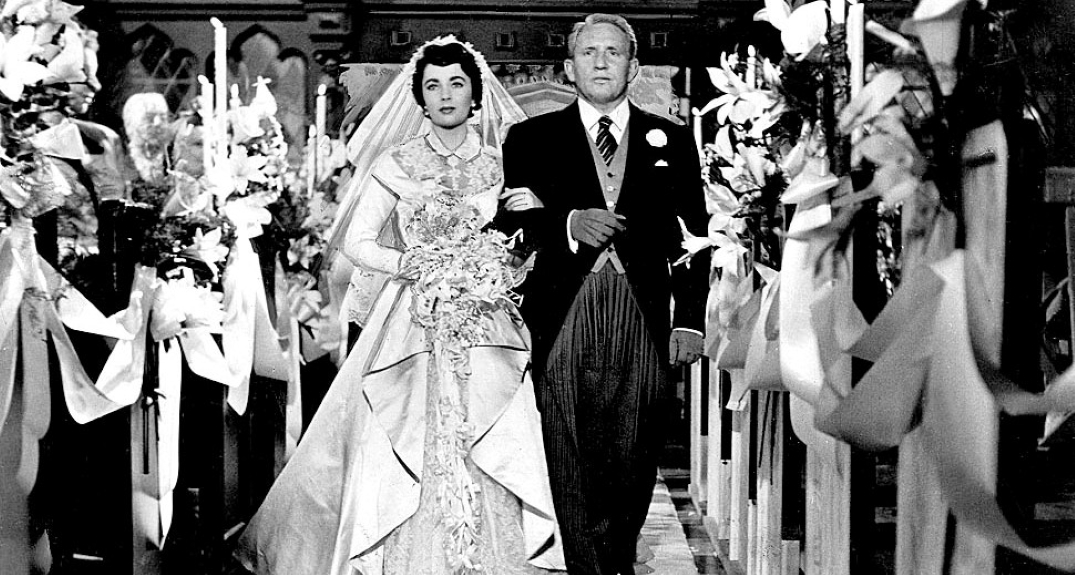
Apparently almost 70% of couples find wedding planning stressful. Perhaps they would be reassured to hear things haven’t changed much since the 1950s! Stanley Banks (Spencer Tracy) is a successful partner in a law firm whose domestic bliss is disrupted when daughter Kay (Elizabeth Taylor) announces she intends to marry boyfriend Buckley (Don Taylor). With the support of her mother Ellie (Joan Bennett), Kay dreams of a big church wedding – and Stanley is left counting the cost while struggling with his sadness at his daughter growing up and flying the nest for good.

Father of the Bride delightfully takes a simple idea and mines it for as much comic effect as possible. The structure is simple: the build-up to and staging of the wedding, with all absurdities of such things as fussy caterers and exacting church wardens pointed up. There are minor bumps and hiccups, but nothing that would make a viewer ever seriously worry that all will not turn out well. Instead, the film riffs on the constant exasperation of a father watching the plans (and cost) of the wedding spiral ever upwards, as more and more extras pile on top of others.

Much of its success is linked to Spencer Tracy, excellent as the eponymous father. The role was written for him and Minnelli demanded he should play it when producers suggested a more comic actor like Jack Benny might fit the bill better. (Katherine Hepburn did not take on the wife, though I can’t imagine she would found much to engage her in Joan Bennett’s underwritten role.) The entire success of the film revolves around our connection with Tracy, something never in doubt with his skill and assurance.

Minnelli cements this with an opening shot panning across wedding debris before craning up to introduce us to a fourth-wall breaking speech of resigned weariness from Tracy. His narrative voice is returned to again and again, as Tracy shares a wry and exasperated commentary. Father of the Bride is a testament to Tracy’s comic chops, his mastery of the micro-reaction providing constant laughs, from a look of disbelief across a dining table to one of shock as the latest bill flies in. It’s a hilariously effective performance, in which Tracy embraces the ridiculousness of farce. Like a practiced comedian he spays himself (three times) while attempting to open a coke or kids himself into believing he looks dandy in a morning suit several years too small for him.

But the performance – and the film – really works because Tracy also communicate its humanity. In his relationship with Elizabeth Taylor (suitably radiant as Kay, and full of a forceful personality she surely inherited from her father), Tracy makes clear his love for his daughter and his sadness at an end of an era: he won’t be ‘the man’ in her life anymore. Even with small inconsequential moments (such as Kay ignoring Stanley’s appeal to wear a coat before fetching it immediately when Buckley suggests the same), Tracy shows sadness dance across his face. The wedding is awash with bittersweet moments, with Tracy as harried host desperately attempting to speak with his daughter one last time before she leaves. Father of the Bride through Tracy’s performance mines a great deal of quiet, genuine emotion from a parent struggling with a child grown up.

It’s a bittersweet thread Minnelli’s film keeps pinging away under the comedy. Minnelli seems an unlikely choice (you’d expect a Cukor or Capra), but his skill with composition adds to the film without overwhelming the slender story with flash. The opening shot of wedding debris prepares us for the hustle and bustle of the big day, where a parade of carefully choreographed background events in the Banks’ house is as skilled as the bustling crowds of the event. Minnelli gives a Dali-inspired flair to Banks’ pre-wedding nightmare (his feet melting into the ground and clothes falling apart) and he plugs into Tracy’s reactive skill to frame these off-the-ball moments for maximum impact.

Editing also helps accentuate jokes. On hearing his daughter intends to marry, Banks reflects with horror on who this suitor might be, a montage of assorted suitors (from athletic, to bookish, to dancing) spooling past us. (The biggest joke now might be how utterly safe all these suitors are, the sort of lads you imagine fathers today would be desperate for daughters to bring home). Minnelli also fades in and out on blurry close-ups on glasses to communicate both the passing of time and Stanley’s rising inebriation (after a growing parade of martinis) when the Banks meet with Buckley’s parents.

This sort of comic energy helps carry the film very effectively. Of course it is all very simple – the 1991 remake added more moments of crisis and obstacles for the characters to overcome – and that can explain why events sometimes feel stretched out even over its slim 90-minute run time. For all the film’s tagline (“Bride gets the thrills; Father gets the bills!”) suggests frustration on Stanley’s part, moments where he weeds through a huge invite list (525!) or bemoans paying for an orchestra no one is listening to are generally underplayed (perhaps it was thought we could only sympathise so much before starting to think of Tracy as a penny pincher?)

But, overall, the film works very well indeed, mostly due to Spencer Tracy’s hugely effective performance – funny, endearing, likeable and hugely relatable with a perfect balance between comedy and emotional depth. It would have been nice to have had more of a contrast between Stanley and Buckley – when Buckley turns up to a heart-to-heart with father-in-law clutching a briefcase full of his work, I immediately thought ‘never has a woman more clearly married someone like her dad’. But what the film aims to do it, it succeeds at. And that’s to have some good-natured, heart-warming fun showing how even stars like Tracy can find weddings stressful.

Disraeli (1929)

Disraeli (1929)

Early talkie gives a melodramatic insight into a Victorian stateman, with an Oscar-winning star turn

Director: Alfred E. Green

Cast: George Arliss (Benjamin Disraeli), Doris Lloyd (Mrs Travers), David Torrance (Lord Probert), Joan Bennett (Lady Clarissa Pevensey), Florence Arliss (Lady Beaconsfield), Anthony Bushell (Lord Charles Deeford), Michael Simeon Viscoff (Count Borsinov)

Based on an Edwardian melodrama, Disraeli was the sound debut of George Arliss, a highly acclaimed British actor with a successful silent career. Unlike other silent actors, Arliss’ theatre training made him ready made to have his voice be heard around the world and his Oscar for Best Actor saw him ride the crest of the sound wave. Today, the film looks inevitably quite primitive, so careful to get the sound recorded that its camera barely moves from its fixed position in the ceiling-free sets. But Disraeli, for all this, is rather entertaining if you settle down to it despite its stodgy set-up still deeply rooted in its Edwardian melodrama roots.

It’s odd to read some reviewers describing Disraeli as a dry history lesson: there is almost nothing historical about the plot of Disraeli. While Disraeli did arrange the purchase of a controlling share in the Suez Canal, I can assure you he did not do it while dodging Russian spies in his own home, balancing a series of daring financial moves, laying cunning traps for scheming Russian agents or playing match-maker for his young protégé. Far from a history lesson, Disraeli is really a sort of Sherlock Holmesish thriller, with Disraeli recast as a twinkly wise-cracker constantly several steps ahead of everyone else. It’s a playfully silly set-up rather disconnected from history – and certainly far more fun than the actual dry history of financial and diplomatic negotiations.

Disraeli is a surprisingly well-scripted (as far as these things go) play, which mixes some decent jokes and creative set-ups with a liberal use of phrases from the eminently quotable Disraeli himself. You can’t argue with the wit of Disraeli (the man famously had dozens of entries in the Oxford Dictionary of Quotations) and the film bounces several bon mots around (‘That’s good. Perhaps I’ll use it with Gladstone’ Disraeli even comments on one of his own lines). There is wit in other moments, not least Lord Charles’s (Anthony Bushell) proposal to Lady Clarissa (Joan Bennett) which dwells so much on his charitable good works rather than any affections that Lady Clarissa is moved to comment she expected a proposal “not an essay on political economy”.

You can see its melodramatic roots all the way through. Secret talks about the canal are held in Disraeli’s house, in open earshot of a Russian spy Lady Travers (Doris Llloyd), who we later discover Disraeli is carefully leading on. Like a cunning Edwardian detective, Disraeli role-plays illness at one point to delay Lady Travers and resolves a last minute disastrous collapse in his payment scheme for the Suez shares with a swaggering bluff that he delightedly tells his amazed allies about the moment the duped Governor of the Bank of England (forced against his will to back the scheme) leaves the room. All this in a largely single-room setting: this is pure Edwardian theatrical melodrama bought to screen, not history.

It’s similar in its picture of history, here re-worked to position Disraeli as the sort of maverick hero we can immediately recognise from films. Disraeli is established as an outsider who no one in the establishment trusts (never mind he was the leader of the firmly establishment Conservative party, or that his rival Gladstone was seen by the crusty banker types in this film not as their saviour but as a dangerous radical). Despite being referred to as Lord Beaconsfield several times, he sits in the commons to face down Gladstone (an uninspired cameo by an unbilled actor). He is displayed as the sort of negotiating and diplomatic genius whose insights can only be responded to in wonder by Lord Charles, his dim Watson.

Like Sherlock Holmes, he lavishes Charles with backhanded compliments (specifically that his rigid honesty makes him the perfect agency for a secret mission because no one could believe he was up to lying). Like many Edwardian theatrical leads, he’s also an intense romantic. Not only deeply in love with his wife (played by Arliss’ wife Florence) but also at least as interested in making sure Charles and Clarissa end up happily married. Arguably none of that relates to the real Disraeli, a largely scruple and principle free opportunist with more than a few similarities to Boris Johnson (but with a sense of personal honesty and decency, Boris can only dream of).

The main point of interest today is George Arliss’ performance. For all its clearly a version of his stage performance, it’s still very engaging and charismatic. Arliss may deliver some of his lines like they are theatrical asides, and his mugging to a non-existent audience in Disraeli’s fake fitness is (while funny) clearly something that worked much better on stage. But he is twinkly, captures the shrewd intelligence of Disraeli and utterly convinces as a man who could run circles around everyone else. Arliss invests both the speeches and the dialogue with a genuine playful wit and a heartfelt honesty which works very well.

It’s entertaining and he looks very comfortable in front of the camera and he’s head and shoulders above the rest of the cast in terms of the light-and-shade he gives the dialogue. While the rest of the cast deliver their lines with the sort of forced formality that focuses on making sure the mic picks up every word, Arliss performs his lines. He’s got a sharp sense of comic timing, wheedles and boasts with real energy and isn’t afraid to chuck the odd line away. It’s a sound performance probably years ahead of its time.

The rest of the film is very much of its era. Green’s direction is incredibly uninspired. The camera set ups are very basic. The problems of sound can be seen throughout: from the awkward positions and formality of the camerawork to the occasional line flub that creeps into the soundtrack. Disraeli can look a lot like a filmed play, largely because it’s been set-up with such little focus on visuals. It’s reliance on title cards between scenes shows how fixed it still is on the clumsier parts of silent film-making. You could say, without Arliss, there would be very little to actually recommend it, for all there is the odd good line. But with him, it manages to be a little bit more than just a historical curiosity.

The Reckless Moment (1949)

James Mason and Joan Bennett feel Reckless Moment pulls them toward temptation

Director: Max Ophüls

Cast: James Mason (Martin Donnelly), Joan Bennett (Lucia Harper), Geraldine Brooks (Bea Harper), Henry O’Neill (Tom Harper), Shepperd Strudwick (Ted Darby), David Bair (David Harper), Roy Roberts (Nagel), Frances E Williams (Sybil)

It’s a situation anyone could find themselves in: your daughter is infatuated with someone totally unsuitable, and despite all your efforts you can’t get her to shake him off. What’s perhaps more unusual is when the man turns up dead after an accident – but in such a way it looks like your daughter has bumped him off. What lengths will you go to, to save her from prison? That’s the problem faced by Lucia Harper (Joan Bennett) – and it’s made even more complex by the fact that the truth is out there and she’s being blackmailed by surprisingly sensitive small-time crook Martin Donnelly (James Mason), who finds himself developing feelings for Lucia.

Max Ophüls’ The Reckless Moment is an enjoyable enough noir-thriller, that mixes a wonderful sense of its locations with a perverted romanticism that first expresses itself through the daughter’s infatuation with a pathetic bent art dealer and then through the love blackmailer Martin Donnelly feels for his victim (and she for him). But it’s also a film about women, and how alone they can be when dealing with problems. Lucia’s husband is a never-seen presence on the end of a phone (busy building a bridge in Germany), her father-in-law is charming but useless and the two other men are criminals intruding into her life.

In fact this is quite ahead of its time with its thinking around women. Far from the usual tropes of a femme fatale, instead Mason takes on that role, while the mother turns out to be practical, brave and dedicated to keeping her family safe – while still more than a little open to illicit feelings of attraction. Lucia still has to balance all this with putting up a front of domestic business-as-usual with her family, not letting them see even a trace of the problems (including her daughter who is blissfully unaware of the situation she has landed her mother in). 

Ophüls’ directs this with a moody intensity, with a wonderful use of the LA backgrounds, particularly of the boat landing where much of the crucial action takes place. His camera placement is impeccable, and he finds a number of interesting and striking angles to throw events into a sharp relief. It’s a beautifully shot film, with wonderful use of black and white, and hints of Ophüls’ background in German expressionist cinema. His camera constantly manages to put us in the shoes of Lucia with tracking shots (another Ophüls’ trademark) loyally following her actions and placing the viewers into her perspective of events to help build out bonds with her. 

It’s a bond that obviously Donnelly ends up feeling very strongly tied to. James Mason enters the picture surprisingly late, and the film’s short length (less than 80 minutes) means many of the developments around the blackmail end up feeling rather rushed. Perhaps the plot didn’t even need the blackmail angle – there could have been more than enough tension of Lucia dodging the police case that surely should have built around her. Instead, the blackmail plot often feels rather forced, not least due to the build of a romantic subplot between the two characters.

It’s a romance that never quite rings true, partly because we never get the time for it to breathe. It seems forced and bolted onto the film because it is expected, rather than something that grows organically. It leads to sudden plot leaps, with Donnelly moving swiftly from business like to buying gifts and even offering to pay part of the blackmail for her to his shady boss. I’m not sure that the film ever earns this leap with its rushed runtime. It never pulls together into a romance that we can really believe in – and Lucia is such a carefully restrained and standoffish character that we don’t always get a sense of the emotions that she is carrying below the surface. 

Despite this Joan Bennett does a decent job as the heroine, an intriguing and rather admirable character who gets caught up in wild and crazy events but never lets them overwhelm her. Indeed, Ophüls’ stresses her calmness and practicality at several points, never shaken by demands of events and responding with ingenuity and calm to a range of circumstances. Bennett might not be the most charismatic actress, but she does a very good job here. James Mason struggles slightly with his slightly incoherent character arc, but as a reluctant heavy he does a marvellous job here, while mastering the sense of ruffled, shabby charm Donnelly has. It does help believe that he might contribute to a reckless moment of attraction from Lucia.

The Reckless Moment is a well-made B movie, that Ophüls’ adds a great deal to with his empathy for Lucia and stylishly smooth film-making. It makes for a very polished film, which on its actual character and plot beats doesn’t really always make a great deal of sense – rushing us into relationships and feelings that it doesn’t always feel the film justifies. But despite that there is just enough style here, even if this is always a film destined for the second tier of classics.