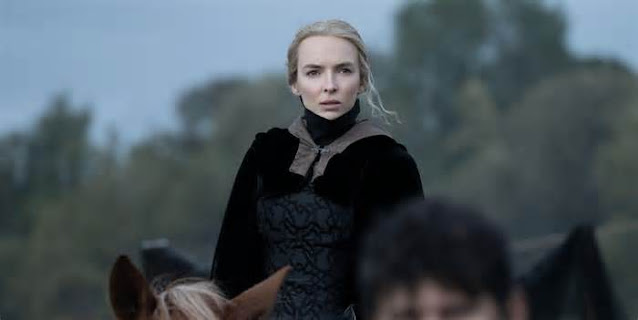
Tag: Jodie Comer

28 Years Later (2025)

28 Years Later (2025)

Belated sequel successfully compliments gore with thoughtfulness and surprising sensitivity

Director: Danny Boyle

Cast: Alfie Williams (Spike), Jodie Comer (Isla), Aaron Taylor-Johnson (Jamie), Ralph Fiennes (Dr Kelson), Edvin Ryding (Erik), Chi Lewis-Parry (Samson), Christopher Fulford (Sam), Amy Cameron (Rose), Stella Gonet (Jenny), Jack O’Connell (Jimmy)

Following on not quite 28 years since the original (23 Years Later wouldn’t have had the same ring to it), 28 Years Later sees Danny Boyle return to the post-apocalyptic hell-scape that is a Britain over-run by rage-infected, super-fast, permanently-furious, adrenaline-filled humans (don’t call them zombies!). But those expecting a visceral, gut-punch of blood-soaked violence may be in for a surprise. 28 Years Later is a quieter, more thoughtful film, where the battlefield is for the sort of values to embrace in a world gone to hell.

After a viciously terrifying opening set on the day of the original outbreak – in which vicar’s son Jimmy flees, terrified, from his home after a gang of infected literally rip-apart or infect his family sand terrified telly-tubby-watching friends – we flash-forward decades. Britain is now quarantined and nature has reclaimed large chunks of the land. The few remaining survivors live in protected communities, like a group on Lindisfarne, protected by a causeway flooded at high tide. In the community, 12-year-old Spike (Alfie Williams), is taken to the mainland by his father Jamie (Aaron Taylor-Johnson) to claim his first infected kill, while his confused and ill mother Isla (Jodie Comer) sits at home. But Spike will learn things about himself and his father on the mainland – enough for him to decide to risk taking his mother to meet with the mysterious Dr Kelson (a magnetically eccentric and softly-spoken Ralph Fiennes, in a performance that defies all expectations), who lives in isolation and may just know how to cure her.

Boyle’s film is kinetic and vicious at points, but also has a magnetic beauty as his camera flows across a world in some-ways unchanged from 2002 and in others utterly alien. Scavenged supplies are full of technology from the earlier noughties. The remains of things like Happy Eater restaurants are everywhere, and (proving not everything is bad) the Sycamore Gap tree remains standing. Buildings and villages are overgrown with plant-life and trees. Colossal herds of deer – enough to shake the earth – roam the countryside. In many ways the future is once more the green and pleasant land, with the Lindisfarne community sharing supplies and relearning skills like farming and archery (echoing the days of Henry V, with Boyle calling back to this with a series of shots from OIivier’s film, it’s a compulsory skill as the safest way to kill infected).

There is no chance of salvation or change here. That’s made very clear to us, with the Act Two arrival of Edvin Ryding’s scared Swedish soldier who tells us plainly that being stranded on the island is a death sentence. The world has left Britian behind and they way Erik describes it, all iPhones and Amazon deliveries, is as familiar to us as it is utterly incomprehensible to young Spike. This is not a film about fixing, averting or liberating the island. It’s a film about existing in a permanent state where mankind is no longer the apex predator.

Boyle’s film, with an excellent and thoughtful script by Alex Garland, is therefore all about defying expectation. Spike’s journey with his father is less about a terrifying chase from hordes of infected (though there is plenty of that), or him hardening himself in a brutal world. Instead, it’s about Spike’s nagging doubts about his father being confirmed. Aaron Taylor-Johnson is a very good as a man who is brave and protective, but morally weak and desperate for approval. He’s the sort of man who harangues his son into executing restrained infected (even children) and takes every opportunity in between dutiful caring for his wife, to slip off to his girlfriend. A man who brags on their return as if his son was some sort of Hercules, when Spike knew he spent most of his time missing with his arrows and in a constant state of terror.

28 Years Later captures that sinking feeling children can have when they realise beyond doubt that their parents aren’t perfect. Alfie Williams is excellent as a caring boy, who doesn’t see sensitivity and humanity as weaknesses in the way you suspect his father does. Who sees through his father’s need to promote himself and is disgusted by it. And finds himself drawn closer to his sick mother (a carefully vulnerable performance from Jodie Comer) and finding he has more affinity for a world that still has a place in it for decency, where going back to help someone is not written off as foolishness.

It’s a film that raises fascinating questions about the infected themselves. While millions of infected passed away – their rage filled minds unable to carry out basic tasks like eating or drinking – the small percentage who survived, seemed to retain enough of themselves to maintain some sort of life. They move in herds – or, as some of the obese ground-crawlers do, in a bizarre family unit – and they even have leaders. ‘Alphas’ – those who the disease caused to grow to humongous proportions (in every organ) – direct their charges. And they have intelligence: our main Alpha ‘Samson’ enraged at the death of his comrades, holds back from an attack until the moment is right, mourns the loss of a female infected and maintains a relentless pursuit for reasons we’d recognise from thousands of movies.

28 Years Later uses this to force us to ask questions about ourselves and when human life ceases to matter. To Jamie, the infected have ceased to be human and killing them a duty. But Spike is forced to start to ask: what right do we have to decide there are less human than us, these people who were like us perhaps moments before? Beyond self-defence, is killing them as noble as all that? 28 Days and Weeks Later featured the instant slaughter of anyone with even a suspicion of infection. Years questions this like never before. Everyone on this island is a victim, and the infected deserve just as much memoralizing as victims as the uninfected.

It makes for a surprisingly quiet and meditative drama – even if it is punctuated by moments of shocking blood and gore, from heads and spinal cords being ripped out to a blood-spatted TellyTubbies screening in a vicarage – and one that demands you think almost more than it demands you be thrilled. With exceptional performances, especially from Alfie Williams, it’s a different but mature sequel that redefines aspects of the series. And, based on its jaw-droppingly bizarre ending, its sequel will only take this thinking further.

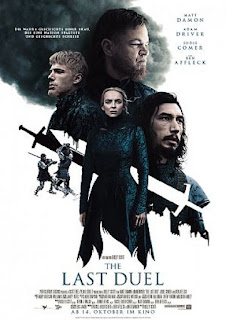
The Last Duel (2021)

The Last Duel header1
Adam Driver and Matt Damon fight The Last Duel in medieval France

Director: Ridley Scott

Cast: Matt Damon (Sir Jean de Carrouges), Adam Driver (Jacques Le Gris), Jodie Comer (Marguerite de Carrouges), Ben Affleck (Count Pierre d’Alencon), Harriet Walter (Nicole de Buchard), Alex Lawther (King Charles VI), Marton Csorkas (Crespin), Željko Ivanek (Le Coq), Tallulah Haddon (Marie), Bryony Hannah (Alice), Nathaniel Parker (Sir Robert de Thibouville), Adam Nagaitis (Adam Louvel)

The medieval era had its own solution for “He said, She said”. Let God decide via a fight to the death. After all, He would never let the injured party lose, would he? Scott’s The Last Duel is a dramatisation of one of the last French judicial duels, in December 1386, between Sir Jean de Carrouges (Matt Damon) and his former friend Jacques le Gris (Adam Driver), after Le Gris is accused of raping Carrouge’s wife Marguerite (Jodie Comer). Scott’s Rashomon-inspired film shows the events leading up to the duel from all three characters’ perspectives.

The three different stories we see are not radically different. Unlike Rashomon – which presented totally different versions of the same events, according to the prejudices or agendas of the storytellers – The Last Duel’s versions stress subtly different reactions or presents different fragments of an overall story. So, for instance, Le Gris and Carrouges remember different elements of a battle. Carrouges recalls the noble charge to save the innocent, saving Le Gris’ life in the final stages of combat. To Le Gris it’s a suicidal charge, in which he saves an unhorsed Carrouge’s life. After the rape, Carrouge remembers offering his wife sympathy; she remembers his anger and demand they have sex at once to “cleanse her” of the stain.

These mixed recollections work best when we see each of them remember a fateful reconciliation meeting between Le Gris and Carrouges (where Le Gris and Marguerite first meet). A wedge has been driven between them ever since Carrouges believed Le Gris cheated him out of both land and his father’s former position. When the two agree to try and put the past behind them, Carrouge asks Marguerite to give Le Gris a kiss of peace. He remembers her surprise and timidity. Le Gris remembers her as being quietly excited with a kiss that lingers. Marguerite remembers a kiss from Le Gris that lingers too long. Small moments like this are where the film is at its strongest, making its concept feel very relevant today in our world of accusation and counter accusation.

But these moments are few and far between. Most of the time there isn’t this subtle variation. Where the film is weakest is when we (frequently) see the same events, presented the same way, three times. While our perception of Carrouges changes – from the ill-treated noble he sees himself to the sullen, self-entitled whiner everyone else sees – our idea of Le Gris is fundamentally the same (blissfully self-entitled). Fundamentally, when we see events the first time, later versions only really tweak our perception of them rather than challenge it.

You can see this in the rape itself, which we first see from Le Gris’ perspective. The film shows Le Gris’ understanding of consent has been twisted by most of his sexual experience being court orgies with playfully protesting prostitutes. His pursuit of a genuinely unwilling Margeurite around her room echoes exactly the pretend-chases and “chat up lines” he’s used in those earlier scenes, so we understand it’s possible he doesn’t actually understand he’s raped her. But no viewer can see Le Gris’ version as anything other than rape. In fact, the only tangible difference when we see the event from her perspective is that her screams of “No” and “Stop” are louder and the camera focuses more on her anguished face. If the film is presenting any tension about whether this is a consensual encounter or rape, it ends the second we see Le Gris’ story.

This negatively effects the drama – and actually makes Marguerite’s version seem strangely superfluous. You start to feel we might as well see all three perspectives at the same time, as the narrative trick ends up adding little to the film – especially since the film categorically states Marguerite’s version is the truth. Why not just tell the whole film from her perspective in that case? It also doesn’t help that Marguerite goes last – which means until an hour into the film, the character we should be most engaged with and sympathetic towards has stood on the side-lines.

This is particularly unfortunate as the film is striving for a feminist message. The men are callous and self-obsessed, treating women as sex toys or assets – and are praised for it. Marguerite though is intelligent and principled, marginalised by her husband and condemned as a whore when she protests her rape. She pushes her case with determination, despite discovering she will be condemned to burn if Carrouge loses (he of course is only in his own honour). Her word is only good if backed a man, and she is powerless to defend her innocence.

It’s the lot of medieval women. Harriet Walter (rocking a bizarre appearance, straight out of David Lynch’s Dune) as Carrouge’s mother tells Marguerite the same thing happened to her, but she considered it pointless (and dangerous) to press charges. What we see of the judicial system is ruthlessly unjust and misanthropic, with women harangued to confess their guild for tempting men.

But it doesn’t quite click together. It’s a shame, as many scenes are highly effective. The rape – both times we see it – is alarming. The final duel is brilliantly shot and hugely tense, not least because Marguerite stands literally on the top of an unlit bonfire watching every blow. Scott’s shoots the film with the same blue-filtered beauty he gave to the early scenes of Kingdom of Heaven.

There is of course an oddness in seeing such American actors as Damon, Affleck and Driver in period setting. The accents are an odd mix: Comer basically uses her regular (non-Scouse) performance voice, Damon does a gravelly version of his own, Walter an American twang to match Damon, Affleck is halfway to plummy Brit, Driver flattens his Californian tones. Damon is pretty good as the sulky, surly Carrouge who gets less sympathetic the more we see him, Driver is suitably charming on the surface but selfish. Comer plays wounded injustice extremely well and brings a lot of emotion to a difficult role. Affleck has the most fun, flouncing around in a blonde wig as a lordly, hedonistic pervert who likes nothing more than belittling Carrouge.

The Last Duel is part way to a decent film, but it just lacks that little bit extra to make it really come to life. Its alternative versions of the truth don’t illuminate as much as they need to – even if they are at points pleasingly subtle in their differences. It has an admirable feminist message, but defers most of it to the second half of the film (were they worried about sidelining the famous male actors?) and it’s concern that we should not doubt Marguerite at any point does undermine its drama. Handsomely filmed, it doesn’t make the impact it should. Perhaps that’s why it was one of the leading box office disasters of the Covid Pandemic?