
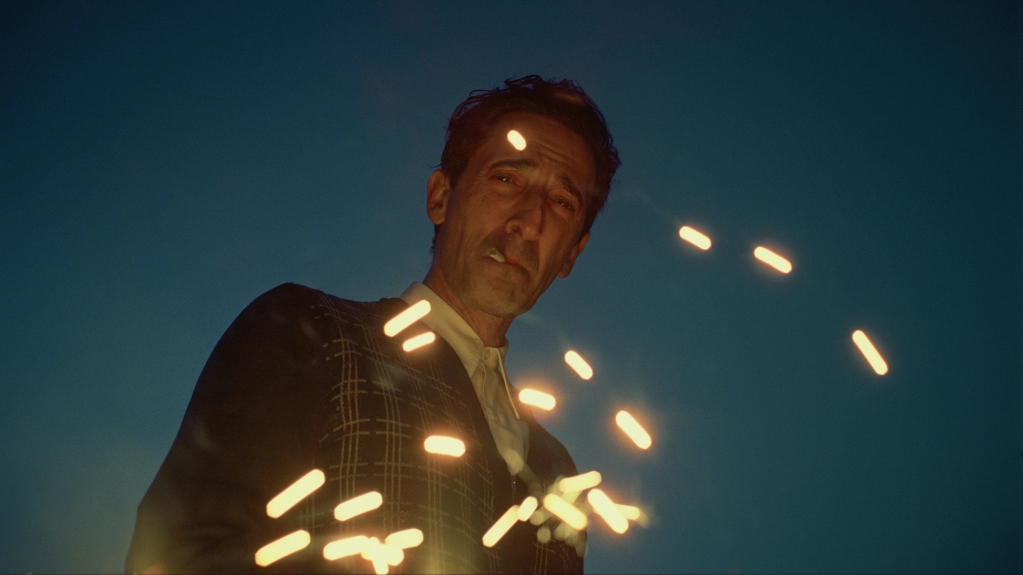
Stunningly filmed, ambitious epic brilliantly unpacks patronage, immigrant experience and the American dream
Director: Brady Corbet
Cast: Adrien Brody (László Tóth), Felicity Jones (Erzsébet Tóth), Guy Pearce (Harrison Van Buren), Joe Alwyn (Harry Lee Van Buren), Raffey Cassidy (Zsófia), Stacy Martin (Maggie Van Buren), Alessandro Nivola (Attila Miller), Emma Laird (Audrey Miller), Isaach de Bankolé (Gordon), Ariane Labed (Adult Zsófia), Michael Epp (Jim Simpson), Jonathan Hyde (Leslie Woodrow), Peter Polycarpou (Michael Hoffman), Maria Sand (Michelle Hoffman)
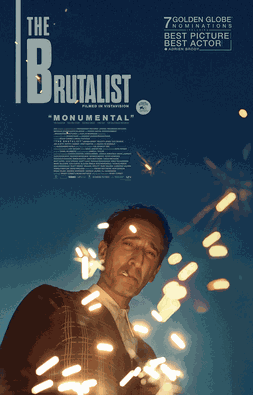
As long as there have been artists, there have been patrons: wealthy men who provide the finance for the artist to create. The relationship between them has quietly defined our cultural history, the legacies of famed artists whose work fills galleries and public spaces coming about due to the wealth and ego of those behind them. It’s one of many themes explored in Brady Corbet’s epic The Brutalist, the mix spiced by placing its powerless, traumatised artist as a friendless stranger in a strange land, escaping a lifetime of persecution: a Holocaust survivor making a new start in the Land of the Free.
László Tóth (Adrien Brody), a famed Jewish Hungarian architect who narrowly survived the inhumanity of Buchenwald, arrives in America in 1947. Greeted with exploitative warmth by his wife Erzsébet’s (Felicity Jones) cousin Atilla (Alessandro Nivola), an Americanised furniture salesman, László’s skills are poorly exploited until Atilla is commissioned to build a library for billionaire Harrison van Buren (Guy Peace) by his son Harry (Joe Alwyn) as a surprise birthday present.
Van Buren, who loathes surprises, reacts with rage until, years later, an architectural magazine commends László’s library as a work of genius. László, thrown out by Atilla (who blamed him for losing the van Buren’s as clients) is hired by van Buren to build a gigantic community centre: a concrete cathedral on a hill. Van Buren helps arrange the immigration of Erzsébet in the country, but both Tóth’s discover van Buren’s darkly sinister passion is control, the two struggling against constant obstructions and László’s self-destructive qualities in a country where they are always strangers.
Corbet’s epic film partly becomes an exploration of the struggles of an outsider in a new land. It’s made abundantly clear that, far from a land of equality, America is a country of fierce hierarchies where those with money and power have almost complete autonomy to do whatever they want, and those at the bottom can be bought and sold. And few are as low and unwanted as the immigrant (it’s striking László’s closest friend is Gordon, a unemployed Black single father, another walking symbol of the underclass).
Corbet signals all in America will not be plain sailing on László’s arrival at New York – after a virtuoso tracking shot (one of many in this lusciously filmed epic) – László stumbles out to the deck of the boat and cranes upward, the camera following him to see an upside-down vision of the Empire State Building. This is not an image of hope and expectation. The immigrant, even the Holocaust survivor, is an unwelcome figure. Alessandro Nivola’s Attila has bent over backwards to hide his roots – changing his name and accent and pouring all his self-loathing into the thin charity he offers László (a poorly furnished room at the back of his shop, a blasé offer of an invite to the odd meal). Flashes of generosity don’t hide the fact László is first for any blame.
It’s just a warm-up though for László’s life as architect-in-residence for Harrison van Buren. Played with a smarmy grandiosity with a streak of reptilian cruelty, Guy Pearce makes Harrison a true monster, a Medici for the modern ages with László as a Michaelangelo, whose flourishes are tolerated only while his artistry reflects glory onto Harrison. Harrison, with his studied references to art, understands he has no legacy of his own (other than money) and demands one created for him by László. It’s his name that will be on the van Buren centre, his glory that will be embodied by it.
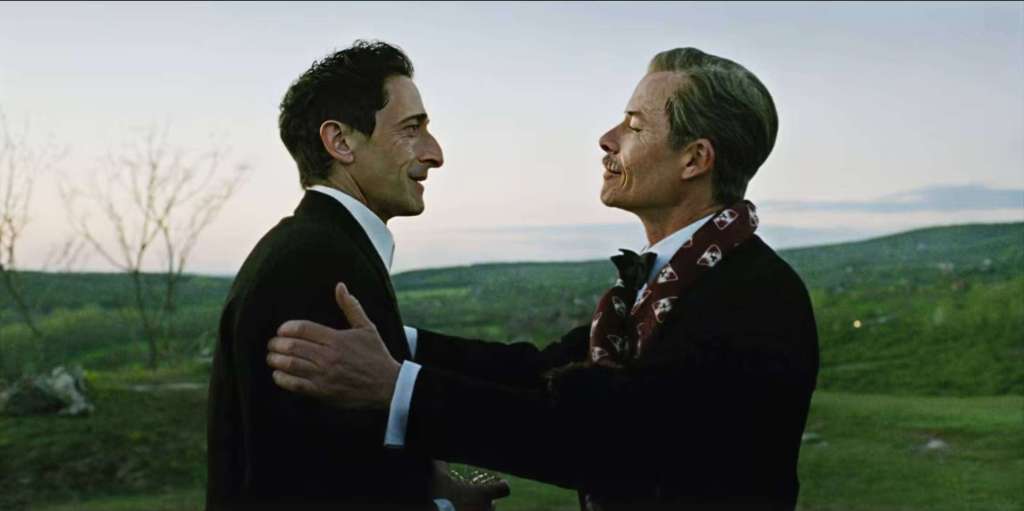
Van Buren, like many powerful businessmen, talks art but his real interests are control and power. Asserting his control over László, as if wanting to absorb his creativity into himself, is crucial to him. This sees him set up László in a poorly furnished house on his estate like a pet, interjecting tiny modifications and his own controlling placemen into the project, revelling in his control over every element of László’s life. He takes a sadistic pleasure in alternating praise (his constant refrain of the greatness of László feels incredibly self-aggrandising, as if László was just another one of his bottles of fine wine) and casually cruel jibes at his accent, dress sense and lack of drive.
These are qualities instantly recognised by Erzsébet, played with a fiercely restrained passion by Felicity Jones. Open-eyed at the restrictive oppression of van Buren over her husband – after decades of first the camps and then the brutal oppression of Soviet Hungary – it is she who has more overt fight then the naturally quiet, oppressed László brings. But even she knows they are dependent on van Buren’s patronage to exist (especially after her husband’s offer to sacrifice his salary to maintain crucial elements of his design is gladly accepted), urging her husband that he must do everything possible to maintain van Buren’s passion and interest. She knows to the tasteless van Buren this cathedralic construction is little more than a kitchen renovation.
The building itself is an intriguing concrete monolith, that slowly takes shape over the course of the many years the film covers, like a medieval cathedral. Imposing pillars, and vast ceilinged rooms tower above the skyline. It’s hard to shake the feeling that, for all the passion and fire László pours into its building, it feels a dark, punishing place. Its structures reflect the concrete towers of death camps. This committed Jew might be pouring years of his life into a building crowned by a colossal cross. Its bowels fill like the water sewers so many of his people were forced to try and escape through. Its rooms feel less inviting and more like prisons with the hope of skylights and vast upward spaces. It feels at times that the building itself is a tribute to the psychological damage László has had inflicted on him by his experiences.
Experiences he cannot bring himself to speak about. His scars are less visibly clear than the wheelchair Erzsébet has been confined to, or the wordless dumbness his niece Zsófia, wonderfully played by Raffey Cassidy, suffers. But it’s there in every inch of Adrien Brody’s tortured face. Few actors are more perfectly suited to embody tortured, long-suffering perseverance than Brody (his famously broken nose is even worked into the script), and László is a tour-de-force, an austere, proud man who will not beg but also will not fight, who on some level accepts repression.
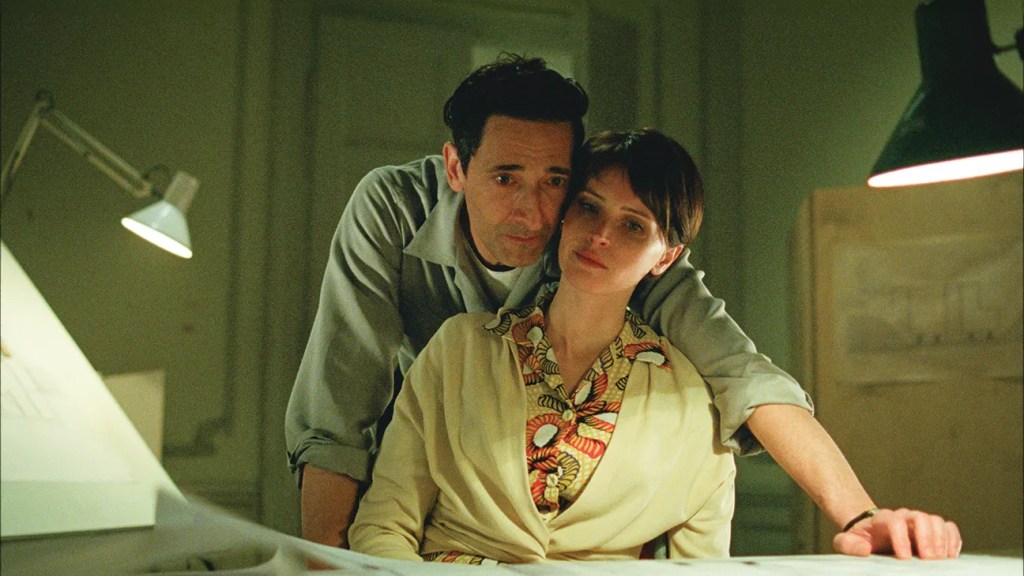
Brody’s Oscar-winning performance is a portrait of a mix of unacknowledged PTSD, self-destructive impulses (he remains a heroin addict for much of his life), survivor’s guilt and a quiet willingness to accept abuse that makes him a life-long victim. From the chaos of his own life, full of trauma, his art is all about clear, clean, ordered lines. His genius is also his curse, lifting him to the attention of monsters who exploit and take advantage of his talents for their own ends and offer him no loyalty in return. While The Brutalist could suggest László has his own secret intentions with his grand construction, the film could just as well close in its epilogue that László is trapped, wordlessly and powerlessly, within the giant edifices he has built, doomed to continuously relive in different ways the horrors of his experiences during the war.
László’s whole life feels like a quiet inversion of the American Dream. The idea that anyone can come to the country and make a future for themselves is for the birds. It’s all a roll of a dice and depends on entirely on chance and whim: without a magazine taking an interest in van Buren’s library, László could have just as easily died as an obscure docks worker. America is shown as no land of opportunity, but one where those in power control everything, get away with anything they please and pass their power and influence on to their children. Where László and his like are tolerated as exotic points of interest at the dinner table, but are never really equals. Van Buren exploits and uses László for as long as his interest holds and humiliates him (and much worse) at any point when the architect starts to forget that he is not just an extra in van Buren’s American dream.
These complex and fascinating ideas and interpretations line the walls of Corbet’s own grand edifice: The Brutalist is a film of powerful epic sweep, stunning VistaVision images and looming, ominous intensity. Stuffed with wonderful performances, it’s the sort of ambitious, epic film-making that the cinema sorely needs to hold its place as an art-form. And in its sweep and Hopper-esque artistry, it’s a superb advert for American film-making.
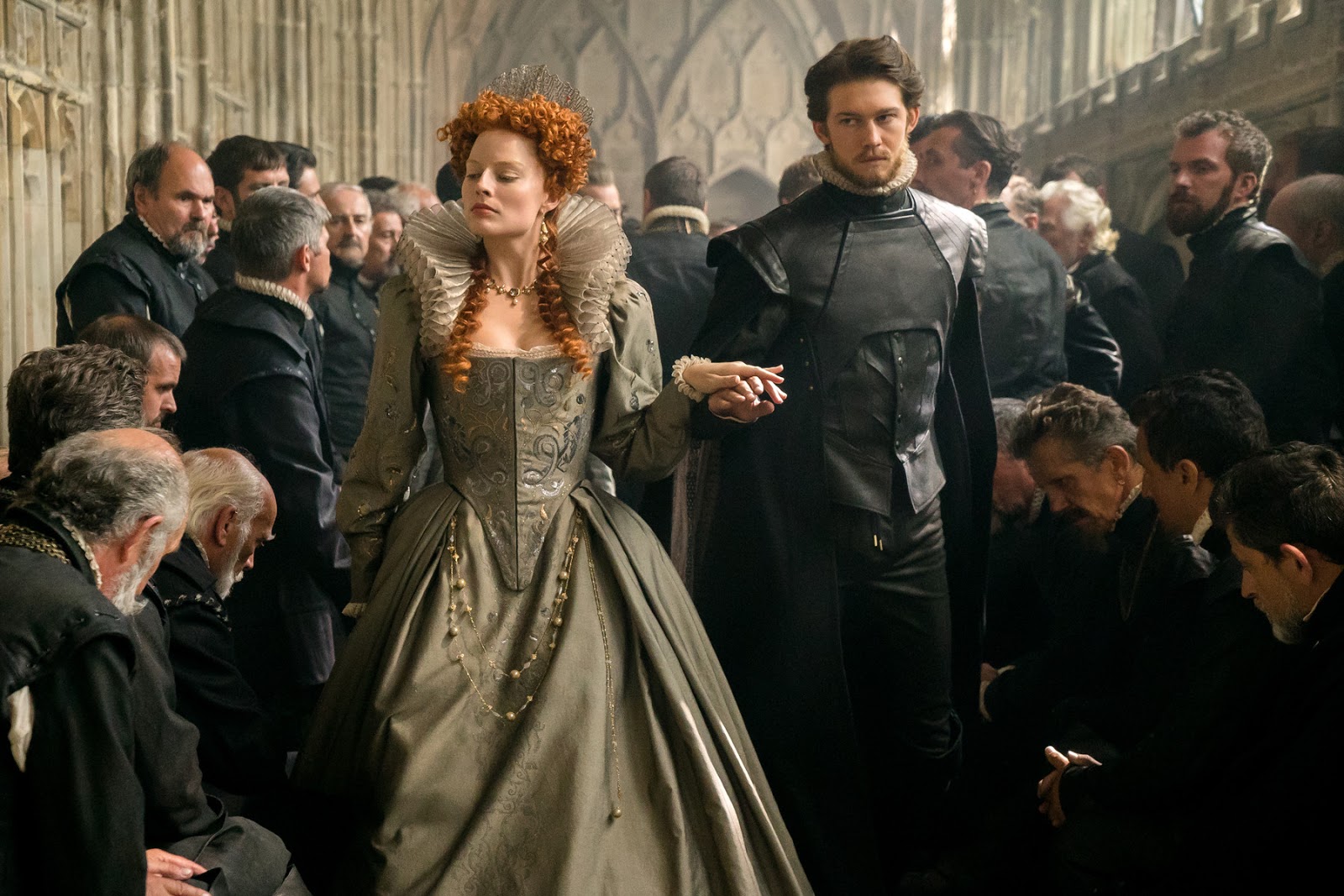
 The history of the Tudors has been mined so often by film and theatre that there can hardly be any hidden stories left to tell, barely any twists that can be unveiled or reimaginings that haven’t already been imagined. Mary Queen of Scots certainly fails to find any new angles on its oh-so-familiar tale, and even its attempt to rework events and characters keeps banging its head on those damn, unchangeable real events that spoil the story it seems to want to tell.

 Movie Musings