Tag: John Boyega

The Woman King (2022)

The Woman King (2022)

Punchy historical action epic is very entertaining (if not hugely original narratively) as well as being a triumph of representation

Director: Gina Prince-Bythe

Cast: Viola Davis (General Nanisca), Thuso Mbedu (Nawi), Lashana Lynch (Izogie), Sheila Atim (Amenza), John Boyega (King Ghezo), Hero Fiennes Tiffin (Santo Ferreira), Adrienne Warren (Ode), Jayme Lawson (Shante), Masali Baduza (Fumbe), Angélique Kidjo (The Meunon), Jimmy Odukoya General Oba Ade), Thando Dlomo (Kelu), Jordan Bolger (Malik)

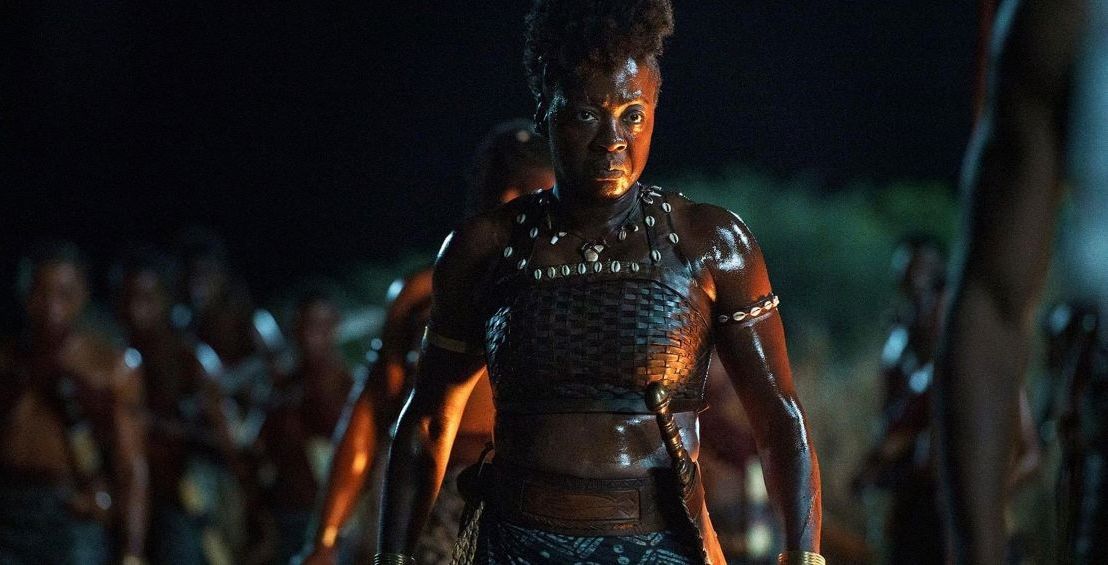
It’s 1823 in the West African Kingdom of Dahomey. The kingdom is trapped in the middle of a host of competing interests: most notably the rival Oyo empire and the European slavers controlling the region’s main port. Dahomey depends for its security on the Agojie, an elite group of women warriors commanded by their respected general Nanisca (Viola Davis). War brews between Dahomey and Oyo, and Nanisca is pushing King Ghezo (John Boyega) to end Dahomey’s involvement in the slave trade. At the same time, a new Agojie recruit, Nawi (Thuso Mbedu) brings memories of past traumas flooding back to Nanisca – might she and Nawi have some lost bond?

The Woman King is a pulsating action film, a mixture of Braveheart and Black Panther (it even has a cold open, as the Agojie storm an Oyo village to save captured Dahomey citizens bound for the slave ships, that feels like a straight lift from the latter film’s opening). Proudly celebrating both women and black people (men are very much in secondary roles, while the only white character is a hypocritical slaver played with relish by Hero Fiennes Tiffin), it’s a punch in the solar plexus for what’s been a male-dominated genre.

Watching it I suddenly realised, half-way through, that if the film had been made 10 or 15 years ago, the plucky new recruit having to prove she belonged among the Agojie would have been played by a white actress. There would have been a flashback to the child being found by the Agojie and then a montage of her searching from fear to longing to emulate the women around her. Like Cruise in The Last Samurai, she would have become the best-of-the-best, accepted by her new black sisterhood. It’s a triumph that Hollywood no longer needs stories like this filtered through white eyes before they would even consider bringing them to the screen.

Instead, the focus is strongly on a story that wants to celebrate the rich culture and history of African kingdoms. Dahomey’s civilisation, advanced farming and irrigation, egalitarian culture and humane religious and spiritual practices, are shown in loving detail. Their tenuous position as a small kingdom surrounded by rivals is carefully presented, just as the corrupting nature of European powers is made clear. It is they who have turned slavery – an ever-present in African history – into an industry that dominates the African economy and has led to a subtle devaluation of human lives that many Africans openly collaborate in.

In this, Prince-Bythe’s tightly directed film juggles a coming-of-age story for Nawi with a coming-to-terms story for Nanisca. It’s a film that manages to present both in the context of a series of action set-pieces and exciting training montages (the Agojie effectively have to complete a massive obstacle course to qualify as a member of the sisterhood). To be honest, much in the film isn’t really that original, more a remix of set-pieces and ideas from similar films. What makes it stand out is the representation and the context where it is taking place.

It also allows impressive actors to take on roles way outside of public expectations. None more so than Viola Davis, whose pumped up physique shatters any perceptions of what you might expect. This is a tour-de-force role from Davis, as she plays a defiant and strong woman, secretly terrified of trauma in her own past (and worries about her own weakness) who leads by charismatic example, but is just as capable of unjust slap-downs. She’s a woman struggling to embrace all facets of herself, doing so in the spotlight of a whole country looking to her for leadership. It makes for a powerful performance from Davis, perfectly fusing her skill at playing matronly warmth, imperious distance and deep reserves of determination and courage.

There are similarly excellent performances from a uniformly strong cast, with Lashana Lynch a stand-out as a courageous fighter who surprises herself with her mentorship abilities. Thuso Mbedu gives a star-making turn as Nawi, a young woman who matches Nanisca for bull-headedness and suppressed self-doubt, who reveals herself as a natural leader. Shelia Atim is excellent as Nanisca’s level-headed trusted number two, while John Boyega walks perfectly a fine-line of a man teetering between being a wise leader and a playboy.

They are helped by a film that may lack originality in its plotting and structure, but makes up for that with its warmth for its characters, and the gritty, involving realism of its shooting. Prince-Bythe keeps the pace of the film running smoothly and stages each of the film’s many set-pieces with a dynamism that keep you on the edge of your seat. She also successfully manages to incorporate some searching material around Nanisca’s past traumas without being exploitative.

Historically, the film is a little dubious, walking a carefully curated line on Dahomey’s involvement in slavery (in many ways it might have been better if the film was set in a fictional kingdom inspired by Dahomey). It doesn’t dwell on the Agojie chaining up their captives to be shipped to the slavery markets. It pushes an anti-slavery message strongly – but ignores the historical fact that the real Ghezo continued in the trade until the bitter end. (Legitimate points could have been made about his right to the same compensation as plantation owners elsewhere.) There is a complex, difficult story here that the film romanticises into something with cleaner rights and wrongs.

But, with a history of poor representation and white-only-lens view on African culture in film, you can forgive a film aiming to redress that balance. Strongly directed, exciting and crowd-pleasing, with well-drawn characters played with real skill by a very strong cast, it might recycle many ideas from other films, but it does it with a compelling freshness.
Star Wars: The Rise of Skywalker (2019)

Our heroes prepare for one final adventure in Star Wars: The Rise of Skywalker

Director: JJ Abrams

Cast: Carrie Fisher (Leia Organa), Mark Hamill (Luke Skywalker), Adam Driver (Kylo Ren), Daisy Ridley (Rey), John Boyega (Finn), Oscar Isaac (Poe Dameron), Ian McDiarmid (Palpatine), Billy Dee Williams (Lando Calrissian), Anthony Daniels (C-3PO), Naomi Ackie (Jannah), Domhnall Gleeson (General Hux), Richard E. Grant (Allegiant General Pryde), Lupita Nyong’o (Maz Kanata), Keri Russell (Zorii Bliss), Joonas Suotamo (Chewbecca), Kelly Marie Tran (Rose Tico)

When Disney took over the control of the Star Wars franchise, they had in mind an epic continuation of George Lucas’ space opera that would take in everything from more tales from the renamed “Skywalker saga” to standalone entries like Rogue One and Solo. Well, we are almost seven years into this journey now, and the series has delivered some hits but also the first flop Star Wars film (Solo) and the most divisive entry for the fandom ever in The Last Jedi. So where does Rise of Skywalker fall in its plans to cap the third (and they claim final, but let’s see…) trilogy?

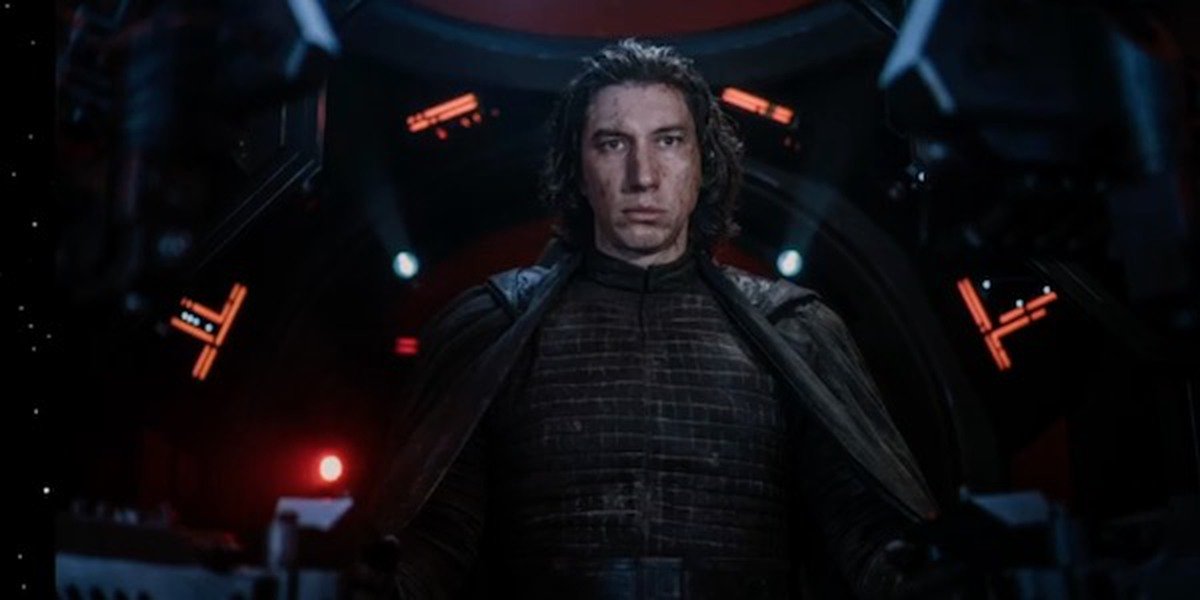
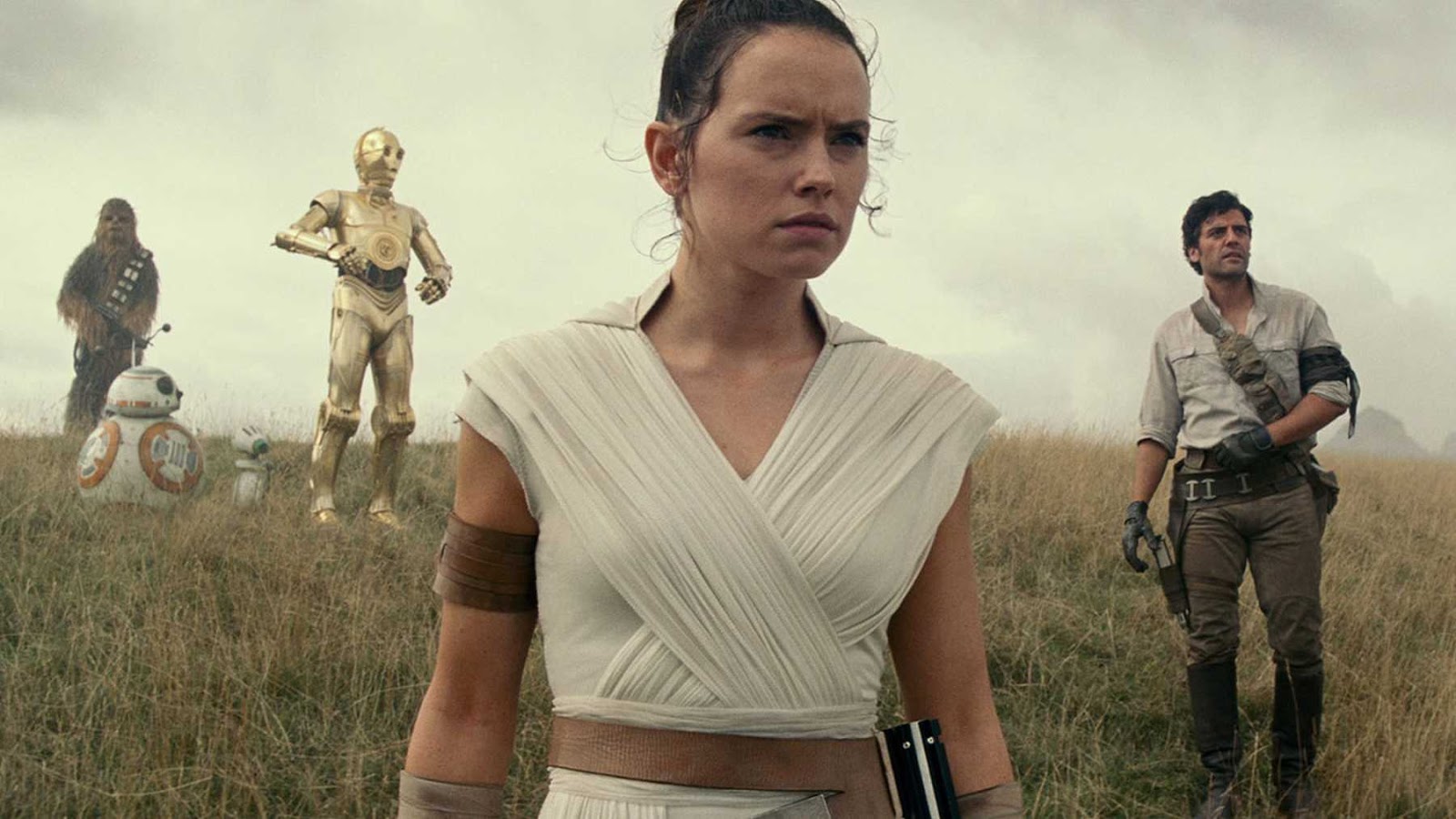
Set a year after The Last Jedi, the Resistance has rebuilt itself under the leadership of Leia Organa (Carrie Fisher), who has also been training Rey (Daisy Ridley) in the Jedi arts. Imagine their horror when a message from the not-so-late Emperor Palpatine (Ian McDiarmid) rings out across the Galaxy, threatening revenge. Kylo Ren (Adam Driver) has been searching for Palpatine and forms a deal – Palpatine will make him emperor of the galaxy, if Ren will kill Rey. Meanwhile Rey heads out into the galaxy with Finn (John Boyega) and Poe (Oscar Isaac) in a race against time to find the location of Palpatine and his armada, before the late Emperor can launch a deadly attack.

JJ Abrams’ return to the franchise is also a return to the fun-focused, action-packed, fast-paced explosion of entertainment and thrills that he offered with the excellent (and still best film in this new trilogy) The Force Awakens. It will excite you, entertain you, and offers some terrific work from many of its players, not least Daisy Ridley (who has grown and grown with each film as an actress confident in carrying a huge franchise) as Rey and Adam Driver as a morally conflicted Kylo Ren. JJ Abrams gently handles the death of Carrie Fisher, skilfully using off-cuts and deleted scenes from past Star Wars films to retroactively create a series of scenes using what dialogue they had from the actress to give her arc some sort of resolution.

It’s one of many things the film gets right here, along with its electric pace and sense of excitement, that never lets up and takes you on such a gripping thrill ride that you hardly notice that most of the film makes very little if any sense (so little sense, I didn’t really understand whether the baddies were the First Order, the old Empire or the Final Order or whatever they were meant to be). It’s a top-to-bottom piece of entertainment, designed to thrill the initiate and the casual fan and give all that you might want to the superfan.

In fact you could say it’s more or less a course correction from the deeply unpopular (with certain elements of the fandom, although its box office success was huge) The Last Jedi. Rise of Skywalker lacks all the iconoclastic “forget the past” attitudes of Rian Johnson’s film. In fact it goes out of its way to ignore as much as possible everything that happened in that film – to the extent that, apart from the growing bond between Rey and Ren and the initial training of Rey, you could more or less skip over it if you wished when viewing the trilogy. I’m not sure how I feel about this – or the fact that the franchise feels it has effectively side-stepped by-far-and-away the most interesting and different film it has produced in favour of a safe-return to familiar stories.

It does mean that Rise of Skywalker is a far less brave film than Johnson’s – and one that avoids doing anything new as well. Many elements from The Last Jedi are disregarded, and all the plot hooks that film are ignored are firmly, and hurridly, reinstated. It means that Rise of Skywalker rushes from revelation to revelation, from plot point to plot point, hardly stopping to draw breath, so eager it is to give the fans what it feels they want. It’s probably a testament to fan power – but also to the savviness of film producers, working out the vast majority of people will come and see any Star Wars film, but the hardened fans will only support a film that matches their agenda.

So it reckons the fans wanted to see answers to questions raised in Force Awakens, lots and lots of cameos and call backs, and plenty of action and space battles. So Rise of Skywalker is a film almost exclusively made up of these things. While there are flaws in this approach, it does mean that this film is a joyfully fun piece of excitement, with lots of great set pieces and some terrific gags among the screenplay. JJ Abrams is a wonderfully confident director of this sort of action, and while the film often feels like it never takes a second to really explain any of its plot dynamics, he is also able to create a narrative that is much more fun and exciting than The Last Jedi, for all its faults of pacing, narrative and characterisation.

What this film does the most is hammer home the bizarre fact that Disney set about making a franchise of three films – guaranteed three films! – with no coherent thought at all about how all these three films would work together either in terms of tone or plot. Now that all three are assembled there is no sense of them having any particular themes, or that they connect together to form an overarching story. The conclusions reached in this film are only faintly threaded in Force Awakens and all but contradicted in The Last Jedi. It’s this lack of planning that underwhelms the film – fun as it is, these are more like three loosely linked films rather than ones that progress one to the other, or feel connected to the original three films.

It’s of course made worse by the ignoring of The Last Jedi – Rose Tico, a character that film spent a lot of time building and establishing gets less than three minutes of screen time – and a re-focusing of the film on the “family of three” in Rey, Poe and Finn that mirrors the first film. This relationship is now far warmer and closer than we ever saw developing in Last Jedi (a film they never appeared in together until the final seconds) – and also laced with an odd, almost queer-baiting sexual tension, where they seem at times like a borderline thruple. (The film offers a cop out on LGBTQ people in Star Wars by having two background characters kiss at one point, a blink-and-you’ll-miss-it shot, cut in China.)

It’s part of a general lack of imagination in the film as a whole, which leans often on bringing back people from the previous trilogy and even sidelines the villains of the rest of the trilogy to shoe-horn back in Palpatine (a reintroduction that is barely explained – like much of the film – and also rather undermines the ending of Return of the Jedi) as the big-bad, and which again doubles down on many of the tropes of the first trilogy. JJ Abrams often mistakes bigger for better – and this film is big, with races against time, fleets beyond imagining, planet destroying tech that can be put into a single star destroyer, Sith powers that can stretch over thousands of miles etc. etc. He takes the same approach with the film, throwing so much of the old trilogy in that it becomes more of a surprise that stuff is missing rather than appearing (I was shocked Yoda wasn’t in this one).

But it’s what the film is going for, offering something safe and recognisable, something that is a thrill ride like you remember rather than the different path the trilogy seemed to be heading towards. There is nothing wrong with that of course at all, but it feels like a missed opportunity. For all its faults, The Last Jedi tried to do something new. This doubles down on the things it knows fans will love, and offers all the entertainment it suspects the casual viewer wants. And maybe that’s enough.

Star Wars: The Last Jedi (2017)


Could Daisy Ridley be The Last Jedi in this controversial new Star Wars chapter

Director: Rian Johnson

Cast: Mark Hamill (Luke Skywalker), Carrie Fisher (General Leia Organa), Adam Driver (Kylo Ren), Daisy Ridley (Rey), John Boyega (Finn), Oscar Isaac (Poe Dameron), Kelly Marie Tran (Rose Tico), Andy Serkis (Supreme Leader Snoke), Lupita Nyong’o (Maz Kanata), Domhnall Gleeson (General Hux), Laura Dern (Vice Admiral Amilyn Holdo), Benecio del Toro (DJ), Gwendoline Christie (Captain Phasma), Anthony Daniels (C-3PO), Frank Oz (Yoda)

Spoilers! OK I’m really trying my best to not have too many spoilers in here, but you know it’s pretty much impossible. So you should do what I do and go to the see the film knowing almost nothing about it. That would be much better than reading any reviews!

It’s pretty clear the Star Wars franchise is going to be with us for some time. So eventually it’s going to have to move past telling similar stories, with familiar characters, in very familiar settings, and branch out into something new and a bit more daring. Star Wars: The Last Jedi is an attempt to do this. Is it completely successful? No, probably not. Does it try and push the franchise into a slightly new direction? Yes it does.

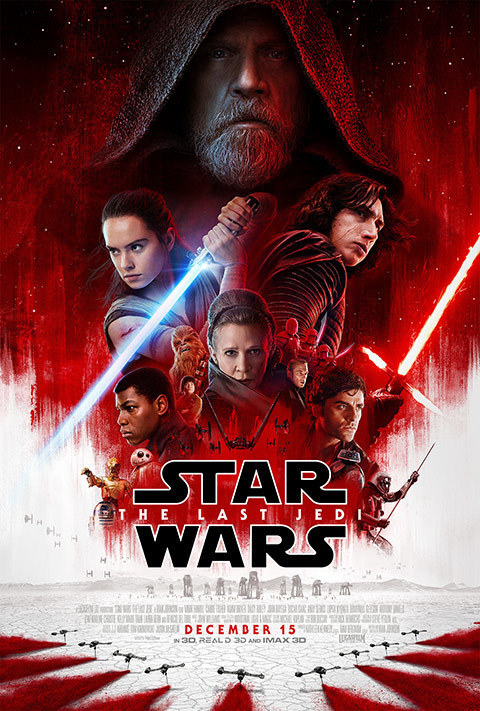
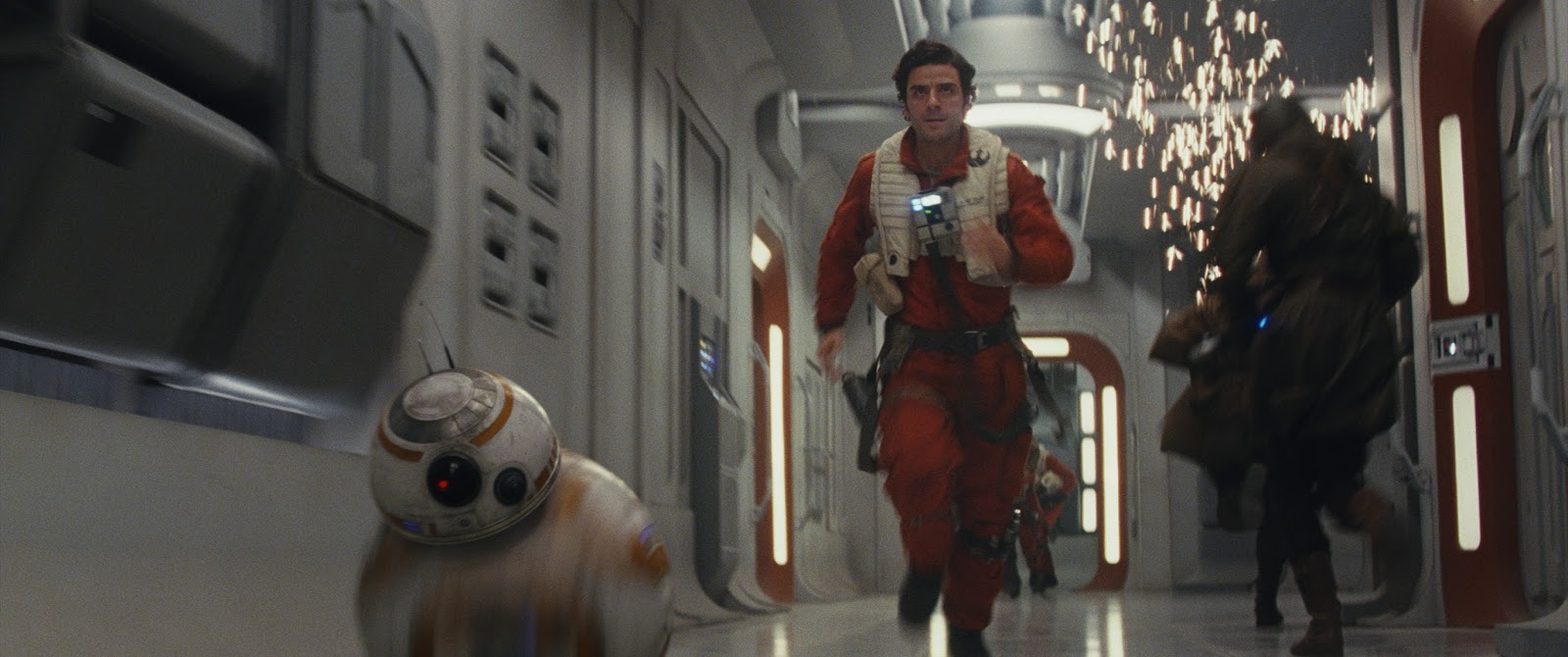
The film starts moments after the end of The Force Awakens. Rey (Daisy Ridley) has met with Luke Skywalker (Mark Hamill) on the remote planet he has spent the past decade hiding on. She believes (as do we!) that he will train her in the ways of the Jedi – instead he tells her to leave, and firmly states that the Jedi are a failed organisation that don’t deserve to continue. Meanwhile, during a speedy evacuation of the resistance base – covered by a suicidally reckless military operation by Poe Dameron (Oscar Isaac) that costs the lives of dozens of resistance ships and pilots – General Leia Organa (Carrie Fisher) is incapacitated, and the surviving rebel ships find themselves relentlessly pursued by the First Order. While the new leadership of the resistance seems to be offering no alternatives, Poe and Finn (John Boyega) hatch a plan to travel to a distant planet and recruit a codebreaker, to help them hack into the First Order flagship and disable the tracker it’s using, allowing the fleet to escape.

The Last Jedi is a film that has had a mixed reception from the fandom. After spending a couple of days thinking about it, this might be because the film so completely inverts expectations and refuses to play it safe. It’s a film about loss and disillusionment, but also about hope against adversity. It would have been very easy to transform Luke into a new Yoda, to make Poe and Finn heroic guys whose actions save the rebellion over the heads of their stuffed-shirt commanders. To build Kylo Ren further towards a redemption arc. These are all things you could expect – none of them happen.

Subverting these expectations has angered a lot of people – fascinatingly the same people who complained The Force Awakens was too similar to Star Wars. So I guess that kinda shows you can’t keep the Internet happy – so why even try. The main issue has been the re-imaging of Luke Skywalker. The man the first trilogy presented as the universe’s bright-eyed-boy, our new hope: here he’s a bitter, depressed man who has lost hope and his love for the Jedi. He’s a man who confesses to dark thoughts, who it transpires considered acts of murder, who has failed at almost everything he’s touched since the conclusion of Return of the Jedi. This is a big turnaround for the franchise’s hero, and yes it is jarring. Is this what people expected after the end of Force Awakens? It sure ain’t.

But, after the play-it-safe Rogue One and the thrilling remember-what-you-used-to-like-before-the-prequels joy of The Force Awakens, the franchise needed something like this. A shake-up, a repositioning of the universe. It’s not always bright and hopeful, and our heroes are flawed people who make huge mistakes. It’s in many ways a logical extension: if Rey is the new hope, than something must have gone wrong with the old hope. Luke has failed totally in the same way both his mentors (Yoda and Obi-Wan) did – he encouraged and honed the viper-in-the-nest.

As that viper-in-the-nest, we’ve got the terrifically complex Kylo Ren. Ren’s path in this film is the most inverted, unexpected and unusual development in the series so far. Adam Driver was superb in Force Awakens, and he’s great here once again as a very different type of villain. Ren is strong in the force, but in almost every other way he’s hugely weak: a sullen, moody man-child, straining for greatness, a tearful brat easily led, driven by his emotions, trying to take on a mantle of greatness he is psychologically ill-equipped for. He seems barely aware of what he wants from life, except for a vague wish to pull the world down – like any teenager, angry at his parents, which is what he is.

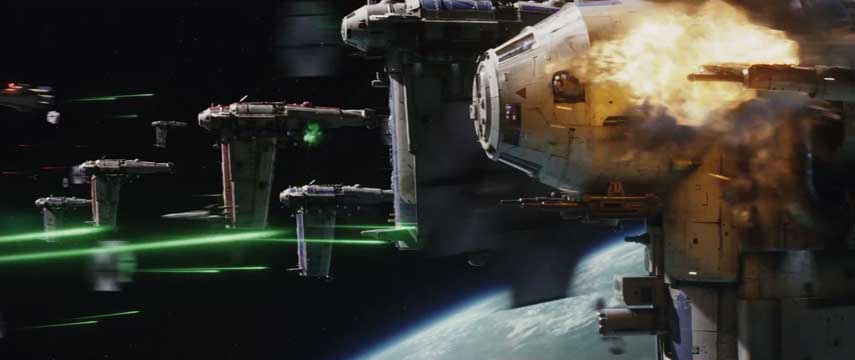
Pulling the world down seems to be Rian Johnson’s aim as well. An early attack wipes out the resistance leadership – Admiral Ackbar! No! – and the resistance itself is eventually reduced to a single ship, desperately running from the far stronger First Order. Never mind Empire Strikes Back, the resistance has never been so pummelled, its military achievements so minor. Even their one victory in the film – the destruction of a fearsome First Order ship – carries such a huge cost of men and equipment that Leia strips Poe of his rank for even attempting it. Thereafter, the only victory the resistance can hope for is to survive. No other Star Wars film has ever allowed such monumental failure to be the main plotline for our heroes. Johnson is clearing the decks and resetting the tables – he even wraps up lingering mysteries from The Force Awakens with such abruptness you wonder if he wanted to kill parts of the Internet dead.

Failure also ekes through the Poe/Fin subplot. Every single decision these characters take in this film is wrong, misguided, hugely costly or all three. If the film does have a major flaw it’s that Finn’s journey to the gambling planet is a cul-de-sac of plot development, that could have easily hit the cutting room floor and probably cost the film very little indeed. It never really goes anywhere, other than to allow Johnson to make some points about arms traders selling weapons to both the First Order and the resistance. It also introduces into the mix Benecio del Toro’s fantastically annoying, overly-twitchy performance as the hacker DJ – Del Toro seems to be getting more and more prone to “Deppism”, where a good actor succumbs to twitches and quirks rather than acting.

What is most interesting about this plot-line though is its very pointlessness. The plan (major spoiler here) doesn’t work at all, in fact it leads to many, many, many more resistance lives being lost, and wrecks Hondo’s secret plan which would have saved everyone’s lives. The film doesn’t quite have the courage to pin the blame for this disaster directly on Poe and Finn. In fact the film gets a bit confused here about the message it wants Poe to learn – it’s something about costly actions in war not being worth mindless sacrifice, but then this is a film that at its conclusion celebrates another character making a huge sacrifice. Unclear? A bit. Anyway: the point however is: you can’t imagine previous Star Wars films allowing our characters to so completely fuck up here as Poe and Finn do – and give them no moment of triumph to make compensation later in the film. 

What this does though, is Rey to be repositioned at the real hope – although the film goes about inverting her as well, with several suggestions that she is far more open to the dark side of the force might have thought. Daisy Ridley is very good as Rey, juggling conflicting pulls on her personality, her desire to redeem both Ren (and there is a great sexual chemistry between these two) and Luke, and the different directions these desires pull her in. Rather than seeing the force as a binary good/bad thing, Rey seems to want to find a balance between the two of them. Johnson explores this via a number of visually interesting scenes, not least Rey in a cave from the dark side, full of endless reflections. It’s an unexpected re-working of the Luke/Yoda relationship and works very well.

The Last Jedi is not a perfect film. For all its interesting inversion of old tropes, and the lack of triumph it allows our characters, it’s way too long. It could easily have been cut down by half an hour at least. Although some plots are designed to be expectation-defying dead-ends, they still end up feeling less than interesting (and ripe for fast forwarding on later viewings). Despite an attempt to include some scenes of deliberate humour, the film has less spark and joie de vivre than many of the other entrances in the franchise. Structurally, it’s not always clear what the timeline of events is between the different locations (weeks seem to go past for Rey, while only hours go by in the rebel fleet), and some of the points the film wants its characters to learn are unclear or hard to understand (I genuinely don’t know what Poe was supposed to have learned by the end of this film).

Its strength though are the characters – building on the groundwork from The Force Awakens(and very differently from Rogue One) this film is full of characters we care about. John Boyega and Oscar Isaac continue to excel as Finn and Poe (and still have great chemistry, shippers…) – Boyega in particular is quite the star. Ridley and Driver are superb. Hamill was never the strongest actor in the world, but he gives his most complex performance yet as Luke. The film mostly rattles along very nicely, and has plenty of action and excitement as well as “race against time” structure that works very well. Interestingly, its main handicaps are that it defies expectations almost a little too much (so it demands second viewing and reflection) and that it’s overlong and at times unclearly structured. But as a step forward for the franchise it’s still a good thing. A new hope indeed.

Coda: The film’s main sadness is the premature death of Carrie Fisher. One problem watching the film was that two or three times I was convinced that the film was about to show us Leia’s death. Johnson avoids changing the film from its original plan (Episode IX was intended to be “The Leia film” after films focusing on Han Solo and Luke), but it does seem a shame that Fisher’s good work wasn’t crowned by the sort of iconic final scene she deserves. The Episode IX planned will now never happen – but it would have been great to see Fisher really head centre stage in that film. RIP.

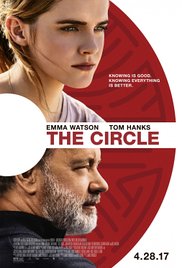
The Circle (2017)


Emma Watson struggles against the surveillance state in shockingly bad adaptation The Circle

Director: James Ponsoldt

Cast: Mae Holland (Emma Watson), Tom Hanks (Eamon Bailey), John Boyega (Ty Lafitte/Kalden), Karen Gillan (Annie Allerton), Ellar Coltrane (Mercer), Patton Oswalt (Tom Stenton), Bill Paxton (Vinnie Holland), Glenne Headly (Bonnie Holland)

Is there anything sadder than seeing a book you thought was fantastic get totally screwed up by film producers? Worst of all, Dave Eggers, the book’s author, even gets a screenwriting credit here. I hope to God his contribution was a rejected earlier draft, rather than the bland, aimless drivel on display here. It would be too depressing to think he gutted his own work and then mutilated its corpse.

Mae (Emma Watson) is thrilled to land a job at The Circle, an all-powerful, Google-style corporation with a virtual monopoly over the internet. However, she discovers while she works at the Circle that there are (of course!) dark secrets at the heart of the company, and that its charismatic CEO Eamon Bailey (Tom Hanks) may not be all that he seems.

Imagine an adaptation of 1984 at the end of which Winston Smith defeats Big Brother but decides there are positive sides to living under a dictatorship, so carries on doing so. That’s exactly as ballsed-up as this total misreading of Egger’s gripping critique of our internet age. In this terrible adaptation, the novel is neutered beyond recognition into just another bland “Big Corporations Acting All Corporation-y” nonsense. The film is pretty much exactly as awful as the book is brilliant.

Where did it all go so completely and utterly wrong? Did they not understand the book? The novel is not only a critique of the pervasive power of its shady Google-like organisation. It’s also a savage attack on our own tweeting, social media obsessed world – the sort of world where private actions are theft as they rob everyone else from experiencing them vicariously through tweets, photos and posts. It’s this part of the story the film completely (and almost wilfully) misses the point of.

They seem terrified at the thought that the social media Twitteratti might take against the film if it too openly attacks the actual users of systems like this, with their (at times) shallow, demanding and entitled pushing of their own opinions, and intrusions into others’ lives. Instead the film gives a complete pass to all the users of the systems, while attacking the corporation providing them. So we get the bizarre set up of a film that seems to say it’s totally fine for normal people to record everything and push it all onto the internet, turning their world into a judgemental surveillance state, but it’s evil for a corporation to create the devices they use to do it.

Even the film’s criticism of corporations isn’t very clear, largely because we never get a sense of the Circle’s power and its hunger for getting more and more control. The film throws away its involvement in politics and its control over everyday lives. Perhaps because it knows so many of the viewership love gadgets, there is no exploration of the creepy, controlling aspect of the many tracking and recording devices the Circlers wear throughout the film, as there is in the novel. Instead the target is the shady business people at the top (not that we learn anything about what they want) because everyone hates businessmen don’t they? Nice easy target. I can tweet my loathing of them very easily.

It’s a film devoid of any challenge. A character’s suicide from the book is changed to an accidental death. The more vulnerable and desperate of the characters from the book have been deleted. The obsessive self-definition the Circlers gain from what other people tweet about them is downplayed. The ending of the film completely inverts the novel, and leaves us with a bizarre final image of our hero kayaking on the lake, but warmly smiling at the drones watching her, even after she has destroyed the “villains” who run them. It makes no sense whatsoever. My jaw literally dropped when this happened by the way.

Mae is a character who now has no consistency. Her growing obsession with the power of social media – and the destructive effect it has on her actual human relationships – is completely ignored. It’s the key part of her character from the book, and its removed here to try her as traditionally ‘likeable’ as possible. An anti-hero becomes a flat out hero. The film shows the impact of actions she carries out in the book – particularly on Annie – but removes these actions from the film. Why do people slip into depression or depart from the film? Who knows. Left with nothing to work with from the original book, Emma Watson gives a bland and forgettable performance. No one else really makes an impact, playing dull, neutered versions of the characters from the source material, devoid of depth or interest.

The Circle might be one of the worst literary adaptations I’ve ever seen. It guts the original book and removes any of the most challenging and interesting content. It’s terrified of criticising in any way anyone who might be watching. It’s a satire on the social media age that has no satire in it, and is desperate not to talk about social media. Worst of all it will discourage people from reading the original novel. In the words of the modern age: #uttershit.