Tag: John Cusack

Con Air (1997)

Con Air (1997)

Big bangs and silly action abounds in Nicolas Cage’s enjoyable action epic

Director: Simon West

Cast: Nicolas Cage (Cameron Poe), John Cusack (US Marshal Vince Larkin), John Malkovich (Cyrus ‘The Virus’ Grissom), Steve Buscemi (Garland ‘The Marietta Mangler’ Greene), Ving Rhames (Nathan ‘Diamond Dog’ Jones), Colm Meaney (DEA Agent Duncan Malloy), Mykelti Williamson (Mike ‘Baby-O’ O’Dell), Rachel Ticotin (Guard Sally Bishop), Monica Potter (Tricia Poe), Dave Chappelle (Joe ‘Pinball’ Parker), MC Gainey (‘Swamp Thing’), Danny Trejo (‘Johnny 23’)

A rickety plane full of the worst of the worst and very low security. Battles to the death over the fate of a cuddly bunny. A car dragged after a flying plane. On any other day, that might all be considered strange. In Con Air it’s just grist to the mill. Made in the heart of Cage’s post-Oscar swerve from off-the-wall indie star to pumped-up, eccentric action star, Con Air is loud, brash, makes very little sense, feels like it was all made up on the spur of the moment and is rather good fun.

Cameron Poe (Nicholas Cage) is an Army Ranger who ends up in jail after he is forced to protect himself and his wife (Monica Potter), with deadly consequences, in an unprovoked bar brawl. Seven years later he is finally about to be released from prison to meet his young daughter for the first time. To get him to his release though, he’ll need to hitch a ride on a prison transfer plane that is shuttling the ‘worst of the worst’ to a high security prison. With criminal genius Cyrus ‘The Virus’ Grissom (John Malkovich) and his number two ‘Diamond Dog’ (Ving Rhames) on board, what could go wrong? Needless to say, the criminals seize the plane – can Cameron, with help on the ground from US Marshal Vince Larkin (John Cusack) protect the hostages and save the day?

There isn’t really any way of getting around this. Con Air is a very silly film. Nothing in it really bears thinking about logically. To the tune of a soft rock score and Leann Rimes (actually, How Do I Live is a damn good song, and I won’t hear a word otherwise), Simon West shoots the entire thing like it was a primary-coloured advert for action movies. It’s the sort of film that feels like the action set-pieces were written first – “The plane will crash on the in Las Vegas! Right, how do we get the plane to Las Vegas and out of fuel?” – and where the actors thrash around trying to make a plot that feels made-up on the spot full of try-hard dialogue work.

But despite this, Con Air seems to work. Whether it’s because of its brash confidence in its own ridiculousness or because it hired enough scribes to pen one-liners and character quirks to just about give the film a sense of wit and character (Poe’s ongoing effort to protect the cuddly bunny he intends to give his daughter is just one of a decent set of running gags – “Put the bunny. Back. In the box.”). You suspect watching it that there was the intention somewhere along the line to make something darker and more violent – the criminals’ seizure of the plane is surprisingly bloody – that just got forgotten about when it was decided it worked best as a dumb end-of-term panto.

A large part of its success stems from Cage’s droll performance. Turning himself into a sort of every-day action hero with just the odd trace of his famed grand guignol eccentricity here and there, Cage’s Cameron Poe makes for an intriguing lead for a balls-to-the-wall action film. Poe is softly-spoken, invariably polite, sweetly excited about seeing his daughter and pretty much encounters every unlikely event he sees with a laconic dead-pan (“On any other day that might be considered strange” he murmurs when witnessing the plane drag a sports car behind it through the air).

Cage of course looks ridiculously pumped up and spends most of the film in an obligatory Die Hard style vest. He hands out ruthless beatings of ne’er-do-wells – although only Cage could impale a serial killer on a pipe and sadly intone “Why couldn’t you just put the bunny back in the box”. Only Cage would take a part clearly intended as a Bruce Willis smirker and turn it into a sort of kick-boxing Paddington Bear. His stubborn refusal to take the film seriously means he cancels out Simon West’s ridiculously macho aesthetic that otherwise infects almost every frame. While everything else is loud, sharply cut and features actors spouting try-hard tough dialogue, the film’s central character spends the opening of the film learning Spanish and exchanging surprisingly sweet letters with his daughter and strolls around earnestly trying to do the right thing.

John Cusack similarly runs counter to the tone. Clearly counting the minutes until he can cash his cheque, Cusack turns his US Marshal into a laid-back, sandal-wearing boy scout, quietly exasperated about the wildness around him. I suspect half of Cusack’s drily low-key dialogue was written by him just to keep himself interested. Malkovich is cursed with the film’s worst try-hard tough-guy dialogue, but even he enjoys downplaying the role into softly spoken comedy. The three leads leave the blow-hard silliness to their foils Colm Meaney (as a permanently angry DEA agent) and Ving Rhames (as a violent would-be revolutionary).

With most of the people in it not taking it seriously, it generally means the ridiculousness of the plot – an aimless capture of a plane built around a series of set-pieces – and flashes of violence get watered down in favour of comic nonsense that of course ends with a rammed slot machine hitting a jackpot and the villain being stabbed, launched, electrocuted and crushed in a super-display of overkill. Whether this is what West intended who can say? But it’s certainly a lot better this way.

After all who cares if the villain’s masterplan depends on the sudden appearance of a sandstorm or that no war hero would ever go to jail for protecting his wife in a bar (Poe must have the worst lawyer in the world). It’s all about the jokes (a body at one point has a message scrawled on it and is literally posted into thin air), the bangs and, above all, the weary, half-smirking performances of the leads who can’t believe the nonsense they are sitting in the middle of.

Being John Malkovich (1999)

A portal into the head of a famous actor? What better way to find out what it’s like Being John Malkovich

Director: Spike Jonze

Cast: John Cusack (Craig Schwartz), Cameron Diaz (Lotte Schwartz), Catherine Keener (Maxine Lund), John Malkovich (John Horatio Malkovich), Orson Bean (Dr Lester), Mary Kay Place (Floris), Charlie Sheen (Himself), W Earl Brown (JM Inc Customer)

Is there a more consciously eccentric film ever made than Being John Malkovich? Can you imagine the pitch to the Hollywood suits? 

Our hero, Craig Schwartz (John Cusack) is a weedy, bitter puppeteer (as well as creep and potential stalker), whose wife Lotte (Cameron Diaz) fills their house with rescue animals, from talkative parrots to a chimp with PTSD. Needing to make ends meet, Schwartz takes a filing job at a company based on floor 7½ of an office block (it’s a low ceilinged floor built between the other two floors – it’s cheaper on the rent obviously) where he becomes obsessed with his sexy co-worker Maxine Lund (Catherine Keener), who is resolutely not interested. But all this changes one day when Schwartz finds a fleshy, dark tunnel behind a filming cabinet that takes someone into the mind of actor John Malkovich (John Malkovich) – for 15 minutes, before expelling you onto the New Jersey turnpike. Sounds like a business interest for Schwartz and Maxine (spend 15 minutes in someone else’s body!), but the experience of being in someone’s body slowly begins to change Schwartz, Lotte and Maxine – and having his brain invaded has a terrible impact on Malkovich himself.

If that’s not the oddest plot you’ve ever heard, then I don’t know what films you’ve been watching. The film was the brainchild of Charlie Kaufman, who developed from this into one of the most distinctively gifted screenwriters in Hollywood, a master of the quirky and weird, the off-the-wall and the science fiction tinged everyday fantasy, blessed with the ability to mix in genuine human emotion amongst the oddness. 

Being John Malkovich is an inspired idea and Kaufman’s script is ingenious in its structure and progression. Never once does the film settle for the expected narrative development or the conventional structure. It’s a livewire of a film that constantly leaves you guessing, switching tone and throwing logical but unexpected plot twists at every turn. There are plenty of moments where you could expect events to take a conventional turn, but the film never settles for the obvious.

Kaufman’s inspired script was lucky enough to find a quirky visual stylist who was willing to embrace it as much as Spike Jonze did. Jonze’s direction is a masterclass in small detail, slight twists and little touches of invention that never draw excessive attention to themselves but combine to make a thrillingly off-the-wall final picture. 

Jonze knows that the jokes and surrealism of Kaufman’s script are so effective that they don’t need a firm directorial hand to lean the humour on – they work absolutely fine presented almost as written, and make for terrific entertainment. He shoots the low ceiling of floor 7½ with such straightforward confidence that each scene becomes hilarious for its stooped actors and crammed rooms. Jonze can therefore concentrate the flourishes on core moments, from the puppetry that Schwartz and later a Schwartz-controlled Malkovich make their life’s work, to assorted training and educational videos that pepper the film at key moments.

Like Kaufman as well, Jonze’s storytelling works because he inherently understands human emotion and isn’t afraid to throw it into the film alongside the humour. Plenty of directors would have been happy to have all the principals settle into being comic stereotypes, or overplayed pantomime figures. Jonze encouraged the actors to find the depth – and sometimes the darkness – in their characters, to ground the film effectively with touches of real life tragedy and human flaws that give weight to the surreal sci-fi elements – so much so that they start to feel as real as the rest.

John Cusack’s Schwartz is a bitter, increasingly twisted fantasist and dreamer – the sort of guy who believes that his lack of willingness to compromise his art in any way is a strength (his puppetry shows are highly complex, sexualised, high-blown, poetry-inspired hilarious puffs of pretension). Schwartz could have become a joke or a guy with a big dream – but the film increasingly shows him to be a dark, obsessive, cruel even dangerous outsider, who has no problem with harming other people to get what he wants, his moral compass is driven by his self-assessment of himself as a man treated badly by others, so doing what he wants is somehow deserved. It’s an increasingly dark portrait of a man who has more than hint of danger to him.

Keener, as the focus of his obsession, also does extraordinary work as a woman the film is not afraid to present as unpleasant in her selfishness, casual cruelty and greed – but a woman who slowly allows herself to open up and reveal an emotional openness and romanticism someone watching the start of the film would never expect. Similarly Diaz’s downtrodden, sad wife at home flourishes and grows as a person, as she finds in herself a new comfort and ease with who she is, from inhabiting the mind of another person. Both are excellent.

The film explores fascinating ideas of identity – Lotte and Maxine find a freedom and an exciting otherness in being a passenger in another person’s body, and use it as voyages of self discovery for themselves. Schwartz on the other hand sees this body – just as he sees all human beings – as just another puppet for him to control, another way of adjusting the world to match his requirements, rather than change anything about himself. While some lose themselves in Malkovich’s body and find the experience rewarding, Schwartz can only find happiness when bending the body to his own will.

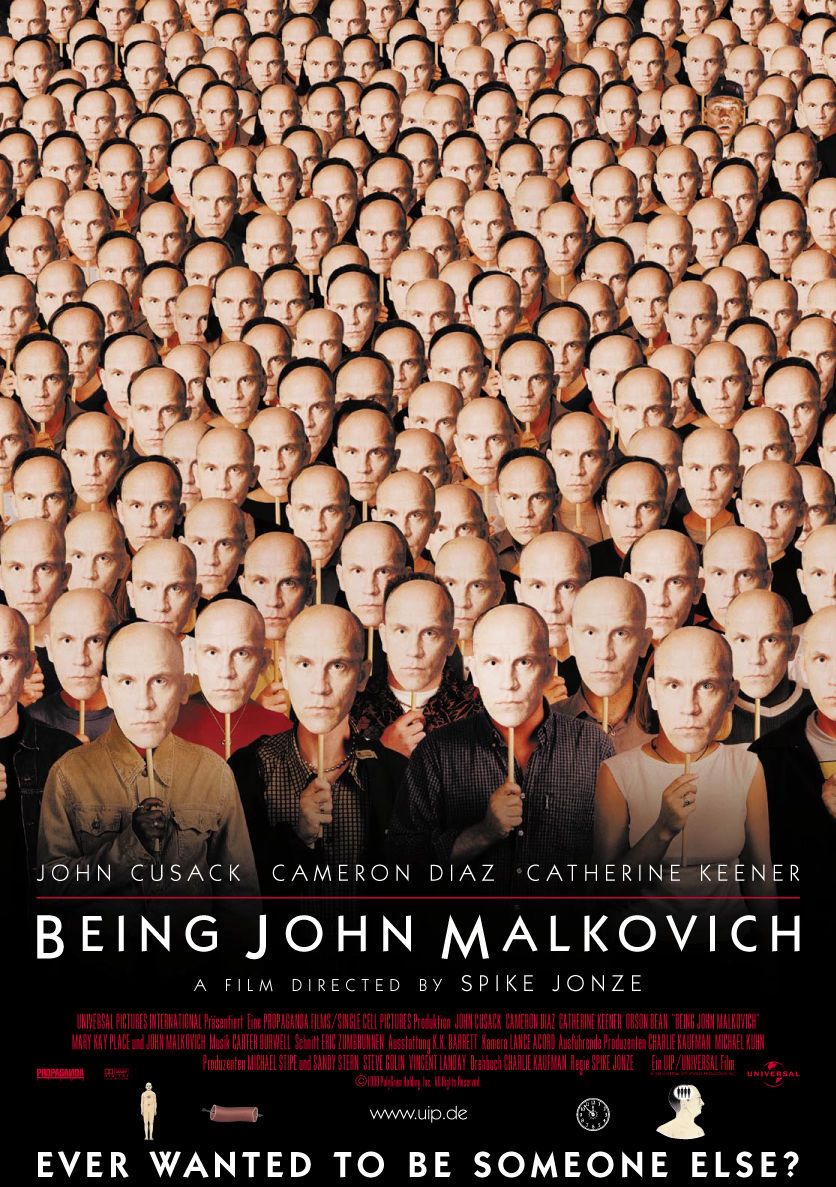
And what of Malkovich himself?  Well has there ever been a braver performance in film? Malkovich is superb as an arch portrait of himself as a rather self-important actor, with an unknowable coolness about him, an intellectualism that makes him a man easy to respect but strangely hard to relate to, a face that is distinctive but a strangely unrelatable style that makes him hard to remember (it’s really an extraordinarily funny and brave performance). As Malkovich realises what is happening to him, the film plays with real beats of tragedy and even horror – what would it be like to be forced into being a passenger in your own head? This is nothing compared to the horror Malkovich encounters when he enters the tunnel himself – to find himself in a world where everyone looks like Malkovich and can only speak using the word “Malkovich”.

Being John Malkovich uses its surreal ideas to explore profound – and even chilling – ideas of control, destiny, personality and identity. With several superb performances, a brilliant script and controlled and intelligent direction, it’s a film unlike any other – and continues to delight and surprise twenty years on from its release.

The Butler (2013)


Forest Whitaker takes on a lifetime of service, as the Civil Rights movement meets Downton Abbey

Director: Lee Daniels

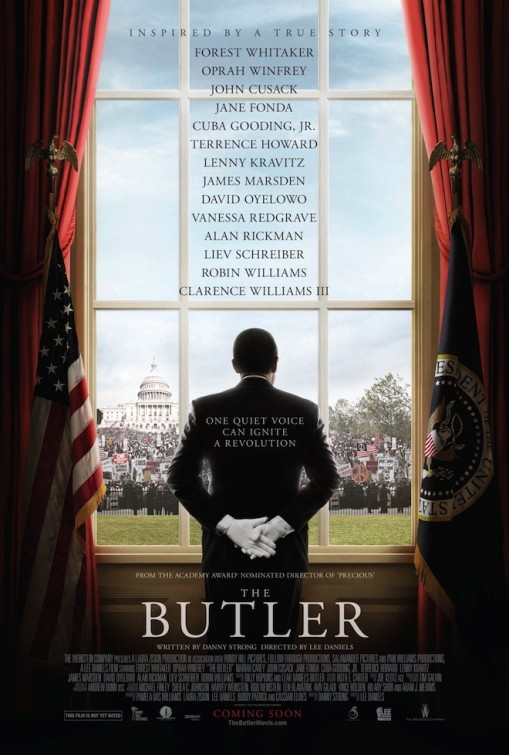
Cast: Forest Whitaker (Cecil Gaines), Oprah Winfrey (Gloria Gaines), David Oyelowo (Louis Gaines), Cuba Gooding Jnr (Carter Wilson), Lenny Kravitz (James Holloway), Colman Domingo (Freddie Fallows), Yaya DeCosta (Carol Hammie), Terrence Howard (Howard), Adriane Lenox (Gina), Elijah Kelley (Charlie Gaines), Clarence Williams III (Maynard), John Cusack (Richard Nixon), Jane Fonda (Nancy Reagan), James Marsden (John F. Kennedy), Vanessa Redgrave (Annabeth Westfall), Alan Rickman (Ronald Reagan), Liev Schreiber (Lyndon B. Johnson), Robin Williams (Dwight D Eisenhower)

Cecil Gaines (Forest Whitaker) grows up on a plantation in the South; after his mother is raped and his father killed by the son of the house, the family matriarch (Vanessa Redgrave) takes him on as a house servant as a token gesture of regret. His training here sets him on the path to working in a succession of increasingly wealthy hotels and, finally, the White House. Over 30 years, he serves the Presidents in office, never involving himself or commenting on policy, proud of his service to his country. This often puts him in conflict with his Civil Rights activist son Louis (David Oyelowo), with his wife Gloria (Oprah Winfrey) stuck in the middle.

This is the sort of film that feels designed to win awards. It’s based on a vague true story (it changes nearly all the events of course) and it’s about a big subject. It’s got big name actors doing acting. It aims at big themes. What it actually is, is a film that misses its marks. It’s a film that spends time with big themes but has nothing to say about them, or in fact anything interesting to say full stop. It assumes that the historical context will do the work, and leaves it at that. Instead, it settles for trite sentimentality and cliché, personal stories played on a stage that makes those stories seem slight and inconsequential rather than giving them reflective depth.

The biggest problem about the film, leaving aside its heavy-handed sentimentality and mundane predictable storytelling, is that all the way through it feels like we are following the wrong story. It’s such a vibrant and exciting period of history, so full of events, passion and struggle: and instead we follow the story of Cecil, essentially a bland passive character who achieves very little and influences even less. There are vague references to leading “the regular life” and how working in domestic service is like some sort of subversive act to demonstrate the education and hard-working possibilities of the minority, but to be honest it never really convinces.

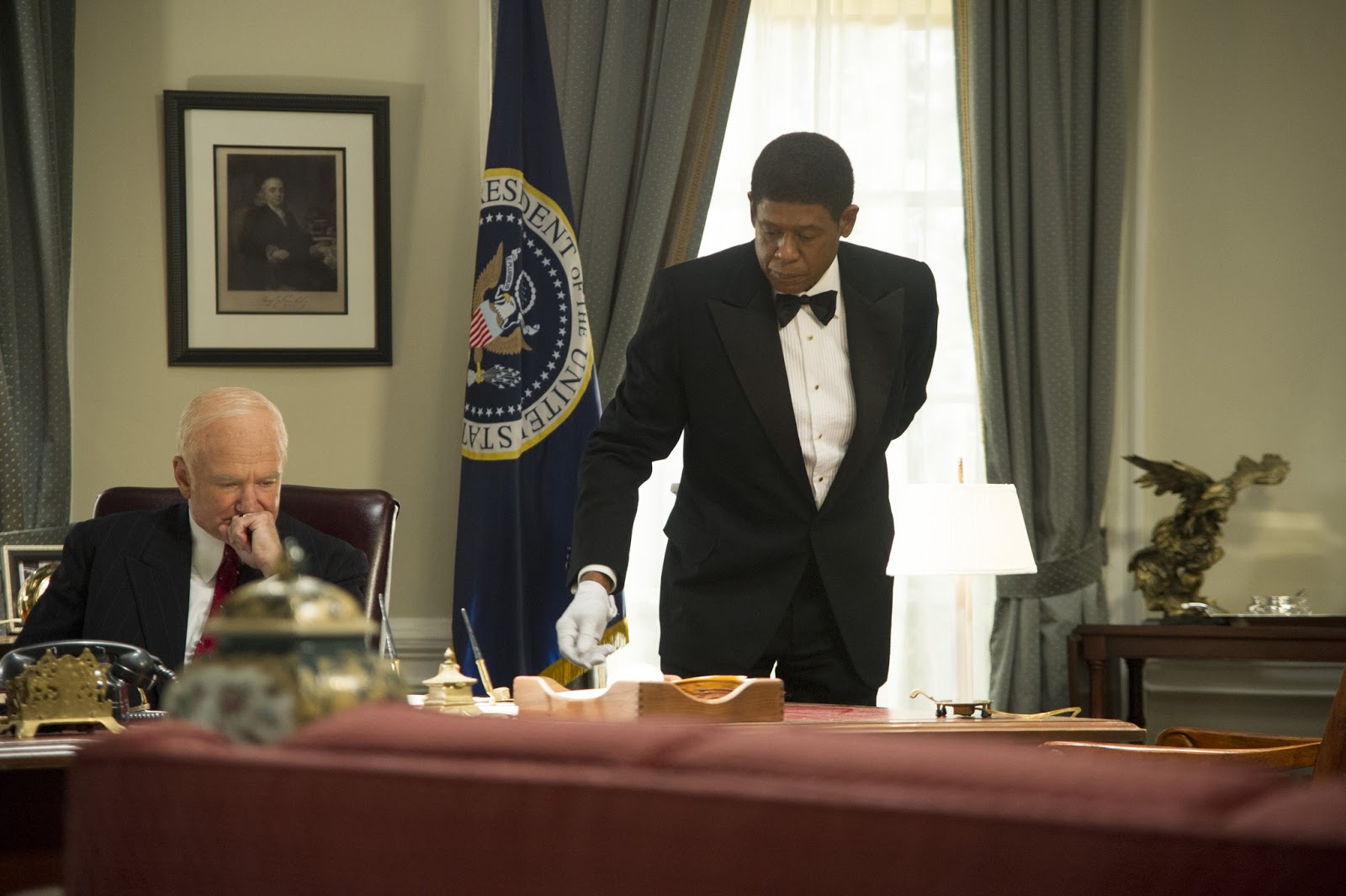
The film promises that Cecil was a man who had a profound impact on the people he served – but this doesn’t come across at all. Instead, the parade of star turns playing US Presidents are there it seems for little more than box office: we see them speaking about Civil Rights issues or planning policy, but we get very little sense of Cecil having any bond with them. The cameos instead become a rather distracting parade, as if the film was worried (perhaps rightly) that Cecil’s story was so slight and bland that they needed the historical all-stars to drum up any interest in it. It doesn’t help that the cameos are mixed – Rickman, Schreiber and Marsden do okay with cardboard cut-out expressions, but Cusack in particular seems horribly miscast. A braver film would have kept these pointless camoes in the background and focused the narrative on Cecil and his colleagues below stairs, and their struggles to gain equal payment with their white colleagues. This film is seduced by the famous events and names it spends the rest of the time backing away from.

The performance at the centre is also difficult to engage with. Forest Whitaker is such an extreme, grand guignol actor that it’s almost sad to see him squeeze himself into a dull jobsworth such as Cecil. Whitaker seems so determined to play it down that he mumbles inaudibly at great length (it’s genuinely really difficult to understand what he is saying half the time), slouching and buttoning himself into Cecil’s character. It doesn’t come across as a great piece of character creation, more a case of miscasting. Oprah Winfrey does well as his wife, although her character is utterly inconsistent: at times a drunk depressive, at others level-headed and calm. The link of either of these characters to the hardships of life as a Black American or their role in racial politics is murkily unclear.

The star turn of the film – and virtually all its interesting content – is from David Oyelowo, who ages convincingly through the film from idealist to activist to elder statesman. His story also intersects with the actual historical events that are taking place in America and he is an active participant – unlike Cecil the passive viewer, just as likely to switch the TV off as follow the news. Often I found myself wishing the film could follow his character rather than Whitaker’s.

That’s the problem with the film: what point is it trying to make? The film seems to want to honour Cecil’s service in the White house – but the film is a slow journey towards Cecil’s sudden revelation that maybe his son’s campaigning for Civil Rights was the right thing to do. This flies in the face of the film’s tribute to Cecil’s decades of quiet, unjudging service: the film can’t make up its mind whether it wants to salute Cecil for being an unjudging, dedicated servant to a long line of Presidents, or for having the courage to take a political stance towards the end. It’s having its cake and eating it. It’s this shallow lack of stance that finally makes it an empty and rather dull viewing experience.