
Tag: John Emery

Spellbound (1945)

Spellbound (1945)

Hitchcock dives into psychiatry with mixed success in a middle-brow effort

Director: Alfred Hitchcock

Cast: Ingrid Bergman (Dr Constance Petersen), Gregory Peck (Dr Edwardes/John Brown/John Ballantyne), Michael Chekhov (Dr Alexander Brulov), Leo G Carroll (Dr Murchison), Rhonda Fleming (Mary Carmichael), John Emery (Dr Fleurot), Norman Lloyd (Mr Garmes)

Spellbound was born out of Selznick’s faith in the magic of psychiatry. It opens with a touchingly naïve dedication that stresses a little touch of Freud is a magic bullet: “once the complexes that have been disturbing the patient are uncovered and interpreted, the illness and confusion disappear and the devils of unreason are driven from the human soul”. Oh, would that it was so easy. Spellbound turns psychiatry as a sort of detective game, the subconscious a sort of smorgasbord of clues that, when shuffled into the correct order, will produce the answer.

The mystery is what exactly has happened to the new head of Green Manors Psychiatric Hospital, Dr Edwardes, here to replace the not-exactly-happy-to-retire Dr Murchison (Leo G Carroll)? The man who has arrived claiming to be Edwardes (Gregory Peck) may be charming but his odd obsessions with dark parallel markings on white surfaces, tendency to faint and lack of familiarity with psychiatry in general raise suspicions. Dr Constance Petersen (Ingrid Bergman), leading light of the Hospital, deduces Edwardes or “JB” as he vaguely remembers his initials being, is suffering from guilt-induced amnesia. Petersen refuses to believe – despite mounting evidence – that this man she has fallen in love with could be a killer. On the run, she recruits her old mentor Dr Brulov (Michael Chekov) to help analyse JB’S dreams, convinced the answer to the mystery is there.

Selznick hired his psychiatrist to act as a consultant on the film. This didn’t matter that much to Hitchcock, who considered the film essentially another murder-mystery thriller with a bit of Freudian dressing and bluntly told the advisor at one point when she protested yet another inaccuracy “my dear, it’s only a movie”. Spellbound is a decent, mid-level Hitchcock effort, with a touch or two of the master’s invention and magic, but which slows down for an extended act three analysis scene crammed with dodgy psychiatry and a detailed Salvador Dali-inspired dream sequence.

Of course, no one watching the film (rather like Cary Grant in Suspicion) could ever believe for a minute that the charming, handsome Gregory Peck is actually a murderer. Hitchcock’s trick is to keep the tension up, since (at best) there are only two suspects (and only one of them has a heavily advertised motive). You could argue here the trick is a “howdunnit” rather than a “who”. What mystery is Peck holding in his head and why can’t he remember who he is? Hitchcock throws in a host of little flourishes to keep us guessing, and if he clearly cares very little about Freudian insight (just as well, imagine the field day Freud would have had with Hitch) that hardly seems to matter.

Spellbound still manages to fairly barrel along, with a sparky script by Ben Hecht interweaving screwball banter between Peck and Bergman with cod-psychiatry. Hitchcock lets most of this play out fairly traditionally, but punctuates it with moments of flair. An early romance dialogue takes place in voiceover over a series of shots of doors opening to reveal a never-ending corridor (a neat visual metaphor for delving inside the mind). A tracking shot on a disturbed Peck down a flight of stairs, focuses on a cut-throat razor in his hand, ending with the razor alarmingly large in-shot. Disturbing POV shots make objects appear ultra-large, from a glass of milk (echoes of Suspicion) to a gun barrel turned to face us at the film’s conclusion. All of this is accompanied by an excellent score by Miklos Rosza which brings together romantic strings and the theremin to suggest the unsettling undercurrents of the subconscious. Rosza, rightly, won an Oscar for his hugely atmospheric work.

Spellbound is also notable for the way it inverts gender expectations. Peck effectively plays the damsel-in-distress here. Vulnerable and scared about what he could do, he lapses into catatonic panicked silence as much as smooth banter. Instead, for all the film stresses her feminine weakness when in love, it’s Dr Petersen who is the protagonist here. Played with a relaxed authority by Bergman, Constance is an assured professional and a dedicated campaigner for the truth. It’s she who constantly drives the plot forward and its her who plays both doctor and detective to crack the case and confront (with an assured coolness) the killer.

Hitchcock’s film provides a subtle commentary on the experience of women. Searching for JB in a hotel lobby, Petersen is first pestered by a drunk traveller who drunkenly all-but calls her a cock-tease when she asks him to leave her alone. Even when saved from an unpleasant scene by a hotel detective, he assumes her to be a schoolteacher or governess, and Petersen immediately recognises that disguising her accomplishments is a perfect way to gain this would-be-saviour’s help. Petersen also has to shrug off the pestering attentions of a colleague (John Emery).

But it’s her who eventually deduces the meaning of JB’s dream. This dream was heavily promoted as the work of Salvador Dali. While full of striking imagery, it feels more like a pastiche of Dali, as if a Hollywood art director threw The Persistence of Memory and Eyes for Your Eyes at the wall see what stuck. Which is pretty much what happened: Dali’s work was largely discarded for being too weird and overlong and William Cameron Menzies was bought into create something in Dali’s style. Selznick hardly cared – what mattered was promoting the Dali collaboration (Hitchcock had little to do with the scene, until it drew praise and he then claimed authorship).

It’s another striking moment in Spellbound. But truthfully the film is a careful construction of striking moments and performances, which power a simplistic and unrealistic plot which relies on coincidence and bizarre logic gaps. Psychiatry is a magic bullet – it’s hard to imagine anyone in real life reacting with the sort of glee JB does here when he discovers he didn’t murder his brother in his childhood, only accidentally fatally impaled him on some railings outside his house. The “revelations” from the analysis takes an over-extended single session with the unconscious yielding a series of Agatha Christie-style clues.

But then that fits Spellbound in the tradition of Hollywood psychiatry, from this to Ordinary People to Good Will Hunting, a touch of confession on a couch eventually solves all problems (all the kissing Peck gets from Bergman – which didn’t stop off camera – also clearly helped). Hitchcock’s work here is professional, but middlebrow. However, the odd imaginative shot, and the impressive performances (Bergman, Peck and also famous acting-coach Michael Chekov, immensely playful and Oscar-nominated as Constance’s cuddly mentor) still make this an entertaining watch.
Here Comes Mr Jordan (1941)

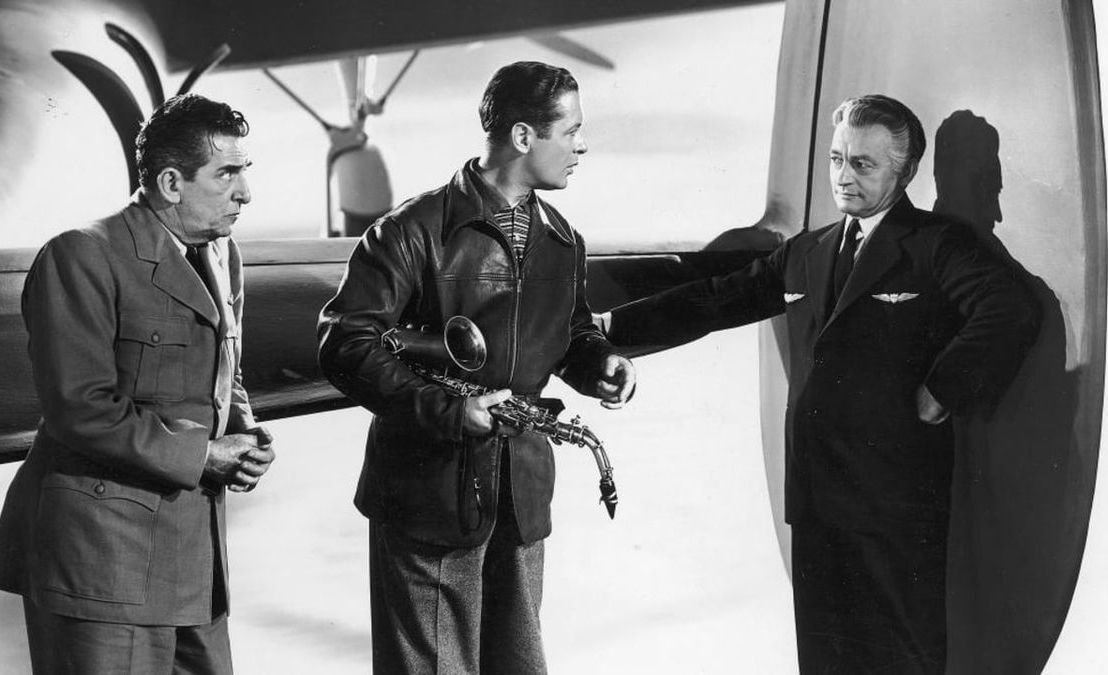
Edward Everett Horton, Robert Montgomery and Claude Rains deal with death, admin and body swops in Here Comes Mr. Jordan

Director: Alexander Hall

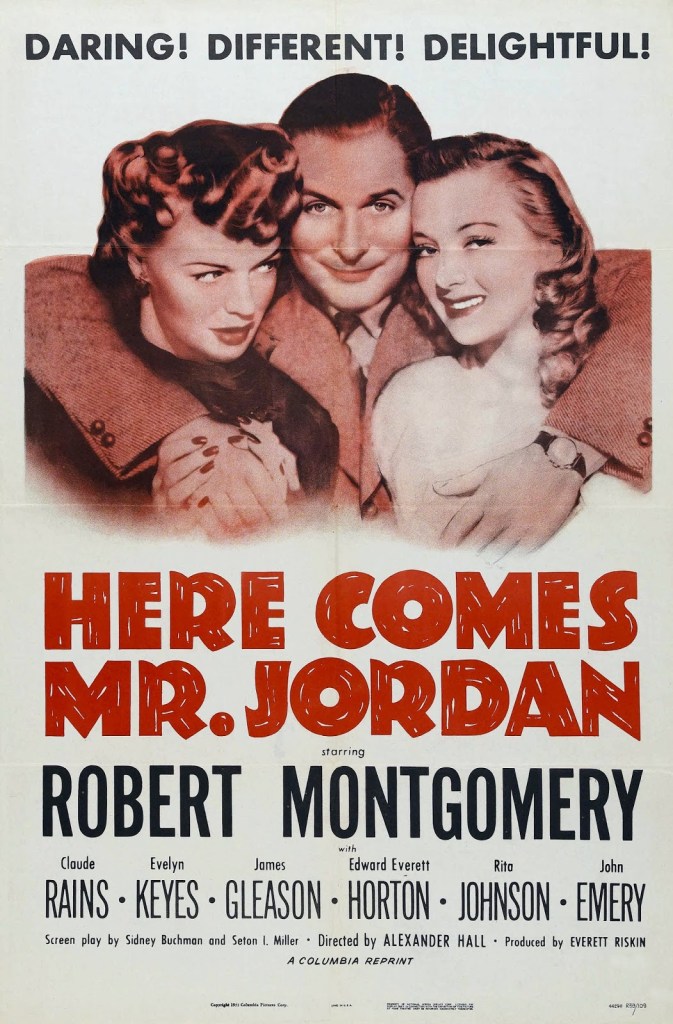
Cast: Robert Montgomery (Joe Pendleton), Evelyn Keyes (Bette Logan), Claude Rains (Mr Jordan), Rita Johnson (Julia Farnsworth), Edward Everett Horton (Messenger 7013), James Gleason (Max “Pop” Corkle), John Emery (Tony Abbott), Donald MacBride (Inspector Williams), Don Costello (Lefty), Halliwell Hobbes (Sisk)

One of the best things about the Hollywood Studio system is that created an environment where middle-brow talents could suddenly lift themselves up to create something very special. That’s certainly the case with Here Comes Mr Jordan, the career high spot for its director and its main stars. It’s the sort of product of Classic Hollywood where everything comes together perfectly and delightfully.

Joe Pendleton (Robert Montgomery) is a boxer with a shot at the title. An amateur pilot, Joe flies his own one-man flight to New York for the match. On the way, his plane crashes. An officious Angel, Messenger 7013 (Edward Everett Horton), collects his soul – only to find on arrival in heaven that Joe was meant to survive the crash and live for another 50 years. Unfortunately, by the time the mistake is found out, Joe’s body has been cremated. Head Angel Mr Jordan (Claude Rains) has no choice other than to find Joe another body on Earth. So Joe winds up in the body of millionaire Bruce Farnsworth, recently murdered by his wife Julia (Rita Johnson) and secretary Tony Abbott (John Emery). In his new body, Joe decides to correct Farnsworth’s wrongs, returning his embezzled money to investors and helping to free the father of Bette Logan (Evelyn Keyes), who took the blame. Joe also wants to retrain for a boxer – recruiting, much to his confusion, his old coach Max Corkle (James Gleason) – and he and Bette begin to fall in love. But Joe’s destiny, it turns out, is to be the champ – and he can’t do that in Farnsworth’s body. How will Mr Jordan clean this mess up?

Here Comes Mr Jordan is a delight, a hilarious musing on reincarnation and afterlife, in which the next world is as weighted down by bureaucracy and red tape as much as this one. With neat, unobtrusive direction from Alexander Hall (who never hit the jackpot like this again), the film keeps its comic balls up in the air beautifully, while throwing in some neat observations around life, death and fate. The script bubbles with lovely bits of invention, from the Afterlife to a bureaucratic organisation to Joe’s inhabiting of Farnsworth’s body (after trying a few other bodies on first), while still appearing to himself (and we the viewers – a neat idea that the film invites us not to think about too much as Joe’s mannerisms and physicality must be completely different from Farnsworth) unchanged from his original body.

Around this the film gets some neat pot shots at big business corruption. In some ways this is a little like A Matter of Life and Death mixed with Capra. As in Capra, the humble, kind-but-not-super-smart regular Joe is the one who takes a long-hard look at the corruption and greed of Big Business and Corporate America and decides “there has to be a better way”. The kind of guy who solves major business problems simply by doing the right thing and listening to his heart. Counterbalancing that is Joe’s ongoing obsession with continuing his boxing career, from his determination to get a body that’s “in the pink” (a phrase that drives Mr Jordan up the wall) to roping in his ageing butler into a series of vigorous workouts.

A large part of the charm of Joe Pendleton lies in the brilliantly dry, witty, sweet but still a little selfish qualities that Robert Montgomery (Oscar nominated) brings to the part. Playing the part with a homespun Brooklyn honesty and simplicity, Montgomery also has a childish delight in finding he can pass unobserved as this new man (particularly funny after his initial terror that he will be “found out” any second), while his boxing obsession has an endearing genuineness to it. Montgomery, as well as getting the light comedic tone spot on (no surprise that Cary Grant was the first choice for the role – although he could never have played the working class Joe as well as Montgomery does he) he also builds a very sweet and charming romance with Evelyn Keyes (also in a career best role), who is ill-treated but defiantly assured of the importance of doing the right thing as Bette.

The whole cast is quite superbly assembled, seasoned pros, doing their thing with aplomb. James Gleason was Oscar-nominated as Joe’s befuddled manager, trying to wrap his head around incarnation. Gleason also gets some of the finest gags, as Corkle tries to interact with Mr Jordan, who remains invisible to the living – but also brings a genuine warmth and tenderness to his feelings for Joe, who he clearly sees as a son. As Mr Jordan, Claude Rains is smoothness personified, playing the entire film with a relaxed grin on his face, gleefully mixing in an obsession with ensuring the “rules” are followed, while offering a dry reaction to events such as murder. As his underling Edward Everett Horton brings his patented A-game of flustered middle-man.

Mr Jordan grins so much through the film it’s easy to forget that he’s basically the Angel of Death. Reasonable and supportive, Jordan is also blithely unaffected by death and murder. The film, among the jokes and the general air of a fairy tale, has a little vein of darkness. In his introduction Jordan is overseeing the collection of souls from some of the battlefields of World War II. Later he calmly informs Joe of Farnsworth’s murder taking place even as they speak. The film doesn’t hesitate to shy away from the details of Farnsworth’s killing – or from two further murders. It’s a little nugget of darkness in amongst the charm, and a reminder that this comedy on death and the afterlife took place while the world was tearing itself apart. No wonder death can sometimes not be as big as a deal to everyone as it is today (especially to the Angel of Death).

Because the film has a more Capraesque belief that what matters is not who we are but what’s inside. Joe will appear as Farnsworth to everyone, but eventually what people will respond to (he is told by Jordan) is the person inside not the outward appearance. The potential that Joe may have to move to a new body to fulfil his destiny of becoming the champ, doesn’t meant that he and Bette need to necessarily be apart if his heart remains the same. While the film does suggest (I feel darkly!) at one point that Joe may forget who he was originally the longer he is in a new body, the more it stresses the point that the basic qualities of his decency won’t be lost.

Its ideas like this – combined with expert telling and superb Classic Hollywood grace and skill in its shooting, directing and acting – that give Here Comes Mr Jordan a little bite, along with its comic impact. Nominated for seven Oscars it won two – and it stands to be remembered in what was a glory year for Hollywood. You might expect something rather slight – but this delightful comedy is as thought provoking as it is playful.