
Overlong, shallow mentor-mentee film that never gets anywhere near finding enough depth or humour
Director: James Bridges
Cast: Timothy Bottoms (Hart), Lindsay Wagner (Susan Fields), John Houseman (Professor Charles W Kingsfield Jnr), Graham Beckel (Ford), James Naughton (Brooks), Edward Herrmann (Anderson), Craig Richard Nelson (Bell), David Clennon (Toombs)

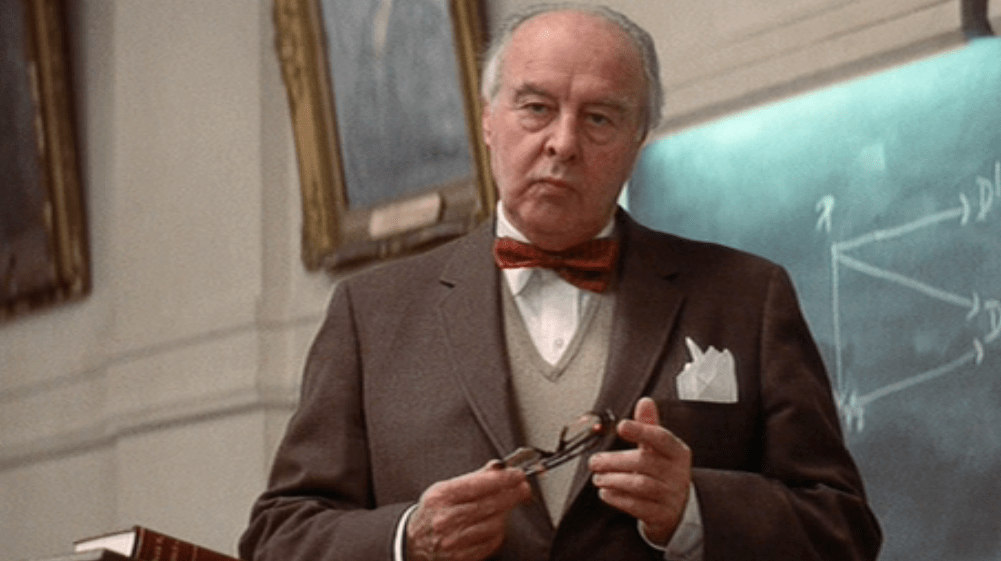
It’s a tale as old as time: the ambitious youngster and the domineering mentor they both loath and love. The Paper Chase rolls through this familiar set-up, based on a novel by law professor John Jay Osborn (descendant of that John Jay) who might well have seen a bit of himself in his novel’s stern mentor. That mentor is Professor Charles Kingsfield (John Houseman), an imperiously patrician professor of contract law at Harvard. Kingsfield is a demanding teacher, treating his class with arch disdain, demanding the best from them. Among his class is Hart (Timothy Bottoms), a fiercely hard-working ambitious young man who finds himself not only increasingly admiring Kingsfield but also (unknowingly at first) in an on-again-off-again relationship with Kingsfield’s daughter Susan (Lindsay Wagner).
This forms the meat of James Bridges’ dry, only fitfully engaging Harvard-set film which ambles gently from largely predictable plot-beat to plot-beat. After an initially promising start it swiftly outstays its welcome. The Paper Chase is frequently far-too sombre, slow-paced and unenlightening film which frequently flatters to deceive either as a character study, an insight into the dynamics of the mentor-pupil relationship, a love story or a comedy. It bears considerable, highly unfavourable, comparison with the more modern Whiplash which takes essentially the same set-up (an ambitious student desperate to impress a domineering mentor he loathes and loves) but uncovers far more psychological depth and insight.
The Paper Chase’s main claim to fame is John Houseman’s Oscar-winning performance. Despite his veteran Hollywood status as producer and screenwriter, Houseman was effectively a newcomer with only a brief performance in conspiracy thriller Seven Days in May prior to this. Houseman took on a part turned down by a host of leading actors (James Mason was the original choice, but scheduling ruled him out). He had the advantage of years of experience as an acting coach at the Juilliard School – his students reflecting Kingsfield was not a radical departure from Houseman’s own teaching style – and having a legendary standing in American Theatre not a million miles away from Kingsfield’s standing in the law.
It’s a smooth, eye-catching performance but neither the role (nor Houseman’s performance) are particularly complex, mostly requiring an ability to confidently roll out arch syllables and raise sceptical eyebrows. It’s funny, but a surface delight, the film continuously avoiding any attempt to delve into the character. Does he brutally push his students to prepare them for a brutal profession? To separate the wheat from the chaff? Because he’s a bully? Who really knows. When a student in his class, struggling to keep up, attempts suicide, Kingsfield barely reacts. He’s a stone-eyed enigma to the end, the character all front and no depth. It’s hard not to think Houseman couldn’t have played it standing on his head (he wrote later, he almost felt ashamed about winning an Oscar for what he considered a ten-day vacation from his teaching).
There is a chance for uncovering real psychological interest in Bottom’s role. Unfortunately, Bottoms lacks Houseman’s charisma, making Hart an unengaging, frequently uninteresting character, who it becomes fundamentally hard to care about – a death knell in a film about Hart’s ability to grow up and not depend on the approval and praise of others. Trapped in The Paper Chase is an interesting tale of a man latching onto a father figure – a father figure who tries to teach him that looking for others for approval is a fool’s errand by treating him with disdain throughout. Such a tale never comes into focus.
Neither does the film’s chronicle of the relationship between Hart and Susan – engagingly played by Lindsay Wagner – burst into the sort of witty interplay the script is straining at. Instead it increasingly drags, not helped by the underplaying of both actors. The barrage of bust-ups and disagreements between them keeps promising to burst into life like an updated Hepburn-Tracy vehicle. Instead, it meanders almost pointlessly, neither making interesting points about Hart’s obsession with proving his worth or Susan’s desire herself to defy her father.
A far more interesting film would have delved more into exactly what attracts Hart to Susan. Surely it can’t be a coincidence that Hart feels an intense attraction to the daughter of the law professor he is obsessed with impressing? Are Hart’s feelings sparked by a subconscious awareness from their first meeting of the similarities between Susan and Kingsfield? Freud would go to town on Hart’s continuing desire to both seduce Susan in the bedroom and Kingsfield in the classroom. It could be rich material for the film, but The Paper Chase seems utterly unaware of this engaging subtext, settling instead for the blandly predictable.
Similarly, the film has no interest in exploring any of the interesting questions around teachers like Kingsfield, who rely essentially on intimidation and academic hazing to motivate students, ruthlessly accepting the collateral damage of drop-outs like a badge of pride. Never once does The Paper Chase pause to question the merits or failings of this system or the type of people it produces or behaviours it encourages. The suicide attempt of a classmate at the pressure applied by Kingsfield, doesn’t stop the rest of the cast giving him a round of applause at the end of the semester. Never does it seem to make up its mind whether Hart’s perverse hero-worship of Kingsfield (who effects to have no idea who he is) is Stockholm syndrome or a vindication of Kingsfield’s methods by transforming a potentially mediocre lawyer into A-Grade material.
In fact as the credits rolled on The Paper Chase I was left wondering what on earth I was supposed to take out of this. Does Hart learn to care or not care about what Kingsfield thought of him? Was Kingsfield a heartless law robot or a great teacher or something in between? Sure, it culminates with Hart throwing away his final exam mark sight unseen – but the film is careful to make sure we the audience have seen he’s (of course) aced the class. It’s a sign the film was as blindly in love with Kingsfield as Hart was, vindicating all his methods (deliberate or otherwise). The Paper Chase is slow, unenlightening, nowhere near funny or dramatic enough to sustain interest for a class let alone a whole semester.


 Movie Musings