
Tag: John Mahoney

Moonstruck (1987)

Moonstruck (1987)

Charmingly romantic comedy with little touches of Shakespeare in its celebration of family love

Director: Norman Jewison

Cast: Cher (Loretta Castorini), Nicolas Cage (Ronny Cammareri), Olympia Dukakis (Rose Castorini), Vincent Gardenia (Cosmo Castorini), Danny Aiello (Johnny Cammareri), Julie Bovasso (Rita Cappomagi), Louis Goss (Raymond Cappomagi), John Mahoney (Perry), Feodor Chaliapin (Old man), Antia Gilette (Mona)

People do strange things all the time. We don’t always understand why, so why not say it’s a midsummer madness caused by the moon. Moonstruck seizes that old superstition of blaming the position of our nearest celestial neighbour for sending us all a bit barmy, and weaves it into a film that’s both a playfully eccentric romantic comedy and a sweet tribute to the power of a family’s loving bonds. John Patrick Shanley’s (Oscar-winning) script pulls these strings together so well, it’s not a surprise it’s the sort of a film that frequently ends up on people’s ‘favourite film’ lists.

Loretta Castorini (Cher) is an Italian-American widow, living with her parents, who is starting to wonder if she is cursed with spinsterhood. As the moon reaches its bright zenith, she agrees to marry her terminally dull, utterly unromantic boyfriend Johnny (Danny Aiello), because anything’s better than nothing (despite the fact he seems to see her as much a substitute for his mother as a romantic partner). She agrees to mend the bad blood between him and his younger brother Ronny (Nicolas Cage). Ronny is a picture-postcard of an eccentric, a one-handed baker (blaming his brother for that) prone to melodramatic fits of rage and outbursts of Operatic passion. Loretta and Ronny – blame that moon – are instantly smitten with each other. Who is going to sort that out?

It all pulls together into a sort of modern fairy tale, where everything has an air of gently heightened reality. It’s also the sort of thing that wouldn’t seem out-of-place in Shakespeare’s lightest comedies: people fall in love on a sixpence, feuds are fixed in minutes, cheating spouses instantly return to their wives and jilted suitors smile and join in the celebratory drinks. In this world of theatrical, fairy-tale comedy, it’s quite easy to buy that an exceptionally bright moon is sending everyone a little bit crazy (like Shakespeare’s Dream lovers in the forests outside Athens, going through one crazy doped-up night before settling suddenly into two loving couples) and eventually you just run with it in Jewison’s charming film.

With a script full of witty lines and theatrical bits of bombast (which Cage in particular, inevitably, rips through), Moonstruck is also one of those endlessly charming, relaxing and pleasant films where fundamentally everyone is at-heart decent. Sure, mistakes are made throughout; harsh words and truths are spoken, but within a film where everyone cares for each other. Ronny may (rather unjustly) blame his brother for briefly distracting him at work into losing his hand, but deep down he’s just waiting for an excuse to forgive his brother. Loretta may have a prickly relationship with her mother, but it’s roots are really firm and based around both protecting the other from knowledge of the knee-jerk philandering of her father. It takes the influence of the moon to suddenly spark these people into a few days of crazy behavior that changes their lives and leads them to re-address their relationships with each other.

It also makes Loretta, in an Oscar-winning comedic turn from Cher, face up to the fears about where her life is going. In a performance that is remarkably unglamourous – Cher plays every inch of the reliable window settling into spinsterhood and the film never falsely ‘transforms’ her – Cher invests Loretta with a deep fear and resignation below her surface of reliability and unflappability. Loretta is so used to being practical and dependable, organising the lives of everyone (even patiently instructing the confused Johnny on how to propose marriage), part of her romantic relief with Ronny is being able to let rip a more sensual and vulnerable part of herself. Cher lets the mask slip, as if having had love potion dripped into her eyes, letting her express her deeper feelings.

It makes sense then that she should fall in love with someone as self-willed and resistant to being mothered as Ronny. In an early role that straight away captures Nicolas Cage’s willingness to rip into a scene (what other actor would feel like such a natural fit for a lovably blow-hard, one-handed, baker melodramatically prone to threatening no end of harm on himself?), Ronny has all the sort of wildness and uncontrolled energy and excitement the rest of Loretta’s life doesn’t have. And he doesn’t want her to fill a surrogate role for another family member – he wants her to be part of an equal relationship on her own terms with him.

It’s probably the sort of relationship Loretta’s parents had at one point. Before her mother Rose (another Oscar-winner, Olympia Dukakis) become cynical and shut-off from her husband Cosmo (Vincent Gardenia). Cosmo has let his decency get squashed under a fear of growing old, clinging to a younger girlfriend (Anita Gillette) who he conducts an affair more out of habit more anything. No wonder Rose considers flirting with John Mahoney’s constantly-jilted professor (in a touch that hasn’t aged well, he keeps trying to date his students), but not going the whole hog, while Cosmo tries to feel young again by doubling-down on his quietly dying affair.

What’s surprising then is that Moonstruck bubbles all this romantic back-and-forth into a warm celebration of familial love. While romantic bonds are firey, they are transient – the bonds of family last. Moonstruck culminates in the family putting the sort of romantic divisions that have kept them apart aside to come together in a warm celebration: like Shakespeare’s lovers they have woken up and found out everything is in fact fine. There’s something really reassuring and hopeful about this – that our feuds and divisions can bring us together as much as they can tear us apart.

It’s another reason as well why this is a popular film. It’s helped of course by John Patrick Shanley’s well-crafted script, and the terrific playing of the actors. Cher and Cage both have great chemistry and get the tone of the eccentric but touchingly tender unlikely romance just right. Dukakis and Gardenia are both funny and sweet as their parents, Aiello gives a very generous performance as a dutiful-boy-who-never-grew-up and there’s a scene-stealing cameo from Feodor Chalipin as Loretta’s eccentric grandfather. Above all, Moonstruck is a playful, feel-good film that doesn’t take itself too seriously and lives you feeling hopeful that everything can work itself out – even when the magic of the moon sends us a little crazy.
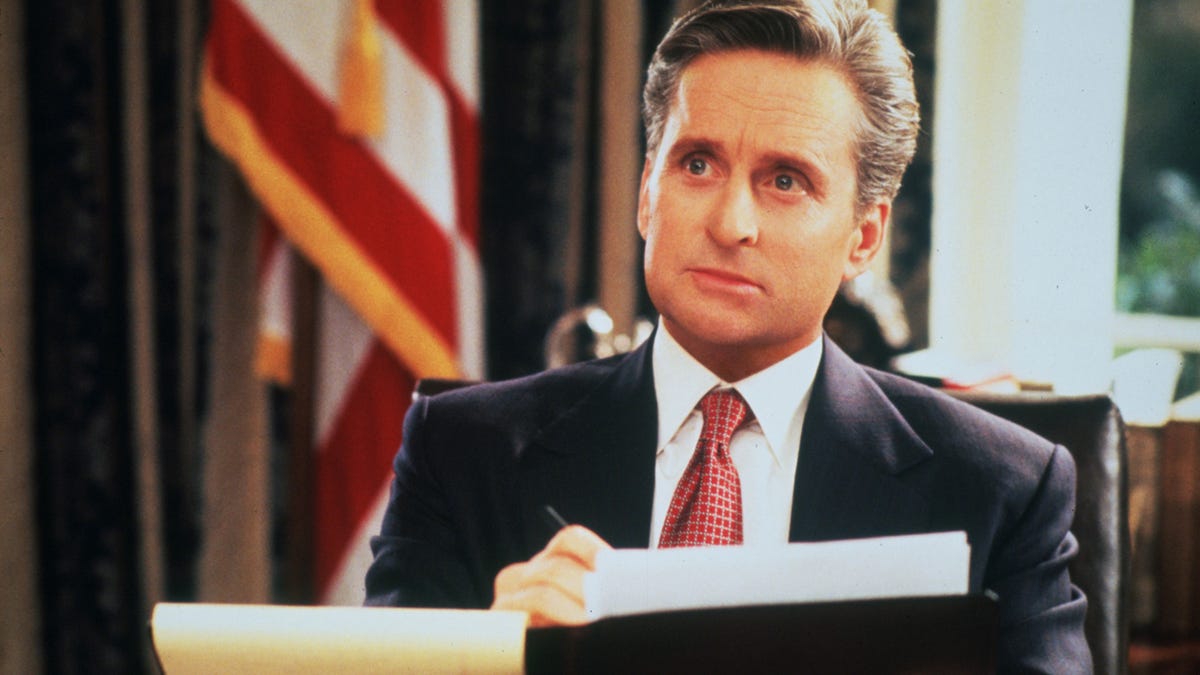
The American President (1995)

The buck stops with Michael Douglas in Aaron Sorkin’s dress rehearsal for TV, The American President

Director: Rob Reiner

Cast: Michael Douglas (President Andrew Shepherd), Annette Bening (Sydney Ellen Wade), Martin Sheen (AJ MacInerney), Michael J Fox (Lewis Rothschild), Richard Dreyfuss (Seantor Bob Rumson), David Paymer (Leon Kodak), Samantha Mathis (Janie Basdin), John Mahoney (Leo Solomon), Anna Deavere Smith (Robin McCall), Nina Siemaszko (Beth Wade), Wendie Malick (Susan Sloan), Shawna Waldron (Lucy Shepherd), Anne Haney (Mrs Chapil)

Taken solely on its own merits, The American President is a charming, witty romantic comedy which makes some shrewd (liberal-tinged) comments about American politics. But no-one is ever going to take The American President on its own merits. Because this Sorkin-scripted bundle of joy is so clearly a dry-run for The West Wing, it’s hard to watch it without spotting the roots of it here: everything from shared characters to scraps of dialogue. Perhaps only M*A*S*H stands with this film as so dwarfed by its spin-off.

President Andrew Shepherd (Michael Douglas) is a widower, raising his daughter Lucy (Shawna Waldron). Heading into the third year of his first term, he’s got a domestic agenda dominated by his new crime bill (although Shepherd won’t risk increasing gun controls). Charming, articulate and passionate – he’s also lonely. But his life changes when he falls for environmental lobbyist Sydney Ellen Wade (Annette Bening), their courtship seeing them fumble through “boy-meets-girl” when boy just happens to be the most powerful man in the world. Will the President’s popularity survive him dating someone outspoken and passionate? Or will it be a tool for his Republican rival Senator Bob Rumson (Richard Dreyfuss) to hit him on everything from family values to patriotism?

It’s impossible not to enjoy The American President. Sorkin’s playful, articulate and smart dialogue is of course an absolute triumph. The cast are extremely well-chosen. Few actors look as damn Presidential as Michael Douglas, not to mention carrying with them an air of impassioned authority and commanding bonhomie. Annette Bening is spot-on as exactly the sort of feisty and intelligent woman that would attract a liberal minded President, but turn off pundits and regular people. Martin Sheen was obviously so comfortable with Sorkin’s dialogue style that promotion to the President seemed inevitable (seriously it’s very odd watching the film and seeing Sheen not being treated like the President!). Michael J Fox’s entire career was revitalised by Sorkin tapping into the frantic, fast-paced comic energy that is the actor’s forte.

Rob Reiner’s direction is fresh, relaxed and perfectly complements the dialogue. We get a few West Wing style walk-and-talks (does this make Reiner the inventor of it?). The film superbly balances romantic comedy with serious political discussion on military intervention and proportional response (“the least Presidential thing I do”), the environment and gun control. It also gets a neat idea of the shady, and dirty, business of generating votes in the House – and the deals that need to be done to secure legislation. Reiner gets great stuff from the actors (Sorkin didn’t question his casting, since so many of them ended up in The West Wing) and keeps the momentum up beautifully.

The film has a lovely Capra-esque feel to it. Sorkin is even witty enough to lean on this by having Sydney discuss Capra openly with a White House security guard – also a lovely moment to establish Sydney’s genuineness and openness, as compared to the jaded I-don’t-care attitude of her colleague. There is a real feel in it – and of course this optimism carries across to The West Wing – that good people in the right place can change the world. That decency and compassion can trump (so to speak) the cynicism of Washington insiders. (The idea appeals to everyone – what is Donald Trump but a nightmare version of a plain-speaking man in Washington who says what he thinks?).

Balanced with some lovely comedy, it works extremely well. Along with the debate, Sorkin has a great feeling for the absurdity of the Leader of the Free World trying to work out how he can behave like a regular Joe and ask a girl out on a date. Simple ideas, from sending flowers to the etiquette of having someone stay over, are laced with difficulties. The film gets a wonderful sense of how the public eye can unjustly tear people apart – all drummed up by Dreyfuss’ eminently hissable villain.

There is some great chemistry between Douglas and Bening. Douglas is at possibly his most charming and authoritative here, effortlessly selling the lightness but also the powerfully effective speeches Sorkin crafts for him (his final press conference speech that effectively closes the film is a barnstormer). Bening, as well as being perfectly cast, walks a neat line between serious professional and girlish crush, that comes across extremely well.

It’s hard though, for all the film’s romantic charm, not to look at it through the filter of The West Wing. It’s both a first pass, and a historical curiosity. Sorkin recycled many of the ideas touched upon here (most noticeably Sheen’s President would spend an entire episode discussing proportional responses) and also expanded several characters. Douglas’ teacher turned President, widely read and with a liberal outlook, is a clear forerunner of Bartlett. Sheen himself plays a character who is all but Leo. Fox plays a character combining elements of Josh and Toby. Anna Deavere Smith is a CJ without those distinctive touches Allison Janney bought to the role. Names, plot developments, concepts are all recycled. Stylistic flourishes in the writing match.

The American President isn’t as good as The West Wing of course – few things are. But as a boiled down, Hollywood version with a romantic twist, it’s still pretty damn good.

Primal Fear (1996)


Richard Gere prepares an impossible defence for unbalanced Edward Norton. Twist ahoy!

Director: Gregory Hoblit

Cast: Richard Gere (Martin Vail), Laura Linney (Janet Venable), John Mahoney (John Shaughnessy), Alfre Woodard (Judge Shoat), Frances McDormand (Dr Molly Arrington), Edward Norton (Aaron Stampler), Terry O’Quinn (Bud Yancy), Andre Braugher (Tommy Goodman)

Courtroom dramas are the bread and butter of film drama. You get to deal with good vs evil, right vs wrong – and you even have two advocates on each side there duelling it out on camera for you. Primal Fear came at a time when John Grisham and his like were ruling the bestseller charts, and it’s a fine demonstration of that very late 80s to mid 90s genre: the all-star court case film.

After the murder of a beloved archbishop in Chicago, bloodied altar-boy Aaron Stampler (Edward Norton) is found near the scene. There seems no doubt that he’s guilty. Top city lawyer Martin Vail (Richard Gere) takes his case for the publicity of a big trial, but finds himself believing the boy to be innocent. As the trial begins though, Vail’s psychiatric investigation reveals Stampler has a split personality – his gentle main persona and a violent defensive personality, “Roy”, who admits to the crime.

This is an advanced, well-written trial thriller which, through a combination of some neat lines and some very good performers, manages to bring a lot of life and originality to what could have been a collection of stock characters. Instead, each character in the film feels real and their actions seem part of a coherent personality. The mechanics of the plot also move very smoothly, with a well-handled twist. And as a bonus it has something to say about human nature, about our need to believe in something and how easy it is to tell lies about ourselves and believe them from others.

The film is shot with a good eye for grimy real-life locations and muddy shade-of-grey morality. Hoblit’s direction is crisp and straightforward and he avoids getting any pyrotechnics in the way of the actors – here the performances are the special effects. It’s also a brilliant twist movie that doesn’t telegraph the fact it contains a twist until it suddenly pulls the rug out from under your feet. Hoblit doesn’t give us any advantages over the characters and has the restraint not to show his hand too early – instead he sucker punches us with a sudden downer ending. It’s a masterpiece of genre craft film-making.

Richard Gere at first glance is playing well within his range – a smirking hotshot focused on the win, willing to defend anyone and anything. However, what Gere does really well here is play his persona as an actual persona of the character. The “real” Martin Vail, it becomes clear, is actually almost naïve in his underlying faith in the justice system. He has a touching faith in people and the twist of the film works because we believe how much Vail unwittingly allows himself too be manipulated and conned. He’s the sort of true believer who can playfully mock his faith because his belief in it is absolute. It’s even more crushing, then, when that faith is so cruelly used and abused. The final shot of him alone on the street all but screams “My God, what have I done?”.

But though this film has some of Gere’s best work, this is Ed Norton’s movie. Incredibly, this was Norton’s first ever film, and he seizes the film absolutely by the scruff of the neck. Re-watching the film now, it’s less of a surprise when Aaron’s “Roy” personality bursts out – Norton is so well known now you are almost waiting for him to really let rip – but he nails the contrasts between the stammering, gentle Aaron and the ferocious Roy. You always know which one he is at any time – and even better than that, Norton drops subtle hints throughout to set up the film’s twist (which I won’t give away). His performance is largely a triumph of masterful control of acting tricks and a brilliant demonstration of range, as well as a swaggering display of confidence, rather than a subtle piece of character work, but it’s still an absolute knock out for all that – and totally believable.

Strong performances also come from Laura Linney, making an awful lot of the role of Gere’s courtroom nemesis and part-time lover. Andre Braugher is particularly good as an investigating officer. Alfre Woodward is stern and authoritative but fair minded and just as the judge. Frances McDormand makes what could have been a wet liberal doctor feel like a genuinely caring and dedicated intelligent professional. There isn’t a weak link in the cast, and every character beat feels well observed and natural. How many genre films have failed to manage that?

It all works extremely well and offers all the courtroom fireworks you could want with maximum efficiency. All the actors are working at the top of their game, and the direction keeps the action taut and intriguing. Here’s the thing: the plot makes little sense if you think about it, and Norton’s plan depends on so many variables he could never have known that it would success. But the film is made with such confidence and assurance that it never really matters. The twist still has a lot of impact today – and the film bravely offers no happy endings, only hammers home the system’s corruptness. A very good example (perhaps one of the best) of the courtroom genre.