Tag: John Mills

War and Peace (1956)

War and Peace (1956)

Tolstoy is boiled down in this epic and luscious but soapy adaptation of the greatest novel ever

Director: King Vidor

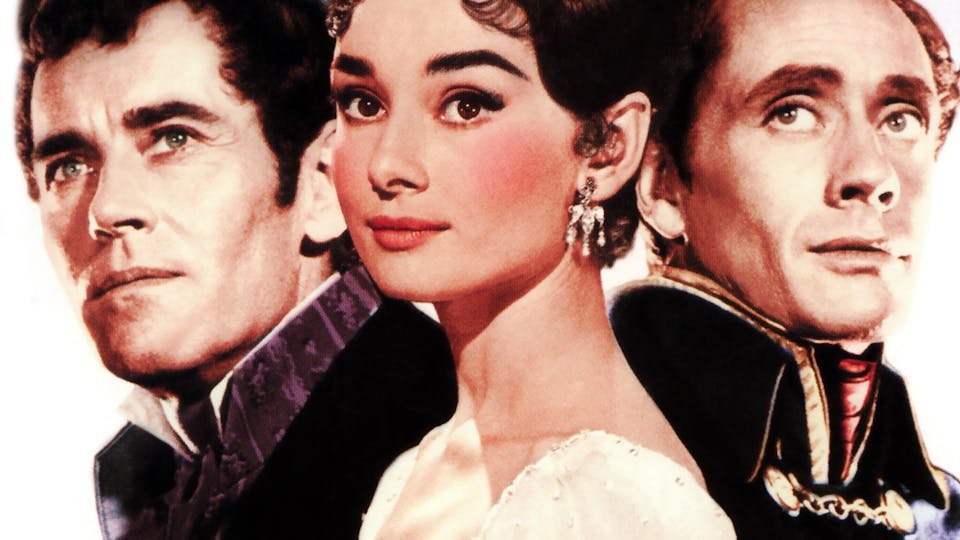
Cast: Audrey Hepburn (Natasha Rostova), Henry Fonda (Pierre Bezukhov), Mel Ferrer (Andrei Bolkonsky), Vittorio Gassman (Anatole Kuragin), Herbert Lom (Napoleon Bonaparte), Oskar Homolka (Field Marshal Mikhail Kutuzov), John Mills (Platanov), Anita Ekberg (Hélène Kuragina), Helmut Dantine (Fedor Dolokhov), Tulio Carminati (Vasily Kuragin), Barry Jones (Mikhail Rostov), Milly Vitale (Lisa Bolkonskaya), Lea Seidl (Natalya Rostova), Anna Maria Ferrero (Mary Bolkonskaya), Wilfrid Lawson (Nikolai Bolkonsky), May Britt (Sonya Rostova), Jeremy Brett (Nicholas Rostov)
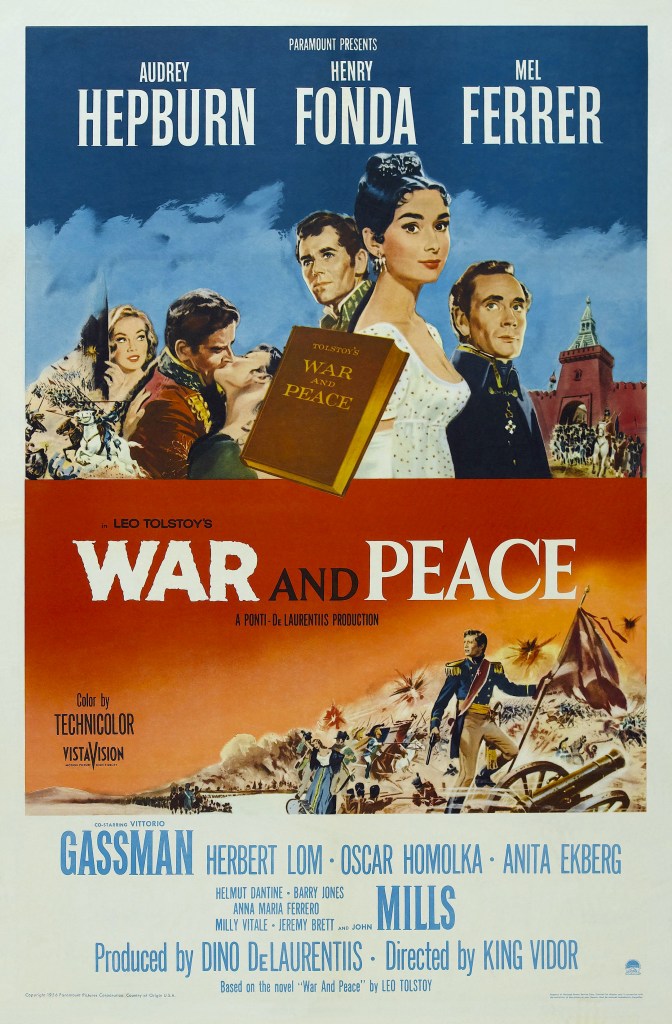
Let’s just say it right from the start: you can’t do Tolstoy’s War and Peace in three hours. All you can hope for is the little chunk of it you’ve bitten on is the most succulent part. King Vidor’s War and Peace zeroes in on the elements of the book Hollywood is most comfortably reproducing: a golden-tinged romance between Natasha and Pierre and the sweeping epic spectacle of Napoleon’s soldiers surging towards Moscow and limping home in the snow. While War and Peace, bravely, barely cuts a single major character or development, almost every other theme Tolstoy attempted gets shoved to the margins. This makes it both a SparkNotes version of the Greatest-Novel-Written, but also a very earnest attempt to do the impossible.

Tolstoy’s story stretched over seven years. The great Russian struggle against Napoleon is a backdrop to the lives of dilettante-turned-thinker Pierre Bezukhov (Henry Fonda), vivacious and impulsive Natasha Rostov (Audrey Hepburn) and stolid-but-thoughtful Andrei Bolkonsky (Mel Ferrer). Around them swirl other characters: Natasha’s warm-but-useless family, worthless womaniser Kuragin (Vittorio Gassman), his sister and Pierre’s faithless wife Hélène (Anita Ekberg), heartless roister Dolokhov (Helmut Dantine) and of course Napoleon (Herbert Lom) and his military antagonist, the pragmatic Kutuzov (Oscar Homoloka). Natasha falls in love with Andrei, betrays him then finds maturity caring for soldiers retreating from Napoleon, all while silently loved by Pierre.

This is compressed together into a film that certainly doesn’t feel like it is covering seven years despite its epic run-time. No one seems to age (just as well since everyone starts the film far too old) and the attempt to cover as much of the plot as possible means the film is moving forward so swiftly any sense of time is lost. It also means that the script frequently has to fill in the dots, communicating vital information that alters the lives of characters – major figures often die or are married off in short, easy-to-miss, sentences – and the ideas Tolstoy masterfully expounded about spirituality, destiny, fate, the quest for a life of meaning, are pretty much rinsed out in the plot focus.

War and Peace effectively reduces Tolstoy down into a sudsy romance against an epic backdrop. The romance is handled reasonably well, even if there is very little chemistry of any sort between any of the three protagnonists. Tolstoy’s rich leads, with the fascinating inner lives, are reduced to pen-portraits. There are odd moments where we have access to the inner thoughts and voices – sprinklings of voiceover dot around the picture – but they never feel real. Andrei has been robbed of the decency and warmth behind his thoughtfulness that attracts Natasha, while Pierre feels more like a second father or benevolent uncle than a soul mate.

This stripping down of Tolstoy’s complex characters to their bare principles fatally compromises all three lead performances. Hepburn comes off best, making a decent fist of Natasha Rostov. This is, after all, a character who embodies in her mix of passion, loyalty, fecklessness and self-sacrifice the very nature of Russia itself. No adaptation has ever managed to translate Tolstoy’s unplayable creation, but Hepburn has all the radiance and self-sacrificial guilt down pat. The film has to rush through her foiled elopement with Kuragin (Hepburn has more chemistry with Gassman than any of the others and their near elopement is artfully framed by Vidor with mirrors, reflections and a real illicit charge). Hepburn conveys the mesmeric impact this playboy has on Natasha and her selfish, tear-stained fury at the foiling of her disgraceful plans is laced with enough genuine guilt and pain by Hepburn to keep us caring. Hepburn skilfully translates this into a far wiser and more generous Natasha, placing others needs before her own.

By contrast, literally nobody reading the novel could picture Henry Fonda as Pierre (he’s the wrong age, shape, manner – there is nothing right about him at all), but Fonda does his best (as one reviewer at the time mentioned he’s one of the few actors who looks like he has read the book). He never convinces as the drunken playboy who gets into duels (he looks and sounds far too mature) and similarly doesn’t capture any of Pierre’s doubt and uncertainty (Fonda always looks like he knows exactly what he needs to do). It’s an intelligent reading for all that, but fundamentally miscast. Which is more than you can say about Mel Ferrer who turns Andrei into a stuff bore, ramrod straight and flatly monotone, an intellectual we never get interested in.

Honestly the film would have done better cutting more. Fonda is so unconvincing as the reckless young Pierre, they may as well have made him officially middle-aged to begin with. Similarly, Natasha’s brother Nicholas and his one-sided romance with cousin Sonya is given a mention so token its likely to confuse casual viewers. Andrei’s first marriage gets about five minutes and his sister Mary is reduced to a few dull scenes. Even John Mills’ thoughtful performance as Platanov strips out the characters worldview (and its profound impact on Pierre), turning it into one of simple, symbolic tragedy. It’s all the more noticeable when the film gets some stuff right, most notably Helmut Dantine’s bullying Dolokhov who war turns into someone with a sense of shame.

Faring much better are the historical characters. Like all War and Peace adaptations, this dials up the presence of Napoleon played with an excellent puffed-up grandeur by Herbert Lom, prowling with a swagger stick and collapsing into childish frustration, then silent tears as his plans for world domination collapse. Equally stand-out is Oscar Homoloka as scruffy realist Kutuzov.
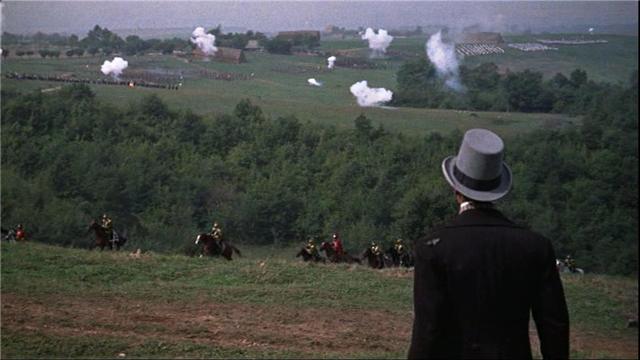
Vidor’s film may offer a simplified, romantic vision of the characters but he delivers on the scale. If you can bemoan the fact the peace leaves the characters neutered, the film completely nails the war.  War and Peace is a beautifully filmed by Jack Cardiff. From the sweeping vistas of the battlefield of Borodino, to the Dante-tinged flames at Moscow that cast orange light through the arches of a monastery where the Rostov’s take shelter, through the white-and-blue chill of the snow-covered retreat from Moscow, the film is an explosion of gorgeous colours. It’s also got the scale that old Hollywood loved. Borodino is restaged seemingly at 1:1 scale with a literal army of extras, soldiers and cavalry charging in their hundreds in long-shot and cannon fire peppering the land as far as the eye can see. Ballrooms are overflowing with extravagantly costumed extras and seemingly never-ending lines of Frenchmen march through the snow in the films closing moments.

It’s what this War and Peace is: a coffee-table accompaniment to the novel. You can look at the images it brings to life and the sweeping camera work Vidor uses to create nineteenth century Russia. But you’ll not understand anything that makes the novel great. In fact, to the uninitiated, you are likely to come away thinking the film must be a sort of high-brow Mills-and-Boon page-turner, a Gone with the Snow. What this tells us, more than anything, is that fifteen years on from the definitive Hollywood epic, Hollywood was still trying to remake it – and bringing Tolstoy to the screen was very much second to that.

The Wrong Box (1966)

The Wrong Box (1966)

Farce, murder, mayhem and comic energy abounds in this sometimes try-hard but fun enough knockabout comedy

Director: Bryan Forbes

Cast: John Mills (Masterman Finsbury), Ralph Richardson (Joseph Finsbury), Michael Caine (Michael Finsbury), Peter Cook (Morris Finsbury), Dudley Moore (John Finsbury), Nanette Newman (Julia Finsbury), Tony Hancock (Inspector), Peter Sellers (Dr Pratt), Cicely Courtneidge (Major Martha), Wilfrid Lawson (Peacock), Thorley Walters (Patience), Irene Handl (Mrs Hackett)

Do you know what a tontine is? For those who don’t (come on, own up!) it’s basically an investment named after the Florentine banker Lorenzo di Tonti in 1653. Investors pay into a scheme which gives a regular income while accumulating interest on the initial capital. As the investors die off, the individual payouts increase until the final surviving investor claims the full ‘pot’ of cash. It’s essentially a lottery for being the last surviving investor. That’s ripe for two things: murder and farce.

We got dollops of the latter in this slap-stick, old-school farce loosely (very loosely) based on a Robert Louis Stevenson and Lloyd Osbourne novel. A Victorian tontine sees its members fall at regular intervals until there are only two survivors: estranged brothers, cantankerous Masterman (John Mills) and almost supernaturally tedious Joseph (Ralph Richardson). With Masterman pretending to be on his own deathbed to lure his brother out (to murder him), the blithely dotty Joseph is kept in health by his greedy nephews Morris (Peter Cook) and John (Dudley Finsbury). En route to see Masterman, a train accident leads to a series of farcical misunderstandings involving mis-identity, confusion and a dead body packed into a box and delivered to the wrong house.

Directed with an, at times, slightly too overtly zany bent by Bryan Forbes, The Wrong Box oscillates between being rather funny and trying too hard. It’s all too obvious to see the influence of the Oscar-winning Tom Jones in the film’s jaunty musical score and use of flowery-lined caption cards to announce events and locations. It’s also clear in the fast-paced, at times overblown, delivery of performances and dialogue, with its mix of improvisational humour and cheeky lines. Despite this though, The Wrong Box manages to be just about be fun enough (and it’s funnier than Tom Jones).

That’s probably because it’s not aspiring to be much more than a jaunt, an end-of-term treat in which a host of famous actors and comedians put on a show. Forbes might not have the inspired flair at comedy or the sort of timing this needs. But he’s got a nifty touch with dialogue and does a decent job of translating classic British theatre farce to the screen. The Wrong Box – even the title leans into this – is all about those classic farcical tropes of things being delivered to the wrong people because they have similar names, mistaken or misheard messages being passed on and people obliviously talking at cross purposes.

We get set-ups like Mills’ fake-bed-ridden old man trying multiple times to off Richardson’s bore, each attempt obliviously foiled by coincidence and accident. A body misidentified because its wearing someone else’s coat, then packed into a crate and delivered (to the wrong house) to disguise a death that hasn’t actually happened. Undertakers mistakenly taking away a man who has fainted at the foot of the stairs rather than a body in another room. All classic farce.

It’s not a surprise that experienced theatre actors emerge best. Richardson, in particular, is a delight as a man who has made such a study of trivia that he compulsively bores anyone he encounters. Fellow passengers on a train, a farmer who gives him a lift in his cart, attendees at a funeral – all of them glaze over in despair while Richardson’s Uncle Joseph, with monotonous eloquence, expounds mind-numbing trivia (including, at one point, in Swahili). He makes a fine contrast with Mills’ angry short-man, constantly fuming at a string of slights, real and imagined.

These two leads set the standard for the rest of the cast, a mix of comedians, theatre pros and star names. Peter Cook occasionally tries a little too hard as a bossy-boots determined to inherit the tontine – it’s remarkably that, even this early, Dudley Moore looks more relaxed in front of the camera (Moore’s later stardom would be inexplicable to the jealous Cook). Tony Hancock looks rather sadly like a rabbit-in-the-headlights as an inspector. Peter Sellers, not surprisingly, shows how it’s done: his two-scene cameo as a drunken doctor of loose morals, surrounded by cats and permanently sozzled is a master-class in low-key, rambling hilarity.

Michael Caine and Nanette Newman also acquit themselves very well. Throwing themselves into the spirit of things as our romantic leads – fulfilling the requirements of the genre by being both charming and sweet but also naïve and a little dim – they strike up a romance that manages to be both rather touching and also a neat parody of costume drama flirtation. Forbes shoots a rather nice scene where they breathlessly eye each other up, the camera cutting rapidly from exposed arms to facial features one after the other. Both are very funny, with Caine striking up a lovely double-act with Wilfrid Lawson as an almost incoherently drunk butler (Lawson’s finest hour since Pygmalion).

The film keeps its comic energy flowing well, with Forbes using a good mix of interiors and some attractive Bath locations (doubling for London). It’s also a film which – surprisingly since its written by a pair of Americans – really captures a sense of British eccentricity. I really enjoyed, in particular, the opening sequence that charts the deaths of the other members of the tontine – a parade of inept empire builders (soldiers, explorers, big game hunters) meting a series of surreal (often self-inflicted) deaths.

It probably does slightly outstay its welcome – 90 minutes would have been perfect. It’s a little too pleased with its semi-surreal set-up and stylistic flourishes – the floral on-screen captions definitely are far less funny than the films thinks. There is, at times, a little too much of the “isn’t this zany!” air about the film that can grate, with set-ups groaning with their desire to amuse (a late hearse chase scene falls into this) like a pub bore telling you a story in his self-proclaimed “inimical style”.

But at least The Wrong Box does make you laugh. And when that is all it is aiming to do, its hard not to have a soft spot for it.

Great Expectations (1946)

Great Expectations (1946)

Lean’s masterful adaptation is still one of the finest examples of Dickens on screen

Director: David Lean

Cast: John Mills (Pip), Valerie Hobson (Estella), Bernard Miles (Joe Gargery), Francis L Sullivan (Jaggers), Finlay Currie (Abel Magwich), Martita Hunt (Miss Havisham), Alec Guinness (Herbert Pocket), Jean Simmons (Young Estella), Anthony Wagner (Young Pip), Ivor Barnard (Wemmick), Freda Jackson (Mrs Joe Gargery), Eileen Erskine (Biddy), Torin Thatcher (Bentley Drummle)

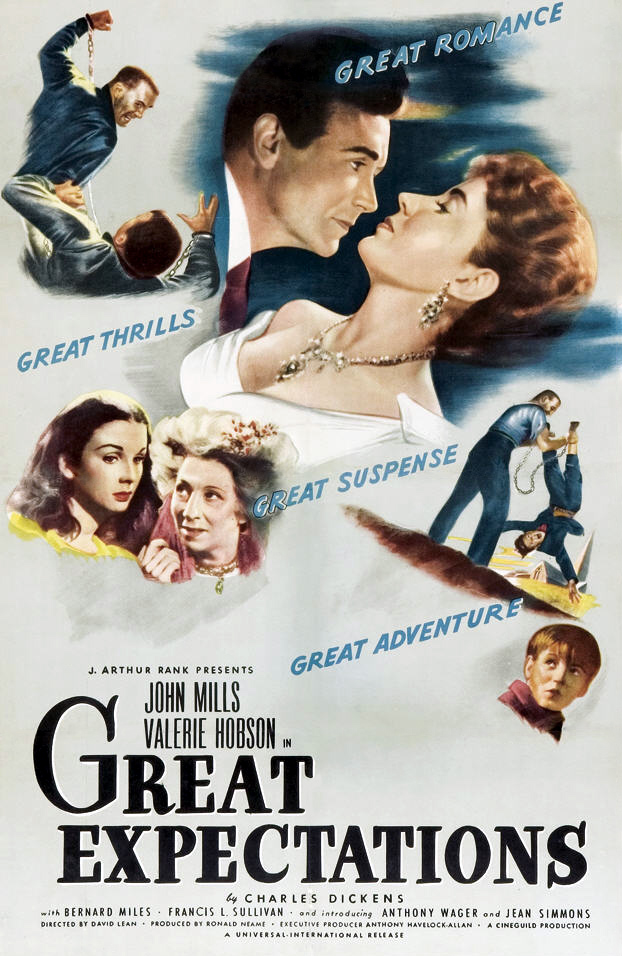
Of all Dicken’s books there is perhaps none so popular as Great Expectations – and no Dickens adaptations are more highly regarded than David Lean’s 1946 film. Of course, just under two hours is only time to tell a simplified version of Dicken’s original. But no-one’s taking the book away. What Lean’s film did triumphantly was turn Dicken’s prose into a clear cinematic language and style, without losing the uniqueness of the author’s voice. Lean’s visual mastery is perfectly matched with his experience as an editor of telling a story to produce an endlessly entertaining film.

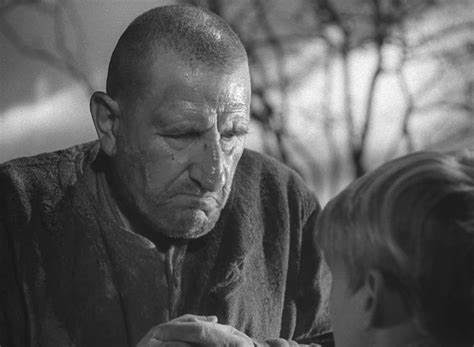
As a young boy Pip (Anthony Wagner) encounters an escaped convict (Finlay Currie) in a graveyard. Intimidated, Pip brings the convict food and tools to escape his chains – acts which the convict clears him of when he is caught later that day. Weeks later, Pip is invited to the home of rich spinster Miss Havisham (Martita Hunt) to provide her and her adopted daughter Estella (Jean Simmons) with company. The visits continue until Pip’s apprenticeship as a blacksmith to his brother-in-law Joe (Bernard Miles) begins. Imagine Pip’s (now John Mills) surprise six years later when he is informed by lawyer Jaggers (Francis L. Sullivan) that he has come into money – that he has become a gentlemen of “great expectations”. Assuming it is the work of Miss Havisham – and that he is destined to marry Estella (now Valerie Hobson) – he is horrified to discover his life is more complex than he believed.

The film repackages Great Expectations a bit more into a romance. While the relationship between Pip and Estella, and the bond between them, is clear in the novel – and a large part of its plot – its but one thread masterfully woven together into the final storyline. Here this thread is given prominence, at the cost of several others. It’s not a complaint as such, but it makes Great Expectations into a more traditional story: a feeling added to by the film’s more conventional “feel-good” ending (very different from the much more uncertain ending of the novel, that Dicken’s edited back and forth in different editions to increase or decrease its hopefulness). However, it works for creating a film story, even if it loses some of the depth of the novel.

Its also more than balanced by how much the film gets right. Lean brilliantly captures the novel’s atmosphere, its gothic sense of impending dread, the burden of the past and the paranoia of persecution. For decades the opening scenes of the film, with its masterfully shot and edited mist covered graveyard (simultaneously a place of peace and a place of unsettling unknowability ) bursting into life through the grasping hands of Magwich, were practically used as a textbook example of cinematic language. Lean’s work is intensely cinematic. The mis en scene of Expectations is masterful – everything from casting, to camera angles to score comes together to bring Dickens world to life. This is exactly his London as he wrote it. It’s a wonderful expression of a particular author’s style, told using a mastery of cinematic language – from camera angles to editing cuts.

The characters have that perfect sense of eccentricity laced with menace that Dickens invests them with. Francis L Sullivan’s Jaggers is an unknowable legal machine who is part man of business, part fearsome fixer. Alec Guinness (in his film debut) is good-natured kindness to a T as Pip’s faithful friend Herbert (in one lovely scene he politely and gently corrects Pip’s primitive table manners). Finlay Currie’s Magwich captures the sense of danger and threat in the book’s opening that will become a fatherly meekness in the story’s later acts.

Largest of all, Martita Hunt’s gothic Miss Havisham sits like a giant spider at the centre of a decaying web. The design of Satis House – with its rotting wedding cake, sprawling cobwebbed dinner service, the heavy curtains and lack of light – is just one of the many perfect touches in the film. Hunt herself is superb as this outwardly eccentric aunt, who in fact has been nursing a core of bile and hatred that ends up only hurting those closest to her. There is something hugely dreamlike about Miss Havisham’s home – you suspect Lean may have watched some Cocteau – with its strangely angled table and mix of intimate framing and wide-angle crane shots.

Perhaps because we only see, not read, Pip’s actions in this film it’s impossible not notice what an arrogant snob he becomes. John Mills does decent work in the part, but (much as in the book) Pip ends up feeling like a slightly colourless figure. The film doesn’t always explore in detail the negative sides of his character meaning moments like his patronising dismissal of the kindly Joe (a perfectly judged Bernard Miles), don’t do the character much favours. Mills does however make a larger impression than Valerie Hobson, left slightly adrift as Estella. She’s not helped by how outstanding Jean Simmons is as the young and preciously flirtatious Estella, the perfect picture of the little cruelties teenagers inflict on each other. (A braver film might have had her play the role throughout – but then Mills would look even older than he does!)

The film is very strong on the pain caused to these two characters – and that they cause for each other. More than any other version, we get a sense here of how Miss Havisham’s misguided aim to use Estella as a weapon of revenge on all men only manages to hurt Estella herself and Pip (her one true love as presented here). Just as a Pip’s snobbish dismissal of Joe stings. And Lean’s brilliant sense of pace and rhythm means that this plays hand-in-hand with Pip’s ever more desperate attempts in the second half to save Magwich from doom.

Many of the complexities of the plot (from Estella’s parents to Herbert’s marriage to several key characters) are cut out, but it’s striking how the film still manages to feel so faithful to the book. Lean’s understanding of Dickens mix of eccentricity and darkness is communicated in every frame. The major moments and characters from the book are beautifully bought to life, from that opening scene to Satis House. But also because small moments, like Wemmick’s “Aged P” remain in the film. Sure, the canvas has been reduced – and refocused into a love story of sorts – but the picture that emerges is still very much in the style of Dickens.

That’s what makes it one of the greatest adaptations of all time: it’s both an interpretation of the original and a beautifully judged capturing of its spirit and tone. An adaptation twice the length may have caught more plot, but would not have been such a fine movie. Because so much of this film’s imagery and drama sticks in the mind long after it is finished. Lean’s masterstroke here was to understand completely the heart of the book, and to focus the film on that. Brilliantly assembled, designed, shot and acted, it’s still one of the best literary adaptations ever made.

Gandhi (1982)

Ben Kingsley excels as Gandhi in Richard Attenborough’s Oscar winning epic

Director: Richard Attenborough

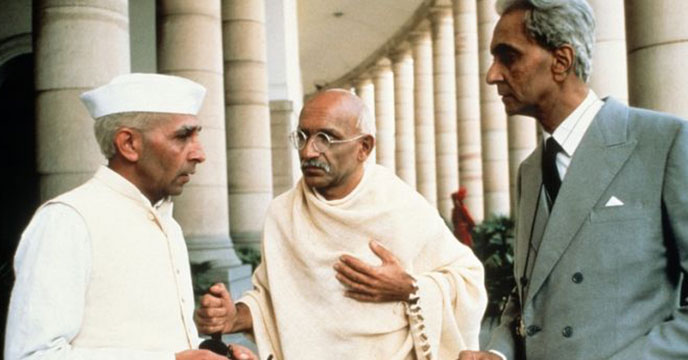
Cast: Ben Kingsley (Mahatma Gandhi), Rohini Hattaggadi (Kasturba Gandhi), Roshan Seth (Jawaharlal Nehru), Pradeep Kumar (VK Krishna Menon), Saeed Jaffrey (Vallabhbhai Patel), Alyque Padamsee (Muhammad Ali Jinnah), Virendra Razdan (Maulana Azad), Candice Bergen (Margaret Bourke-White), Edward Fox (Brigadier General Reginald Dyer), John Gielgud (Lord Irwin), Trevor Howard (Judge Broomfield), John Mills (Lord Chelmsford), Martin Sheen (Vince Walker), Ian Charleson (Reverend Charles Andrews), Arthul Fugard (General Jan Smuts), Geraldine James (Mirabehn), Amrish Puri (Khan), Ian Bannan (Senior Officer Fields), Richard Griffiths (Collins), Nigel Hawthorne (Kinnoch), Michael Hordern (Sir George Hodge), Om Puri (Nahari)

In 1962, Richard Attenborough was approached by Motilal Kothari, an Indian civil servant, who believed Attenborough was the man to bring the life of Mahatma Gandhi to film. All this despite Attenborough having never directed a film. But the life of one of history’s greatest men, and passionate advocate of peace and non-violence, spoke deeply to the socially-engaged Attenborough who dedicated 20 years of his life to bringing the film to the screen, immersing himself in Indian culture along the way and winning the support of Nehru (until his death delayed the project again) and Gandhi’s family. The eventual film was a huge success, cementing the public perception of Gandhi and beautifully capturing both the importance of the story, and its emotional heart.

Opening with Gandhi’s assassination in 1948, the film covers in flashback his life from combatting anti-Indian prejudice in South Africa as a young, British-trained, lawyer to his return to India and long involvement in the campaign to win India its independence from the British Empire, stressing non-co-operation, his eventual success but also his failure to hold the Hindu and Muslim parts of the country together and his attempt as “father of the nation” to put an end to religious violence, a failure that will eventually lead to his assassination. 

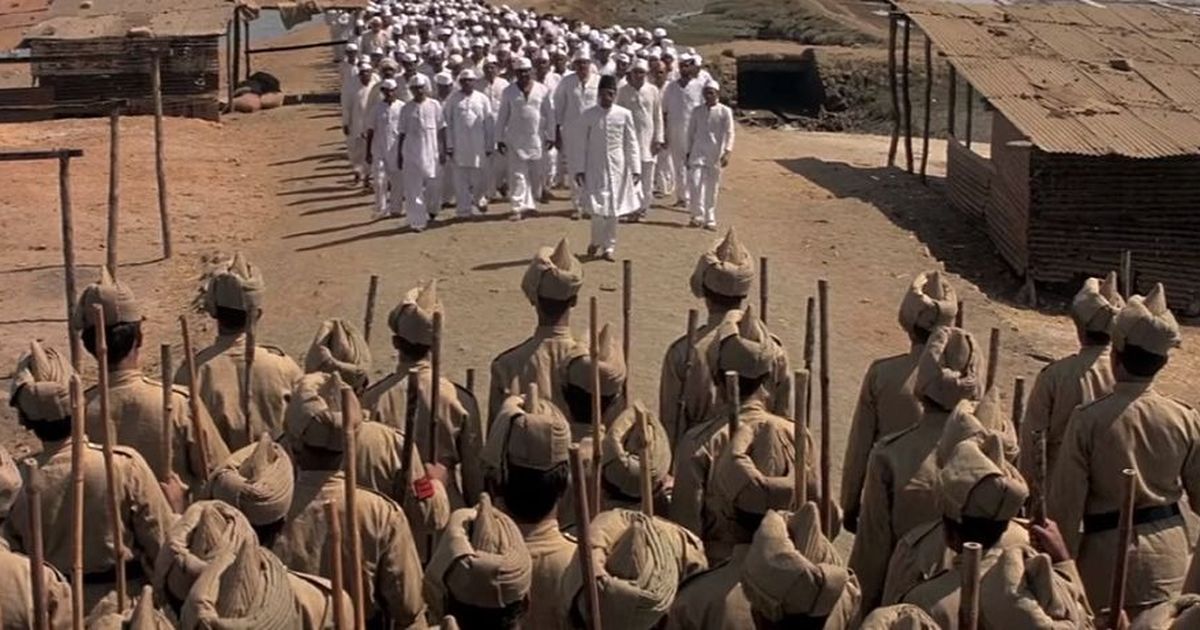
Attenborough’s grand, epic film marshals thousands of extras to bring to life pages of history. At times events fly by with speed, but Attenborough never loses sight of the emotional heart of the story – both Gandhi and the status of Indians as not being masters in their own home. Attenborough directs scenes of real power, most strikingly a heart-rending peaceful march on a salt works (the tax on salt use being a major burden on many poor Indians) that culminates in line after line of peaceful Indian protestors walking calmly forward to be beaten down by soldiers. Despite being the grandest and largest of films, it allows questions of pure morality and decency to lie at its heart and, supported by a parade of British acting greats, keeps the Indians at the heart of their own story and the masters of their own destinies.

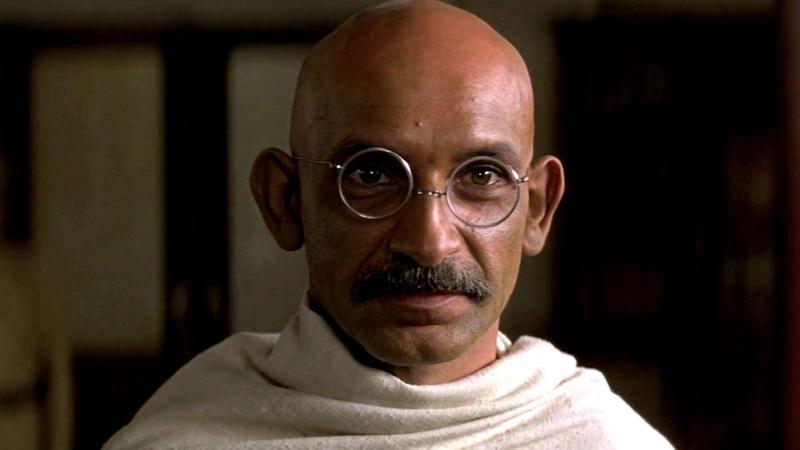
The film’s impact though may be directly connected to the gloriously transcendent performance of Ben Kingsley in the title role. For years it was believed the film could only work with a British actor in the title role – imagine how it would be received today if Gandhi had been played by (as it nearly was) a browned-up Anthony Hopkins or John Hurt (who famously told Attenborough he looked absurd). Instead half-Indian unknown RSC actor Ben Kingsley took the role. Kingsley so completely and utterly immersed himself in Gandhi – everything, the physicality, the morality, the voice, the intellectualism – that not only has he become so completely associated with the role but it’s hard to imagine anyone else playing it.

Ageing almost 50 years over the course of the film, Kingsley’s Gandhi is above-all moral, softly-spoken, observant and considerate – the very spirit of the original man seems to be up on the screen. Far from the sort of histrionics you might expect from a subject of an epic movie, Kingsley is not afraid to be quiet, gentle even underplayed. He completely understands that the charisma and power in Gandhi laid in his moral authority, not his speech-making, but his careful example-setting of even-handedness, patience and desire for peace. 

But Kingsley is also willing to show Gandhi as shrewd and stubborn, even while mixing it with both a deep pain at the loss of life. Kingsley is superbly good at the smaller quieter moments – he wrings heart-rending force from the loss of his wife (a similarly impressive and quietly authoritative performance from Rohini Hattaggadi), which partly works because the film quietly centres the truth and faith in their marriage. This is extraordinary work from Ben Kingsley, that seems to carry not just the entire film but the sense of a nation.

Attenborough though was a director who was at his best when working with actors, and his ability to coax truthful and heartfelt moments from quiet scenes are what gives the other sequences the emotional force to make them work. Attenborough seemingly called in every favour to assemble the supporting cast that backs up Kingsley, many of them juggling only a few scenes. Among the stand-outs we have a martially certain Edward Fox as General Dyer, an archly arrogant John Gielgud and a frustrated John Mills as viceroys, Trevor Howard representing decent British rule as an honest Judge and Martin Sheen as a reformist minded journalist. That’s to overlook dozens of others in small roles, all of them clearly committed to the intention of the project.

The film though allows the Indians themselves to take centre stage, even if it is easy to criticise some of the simplifications of many of the issues that would eventually culminate in partition. The film has a clear hostility towards the idea of religion, seeing it as the root of much of the violence that erupted in India in the last years of Gandhi’s life. While Roshan Seth is excellent as Nehru, the character is portrayed more as the faithful follower of Gandhi than the shrewd politician in his own right (it’s a role most of the other leading members of congress are also placed in). Alyque Padamsee carries a high level of charisma as Jinnah, founder of Pakistan – but the film can’t quite resist painting him into the corner as a semi-villain, ignoring Gandhi’s desperation to get Jinnah to invest in a united India.

It’s part of what has been seen since as the film’s more hagiographic stance towards Gandhi. Certainly later historiography has outlined a few shades of grey in Gandhi – although I would argue that seeing him as a man and not a saint only heightens (similar to Mandela) the awe at what he went on to achieve. The film’s whistle stop tour of Indian history – taking in every major event and personality, some in a matter of moments – looks particularly old-fashioned now with our current trend being biographical films that focus only on crucial moments, not the whole life. It adds a slight air of schoolboy history to the project, an unfortunate side-effect of the passionate earnestness with which the story is told.

But then even in 1982 – when it lifted 8 Oscars including Best Picture, Director and Actor and most of the technicals – it was seen as slightly old-fashioned. Attenborough has generously repeatedly said that he believed Steven Spielberg was more deserving of Best Director for ET. And it’s true that Attenborough was in many ways a producer at heart with these epics than an inspired director like Lean. His marshalling of crowds, finances and simply forcing the will together to make the picture – and to allow it to focus on Indians rather than Westerners – is a tribute to his organisational skills. His strengths as a director were more in performances, and as with many of his epic films the most memorable moments are smaller, intimate ones. The larger moments are shot with an assured professionalism rather than inspiration, but Attenborough understands how to wring emotion from moments and how to let character drive action.

Gandhi works above all because even today you can see it is a passionate labour of love, that everyone involved in clearly believed in passionately. It may well be that at times it is workmanlike or simplistic – and covers the sweep of history with an earnest completeness, even while it is unafraid to be critical certainly of the British – but it still invests it crucial moments with humanity, life and deep emotion. You can’t help but be moved by it – and you are instantly stunned by the sheer brilliance of Kingsley as Gandhi, one of those performances like George C Scott as Patton which seems more like the man than the real thing. Gandhi may be old fashioned, but that’s not a crime when the quality is still there.

Young Winston (1972)

Simon Ward as the Young Winston: episodic but fun look at the early life of the Greatest Briton

Director: Richard Attenborough

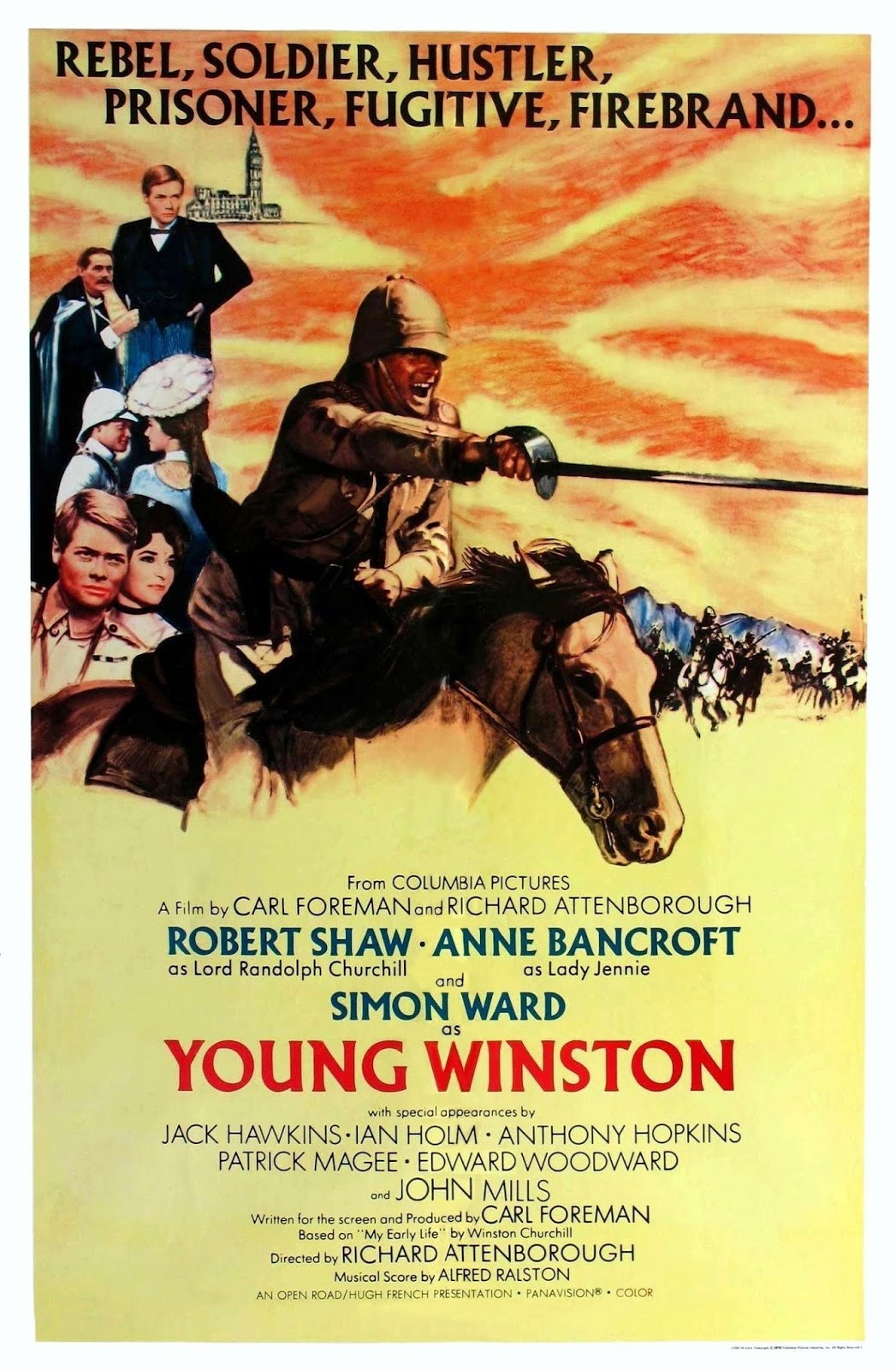
Cast: Simon Ward (Winston Churchill), Robert Shaw (Lord Randolph Churchill), Anne Bancroft (Lady Jennie Churchill), John Mills (Lord Kitchener), Jack Hawkins (James Welldon), Ian Holm (George Earle Buckle), Anthony Hopkins (David Lloyd George), Patrick Magee (General Sir Bindon Blood), Edward Woodward (Captain Aylmer Haldane), Pat Heywood (Elizabeth Ann Everest), Laurence Naismith (Lord Salisbury), Basil Dignam (Joseph Chamberlain), Robert Hardy (Headmaster)

Any poll of the Greatest Briton is bound to throw up, near the top, Winston Spencer Churchill. So famous is he, that his surname isn’t even required for Attenborough’s biography of the Great Man – just that name Winston gives you a pretty good idea of what you’re going to get. And you’d be right, because this film gives you a pretty straightforward rundown of Winston Churchill’s early years, in an episodic breakdown that gives us some small insight into what shaped the chap who went on to implore us to “fight them on the beaches”.

Simon Ward is the Young Winston, with Robert Shaw and Anne Bancroft as his parents Lord and Lady Churchill. Lord Randolph is the high-flying MP who throws away his career, catches syphilis, loses his mind and dies aged 37 – all the time disappointed with the son desperate for his approval. Lady Jennie is his loving, supportive but slightly distant mother. Winston himself? A bright lad, but a hopeless academic, struggles at school, needs umpteen attempts to scrap into Sandhurst for a career as a cavalry officer (a dunce’s career in the opinion of Randolph), serves in the Sudan under Kitchener (John Mills) and starts writing books and newspaper articles – because hopeless academic he might be, he’s still gifted with words. A career in Parliament is his dream – helped no end by his escaping captivity during the Boer War, making him a popular hero. 

You can probably tell from that plot summary that this is a somewhat episodic film. Although initially throwing us into a clash in North-West India between the 35th Sikhs regiment and Pashtun rebels – an action during which embedded journalist Churchill wins a mention in dispatches – the film quickly settles into a straight narrative run down of Churchill’s early life, filtered through the great man’s own writings. This makes for an episodic, at times rather dry, box ticking exercise of key moments in his life although it gets enlivened with some decent scenes and some good performances.

The one fact that comes out most strongly from the film is the wretchedly unhappy childhood of Winston himself. A borderline dunce, Churchill is a hopeless student from an early age. His school days are miserable, dispatched to some ghastly boarding school where thrashings from the headmaster (ironically played by later regular – and definitive – Churchill performer Robert Hardy) are handed out as regularly as dollops of gruel. There is a certain emotional impact throughout these scenes, with extensive quotations from the pre-teen Churchill’s letters barely concealing pleas for his parents to visit him (save him) under protestations of his happiness at school.

But this emotional connection doesn’t really last once we get into the adventures of the younger Churchill. This is despite an excellent performance from Simon Ward, who perfectly captures the mood and manner of the more famous older man while splicing in plenty of youthful exuberance and naivete. Ward does a terrific job of holding the film together – so well in fact you are left feeling slightly sorry that he never got a part as good as this ever again. His final speech is a perfect capturing of the speech-making prowess of the young statesman.

The film takes a mixed attitude to Churchill’s parents. It’s very open about the syphilis that afflicted Lord Randolph, and even before that makes clear his career is one governed by rashness and poor judgement. Robert Shaw is excellent as Churchill’s father – a stern taskmaster, constantly disappointed in his dullard, lazy son, but spicing it with enough small moments of affection to make you understand why Churchill worshipped this man whom he surpassed by every measurable factor. Shaw also makes a pre-illness Churchill, sharp, witty and strikingly intelligent: making his later descent into illness and unpredictability all the more affecting. Randolph’s final speech in the House – raddled by syphilis he looks awful and can barely remember his train of thought for longer than a few seconds – is remarkably moving.

The film takes far more of a conventional view of Lady Sarah, presenting her far more as the idealised mother figure she must have been for Churchill. Anne Bancroft is saddled with a rather dull part that never really comes to life, as the more interesting aspects of her colourful life are largely left on the cutting room floor.

Attenborough’s film does try to drill down into the personalities of these three people with a curious device where each character has a scene speaking (direct to the camera) to an unseen journalist asking them questions about themselves and the events around them. This interrogational style looks like a rather dated 1970s innovation today – look how we put the spotlight on these people! – but it does give a chance to see them from another perspective, and give the all-seeing author of the screenplay (Carl Foreman) a chance to ask questions viewers are probably asking. It’s on the nose, but still kind of works, even if the revelations we get barely seem to give us any shocks.

It’s about the only slight moment of invention anyway in a film that is another example of Attenborough’s excellence at marshalling a huge number of actors and locations into something very reassuringly safe and professional that is going to have a long lifespan on Sunday afternoon TV schedules. Young Winston is a decent, enjoyable mini-epic, but it’s not the film for those really wanting to either understand the times or understand the personalities involved.

Scott of the Antarctic (1948)

Scott of the Antarctic (1948)

Captain Scott’s tragic end is bought to life with low-key hero worship

Director: Charles Frend

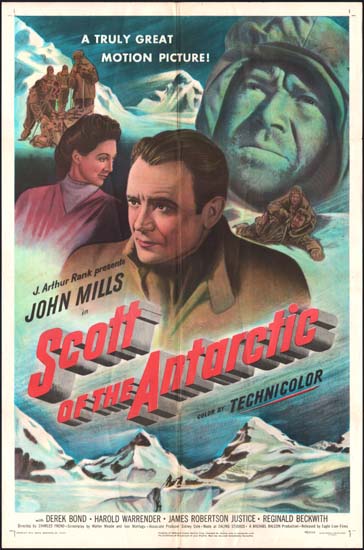
Cast: John Mills (Robert Falcon Scott), Diana Churchill (Kathleen Scott), Harold Warrander (Dr Edward Wilson), Anne Firth (Oriana Wilson), Derek Bond (Captain Laurence Oates), Reginald Beckwith (Lt Bowers), James Robertson Justice (PO “Taff” Evans), Kenneth More (Lt Teddy Evans), Norman Williams (William Lashly), John Gregson (Tom Crean), James McKechnie (Dr Edward Atkinson), Barry Letts (Apsley Cherry-Gerrard), Christopher Lee (Bernard Day), Clive Morton (Herbert Ponting)

There are perhaps few more controversial figures in historical discussion than Robert Falcon Scott. The great polar explorer was, for most of his career, and for a long period after his death in 1912, a national hero, the man who – with stiff-upper-lip bravery – gave his life struggling against the elements to conquer the South Pole. Scott’s reputation only began to be questioned in the late 1970s, with a series of biographies culminating in a near-vicious – but compelling – anti-Scott argument laid out by Roland Huntford in his book Scott and Amundsen. Scott’s many flaws – both personal and in planning – set a new landscape for seeing his achievements as carrying too high a cost, especially in an atmosphere where the extreme sacrifice was seen as something to be avoided if at all possible, rather than an everyday fact of life for post-war generations.

In this context, watching this Ealing Studios 1948 Scott biopic – one of the biggest box-office hits of its year in the UK – is an interesting experience. While the film’s tone and its depiction of Scott are essentially fairly heroic, the film flirts at points with the errors and misjudgements that led to Scott leading himself and his companions into an icy immolation in a tent eleven miles away from a depot that could have given them a chance to survive.

Frend’s film is very well made and beautifully shot – so perfectly does it capture the look and feel of the Antarctic, and the extreme cold, that you overlook the fact that at no point can you see the actors’ breath – and it covers the main points of the expedition very well. It’s in some ways, today, almost hilariously stiff-upper lip, with the expedition members marching dutifully (and with a self-deprecating smile) to certain death, and the ladies at home speaking with such cut-glass primness you have to keep checking that Celia Johnson isn’t in the film.

There are some strong performances, not least from Mills (a very close physical likeness for Scott himself). Mills was the perfect choice for this role –overflowing with a sense of duty, but with a slight edge of idee fixe pride where it’s clear that he’s not willing to budge from anything to do with his mission. Harold Warrander also makes a strong impression as an artistic spirited scientist, Dr Wilson, who quietly hides his premonitions of disaster and later feelings of regret due to a sense of personal loyalty to Scott. Reginald Beckwith, James Robertson Justice and Kenneth More also give decent performances.

But the main appeal is the glorious technicolour look of the film. The film used no fewer than three photographers and brilliantly mixes together painted backdrops, studio locations and some genuine location footage with skilful and glorious aplomb. The technicolour tinge to the shots is wonderful – watching it in high definition, it’s like a series of polar expedition photos brought skilfully to life. The film in fact apes several of the famous photos from the expedition with such beauty that you feel like they could be printed and framed.

The plot however is more concerned with checking off the events of the expedition – from its conception, through its financing and recruitment, initial excursions and the final (futile?) march to the pole and the death march home. Frend’s film is clearly largely intended to be hagiographic – the men are by-and-large totally committed to the journey, there is nary a cross word between them, and the film never really questions the point or purpose of the journey – or if it was worth the lives of five men to achieve it.

However, there are moments where the film leans towards a more interesting criticism of Scott’s planning and leadership. The funding campaign is largely a disaster, bailed out only by a last minute donation. Scott ignores advice from famed explorer Nansen to take dogs (man hauling is of course more noble) and places far too much faith in motor sledges (he is shown ruefully staring at one after it breaks down). Equipment – not least the vital fuel canisters kept at depots – is shown to be inadequate. The dogs perform extremely well – far better than the horses. The film doesn’t avoid the grisly fate of the horses either – I’ve never understood Scott defenders who claim it would have been cruel for Scott to take dogs to the pole, but never question the working to death and shooting of ponies in conditions they were totally unsuited for. 

The film skirts around the moral responsibility Scott bore for the death of the men who entrusted their lives to his planning. It does show – faithfully – the final depot being placed one degree less further south than originally planned (a shortfall that would contribute heavily to dooming the men later on). But as first Evans then Oates pass away, the film focuses on the tragic loss rather than the planning, preparation and “cut to the wire” contingences Scott was working with that contributed to this (not least his last minute decision to expand his polar party to five from the original number of four, sending three men back to base – with all rations and provisions having been packaged for two teams of four). 

The film is less interested in this, more keen on showing the heroic progression of events. It gives us moments, but the main purpose of the film is to sing the praises of Scott. This means, for me, the film becomes more and more deficient as time goes on and the histographical debate around Scott becomes all the richer and more engaging. For all the qualities of the film itself technically, it doesn’t have anything to contribute towards this and just offers up the straight printing of the legend.

For me, by the way, Scott is almost the ultimate expression of Edwardian amateurness, taking on the most challenging environments of the world with a superb confidence in a “special role” for the British in history. While Huntford’s personal dislike for Scott stings too much, there are legitimate points to be made about Scott’s poor planning, his obsessive disregard for learning from his mistakes and his refusal to engage with or embrace the sort of Inuit techniques that Amundsen learnt from. And, at the end of the day, while you could say Scott was unlucky compared to Shackleton, whose equally disastrous expedition at least saw all his men return alive, the fact remains that Scott’s old-school, old-fashioned, Britain-shall-prevail-attitude led not only to his own death but the deaths of four other people in hellishly cold conditions thousands of miles away from their families. Say what you like for his bravery, but don’t forget the price that others also paid for it.

Goodbye Mr Chips (1939)

Robert Donat is superb (and Oscar winning) as an (eventually) beloved teacher in Goodbye Mr Chips

Director: Sam Wood

Cast: Robert Donat (Mr Chipping), Greer Garson (Katherine), Lyn Harding (Dr John Hamilton), Paul Henreid (Max Staeffel), Terry Kilburn (John Colley/Peter Colley I/Peter Colley II/Peter Colley III), John Mills (Adult Peter Colley), Scott Sunderland (Sir John Colley)

Goodbye Mr Chips is the sort of film that feels ripe for spoofing. The sort of idealised stuff-upper lip, Tom Brown’s Schooldays look at the past that should have you spluttering and chuckling. But it’s done with such warmth, such genuine emotion and tenderness, that instead you can’t help but feel yourself welling up while watching it. I certainly did (although I was watching it at half seven on a Sunday morning…)

The film follows the fortunes of Mr Chipping (Robert Donat) from his first joining the school in 1870 as a naïve young Classics teacher, struggling to exert authority over the children, to a beloved elder statesmen of the school in 1933. Along the way, he deals with a host of personal and worldly trials and tribulations, falls in love with a young suffragette Katherine (Greer Garson) who recognises his tender soul, and eventually helps the school through the national trauma of World War I.

It’s a quite beautifully done piece of old fashioned film-making, crammed with those moments of suppressed emotion and unspoken depths that get me every time. Maybe it’s something peculiarly English, but nothing can touch our repressed souls than seeing a kindred spirit struggle to keep his emotions locked down. Chipping loves his job, he loves the children he teaches and he will work tirelessly to give them the best start in life he can. The schoolchildren across 60 years are his children – can he express any of this before his deathbed? Of course not, he’s British.

It’s a film that celebrates the strength of that indomitable British characteristic of keeping on, of struggling forward, of keeping traditions and decency going. It’s a strongly conservative message, I’ll give you that, but it’s carried by such nobility and morality that it stresses the positives of this patriarchal affection. And Wood’s direction avoids over-sentimentality at nearly every point, helped by a wonderfully constructed script by Journey’s End playwright RC Sheriff (among others).

And Chipping himself is such a gentle, unassuming and kindly character – a decent, compassionate man who does everything he can to help others – that the film never feels forced. Indeed, it gives many scenes a real emotion. The courtship between Chipping and Katherine is all the more affecting for understanding how unnatural and difficult it is for the shy and reserved Chipping to open himself up to love. It’s also deeply sweet and endearing to see how Katherine is able to see past his awkwardness and bashful quietness to understand the caring, deeply humane person below the surface, and how hard she works to help this better man flourish.

This humanity is behind everything that Chipping does in the film: from the start it’s clear he cares deeply for the pupils at the school, even if he struggles to build a connection. It’s there on his first day where he tries – ineffectually – to comfort a new boy. At first he is led to believe domineering discipline is needed to keep his authority. What marriage – and Katherine’s love – teaches him is that he can allow people to see his natural warmth, and that personal affection makes discipline all the easier and natural. And makes him a better teacher.

It’s that romantic subplot between Katherine and Chipping that really gets the cockles warmed at the centre of the film. Beautifully played, with sensitivity and tenderness, by both Donat and Garson this is an extremely sweet relationship, where Katherine has to make most of the running to get round Chip’s shyness. You can enjoy – as Chip’s best friend Max Staefel (a lovely performance by Paul Henried) does – the fact that his colleagues expect Katherine to be some sort of aged harridan rather than a beautiful young woman. And it’s clear to see why the boys become devoted to someone warm, friendly and charming like Katherine. In Greer Garson’s first major role, she is superb – a character you feel as strongly about as Chips does, and feel her loss as deeply. 

The death scene – and its reaction – nails everything perfect about Robert Donat’s Oscar-winning performance. Chipping’s shell-shocked, robotic return to work is a brilliant demonstration of his trauma, his determination to not let it affect his work, and (in his quiet, middle-distance staring) his utter inability to get over the pain of losing the most important person in his life. Donat’s performance is superb throughout, convincingly ageing over 60 years during the film, but never losing that consistent sense of Chips being a man who has to learn how to find the balance between the warmer side of his character and the needs of being in a position of authority.

It’s a balance he finds wonderfully, by slowly allowing his humour to be seen by the boys – winning him a reputation as a sort of beloved eccentric, and surrogate father to hundreds of boys. This comes together beautifully as he guides the school through the horror of World War I. The film captures perfectly the shock and horror – under that English reserve – of so many dying for so little, of entire generations of former pupils being lost. Donat’s speech in the church near the war’s end seems to capture these feelings of reeling at the senseless violence.

But what the film does so well is not to make these moments sickly, but play them straight and let the emotions of these moments speak to themselves. We don’t need sentimental camera tricks or swooping music, or zooms into tear laden faces. Robert Donat’s performance brilliantly plays into this – he’s an absolute pillar of gentle reserve and kindness and every moment (he’s in every scene) rings absolutely true. It’s a beautiful, gentle, star turn at the heart of a film that slowly becomes deeply moving.

In Which We Serve (1942)


Noel Coward takes command in stirring British wartime drama In Which We Serve

Director: Noël Coward, David Lean

Cast: Noël Coward (Captain E.V. Kinross), Bernard Miles (CPO Walter Hardy), John Mills (Shorty Blake), Celia Johnson (Alix Kinross), Joyce Carey (Kath Hardy), Kay Walsh (Freda Lewis), Michael Wilding (Flags), Leslie Dwyer (Parkinson), James Donald (Doc), Philip Friend (Torps), Frederick Piper (Edgecombe), Richard Attenborough (Young Stoker)

Only the British would make a wartime propaganda film about a sunk ship where over half the crew gets killed (the Navy nicknamed the film In Which We Sink). It says something about this endearingly muddle-headed country that the stories that appeal most to us are those that celebrate our struggles against adversity. It was filmed in the aftermath of the Battle of Britain but before the Battle of El Alamein – the British considered themselves safe from invasion, but still saw victory was a long way off. In that climate, the film’s attitude of knuckling down and doing your duty to achieve a distant dream must have resounded profoundly with millions of people.

Based on the early war career of Louis Mountbatten, this “story of a ship” revolves around the Torin, a destroyer captained by E.V Kinross (Noël Coward). The ship is dive bombed and sunk by the Luftwaffe, and the captain and survivors cling to a lifeboat, waiting for rescue. While they wait, the crew remember their lives back home in flashback – in particular the captain, CPO Hardy (Bernard Miles), and able seaman ‘Shorty’ Blake (John Mills). Can you imagine an American propaganda film with a plot like that?

It’s easy to mock a film like In Which We Serve today. Its stiff-upper-lipped, duty-led, hierarchical world has been lampooned countless times since Peter Cook’s pitch-perfect Bernard Miles impersonation in Beyond the Fringe. (Early in the film, watching Kinross at home, I remembered Eddie Izzard’s spoof: “Don’t go to the war Daddy / I must they won’t start without me…”). The first 30 minutes, with its clipped dialogue, fast-paced delivery and stiff-backed, formal playing style takes a while to tune into. But it’s worth it, as the establishment of this carefully controlled exterior is what makes the later sections, with strong emotions just below the surface, so moving.

Coward was of course primarily a man of the theatre, and this was his only original film script. His collaboration with experienced film-makers produced a stirring, skilfully crafted epic that reflects on several levels of British rank and society, and not only shows us “why we fight” but also “why we should fight”. Coward is credited as the principal director, but much of the direction (and the film’s skilfully constructed structure in the editing suite) comes from his co-director David Lean, here making his directing debut.

Lean’s expressive hand is clear in the brilliantly composed sequences on board the ship itself, both in action and at ease. An example of the fluid editing, is where the camera follows the progression of a missile through the ship, passed from crew member to crew member, each given some brief moments to show their quiet determination and resolve. Similarly, the sequences on the drifting lifeboat have a claustrophobic intensity about them. The flashbacks are carefully placed to allow our understanding of the characters and their backgrounds to grow each time.

The scenes back home are remarkable for their dramatic simplicity. Coward understood the stories that move are those of normal people. The sailors’ home lives – from the captain down – are domestic, calm, happy and above all normal. Very little happens: one sailor gets married, the captain plays with his children, the Petty Officer teases his wife. This regularity makes their courage under fire all the more stirring: truly ordinary people doing the extraordinary. Some critics have called Coward’s attitude to the working classes snobbish, but there is no disdain at all here – instead there’s a paternal admiration with genuine warmth.

This warmth extends even to a stoker who cuts and runs during action. It would be easy to use this moment to amplify the braveness of the others. Instead, in a moving speech to the men, the captain takes the blame onto himself for not supporting the young man earlier. The mortified stoker, in a wonderful little scene, struggles to express his shame to a barmaid, not in anger but in a quiet, confused guilt. The film never condemns or judges him – he is quietly shown returning to his duties. There is no explicit moment of redemption, just a sense of a man who has let himself down, resolving quietly to do better.

The opening sequence covers the lifespan of the ship – from its construction and commissioning, to its launch, early actions and sinking, with the implication of a nation coming together. Later scenes mix theatrical touches with documentary realism. A marvellous sequence covers Dunkirk, which feels incredibly real but also showcases a few wonderful flourishes, from Kinross’ speech praising the soldiers’ bravery to Shorty’s affectionately wry remark on the rivalry between soldiers and sailors. The final sequence brings us full circle, with the construction and launch of another battleship under Kinross’ command. We may lose a battle, but we are never beaten.

Coward takes on the lead role. To be honest, it’s a striking piece of miscasting that somehow works out – Noël Coward is no-one’s idea of a hard-nosed naval veteran. He lacks the range in particular for his scenes of domestic life, coming across as too detached and distant – particularly noticeable since his wife is played brilliantly by the radiant Celia Johnson, conveying layers of emotion under a controlled exterior. But, his quiet, buttoned-up professionalism and clipped Englishness work perfectly for the quietly emotional speeches he delivers. These he nails perfectly, his voice just giving the hint of cracking. It’s a curiously stagy, and in no way naturalistic, performance – but as a representation of a particular type of Britishness it’s perfect.

And Kinross is just the sort of man you would follow to the end – distant and authoritarian, but just and warm. Rescued from the ocean, he goes immediately to his men, moving quietly from wounded man to wounded man, collecting addresses, issuing quiet words of unexpressive comfort (“I’ll tell her you did your duty”). His closing speech (heavily based on Mountbatten’s own address to his crew) throbs with emotion just below the surface as he thanks his men – and it’s hard not to feel it as he shakes the hand of each man and is overcome with emotion, he can only nod a brief acknowledgement to his officers. Lean trains the camera on his back, as we see his shoulders seem to swell to support the pride, respect and love for his men. It’s peculiarly British, but this unspoken affection is hugely powerful.

The more naturalistic performances from the rest of the cast help to anchor the film – and also allow Coward’s more stylised acting to work effectively. John Mills is wonderful as Gunner “Shorty” Blake, a plucky, kind and witty man. He’s just the sort of unexpressive hero we’d all like to be, and his homespun love story with Kay Walsh is genuinely engaging and moving for its everyday normality. Mills also carries much of the film’s humour.

It’s the final sections of the film that really, really work. I can’t get through the scenes of the surviving crew being saved, the quiet courage of the dying men and the austere warmth of the captain, the speeches that burst with pride and respect under a reserved veneer, without feeling a lump in the throat. It’s a masterful piece of quietly powerful film-making, that pays off precisely because so much of what has gone before has been so normal. The fact that we’ve seen the lives of these people – and can see what, in their quiet way, they are fighting for – I found increasingly moving.

In Which We Serve is a wonderful piece of film-making, very well written by Coward and strongly directed (largely) by Lean. Coward himself, in the lead role, is far better at the speeches than as either a captain or husband, but the rest of the cast is excellent with Mills and Johnson both outstanding. It’s truly the stuff of spoofery in many ways today, but tune yourself up to the accents and the repressed Britishness and this is a heartfelt and deeply moving film. Perhaps one of the finest propaganda films you’ll ever see – and still so very British.