Tag: John Ortiz

American Fiction (2023)

American Fiction (2023)

Intelligent, challenging satire mixes with moving family drama in this excellent debut

Director: Cord Jefferson

Cast: Jeffrey Wright (Dr Thelonius “Monk” Ellison), Tracee Ellis Ross (Dr Lisa Ellison), Issa Rae (Sintara Golden), Sterling K. Brown (Dr Clifford Ellison), John Ortiz (Arthur), Erika Alexander (Coraline), Leslie Uggams (Agnes Ellison), Adam Brody (Wiley), Keith David (Willy the Wonker), Okrieriete Onaodowan (Van Go Jenkins), Myra Lucretia Taylor (Lorraine), Raymond Anthony Thomas (Maynard)
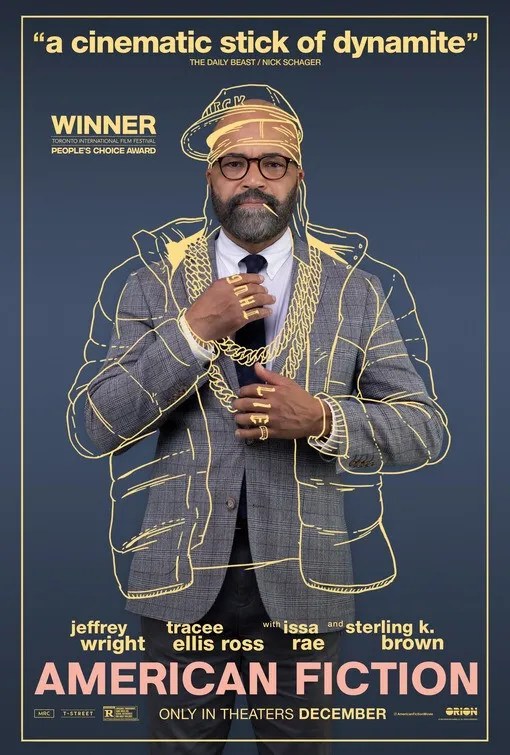
Dr Theolonius “Monk” Ellison (Jeffrey Wright) is fed up. His new book is getting no traction with publishers, who want a “Black book” not the classics-inspired literary novels Monk writes. His family life is at a point of crisis: his mother (Leslie Uggams) has rapidly onset dementia, his doctor sister Lisa (Tracee Ellis Ross) is divorced and tired of being the only child looking after her, his plastic surgeon brother Cliff (Sterling K. Brown) is embracing his coming-out and divorce with drugs and a parade of younger boyfriends. In need of money to pay for his mother’s care, Monk pours his frustrations into writing exactly the sort of book publishers want: My Pafology, a crime-drugs-and-deadbeat filled stereotypical low-brow “Black” novel that he submits as a joke. Needless to say, the liberal white publishers come back with bank-busting advances, wowed by this “authentic Black voice” – much to Monk’s disbelief and self-loathing indignation.

This satire is the flashy clothing American Fiction dresses itself up in. In this impressively confident debut from writer-director Cord Jefferson, it frequently pulls out some whipper-sharp comic lines as it skewers the guilt-ridden pretentions of the liberal white elite, so concerned with being seen to care about embracing Black culture, that they don’t even notice they have effectively ghettoised Black culture into exactly the sort of crime-and-drugs nonsense Monk satirises in his fake novel. It’s a good joke, and the fact that Cord Jefferson’s film wears it a bit thin (the parade of self-congratulatory white people falling over themselves to praise the novel are fundamentally reprising the same joke each time – nothing new is added once you’ve got it the first time) doesn’t change that.

Interestingly, as I sat in an Oxford cinema-screening exclusively filled with white people laughing, I realised American Fiction is its own sort of meta-satire. How many people in the cinema I sat in realised they were proving the point of the film? American Fiction displays to white people a funny sketch about our own concerns to be seen to be saying and doing the right thing. We laugh at these idiots and reassure ourselves that we would never be so utterly unaware about our patronising gate-keeping, while also embodying many of the attitudes the film is skewering. We want to be seen to be right-on and laughing at the right things. It’s a neat way for Jefferson to both entertain and challenge us.

Jefferson’s film is partly about urging us to break beyond our shallow ideas of what “Black America” must be. Monk comes from an affluent middle-class family that, skin colour aside, wouldn’t like out of place in the Hamptons. His background is one of beach-house second-homes, art on the walls, lacrosse sticks in his bedroom and a family where everyone has a doctorate. He even has a devoted housekeeper, expertly played by Myra Lucretia Taylor, who’s both an honorary aunt and also a shrewd commentary on stereotypical Black servants, calling the children “Mr Monk” and “Mr Cliff”.

While Monk writes about the urban ghetto with satiric anger, it’s clear that world is almost totally alien to him. The film itself acknowledges it: in an intriguing exchange, Issa Rae’s author of a more stereotypical ‘Black’ novel (We’s All Lives in the Ghetto) even calls out Monk for us air of class-based judgement around other parts of the Black community, social commentary I would have liked the film to challenge more (The film encourages us to question Monk, a snob and arguably a slight bully, but frequently gives him a pass by contrasting him to the ridiculous and more selfish characters around him). It would have been interesting to see more of the reaction to the book from Black readers, not just white ones eager to show their credentials.

American Fiction though takes on the targets it goes for with a certain aplomb. Publishers, literary prize givers and the overtly-but-dutifully-PC are effectively skewered. It’s also one of the few books that really gives a sense of writing. Monk’s drafting of the novel sees the characters he is bringing life to appear in his study with him, parroting his dialogue and then turning to discuss character, motivation and make suggestions to the author. More of this, giving us more insight into the novel and the assumptions that underline Monk’s writing of it, would have given an interesting extra dimension to the film’s satire.

Jefferson’s clever and vibrant film suckers us in with satire, but really flourishes as a complex family drama. He offers an affecting and compassionate storyline of siblings who have grown apart due to their natural inclination to independence, distance and repressed emotion. (It’s suggested this is a trait inherited from their father, a famed surgeon with a rollcall of infidelities.) American Fiction beautifully sketches very natural portraits of siblings who know exactly how to push each other’s buttons, but also quickly fall back onto a shared language of memories and mutual experience. For all the satire, it’s as a heartfelt, small-scale family piece that the film really excels.
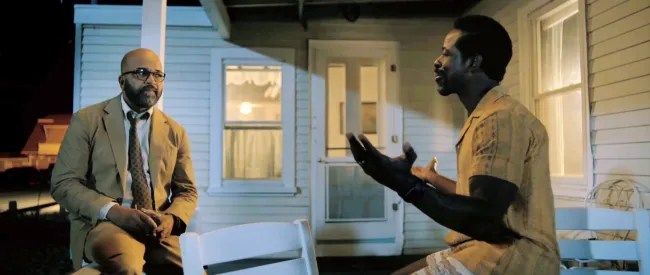
This is partly because it gives such wonderful opportunities to a fabulous array of actors. Jeffrey Wright, so often a supporting player quietly adding depth to a series of under-written franchise films, is excellent as Monk. Wright perfectly captures his hangdog resentments, his bitterness at not getting a fair deal and middle-age ennui. He also brings to life the pre-emptive walls Monk has built up to keep pain (and other people) out, the same intellectual distance that makes his books hard-sells. Combine that with Wright’s expert comic timing – not only his awkwardly uncomfortable shifts into his urban persona, but also his head-in-hands exasperation at the shallowness of the world – and this is a brilliant showcase for a consistently impressive actor.

Equally fine is Sterling K Brown as Monk’s frequently selfish brother Cliff, trying to enjoy life while he can – like Wright, Brown’s comic and emotional touch are spot-on. The film touches on themes of generational homophobia – their increasingly senile mother, sensitively played by Leslie Uggams, is clearly disapproving of his sexuality – but doesn’t hit this beat too hard. Tracee Ellis Ross is a breath of life-filled air as Monk’s sister while Erika Alexander gives emotional weight and depth to a slightly underwritten part as Monk’s new neighbour turned girlfriend Coraline.

American Fiction is frequently stronger when it focuses on crafting this low-key, realistic family drama, refreshingly clear of manufactured drama. What people will remember though is funny (if slightly one-note) satire – Monk even turns his story into exactly the sort of cross-racial appeal movie ready to collect awards, that you could argue American Fiction itself is. American Fiction ends with several alternative endings, each of which just made me feel Jefferson himself wasn’t sure how to end it. But, on the whole, this is a highly promising debut from Cord Jefferson, crammed with excellent dialogue and performances, which casts a fresh and urgent eye on important questions.

Ad Astra (2019)

Brad Pitt goes out to the stars in Ad Astra

Director: James Gray

Cast: Brad Pitt (Roy McBride), Tommy Lee Jones (H. Clifford McBride), Ruth Negga (Helen Lantos), Liv Tyler (Eve McBride), Donald Sutherland (Colonel Pruitt), John Ortiz (Lt General Rivas

Man has looked up at the stars for as long as we can remember and imagined what lies out there. From Gods to other intelligent life form, every culture has been drawn to imagine beyond the bounds of Earth and dream of finding what is out there. It’s a dream that powers the life of leading US Astronaut H. Clifford McBride (Tommy Lee Jones), who in “the near future” led “The Lima Project” to Neptune to try and find intelligent life beyond the Solar System. Now missing 17 years, Clifford’s son Roy (Brad Pitt) has become a leading astronaut, tasked with leading efforts to find his father after a series of devastating power surges damaging the planet and killing thousands are traced back to the Lima. So Roy embarks on an epic voyage, from Earth to mankind’s bases on the Moon and Mars to Neptune in quest of his father.

James Gray’s artfully made film yearns for a moral and thematic depth that it doesn’t quite manage to achieve. Its structure is heavily inspired by Hearts of Darkness, with Marlow and Kurtz twisted into a Son-Father dynamic and many of the stop offs on the way McBride encounters eerily reminiscent of the adventures of Marlow. Is there a longer trek down the river than crossing the Solar System? 

Within this framework, Gray throws in an earnest meditation on the nature of mankind’s yearnings and how our instincts collide between our dreams for an unattainable unknown and the world around us. All of this accompanied by Pitt’s Conradesque voiceover, as McBride muses over his own internal struggles, doubts, inadequacies, frustrations and sorry all bubbling beneath his calmly controlled exterior.

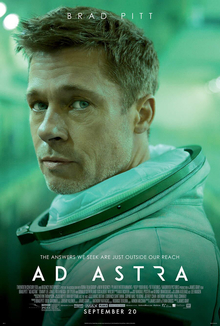
Its Pitt’s film and Ad Astra is a reminder that he is an actor who looks to push himself to his absolute limits. Here he carries the whole film, for long stretches alone, his eyes conveying the cool professionalism and self-control of McBride, along with his own far-more-fragile-than-appears psyche. Carrying burdens of loss and regret, McBride seems to see crises that he encounters in space as relief from his own internal struggles. Whenever the shit hits the fan, McBride is the coolest man in the room (his commanding officers admiringly state his pulse rate never seems to go above about 80 in even the most life-threatening situations) and from tumbling from the outer atmosphere, evading pirates in a moon buggy in space or manually landing a spacecraft, he never fails at his professional duty. Only when confronted with the emotions of his own life is he left with his composure fractured.

Pitt conveys the isolation and pain of McBride extremely well, with acting and expressions so subtle they carry all the more emotional force. It’s a controlled and perfectly judged performance that powers the entire film, and bears a lot of the thematic weight of Gray’s invention. 

Gray’s direction is powered by clear memories of 2001 and Solaris (although I also felt echoes of Danny Boyle’s space horror Sunshine in its fascination with the dread and danger of the vastness of space not to mention Christopher Nolan’s Interstellar). It looks fantastic with a wonderful score, ambitiously grasping for importance.

Episodic as it moves from location to location, Gray’s film creates a convincing world of the future, where mankind has disputed colonies on the moon (space pirates roam between bases, taking hostages like Somalian pirates), space travel is commercialised (by Virgin of course) and people live and die on a far-flung underground base on Mars. While I did briefly think about the enormous cost of all this space travel with its huge fuel consumption and debris of discarded rocket sections (how on earth is this commercially viable?), not to mention the trouble that would be involved in erecting giant neon cowboys on the Moon, it’s convincing.

Gray’s film wants to delve into the mysteries of humanity, and McBride Snr’s entire life has been dedicated to the quest for finding out that we are part of something larger than ourselves, that we are not alone. Gray wonders perhaps if this shark-like desire we have for moving forward, the ruthlessness we display in leaving the past behind in quest for the future, perhaps mars us as a species, prevents us from finding contentment around us and leads to us damaging this world we have been given in our search to make it larger.

But the more Gray’s film closes its grip, the more themes seem to slip through its fingers. The journey is compelling in its creation of a series of worlds, Brad Pitt’s dedicated performance, and the sense of danger and the array of questions that the film throws up. But while 2001 in many ways manages to feel like it is about everything and nothing, so wonderfully engrained is the magical poetry in its soul, here it feels like the film gets less and less engaging the further the journey goes. The destination sadly cannot match the voyage, however beautifully filmed that voyage is.

Instead when the film arrives, we find it becoming more and more bogged down in father-son issues that feel just cheaper and less interesting than the more spiritual and enigmatic concerns the film has for much of the rest of its running time. Not helped by a disengaged performance from Tommy Lee Jones, the more the film heads into this territory the more it seems to lose the depth it aimed for earlier. Late attempts to restore the enigma, mystery and universality don’t succeed to completely restore the feeling that this is classic science-fiction poetry. It’s a shame as Gray’s film as many wonderful moments, beautiful craft in its making and a wonderful performance by Pitt – but it feels in the end as about much less than it could have been. But for all this, there is a magic unknowingness about it that could have it hailed as a classic in years to come.

Bumblebee (2018)

A heart warming double bill in surprising “genuinely good Transformers film” Bumblebee

Director: Travis Knight

Cast: Hailee Steinfeld (Charlie Watson), John Cena (Colonel Jack Burns), Jorge Lendeborg Jnr (“Memo” Gutierrez), John Ortiz (Dr Powell), Jason Drucker (Otis Watson), Pamela Adlon (Sally Watson), Stephen Schneider (Ron), Glynn Turman (General Whalen), Len Cariou (Hank), Dylan O’Brien (Bumblebee), Peter Cullen (Optimus Prime), Angela Bassett (Shatter), Justin Theroux (Dropkick)

Michael Bay started making Transformers films in 2007. These massive, action-packed, technological marvels are testament to the skill of special effects gurus to create live-action versions of these transforming robots – and a testament to the lack of soul in Michael Bay as the films became increasingly empty, sprawling, noisy, pornographic (not in that sense!), tasteless, sexist efforts that leave a bad taste in the mouth. Bumblebee is a soft-reboot of the franchise – and the very first time it feels like this is a Transformers film that those growing up with the cartoons could recognise, and that you would be happy to show to kids.

In 1987, Cybertron has fallen and the Autobots have scattered across the galaxy. Young Bumblebee (voiced by Dylan O’Brien) is sent to Earth, where he loses his voice, his memory and nearly his life combating a Decepticon. Taking refuge as a beat up Volkswagen Beetle, Bumblebee is found by Charlie Watson (Hailee Steinfeld) a young car mechanic enthusiast mourning the sudden death of his father and struggling with her mother (Sally Watson) starting to move on with a new boyfriend Ron (Stephen Schneider). While Charlie and Bumblebee bond, more Decepticons – on the hunt for Bumblebee who they hope can lead them to Optimus Prime – arrive on Earth and join forces with anti-Transformer agency Sector 7, represented by Colonel Jack Burns (John Cena), to track Bumblebee down.

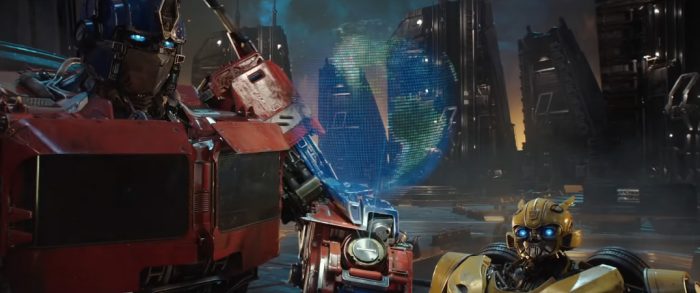
Travis Knight came to the film from directing several successful animation films – and his understanding of the nuances of inflection and character that you need in order to bond with animated characters. He also brings back an innocence, a dignity and a sense of honour to the franchise. Where the Autobots in past films had increasingly become brash blowhards or brutal warriors (not least Optimus Prime who seemed to become more psychotic as the series went on) this film made them again the noble defenders of the weak that they were in the comics and cartoons. It’s not an exaggeration to say if the fans were waiting for a film that got closer to the spirit of the original, they had been waiting for this one.

Knight’s mastery of animation makes Bumblebee a true character, an endearing, bumbling (sorry), accident-prone, scared little kid who is also a tender, caring and understanding friend. With Bumblebee mute for most of the film, the character communicates solely through his body language – and his hugely expressive eyes – and Knight has redesigned the character to have a larger, more open face that immediately makes him a warmer character. Knight also has a brilliant line in visual comedy, with Bumblebee hilariously trashing a house at one point in a stumbling display of silent comedy that works extremely well. 

It also helps that Knight has such a strong, marvellous performance from Hailee Steinfeld as Bumblebee’s carer and protector. Seeing Steinfeld in this film is a real reminder of what brash, very male, figures Shia LaBeouf and Mark Wahlberg cut in the past few films, where women were even objects of tasteless ogling or rebellious kids to be protected by men. All that is thrown out of the window here (thank goodness), with this being the first film in the series written by a woman, Christina Hodson. Steinfeld is allowed to develop a character who is not a Tomboy, a hot scientist or a teenage girl stereotype, but someone who feels very real and hugely charming. Steinfeld brilliantly creates a bond with Bumblebee – no mean feat for a creature that is not there – and the film hinges perfectly on her growing emergence from the shell of trauma and loss at the death of her father, through finding a new purpose with Bumblebee. It’s a great performance anchoring a film full of special effects.

Knight’s film can still handle all the action you want – but unlike with Bay, where spectacle and violence is always considered way more important than story and character, his action scenes are shot with a simpleness and clarity that put character at the forefront. In fact character is what every scene is about, not the shattering punching and tastelessly sadistic, pornographic violence of robotic dismemberment that Bay’s film’s degenerated into. This is a film which feels inspired by the vibe of ET, about two damaged souls who come together to protect each other and find themselves. It’s a film that is about friendship and affection, and Knight’s action scenes carry a sense of these qualities, this desire to protect people, into them.

With the film’s light comic touch – not least from John Cena who is on good form as a Colonel with a grudge against all Transformers (“They literally call themselves Decepticons. That doesn’t set off any red flags?”) and Jorge Lendeborg Jnr, very endearing as Charlie’s would-be love interest – it feels like a film genuinely made by people who loved the original and loved it’s innocent, good-vs-bad themes. Knight also returns the design of the characters back far closer to the look of the 1980s – the opening on Cybertron, with all the characters appearing as souped up versions of their 1980s cartoon form is virtually a love letter to anyone who grew up watching these characters. Knight not only gets the visuals right, with a warmth and depth of character none of the rest of the films have had, he also understands the bravery and heroism of the Autobots in a way Bay never did – Knight’s Optimus Prime is a million miles from the prisoner-executing loonie Bay created.

Bumblebee for sure is no Citizen Kane (although it has lashings of Spielberg in it, not least ET). But it’s on a different planet to the rest of the series, and a film with tonnes in it to enjoy. With its careful balancing of themes from loss to survivor guilt it also has more to it than meets the eye.