
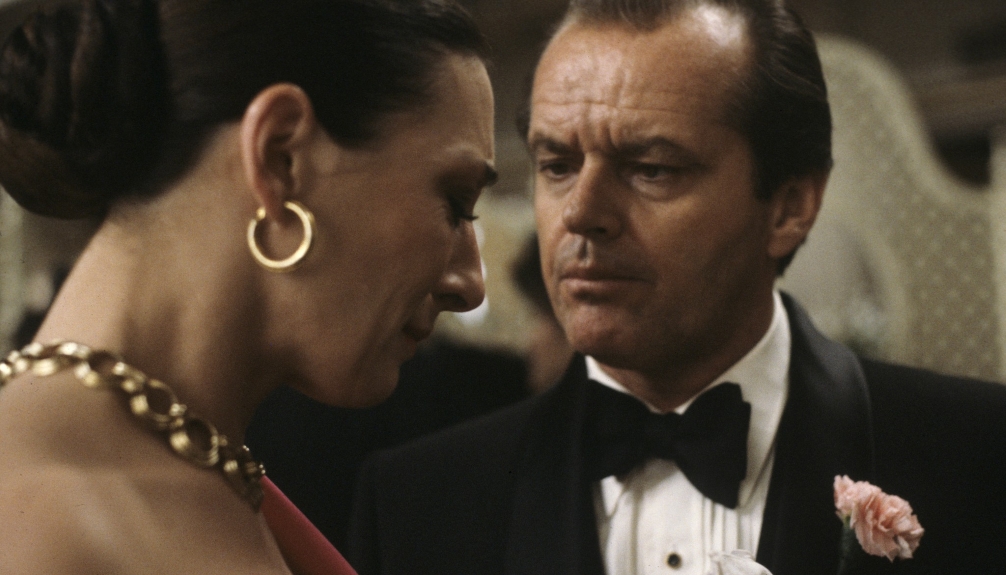
Tag: John Randolph

Prizzi’s Honor (1985)

Prizzi’s Honor (1985)

Would-be satirical mafia farce, that is slow, dense and insufficiently funny to hit its target

Director: John Huston

Cast: Jack Nicholson (Charley Partanna), Kathleen Turner (Irene Walkervisks/Irene Walker/Mrs Heller), Anjelica Huston (Maerose Prizzi), Robert Loggia (Eduardo Prizzi), John Randolph (Angelo Partanna), Lee Richardson (Dominic Prizzi), Michael Lombard (Rosario Filangi), Lawrence Tierney (Lt Davey Hanley)

Charley Partanna (Jack Nicholson) is a good-natured guy, loyal to his job – which just happens to be rubbing people out for the Prizzi crime family in New York. His gentle amble through Mafia life is thrown out of whack after a parade of unlucky events, silly mistakes and random occurrences. All of these can be linked back to his falling in love with Irene Walkervisks (Kathleen Turner), a con-woman, assassin and practised liar who may-or-may-not be in love with the besotted Charley. These two find themselves in the middle of a complex Prizzi family feud, much of it built up by Charley’s former girlfriend Maerose Prizzi (Anjelica Huston). What sides will everyone pick?

John Huston’s Prizzi’s Honor was one of the first films to take Mafia tropes, all that iconography The Godfather had made so ubiquitous and try and satirise it. Adapted from Richard Condon’s novel (by Condon), it carefully recreates the style and features of Mafia films, replaying the conventions – feuds, hits, femme fatales, pay-offs – with a streak of comedy. But what it lacks is the zip and energy this sort of dark satire really needs. It’s far too stately and never quite funny enough. Instead, it’s often slow and difficult to follow – and, damningly, is most engaging when it’s most like a regular gangster film.

It feels like an old man’s film. I’d defy you to look at this and then The Asphalt Jungle and not feel Huston was lacking fire here with this frequently untense, and slow film. It opens with a hugely over-extended wedding sequence, almost twenty minutes long, which laboriously introduces the characters. It frequently fails to pick to the pace from there: too many scenes lack thrust and drive, working their way slowly towards narratively unclear purposes. Now sometimes that is because so many of the characters are lying to each other – but Prizzi’s Honor does a consistently poor job of making sure we are either aware of the real truth or that we are in full understanding of the stakes at play.

A large part of the fault is the wordy, dense screenplay from Richard Condon (how did a sharp adapter of books like Huston allow this?). It takes nearly an hour for the film to really get going with a proto gang-war initiated by Irene impulsively shooting a police captain’s wife during a botched hit. Along the way, it creates too many long conversation scenes that lack spark or wit. It’s a far too faithful an adaptation, relying far too much on telling not showing. Multiple off-screen plot developments (involving complex double cross schemes) are related to us through conversations that are (honestly) hard to follow, boring to watch and delivered and shot with a flat, functional lack of interest. All of these would have worked better with a mixture of words and visuals – seeing some of these complex events playout, with an accompanying voiceover (the sort of thing Scorsese would have done brilliantly – see Casino).

Neither script nor direction is sprightly or engaging enough. It’s languid musical score and the ambling camerawork and editing also doesn’t help. It consistently feels slow, it’s meaning fuzzy, it’s action not gripping enough, it’s jokes not funny enough. Each scene is either too over-stuffed with plot-heavy information or too light on emotional connection or purpose. I’d be surprised if many people could explain exactly how the plot mechanics worked when the credits roll which, for a film that gives over a lot of time to slowly explaining things in dense dialogue is not a good sign.

The film depends on its performers to spring into life. Best of all is Anjelica Huston’s Oscar-winning turn as Maerose, disgraced black sheep of the Prizzi family. She rips into this vampish manipulator, running rings around the other characters with her sexual power or superb play-acting (there is a great scene when she makes herself up to look depressed and miserable to win the sympathy of her dim kingpin father played by Lee Richardson). It’s a funny, engaging and dangerous performance that you wish was in the film a hell of a lot more than it is. Close behind is William Hickey, rasping with malice, as a lizardry Godfather full of greed, ambition and utterly lacking in morals, presenting a neat sideways parody of Brando-style figures.

The two leads have their moments. Jack Nicholson is surprisingly restrained as Charley, surely one of the most gentle and dim characters he’s ever played (probably the film’s best joke, since it’s JACK). Nicholson gives him a childish naivety, easy to manipulate, whether that’s Irene saying she definitely didn’t know about the Prizzi-robbing scam her late husband pulled alongside her or the rings the smarter Prizzi’s and his consiglieri father (a coldly jovial John Randolph) run round him. He’s sexually naïve – putty in the hands of Maerose (‘With the lights on?’ he asks with meek bewilderment when she invites him to a clinch in her apartment) and Irene (‘On the phone? Now?’ he asks when she suggests some sexy banter) – and, with his New Yoick accent and prominent upper lip feels like a dutiful child trusted to run errands by his parents.

Opposite him Kathleen Turner embraces the lusty femme fatale qualities that made her a star, playing a husky voiced practised liar with a ruthless heart. Prizzi’s Honor though deals Turner a tough-hand: she’s the most enigmatic character and possibly its most poorly developed, the film giving so little clarity to her inner life that part of me wonders if Turner herself was slightly confused as to her character. Even in a film where the female lead is a ruthless, murdering grifter, she’s still largely only seen in relation to the men in the film – a potentially satirical point the film doesn’t really develop at all.

Both actors give sterling performances, but so slow and artificial is the film, so laboured its pacing that I found it extremely hard to care about what was truth what was a lie. Prizzi’s Honor has small moments but it’s devoid of the energy and pace that could have made it a dark comic delight. With the lack of investment it creates in an audience, it’s frequently hard-to-follow plot developments and clumsy, unengaging exposition, even the dark ending is unlikely to make much an impact. Hugely praised at the time – partly, you feel, due to affection for its director – it’s a slow, unengaging film that only briefly sparks to life.

Serpico (1973)

Serpico (1973)

Pacino is sensational in this sensational and gripping anti corruption thriller

Director: Sidney Lumet

Cast: Al Pacino (Frank Serpico), John Randolph (Captain Sidney Green), Jack Kehoe (Tom Keough), Biff McGuire (Captain McClain), Barbara Ede-Young (Laurie), Cornelia Sharpe (Leslie), Tony Roberts (Detective Bob Blair), John Medici (Pasquale), Allan Rich (DA Tauber)

Frank Serpico (Al Pacino) is a newly graduated cop in the NYPD. Passionate about changing the world, Serpico wants to clean up the streets – but not at any cost. The aggressive tactics and jobsworth disinterest of many of his colleagues infuriate him while his bohemian style and view that the way to be really effective as an undercover cop is to look like the people he investigates alienates other cops. As Serpico’s experience grows, he discovers the NYPD is overflowing with corruption and on-the-take cops, hoovering up cash and protection money and turning blind eyes. But when Serpico decides to do something about it, he puts himself in the firing line. Literally.

Serpico captures the anti-authoritarian fury of 70s cinema. Who can you trust when your suspicions of those who are supposed to enforce the law are right – they are as dirty, if not more so, than the criminals? Serpico mixes police thriller with paranoid conspiracy thriller, rotoscope filming placing everything in chilling focus, the grimy streets of New York a world where injustice is rampant and the powers-that-be will do anything to maintain the corrupt status quo.

Pacino grips the role of Serpico with the sort of fire-breathing force that made him a phenomenon in the 70s. Pacino transformed himself for the part, prowling the roughest neighbourhoods of New York for research and burying himself under a mountain of shaggy hair. Serpico was shot in reverse, so Pacino could progressively shave off parts of his mountain of hair, starting his work with the jaded, disillusioned Serpico and stripping back into the fresh-faced rookie (there is a neat joke in the fact that the naïve young Serpico looks the spitting image of Michael Corleone).

It’s a performance of bubbling, dizzying intensity, that dominates the film (Pacino is in nearly every scene), with Pacino slowly more and more coiling up with wild, frustrated tension. Edgy, fidgety but searingly naturalistic, Pacino gives this larger-than-life figure a searing sense of moral certainty and rigid principles, a man who slowly realises the world is not what he thought and increasingly furious at its essential shittiness. What Pacino understands is that Serpico doesn’t want to be a crusading whistle blower – he just wants to be a cop, but won’t sit back and watch his colleagues laughing with crooks. It’s a stunning, passionate, technically and emotional superb performance, from an actor at the pinnacle of his powers.

Serpico is a chilling exploration of police corruption. It’s casual, everyday and all evasive. From the free sandwiches handed out by café owners (“If I pay can I get what I want?” Serpico asks and is promptly told to shut up) to the casual brutality handed out to suspects. For a man like Serpico who wants to change the world, it’s a nightmare, even before a stuffed brown envelope is dropped into his hand and he’s urged to take it and shut up. It sits alongside crippling indifference: he can’t even arrest two rapists he spots on the street because the detective running the case is on leave (“They’re here now!” he screams down the phone before taking matters into his own hands.)

All this and more makes Serpico stick out to other cops. In an NYPD still overwhelmingly made-up of white, middle-class besuited guys (the collection of potential undercover cops in a training lecture are hilariously uniform in more ways than one) he’s a bohemian. Interested in the arts, reading books, listening to classical music and watching ballet. In his spare time he dates actresses and hangs out with arty types. He’s a world away from the cops, who view him with mistrust and a potential threat in more ways than one (a fellow cop, disgusted at overhearing Serpico talk ballet, accuses him of soliciting in the department bathroom and won’t be shaken in his belief).

So, he’s in huge danger when he eventually decides he can’t close his eyes to his army of colleagues on the take, but must do something about it. He’s already been warned that the answer “I don’t know” to the question if he would always vouch for any cop is the wrong answer. In a world where Lumet makes clear cops see as sharply divided between themselves and everyone else, where taking some extra payments is a perk of the job, someone like Serpico won’t be tolerated.

Inevitably the system turns on the whistle-blower. Serpico’s fellow cops close ranks, his superiors fob him off or treat him with suspicion. His colleagues move swiftly from offering to hold his cut in trust, to asking why he just doesn’t donate it to charity to finally loathing him. Eventually he’s an isolated, despised figure, padded down for wires, routinely ignored in the precinct and unable to trust anyone (rightly so, since the film opens at the end with Serpico shot after a raid, possibly by a cop, before flashing back to his graduation). And the ‘outside bodies’ he brings in? They move like slugs and Serpico’s disgust at their focus on scalps and not systemic change just re-enforces his isolation.

Serpico was shot quick and dirty on the streets of New York (Lumet shot in 51 days with editor Dede Allen editing each scene as it was finished). Lumet’s immersive camera throws the viewer straight into the gritty world of New York in the 70s, and the city has rarely ever felt more like a wretched hive of scum and villainy. It’s dirty and filthy with danger on every corner. There is virtually no sense of community or public duty and everyone, cops and robbers, are solely out for what they can get. It’s a brutal, terrifying world where injustice and violence are just part of the rations.

Wonderfully directed by Lumet, it’s powered by a tour-de-force performance of sheer, dynamite genius from Pacino in one of his greatest (and most overlooked) roles. Serpico is a searing indictment of a world that creates a friendly atmosphere for corruption and wickedness and where doing the right thing leaves you victimised, isolated and in a hospital bed with a bullet in your cheek.

Seconds (1966)

Trauma abounds in dull, self-important conspiracy thriller Seconds

Director: John Frankenheimer

Cast: Rock Hudson (Tony Wilson), Salome Jens (Nora Marcus), John Randolph (Arthur Hamilton), Will Geer (Old Man), Jeff Corey (Mr Ruby), Richard Anderson (Dr Innes), Murray Hamilton (Charlie Evans), Karl Swenson (Dr Morris), Khigh Dhiegh (Davalo), Frances Reid (Emily Hamilton), Wesley Addy (John)

In the 1960s, John Frankenheimer directed a string of conspiracy and paranoia thrillers, the most famous of which was The Manchurian Candidate. Seconds follows on in that genre, but where The Manchurian Candidate is first-and-foremost an adventure story with a deeper soul, Seconds is a self-important piece of overt arty cinema that quickly outstays its welcome.

This is particularly annoying as, on paper, this is a great story. A business makes its living from selling new, younger bodies (and new carefree lives), known as “seconds”, to old, rich people so they can start afresh. One such man is depressed banker Arthur Hamilton (John Randolph), who is reborn as artist Tony Wilson (Rock Hudson). The one rule? They can’t tell anyone about the procedure or about their old lives, and must leave everything behind. Needless to say, the prospect of a new life is a hell of a lot better than actually getting it.

Seconds really should go from there into a fascinating exploration of truth and identity: instead it swiftly gets bogged down in arty camera shots, self-important philosophising about the nature of identity, and tediously over-extended sequences of Hamilton/Wilson trying (and failing) to come to terms with his new life. The entire film never shakes the feeling that it believes it is stunningly important and everything it does is making crucially important, profound points, and it quickly loses the audience. 

The basic problem with it, above all others, is that we are given no reason at all to care about Hamilton/Wilson in either of his two personae. John Randolph is so effectively beige as the original Hamilton, you genuinely end up not caring what happens to him. Nothing in either his life or personality sparks any interest, or any sense of loss. Pile onto that the fact that it seems to take an age for him to commit to having the operation in the first place and you have a rather slow, dragging half-hour opening with a character you care very little about. And that’s just the first act.

The point the film wants to make is that changing your face and your life cannot always change the man inside: that the basic unhappy discontent of Hamilton/Wilson isn’t going to be fixed by giving him Rock Hudson’s face. Sad people are going to be sad whatever. The fact that I have summed up all the ideas of the film in a few short lines tells you everything. The film takes over an hour to make the same statements, with Wilson as tedious a lead as Hamilton was. In fact, one of the main problems is that the most interesting characters by far are those on the edge of the film – from Will Geer’s seemingly benign, but deeply sinister exec running the business to Wesley Addy’s scarily omniscient butler, these side characters all offer a lot more interest than our lead.

Wilson ends up in a beach community, filled with a host of suspicious-looking people and staffed by company representatives determined to make sure Wilson doesn’t disgrace himself or blow the gaff. Hudson makes a decent fist of the job – many commentators have made the rather clumsy point that the famously closeted Hudson probably had more understanding of what it was like hiding your real identity than any other Hollywood star around at the time – but it can’t change the fact that he’s basically not that strong or compelling a performer. Or that, even in the new body, Hamilton/Wilson is still a pompous and dull stick-in-the-mud.

So even in a new skin the character is not one you can feel any investment in. The community sequences are as slow and overplayed as the opening half hour. We are never really clear what exactly Wilson/Hamilton finds so terrifying and unsatisfying about the community, or why he finds the idea of other “seconds” so deeply traumatising. The sequence is also cursed with a bizarre “grape crushing” ceremony, that plays out like a sort of Woodstocky orgy. I imagine it is meant to convey the sudden appeal of free living – but it’s so skin-crawlingly awkward and embarrassing in its staging that it makes Frankenheimer feel like a stuffy dad attempting to relate to the sexy young kids. 

Seconds is basically too dry and empty the majority of the time to really care about or enjoy. Frankenheimer – and in particular his cinematographer James Wong Howe – shoot the film with an inspiring and trippy inventiveness as well as a disconcerting surreality. The woozy black-and-white photography constantly mixes unsettling angles, disconcerting zooms and intense POV framing to leave you uncomfortable and on-edge while watching the film. While this artiness and theatricality does sometimes make the film feel like it’s trying too hard (and makes it feel very of its time) it does at least offer most (if not all) of the interest in the film.

Maybe part of the problem as well is that Seconds is an almost unbearably depressing film, with possibly the most horrifyingly grim ending you can imagine, shot with intense horror by Frankenheimer (I’ll also say that Hudson’s desperation and fear as he realises the final fate the company has in mind for him is brilliant). It’s not exactly fun viewing, but it’s so intense you have to admire it even while finding it terrifying. It’s one of the few moments where the film’s pretensions, and pride in itself, really pay off with the final product. 

It’s the problem all over with Seconds. There are moments in there you can admire – and you can totally see why it has been reclaimed by many now as a lost classic. However, it’s also really easy to understand why the film was a box office bomb, unloved by the cinemagoers and why it’s not very well known today. There is so little in there for you to feel an emotional connection to – its lead character is a bore and a cold fish, his love interest sinister, and huge chunks of the story are delivered with a puffed up pride at how clever the whole thing is. It’s a huge disappointment, considering its potential.