Tag: John Savage

The Godfather Part III (1990)

The Godfather Part III (1990)

The third film in the series is a decent effort – but pales in comparison to the others

Director: Francis Ford Coppola

Cast: Al Pacino (Michael Corleone), Diane Keaton (Kay Adams-Corleone), Talia Shire (Connie Corleone), Andy Garcia (Vincent Corleone), Eli Wallach (Don Altobello), Joe Mantegna (Joey Zasa), George Hamilton (BJ Harrison), Bridget Fonda (Grace Hamilton), Sofia Coppola (Mary Corleone), Raf Vallone (Cardinal Lamberto), Franc D’Ambrosio (Anthony Corleone), Donal Donnelly (Archbishop Gilday), Richard Bright (Al Neri), Al Martino (Johnny Fontane), John Savage (Father Andrew Hagen), Helmut Berger (Frederick Keinszig), Don Novello (Dominic Abbandando), Franco Citti (Calo)
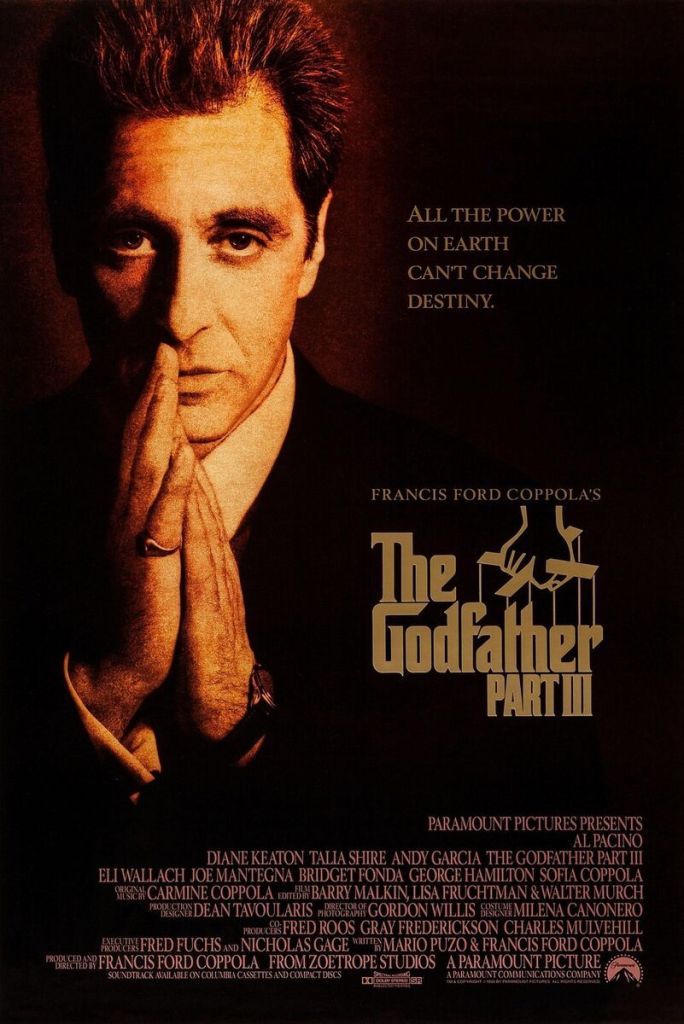
Coppola wanted to call it The Godfather Coda: The Death of Michael Corleone. He got his wish decades later with a belated re-edit release. But at the time, the studio wasn’t having it: this would be a full-blown Third Part to The Godfather. Problem is, those are some very big shoes to step into and The Godfather Part III wasn’t the genre-defining masterpiece its predecessors was. Instead, it’s a decent, melancholic gangster film with touches of King Lear. However, when you are following the sublime being “pretty good” winds up looking like “pretty awful”. The Godfather Part III became the infamous “fuhgeddaboutit” chapter in the saga, the one for completists and those who watch out of duty. On its own merits its fine, but perhaps it was a doomed venture from the start.

It’s 1979 and Michael Corleone (Al Pacino) has aged and mellowed. All his life he’s talked about getting out, and now it seems he finally has. He’s set up a charitable foundation, he’s been honoured by the Vatican and is rebuilding relationships with his children: daughter Mary (Sofia Coppola), now head of his foundation and son Anthony (Franc D’Ambrosio), an opera singer. Even Kay (Diane Keaton) is speaking to him again. Michael is grooming Vincent (Andy Garcia), illegitimate son of his brother Sonny, to take over the reins of the crime family. But then, they drag him back in. Bailing out the Vatican Bank, Michael finds is double-crossed by a collection of Euro-banking crooks, corrupt Church leaders and rival Mafiosi. Will he survive the dangers a return to Sicily will bring?

The unspoken secret of The Godfather is that everyone was always there for the money: they just also had something to prove the first two times and the fire in their bellies to turn gangster grist into cinematic beauty. Fast forward 15 years later, and there hangs an air of “give the studio what it wants” about Part III, coupled with a willingness to rest on laurels. Coppola agreed to do it because his last few films were bombs and he needed the money. Pacino demanded – and got – a massive sum. Keaton coined it. Robert Duvall asked for $1.5 million, didn’t get it and walked. Coppola agreed to turn the script around in lightening time to rush the film to the screen for the inevitable box-office and awards bonanza. No one involved really did the film for either love or passion.

Coppola’s script, written to a deadline, is torn awkwardly between two plots, neither completely satisfactory. His interest lies with the question of whether absolution (of any sort) for Michael is possible. This is the film Coppola wanted to make, but it keeps losing ground though to the other, a complex conspiracy thriller, riffing on real-life events in the Vatican. This conspiracy is frequently dense, difficult to follow and (frankly) not particularly interesting as it trudges through Papal politics and investment banking, seeming existing to provide faces for the inevitable violent montage of inventive hits.

A Part III that zeroed in on Michael himself, his guilts and shame, would have been both distinctive and unique. But The Godfather Part III fudges this. Crucially, the Michael we see here – for all he would have mellowed with age – feels very different from the cold, buttoned-down, calculating figure from the first two. Pacino – perhaps remembering the pressure of Part II that left him exhausted – invests it with more “hoo-hah”. This twinkly Michael, smiles to hide his regrets – when you feel, in reality, years of pressure would have turned him into even more of a murderous Scrooge. I also can’t believe he would be this close to his now adult children. Pacino embraces the moments of raw pain when they come, but this character just doesn’t quite mesh with his previous performances (and his hair looks just plain wrong).
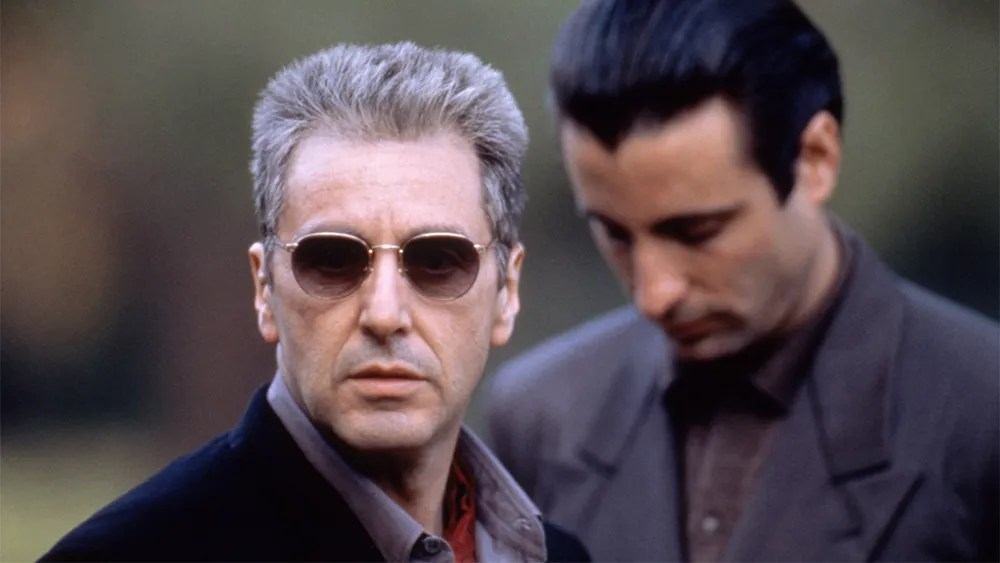
The rushed production further fatally holed this personal plot below the water-line. Duvall was originally intended to serve as the film’s ‘antagonist’, the film planned as a very personal battle between the last two ‘brothers’. Duvall’s departure ripped the heart out of this script, his role redistributed between George Hamilton’s anonymous lawyer, Talia Shire’s Connie (now turned inexplicable consigliere) and Eli Wallach’s treacherous Don Altobello. None of these make any real impact. Rushed production also meant Winona Ryder dropped out of the crucial role of Michael’s daughter, Coppola taking the (disastrous) last-minute decision to cast his daughter Sofia instead.

Sofia Coppola has suffered more than enough from lacerating reviews of her performance (the level of vitriol poured on her is shocking to read today). Let’s just say, while a great director, she is no actor. But then, neither really is Franc D’Ambrosio playing her brother. Both children never become either interesting or dynamic presences. Since their relationship – and the flowering of it – with Michael is crucial to the film’s emotional impact, it’s a fatal flaw. No matter how hard Pacino works, these scenes just don’t ring true. There is no sense of decades of anger and resentment. The drama seeps out of the family scenes and Mary becomes such a flat and two-dimensional character that her impact on the other principle characters never engages.

Sofia Coppola similarly struggles in her romantic scenes with Andy Garcia, again despite his best efforts. Garcia is the best thing in the film, full of cocksure confidence and instinctive cunning, channelling the best elements of Sonny and Michael into a character we’d dearly like to see more of. His facing down of two murderous home-invading hoods is the film’s most memorable moment while Garcia also does excellent work charting Vincent’s slow acceptance of the tragic sacrifices – the killing of parts of your nature – that being ‘the Godfather’ demands. Diane Keaton is also excellent as a far more seasoned and stronger Kay than we’ve seen before.

The Godfather Part III has several fine moments, even if it never coalesces into anything more than a decent film. Coppola restages with assurance and poise versions of previous scenes from the saga – a Little Italy festival assassination, Sicilian countryside violence, an assassin surreptitiously moving through a quiet building, Kay closing a door by choice, the montage of killings – mixed with large scale moments (a helicopter attack on a crime boss meeting is the film’s most ‘action moment’). He works really hard to channel a sense of melancholy: Michael is crippled with diabetes, plagued with guilt for his brother’s death, running to stand still and do the right thing. Pacino’s strongest moments are these moments of rawer emotion: his cloister confession to the future Pope is a masterclass in letting simmering pain suddenly rush to the surface.

But The Godfather Part III always feels like a perfunctory re-heat of key moments, not quite mixed successfully with a redemption (or lack of) tale. This film needed to be a more sombre, focused story about an army of chickens coming home to roost. It needed a stronger sense of Michael desperately scrambling to bring back together the family he was so desperate to protect that he destroyed it. Instead, it’s torn between recapturing old glories and being hampered by fudged attempts to provide emotional depth, linked to a poor structure, unfortunate casting choices and lack of focus. It’s not a bad film – but it is not a great one. And for the third in the greatest series of all time, that wasn’t good enough.

Salvador (1986)

Salvador (1986)

Oliver Stone’s passionate denunciation of American policy, highly politicised but electrically made

Director: Oliver Stone

Cast: James Woods (Richard Boyle), Jim Belushi (Doctor Rock), Michael Murphy (Ambassador Thomas Kelly), John Savage (John Cassady), Elpida Carrillo (Maria), Cindy Gibb (Cathy Moore), Tony Plana (Major Maximiliano Casanova), José Carlos Ruiz (Archbishop Oscar Romero)

To many countries the Cold War was very hot. The USA and USSR may not have crossed swords personally, but they were happy to funnel money and arms to governments and resistance groups in other countries to fight for them. The Salvadoran Civil War became another proxy battleground for East vs West – or rather Capitalism vs Communism. The US backed the military dictatorship, the USSR the left-wing revolutionaries. Caught in the middle? The people of El Salvador and their shattered human rights.

It’s not surprising this attracted the attention of Oliver Stone. Released in the same year as Platoon, Salvador is the second half of a one-two punch against the failures of American intervention. It was considerably less palatable to the masses though: Salvador is a furious, spittle-mouthed denunciation of American policy. Unlike Platoon where the victim is basically the innocence of a whole generation of Americans (an American tragedy), here you can’t fail to notice America is one of the bad guys. To Stone, El Salvador (as Richard Boyle points out in the film) was America’s chance to fight Vietnam again, only this time “right”: win it while sacrificing the lives of another country instead. It’s a considerably less easy to digest message.

Salvador is based on a fictionalised version of gonzo-journalist Richard Boyle (played with mesmeric intensity by an Oscar-nominated James Woods) who escapes from the mess of his life in San Francisco to cover the war first hand in El Salvador. There he finds himself growing increasingly sympathetic to the left-wing rebels, as the US-backed government forces commit atrocity after atrocity: mountains of corpses, assassinations and out-of-control death squads. And no-one in the embassy wants to admit to it, not when they are more concerned about keeping El Salvador from going Red. To stop that, any price is worth paying.

It makes for a passionate, angry but not subtle film. But then is Oliver Stone known for anything else? It hectors, it bellows, it hammers its points home. Stone’s writing is often a touch simplistic. There are traces of the unpleasant racism of Stone’s scripted Midnight Express in the scruffy, lecherous vileness of many of the government troops while death squad leader Major Max (Tony Plana) struts around like a mix of Tony Montana and Henry II, all but saying “who will rid me of this turbulent priest?” as he plots the murder of leading protestor Archbishop Oscar Romero.

It’s a film that lands punches that would have been better pulled. I could have done without the all-too-detailed recreation of the rape and murder of four American missionaries by a government death squad. Changing the names, doesn’t change the fact that these are fundamentally real people whose final moments are staged with a little too much queasy detail (or close-ups of their mistreated, bullet ridden bodies). But then, Stone is equally unafraid – and perhaps rightly so – to show us mountains of dead Salvadoran bodies, including children, so maybe it’s hypocritical of me to argue restraint for American victims.

Stone shoots the film with a real urgency and immediacy. Boyle frequently makes his way to the heat of the action and the camera follows him right in there. It ducks and sways among panicked mobs of people. It sees charges of horse-backed revolutionaries head towards it. It follows Boyle through devastated streets and scenes of despicable human carnage. It doesn’t flinch from executions and murders and when Boyle is thrown to the ground by explosions and gunfire, it goes down with him. Stone allows bombastic excess into the film, twinned with a score that adds a little too much classical self-importance, but at least his reasoning behind making this an overwhelming film makes sense. The whole ghastly civil war is overwhelming.

And so is America’s part in it. Aside from the ambassador – a Carter-ish hangover, played with ineffectual decency by Michael Murphy – the figures we see from government are heartless, cold warriors, interested only in the ends and caring nothing for the means. They pour money into death squads, provide air support and tanks for rebels to be strafed on the ground and are totally indifferent to morality. The media largely backs them all the way, parroting the government line and painting the revolutionaries as terrorists. They even suggest those dead missionaries were either foolish or mixed up with the rebels – either way fundamentally responsible for their deaths.

The government contrasts with the “ordinary” Americans we see. Missionaries down here to do good. And, of course, the cryptic figure of Richard Boyle. Boyle is, in many ways, a deeply unsympathetic character. Woods makes him selfish, sleazy and self-interested, constantly letting people down and taking what he can get from friendships and situations. But the things he sees in El Salvador reawakens his sense of right and wrong. He’s vile but he’s kind of brave. He will call out what he sees as wrong. He will protect others, instinctively covering those he loves when bullets fly.

And, finally, he tries to do something right, smuggling his girlfriend Maria (sweetly played by Elpidia Carrillo) and her young son back to America (needless to say, the authorities do not react well). Part of Salvador’s success is in seeing Woods perfectly craft a character arc that takes a man interested only in himself through to putting himself at risk for innocents. It’s a long road from the gonzo washout who drives down to the country stoned with drinking buddy Dr Rock (Jim Belushi, rather good as grungy stoner, sweeter than he appears, who grows to love the country and its people).

He’s a complex hero though, superbly bought to life by Woods in a performance that’s like a raw wound in a complex film. While Platoon could be seen, for all its loss of innocence, as a film where America was the victim, Salvador casts the country as the villain sharing morally responsibility for the piles of corpses Boyle picks his way through. Stone acknowledges the crimes of the revolutionaries – Boyle furiously denounces them for their shooting of unarmed soldiers pleading for the lives – but his real anger in this passionate, vibrant polemic is America itself. It’s delivered with verve, commitment and drama and helps make Salvador one of his best and most overlooked films.

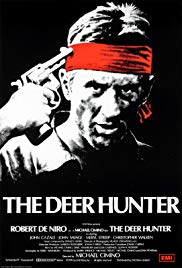
The Deer Hunter (1978)

Robert De Niro goes into a journey into the dark heart of America’s Vietnam experience in The Deer Hunter

Director: Michel Cimino

Cast: Robert De Niro (Mike Vronsky), Christopher Walken (Nick Chevotarevich), John Savage (Steven Pushkov), John Cazale (Stan), Meryl Streep (Linda), George Dzundza (John Welsh), Pierre Sagui (Julian Grinda), Shirley Stoler (Steven’s mother), Chuck Aspregren (Peter Axelrod)

The Deer Hunter is a mighty 1970s milestone of American cinema. Michael Cimino’s Vietnam story is a big poetic epic – its plot is slim but it’s all about the atmosphere, and Cimino’s understanding of the impact that the trauma of war has on different types of men. For vast stretches of the film nothing much in particular happens, followed by short, sharp bursts of gut-wrenching tension – but these have such impact because we have taken the time to see these men’s ordinary lives.

Mike Vronsky (Robert De Niro), Nick Chevotarevich (Christopher Walken) and Steve Pushkov (John Savage) are three Polish-American friends working in a Pittsburgh steel yard, who have volunteered to serve in Vietnam. Before they ship out, they celebrate Steve’s wedding, in a traditional Polish ceremony, and go for one last deer hunt in the woods together – where Mike outlines his philosophy of “one clean shot” (or “This is This”) and the near sacred experience of man communing with nature and hunting. In Vietnam, the three friends are captured by the Viet Cong and forced to take part in a chilling competition of Russian roulette. The impact of these experiences changes their lives – and not for the better – as they struggle to adjust as the war comes to an end.

Michael Cimino was seen at the time as the next great director. This reputation lasted little more than two years, when the box office disaster of his next film Heaven’s Gate (with its tales of ludicrous excess and Cimino’s overly demanding perfectionism) led to the destruction of a studio and effectively ended his career. To be honest, the roots of all this are there in The Deer Hunter. Cimino fought tooth and nail to prevent anything in the film being cut – and he lucked out that he had a few supportive producers and a picture powered by great performances and capturing something of the spirit of the age. Because just this once, more was indeed more.

In some ways The Deer Hunter is an over-indulgent mess. It’s very long, its plot is very slight, it’s very pleased with itself, the camera dawdles for ages through first the friends preparing for a wedding, the wedding itself and then a long hunting trip. This takes up a solid opening hour and 15 minutes of this long film – and progresses the plot forward very little other than establishing the characters and their relationships. But somehow, despite this, the film is magnetic during this. I’m almost not quite sure why, because nothing really happens at great length, but there is a sort of poetic majesty about these sequences that just makes them work.

It’s also a perfect entrée into our characters. After basically sitting and watching them for over an hour do little more than live their everyday lives, we really feel like we understand them. We know Mike is distant, controlled, slightly repressed but prone to moments of exhibitionist wildness that suggest primal, raging emotions beneath the surface. We also understand, with his famous “this is this” speech (“what the fuck does that mean?” his frustrated friend-cum-adversary Stan blurts out), that he is reaching for some sort of symbolic, expressionist understanding of man’s place in the world. He wants to be a poet but doesn’t have the abilities of expression to achieve that.

Similarly, we see Nick as a more carefree, open spirit, someone more in touch with expressing himself and more ready to seize life by the horns. He’s also got a gentle, conciliatory quality to him – out of all the characters, he fits most naturally into the role of confidante. Steven is a child, just trying to do his best in the world, but too naïve for the grown-up world. Most crucially we also see how they interact with each other, and how they relate to women. 

Most women in the film are clearly of very little importance to the characters. Wives and girlfriends are very much on the outskirts of the macho world of the steelyard. And they are of similarly little concern to the men when they come home. Meryl Streep – excellent in an almost nothing part, really it’s amazing how slimly this role is written – plays a woman torn between feelings for Mike and Nick, but the men’s feelings for her waver between uncertainty, indifference and confused affection. Barely any other woman gets a look in, certainly not Steve’s wife who is treated with open suspicion as some sort of floozy.

All this thematic manly matiness then explodes in the later acts of the film, as the after-impact of war – and PTSD, although the word is never used – hits our characters square in the face. And there are few things that will hit you as square on as a bullet. Cimino of course faced waves of criticism about his inclusion of the grisly gambit (no evidence that it was used by the Viet Cong) – but as a metaphor for going to war, and the trauma it will do to your mind, there are few things better than a “sport” which involves placing a gun to your head and pulling the trigger. 

These scenes are already tension-inducing to watch (you can’t help but put yourself in the shoes of the men putting that gun to their heads and wondering if they’ll hear a click or nothing ever again) but Cimino ramps up the pressure here, helped by truly powerhouse performances by De Niro, Walken and Savage. The unbelievable intensity of these scenes, and the total gear shift from everything you’ve seen up to this point in the movie, is a justification of Cimino’s slow pace earlier. After a luxurious opening sequence where we’ve watched the guys fool around, dance, sing and play pool, to suddenly be thrown into this grim, despairing, terrifying situation works brilliantly.

No wonder the rest of the film feels as much in shock as the characters do. Walken is exceptional (and Oscar-winning) as the sensitive soul whose spirit and will to live are destroyed by the incident, who no longer sees any point going home and barely even (by the end) seems to remember who or what he was. Cimino even makes the film feel colder, drabber and chillier in the third act back in Pittsburgh, following Mike’s return home – and his utter inability to deal with his experiences or communicate the horrors of what he has gone through to his friends.

This is also where the film gains immeasurably from a truly sublime performance from De Niro as Mike. In any other actor’s career, this performance would be the stand-out, so it says a lot for De Niro that it’s so often overlooked. But he underplays to devastating effect, as an inarticulate, slightly shy man who has a sheen of confidence, who will do what it needs to survive, who has a poetry and power of love in him that he can’t really express or understand. De Niro is truly brilliant in this film, a still centre that bears almost the total weight of Cimino’s thematic intentions. Essentially De Niro kinda plays an everyman Vietnam vet, and the burden of a whole country after the war without ever having the release of fireworks. He’s excellent.

But then the whole film is a little bit excellent. The Deer Hunter is a masterpiece of a sort, a compelling, dark, tragic and unsettling piece of poetic movie-making. Saying that, there’s something uncomfortable in its depiction of its non-American characters – to a man they are all violence loving degenerates – but then in a film that focuses on the unsettling experience of these Hicksville Americans in a land they don’t understand and can’t deal with, this is at least justifiable in a sense. The Deer Hunter’s main problem at points is that it is a rather pompous, pleased with itself film, but it’s not so much the story that is so strong here but the telling – and Cimino’s telling is first class.