Tag: Johnny Flynn

The Outfit (2022)

The Outfit (2022)

Theatrical, twisty-and-turn filled thriller, with a very fine leading performance

Director: Graham Moore

Cast: Mark Rylance (Leonard Burling), Johnny Flynn (Francis), Zoey Deutch (Mable Shaun), Dylan O’Brien (Richie Boyle), Simon Russell Beale (Roy Boyle), Nikki Amuka-Bird (Violet LaFontaine), Alan Meddizadeh (Monk)

In the 1950s “English” Leonard Burling (Mark Rylance) has fled haunting loss at home to Chicago. A veteran of Savile Row, Leonard is a “cutter” (definitely not a tailor – that’s any fool with a needle and thread) who crafts tailor-made suits for the wealthy. But in Chicago, the wealthiest clients are also the most dangerous: the Boyle family, an Irish mob run by Roy (Simon Russell Beale) whose impulsive son Richie (Dylan O’Brien) hopes to succeed him – as does Roy’s enforcer Francis (Johnny Flynn). The Roys use Leonard’s tailor shop as a dead drop – Leonard scrupulously doesn’t want to know – and Richie is secretly dating Leonard’s shop assistant Mable (Zoey Deutch), who Leonard sees as a surrogate daughter. But, when the Roys discover they have a rat in their turf war with the LaFontaine gang, Leonard’s shop becomes the setting for one long night of cross and counter-cross, where Leonard will need to all his wits to survive.

The Outfit’s title has a double meaning – referring both to the obvious and the Capone-founded crime syndicate the Roy’s dream of joining – and that dual nature is a pointer to the film as a chamber piece where almost nothing or anyone is exactly as it seems. With all its action taking place within the confines of Leonard’s shop it means The Outfit best resembles a decent play. Certainly, it has a theatrical love for its tricksy structure of move and counter-move (perhaps a little too much) and gives rich, chewy dialogue relished by its cast of experienced theatre performers.

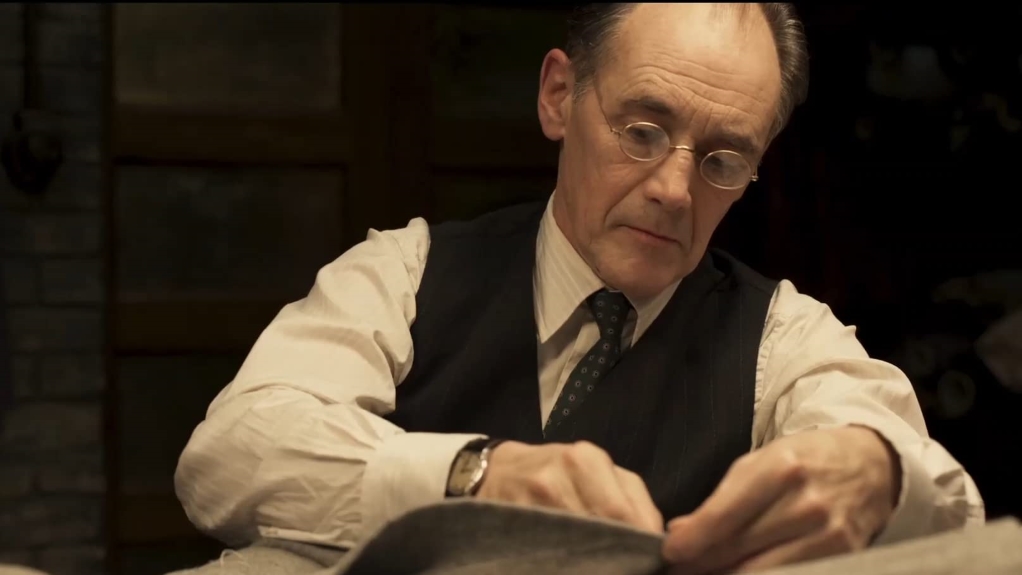
At its heart is a very fine performance of Mark Rylance. Few actors can more skilfully suggest deeper depths, below a softly spoken, quiet exterior. Leonard appears to be a mild-mannered, obsessive crafter of suits, slightly lonely who wouldn’t say boo to a goose or take even a moment to involve himself in anything beyond his shears (and you bet those are going to come into play at some point). He’s fastidious and exact – reflecting a craft where every cut must be made to perfection. Rylance perfectly captures the fastidious timidity of a humble, unquestioning man, cowed by his interaction with blow-hard, trigger-happy gangsters.

But he also subtly implies at every moment there is more to Leonard than first appears. With his gentleness and genuine concern for the well-being of Mable – excellently portrayed by Zoey Deutch as a head-strong, kind young woman making impulsive, reckless decisions while dreaming of an exciting future – it’s a surprise that when guns start appearing he’s fairly calm. Despite protests, when asked to sew up a gunshot wound he doesn’t even flinch. When bodies start to pile-up, he’s able to suggest courses of action without any trace of doubt.

Slowly we realise Leonard is thinking fast on his feet to get him – and Mable – out of a lethal situation. That he is a far more shrewd, resourceful survivor than we first thought. While fearing the dangers of the gangsters he interacts with, they don’t terrify him into inaction. We start to notice he can lie with ease, string out a yarn and think on his feet. That years of judging what clothes will fit a man have made a swift and accurate observer of details and human nature.

Rylance is able to convey all this with an assured skill. In many ways the most compelling thing about The Outfit is watching this consummate actor slowly reveal various cards in his hand, brilliantly balancing the quiet, shy persona with shrewd cunning. It’s also a brilliant camouflage for people to underestimate him – which of course they do – but Rylance also manages to lull the audience into constantly underestimating him as well.

It’s the gangsters who end up looking slightly out-of-the-depth. Ritchie Boyle – who Leonard timidly calls “Master Ritchie” throughout, like he was the scion of a lord of the manor – is a young-man desperate to prove his worth, but hopelessly incompetent and over-confident in his skill as a rough-and-tough man of the street. The real threat emerges as enforcer Francis (played with a sullen sharpness by Johnny Flynn), a born survivor with a ruthless streak a mile wide. Simon Russell Beale is slightly odd casting as a tough Irish gangster (I never quite buy it), but he and Rylance spark off each other brilliantly and Beale gets a great sense of sociopathic lèse-majesté about this crime boss who likes to see himself as a benevolent community improver but is in-fact a ruthless killer.

The Outfit offers an array of twists and turns – and more than a few shocks – and Graham Moore’s direction of his own script keeps up the tense atmosphere in its tight theatrical setting. There is more than enough mystery in exactly how events will turn out and there is enough doubt in the viewer about who is coming out of this alive. It’s final act, however, tips events a little too far – and certainly offers one reveal too many, that comes a little too much of the blue and gilds the lily too much as well as (for me) slightly undermining some of the character work the film works hard to do, as if Moore was trying a little too hard to top what’s come before. But before then this is an engaging theatrical plot-boiler, powered by an excellent Mark Rylance performance.

Operation Mincemeat (2022)

Operation Mincemeat (2022)

Wartime heroics get bogged down in bland love-triangles and tedious inventions

Director: John Madden

Cast: Colin Firth (Ewen Montagu), Matthew Macfadyen (Charles Cholmondeley), Kelly Macdonald (Jean Leslie), Penelope Wilton (Hester Leggett), Johnny Flynn (Ian Fleming), Jason Isaacs (Admiral John Godfrey), Simon Russell Beale (Winston Churchill), Paul Ritter (Bentley Purchase), Mark Gatiss (Ivor Montagu), Nicholas Rowe (Captain David Ainsworth), Alex Jennings (John Masterman)

In April 1943 a body washed up on the shore of neutral Spain. It was a Major William Martin, carrying Allied plans to launch a massive invasion of Greece in July 1943. German agents intercepted these plans before they could be returned to the British and the Germans shifted their troops to counter this invasion. Problem for them was, Major Martin wasn’t real, the plans he carried were inventions and the Allies were planning to attack Sicily. Welcome to Operation Mincemeat.

Adapted from an entertainingly written and well researched book by Ben MacIntyre, Operation Mincemeat is about one of the most successful wartime deception plans ever launched. The film is a bit of a deception operation itself. Although it looks like a Boys-Own caper film, with eccentric boffins solving problems and running circles around the Nazis, it’s actually a dry, slow, sombre film that seems embarrassed at even the faintest idea of flag-waving Wartime heroism. Instead, everything is glum, depressing and bogged down in invented details that never convince.

Which is a real shame, because when the film focuses on the things that actually happened it’s both entertaining and informative. To create Major Martin, MI6 needed a body – specifically a military-age male who drowned. That was almost impossible to find in London at the time – and the final ‘candidate’ had to be kept as ’fresh’ as possible for months. The letters he carried included ‘private correspondence’ from one British General to another – a letter that went through almost twenty drafts as the British authorities squabbled about how blunt its ‘personal’ views could be. When the body washed up, a helpful Spanish officer tried to return the papers immediately. When the film is on this material it’s good.

But it feels embarrassed by the idea of enjoying this stuff. After all, war is hell and the idea that we could even for a moment think these eccentrics (nearly all of whom spend their time penning spy stories) might find part of this subterfuge fun is disgraceful to it. So, we are constantly reminded of the horrors of war: the moral quandaries of using a person’s body for an operation, the troubling “wilderness of mirrors” of espionage. All this means that lighter moments – or moments where we could enjoy the ingenuity of the characters – are rushed over as soon as possible.

The other thing the film is embarrassed about are the lack of female characters. As such Kelly MacDonald’s Jean Leslie – who contributed a vital photograph of herself as ‘Major Martin’s’ paramour and the background of this fictional relationship – is elevated to third wheel in the planning. But, in a move that feels bizarrely more sexist and conservative, she also becomes the apex of a love triangle between herself and Firth and MacFadyen’s characters. This tedious triangle takes up a huge amount of time in an overlong film and is fatally scuppered by the total lack of chemistry between any of the participants.

It also means our heroes are forced to spend a lot of time running around like love-sick, horny teenagers, following each other and passing notes in class. At one point Cholmondeley tells Jean about Montagu’s wife with all the subtlety of “I saw X kissing Y behind the bike sheds”. This also means that the matey “all in this together” feeling essential to these sort of caper films (which is what this story really is) is undermined. This ends up feeling rather like a group of people who learn to dislike each other but vaguely put personal feelings aside for the greater good.

The real exciting history clearly isn’t exciting enough. Instead, ludicrous, artificial “improvements” littered through the story. I get that Jason Isaacs’ Admiral Godfrey is turned into a moronic, obstructive bureaucrat for narrative reasons. But the ridiculous shoe-horning in of a link between the Operation and the Anti-Nazi resistance in Germany in the second half of the film feels blatantly untrue even while it’s happening. By the time one of our heroes is being confronted by a German agent in their own home, the film has checked out of reality.

Truth is, this is a bad film, over-long, overly dry and crammed with artificial flourishes. Partially narrated by Ian Fleming (a woefully flat performance by Johnny Flynn, sounding oddly like Alex Jennings), the film attempts to draw links between this and the formation of James Bond but these fall as flat as everything else. MacFadyen gives probably the best performance among some wasted Brit stars. The truth is, a one-hour straight-to-camera lecture from Ben MacIntyre would have been twice as entertaining and interesting and half as long. A chronic misfire.

The Dig (2020)

THe Dig header
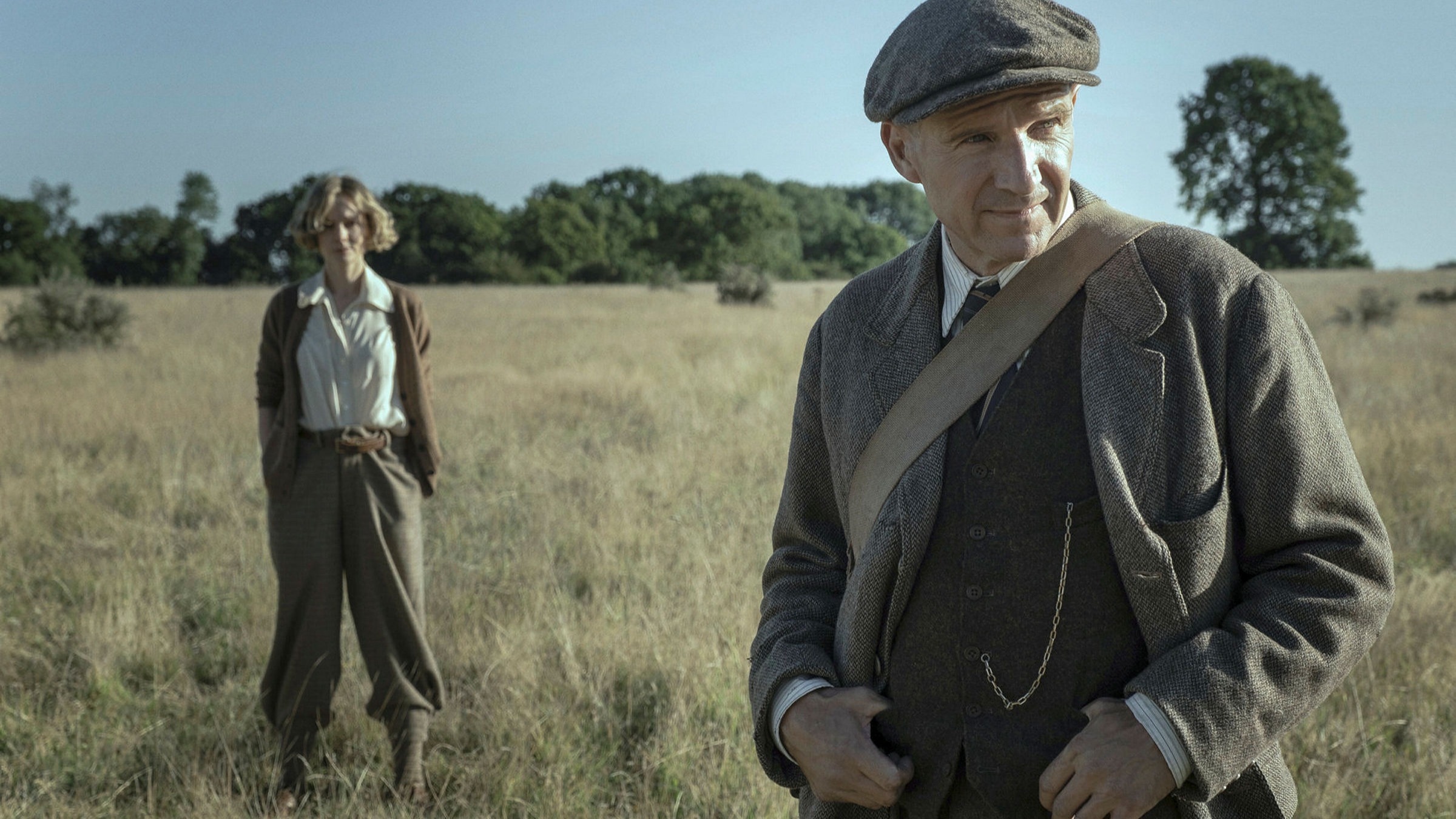
Ralph Fiennes plays an amateur digger who makes a huge discovery in the poetic The Dig

Director: Simon Stone

Cast: Carey Mulligan (Edith Pretty), Ralph Fiennes (Basil Brown), Lily James (Peggy Piggott), Johnny Flynn (Rory Lomax), Ben Chaplin (Stuart Piggott), Ken Stott (Charles Phillips), Archie Barnes (Robert Pretty), Monica Dolan (May Brown)

One of the greatest archaeological finds in British History, the Anglo-Saxon burial ship in Sutton Hoo revealed vast treasures and cultural insights that are very rarely glimpsed. Land-owner Edith Pretty (Carey Mulligan), a widow with a young son Robert (Archie Barnes), hires self-taught excavator Basil Brown (Ralph Fiennes) to investigate the curious mounds on her land. Brown discovers one of them holds the buried ship. But the dig is taken from his control by the British Museum, led by Charlie Phillips (Ken Stott): professional archaeologists who want to ensure the work is ‘done properly’. With tensions of class and profession, everyone must race against time to complete as much of the work as possible before the outbreak of the Second World War.

On the surface, The Dig is a charming, heart-felt reconstruction of a fascinating moment of archaeological history, mixed with engaging (but familiar) stories of a working-class amateurs being patronised by upper-class professionals. However, Stone’s film manages to have a richer second layer. With war approaching, and mortality constantly on the mind of most of the characters, it’s also a subtle investigation of legacy, the past and death itself.

Stone’s film develops this with its rich, poetic filming style. Beautifully shot in a series of gorgeous hazy hues, with dynamic use of low-angles and wide-angle lenses, Sutton Hoo is given an almost mystical beauty. Stone also makes extensive use of playing dialogue over images not of the conversation, but smaller moments in character’s lives, from casual meetings to cleaning shoes, that as such take on a profounder meaning. It’s a visual representation of how our legacy is often a snapshot of images and relics, moments that stay in the memory even when events (or conversation in this case) has moved on. It’s subtly done, but carries a beautiful impact.

Then of course, it’s not surprising legacy in on the mind. Each of the characters is at a tipping point in their own lives. Edith Pretty – so consumed with quiet grief over the loss of her husband that she is desperate for there to be something on the other side – is struggling with her own health, aware she will shortly leave her son an orphan. Her cousin Rory prepares for service in the RAF – service she fears will shortly leave him dead (the dangers of the airforce are clearly shown when a trainee pilot crashes and drowns near to the dig).

This connection to the briefness and intangibility of life pushes people to address their own choices. After all they are all standing in the grave of a man considered so important at that the time, a ship was dragged several miles to honour him – and today we have no idea who he was. Married archaeologist couple Stuart and Peggy Piggott confront an amiable loveless marriage (he’s gay, she’s falling in love with Rory) that shouldn’t define their lives. Basil has dealt with quiet grief at a childless marriage, and sees his work in astronomy and archaeology as his legacy.

These ideas are gently, but expertly, threaded together with a reconstruction of the key issues around the dig. Needless to say, the academics – led by Ken Stott at his most pompous – have no time for Basil’s home-spun methods. Basil’s predictions of the Anglo-Saxon tomb are constantly dismissed until he literally digs the ship up. Immediately he is benched to clearing soil (and only on Edith’s insistence is he allowed to remain at all) and later his name will be scrubbed out of the official record. It’s always the way with Britain – and a sign of how tenuous our legacies can be.

The personal stories are not always as well explored. The film has its flaws, not least the sad miscasting of Carey Mulligan as Edith. In reality, Edith was in her mid-50s when the ship was discovered. The film was developed for Nicole Kidman, but with her withdrawal Mulligan (twenty years too young) was drafted in. Sadly, nothing was changed to reflect this: meaning the characters years of spinsterhood before marriage lose impact (seriously how old can she have been when she married? She’s got a 12 year old son!). A softly underplayed romantic interest between Edith and Basil is also rather unsettling considering the vast age difference between them. (It’s better to imagine it as a platonic bond).

It’s still more engaging than the rather awkward love triangle the film introduces late on between the married Piggotts and Edith’s (fictional) cousin Rory. It’s fairly familiar stuff – the closeted gay Piggott, the growing realisation of this by Peggy and the obvious charm and gentle interest of Rory – and more or less pans out as you might expect, although at least with a dollop of human kindness.

The film’s other delight is the acting. Ralph Fiennes is superb as the taciturn Basil, a dedicated self-taught man who knows what he is worth, but struggles to gain that recognition. Fiennes not only has excellent chemistry with Mulligan and Barnes, he also suggests a quiet regret in Basil as well as a fundamental decency tinged with pride. For all that she is miscast, Mulligan does very good work as Edith while Chaplin, James and Flynn make a lot of some slightly uninspired material.

The Dig is at its best when asking quiet and gentle questions about life and when it focuses on the platonic romance between Basil and Edith. Directed with a poetic assurance by Simon Stone, it doesn’t push its points too far and gets a good balance between fascinating historic reconstruction and more profound questions of mortality.