Tag: Joseph Schildkraut

Cleopatra (1934)

Cleopatra (1934)

DeMille’s blockbuster is a fun, camp spectacle with plenty of his suggested sex and naughtiness

Director: Cecil B DeMille

Cast: Claudette Colbert (Cleopatra), Warren William (Julius Caesar), Henry Wilcoxon (Marc Anthony), Joseph Schildkraut (King Herod), Ian Keith (Octavian), Gertrude Michael (Calpurnia), C Aubrey Smith (Enobarbus), Irving Pichel (Apollodorus), Arthur Hohl (Brutus), Edwin Maxwell (Casca), Ian Maclaren (Cassius), Eleanor Phelps (Charmion), Leonard Mudie (Pothinos)

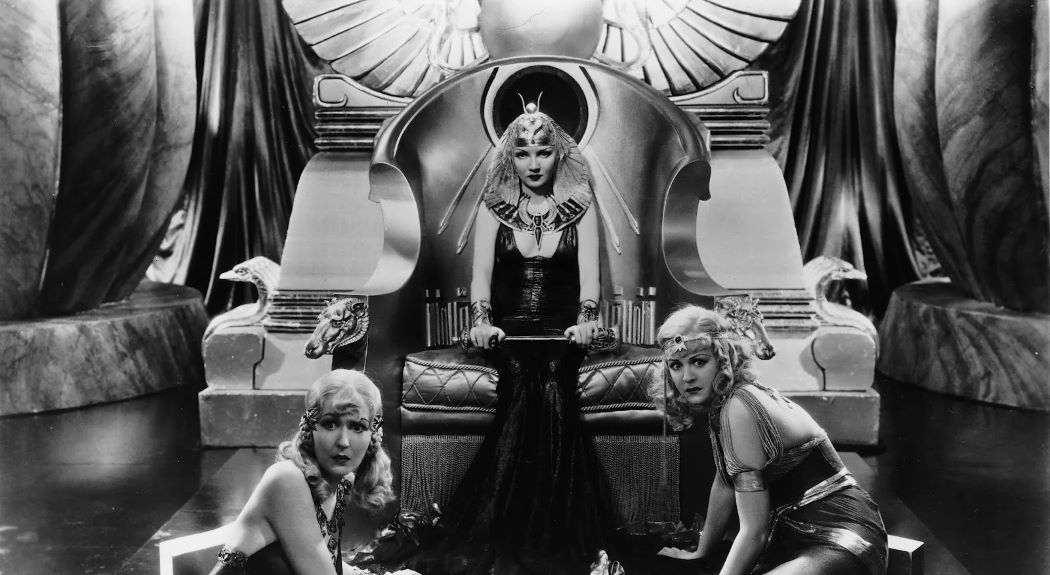
When a sand-and-sandals epic opens with a not-particularly-disguised naked woman cavorting erotically with incense, you know you are in Cecil B DeMille territory. Thirty years before the ill-fated Taylor-Burton epic, DeMille’s Cleopatra was the box-office hit of 1934. It was also a stompingly silly film, crammed with hammy performances and sexual imagery which it got-away-with in those pre-code days because it was an important historical subject taking place on humongous sets. But Cleopatra is also extremely good fun, a film so camply delighted in its naughtiness (and bowling along with such pantomimic energy) that it knocks spots off the turgid 1963 flop.

This Cleopatra follows pretty much the same structure (literally in half the time). Cleopatra (Claudette Colbert) is at war with her brother for the throne of Egypt. Smuggled into the presence of Julius Caesar (Warren William) wrapped in a carpet, she reveals the evil machinations of her rival Pothinus (Leonard Muddie) and seduces Caesar (possibly more with the prospect of controlling Egypt, since this Caesar is a power-mad cold-fish). When Caesar is dispatched by conspirators during the Ides of March, Cleopatra’s focuses on man’s-man Marc Anthony (Henry Wilcoxon) who is very open to her seduction. Before they know it though, the two are at war with envious technocrat Octavian (Ian Keith) who marches all of Rome to Cairo to crush the two. Bring on the asps!

DeMille shoots all this with relentless energy and pace, though not quite enough that you don’t notice the dialogue clunking out of the actor’s mouths (“You and your Friends, Romans, Countrymen…” a bitter Octavius observes about Anthony’s funeral oration). Cleopatra, like many of the Great Showman’s finest films (of which this is unquestionably one) gives us all the sex and smut we could possibly want, disguised in its classic setting. Cleopatra absolutely drips in lust and is crammed with suggestive imagery from top to bottom.

From that cavorting incense-carrier, we cut to the rooms Cleopatra has been kidnapped from. These look like nothing less than the aftermath of a kinky orgy, including a hog-tied servant who looks like he’s passed out in an asphyxiation sex-game. Colbert models a series of deep-dive dresses that leave little to the imagination. Poor, randy Marc Anthony doesn’t stand a chance (we know he’s a hot-blooded man because he never goes anywhere without his two barking greyhounds). Cleopatra even dresses at time like some musicals starlet, trailing billowing fabric behind her as she descends stairs.

Meeting her on her pleasure barge (this ship is practically Tardis-like in its interior dimensions) he’s treated to the sort of show that wouldn’t be out of place in Amsterdam’s Red-Light district. Scantily-clad ladies cavort, dancers dressed in skin-tight leopard skin are marshalled by a whip-carrying ring-master, while they cavort and engage in (literal) cat-fights until broken up by a crack of the whip. All the time Cleopatra reclines on a silk-covered bed, Colbert’s eyes flashing unmistakable “come hither” glances. No wonder the randy sod quickly finds himself going all-in on Egypt.

Along with sex, the film mixes in plenty of action. Caesar’s assassin is rather imaginatively filmed through a POV shot (“You? You too Brutus?!” Warren William intones in despair), as daggers fly in. The forthcoming battles are teased in an early scene where Caesar, bored with an Egyptian delegation, fiddles with various models of siege engines. All of these come into play in the film’s later sequences, that sees a parade of fast-cut war scenes overlaid: siege engines fire, armies plough at each other over deserts, ships clash at sea, men drown in agony. Much like the epic scale of Cleopatra’s court and barge, the film doesn’t skip on the epic conflict.

Between these two tent poles, we basically get a soap dressed to-the-nines in sandals, short skirts and armour. Claudette Colbert in a banner year (this was one of three hits she had, and she won the Oscar for It Happened One Night) is sultry, playful and if she never feels for even-one-minute like a figure from antiquity, at least she has that in common with the rest of the cast. She gives Cleopatra a charismatic energy that makes her believable as a figure round whom all else revolves. Wilcoxon plays Anthony with a thigh-slapping, hail-fellow-well-met quality. Warren William underplays as Caesar – which can make him look dull in a film as overblown as this – but makes for an effectively cold and calculating man.

Egypt, in its voluptuous naughtiness makes all Rome look rather dull though. Our capital is introduced in a house-party where the conspirators pose and moan like hammy matinee performers, stroking their historically incorrect beards, while the ladies bitch like New York housewives gleefully spreading catty gossip. Octavian is re-imagined as whining middle-manager, a weasily Ian Keith constantly moaning about never getting enough attention and clearly far-too inhuman to ever be stirred by Cleopatra the way the lusty Anthony is. With the frame of the film being classic antiquity, we can even pretend this is somehow serious drama when really it’s just Dallas.

These actors march their way through a series of break-ups and get-togethers, punctuated by moments of silly drama. (Cleopatra, Hamlet-like, even stabs Porthinus through a curtain seconds before he can assassinate Caesar!) But it all kind of works because you suspect nothing is really taken that seriously. DeMille is making a big pageant here, a walloping epic of lusty suggestion, powered by larger-than-life performances. It’s meant to fill you with excitement and awe, to make you gasp in awe. It doesn’t really matter that we get a shit-stirring King Herod (a smirking Joseph Schildkraut) or an Enobarbus who puffs like a regimental sergeant-major (C Aubrey Smith, giant of beard). It’s all about the spectacle, the drama and showmanship. And no one really does that sort of stuff better than Cecil B DeMille.
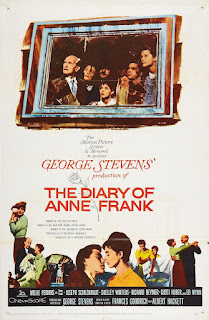
The Diary of Anne Frank (1959)

The Diary of Anne Frank (1959)

Reverent adaptation of the most famous diary ever written, that drains it of any sense of life or drama

Director: George Stevens

Cast: Millie Perkins (Anne Frank), Joseph Schildkaut (Otto Frank), Shelley Winters (Petronella Van Daan), Richard Beymer (Peter Van Daan), Gusti Huber (Edith Frank), Lou Jacobi (Hans Van Daan), Diane Baker (Margot Frank), Ed Wynn (Albert Dussell), Douglas Spencer (Kraler), Dodie Heath (Miep Gies)

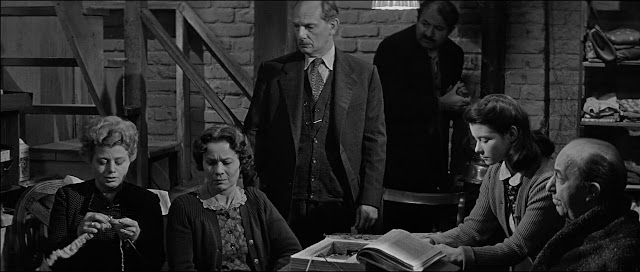
Few personal stories have had such a huge impact on so many people’s lives than Anne Frank’s diary. This literary marvel, written by a teenager who mixed profound insight with teenage obsessions, was a world-wide sensation when it was published after the war. The diary covers the over two years Anne, her family and their friends spent in hiding in a secret annexe in her father’s warehouse in Amsterdam. For Jews hiding from the barbaric persecution of the Nazi occupying forces, every day was a struggle between trying to lead as normal a life as possible and the terror of discovery and deportation to a concentration camp. Of course, we know, tragically, they were discovered – and only Anne’s father Otto survived the war.

Otto discovered the diary when he returned to Amsterdam after the liberation of Auschwitz. Moved by the diary’s mix of maturity and youth, Otto had it published first for friends and then more widely. At various points, parts of the diary were edited to remove more “personal” content (Anne wrote freely at points on her growing sexuality and was sometimes less than kind to the other occupants of the annexe). More modern editions have embraced a less edited, fuller diary that really allows us to see what a brilliant, challenging, sometimes judgemental, fully rounded teenager Anne was. The Diary of Anne Frank hails from an era that framed a more sanitised diary. The worst you can say for it is that I think there is a good chance the real Anne Frank would have found it a bit dull.

Adapted from a Pulitzer Prize winning play by Frances Goodrich and Albert Hackett, George Steven’s film is reverent, noble and very worthy. It also frequently lacks any pace or life, and is so concerned with being life-affirming that it filters out nearly all sense of tension or conflict that these eight people felt (which they often did living, as they did, in a few small rooms for over two years, with very little food). The film also centres a romantic relationship between Anne and Peter – one that, according to Anne’s own diary, was already coming to an end at their discovery (in reality, she felt they had little in common other than living in the annexe together).

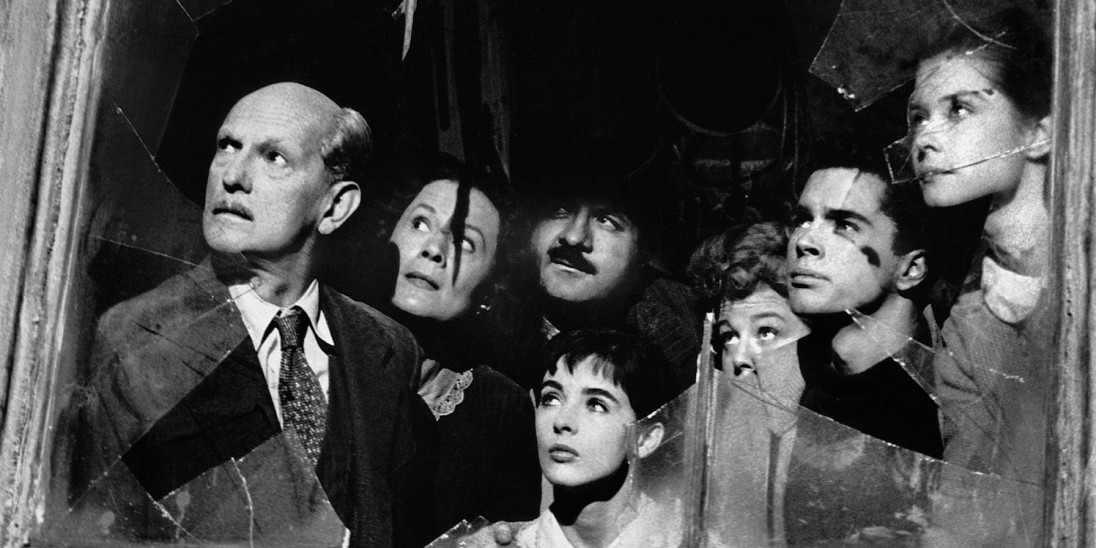
But Stevens’ film is so concerned with framing someone as fascinating as Anne as a secular saint that it removes much of the vibrancy that gives the diary such impact. It also doesn’t help that Stevens shoots the film in a luscious black-and-white, in detailed sets – but also in the widest possible cinemascope. This does allow for some lovely shots – an image of Anne and Peter kissing in a monochrome shadow, before a door opens to bathe them in light is striking – but it sacrifices the most essential fact of the setting: its cramped smallness.

The widescreen frequently makes the annexe seem larger than it is

Who decided that a location defined by its claustrophobia and smallness was best captured in super-widescreen, I don’t know. But the wide angles make the annexe look a heck of a lot larger than it actually is (I’ve been there, I know it was more cramped than this!) and Stevens frequently frames the whole cast in shots which makes the annexe look positively cavernous.

The lack of claustrophobia has a serious impact on the story’s sense of drama. It also helps to filter out the tension. The script removes, or minimises, most of the key personal tensions in the annexe. We have moments of disagreement, but generally the inhabitants are shown to get on extremely well, with Anne herself practically perfect. This doesn’t really square with the diary, which is pretty open in Anne’s difficult relationship with her mother (with whom she felt no affinity), the clashes with the Van Daans and Mr Dussell (not their real names – Dussell basically translates as idiot, which gives a better impression of Anne’s difficult relationship with this unwanted roommate) or her later arguments with her father. Instead, things are smoothed out and nothing that could detract for a moment from the optimistic and hopeful message of the film is allowed.

The film also replicates several changes that the play made for dramatic effect. This most especially affects the character of Dussell (real name Fritz Pfeffer). In real life a respected dentist and pillar of the Jewish community, Dussell/Pfeffer here is a complacent, panicking imbecile, utterly ignorant of the Jewish faith and claims to have lived his whole life in Amsterdam with no idea he was a Jew. The real-life Pfeffer had in fact fled Germany to escape Nazi persecution. Played with a self-satisfied whininess by Ed Wynn (a famous TV comic, Oscar-nominated here for showing he could do drama), Dussell/Pfeffer is a joke. Pfeffer’s family cut ties with the Franks after the play was released.

Wynn’s nomination reflects how the broader performances in this film gained the most attention. Shelley Winters won an Oscar for her role as the blowsy Mrs van Daan – both van Daans are larger-than-life and obsessed with their status. More restrained and effective performances come from Gusti Huber as Anne’s shy and nervous mother and above all by Joseph Schildkraut as her wisely patient father. Richard Beymer gives an effective performance as a young Peter, straining against the leash of being stuck in a sort of suspended childhood.

As Anne, Millie Perkins looks the part in many ways – apart from the fact she is clearly too old. But there is something a little neutered and frankly a little too perfect about her performance. Her voice has a flat American twang to it that makes much of her voiceover a little wearing to listen to, especially as the tweeness is dialled up. I’m not sure she has the presence for the role – although she is not helped by the sanitised, earnest script.

Criticising The Diary of Anne Frank feels almost sacrilegious, like criticising the lives of the real people who went through something unimaginable to try and survive in a world of horror. But Stevens’ film is straining so hard to be reverent – and shaves the edges of its characters so much – that it turns them and their story into something much more easily digestible than it should be. It becomes a feelgood story, rather than something vibrant and alive. And that vibrancy is what has made Anne Frank live for so long after her murder. To create a film that captures so little of that, instead turning her into a conventional romantic heroine, just feels like it misses what made her unique.

The Life of Emile Zola (1937)

The Life of Emile Zola (1937)

Oscar-winning biopic that laid down many of the conventions we expect

Director: William Dieterle

Cast: Paul Muni (Emile Zola), Gloria Holden (Alexandrine Zola), Gale Sondergaard (Lucie Dreyfus), Joseph Schildkraut (Captain Alfred Dreyfus), Donald Crisp (Maitre Labori), Erin O’Brien-Moore (Nana), John Litel (Charpentier), Henry O’Neill (Colonel Picquart), Morris Carnovsky (Anatole France), Louis Calhern (Major Dort), Ralph Morgan (Commander of Paris), Harry Davenport (Chief of Staff), Vladimir Sokoloff (Paul Cezanne)

One of the lesser-known Best Picture winners, The Life of Emile Zola is a prime example of the 1930s trend for “Great Man” pictures, setting the template for a whole genre of biographical movies. A whistle-stop tour of how the Great Man came to be, before a tight focus on what made him great – ideally ending in either triumph or disaster (or, as is the case here, with both). It’s from a time when the viewing public didn’t expect a rigid adherence to the fact – and when films were very open with their flexibility with the truth (the film opens with an on-screen caption which happily states most of what happens in it is made up.) Actually, I think being told from the start you are watching a heavily fictionalised version of the truth covers a multitude of sins: and that The Life of Emile Zola is pretty entertaining when you get past that.

Emile Zole (Paul Muni) is of course one of the most famous French authors. But he was also at least as famous for his campaigning and presence as he was for his volumes and volumes of best sellers. The film follows Zola, for its first forty minutes or so, from poverty-stricken writer, struggling to make ends meet in the draughty hovel he shares with similar future-genius Cezanne, to success (although in real life by the time he wrote Nana, the book that makes him a sensation here, he was already hugely famous). Zola becomes increasingly aimless. What worlds are there left to be conquered? That all changes when Lucie (Gale Sondergaard) the wife of army officer Alfred Dreyfus (Joseph Schildkraut) asks for his help to save his life from unjust imprisonment and exile on Devil’s Island. Because the army are convinced Dreyfus is a spy – and won’t let inconvenient things like evidence that someone else did it get in the way.

The film is called The Life of Emile Zola but really it might as well have been called The Dreyfus Affair. This infamous miscarriage of justice drives the entire second half of the movie – with Zola himself disappearing from focus for stretches as the film covers the conspiracies that led to Dreyfuss spending the best part of a decade imprisoned for something he didn’t do. What seems strange today is that the film makes no mention of the most famous angle of the case: Dreyfus was almost solely suspected because he was Jewish, and the case became one of the most infamous antisemitic persecutions in history. But the studio heads – Jewish themselves and nervous of being accused of making a film that criticised Nazi Germany – removed all reference to Dreyfus’ Jewishness from the script. It’s a curious omission, but by and large doesn’t affect the film’s final impact.

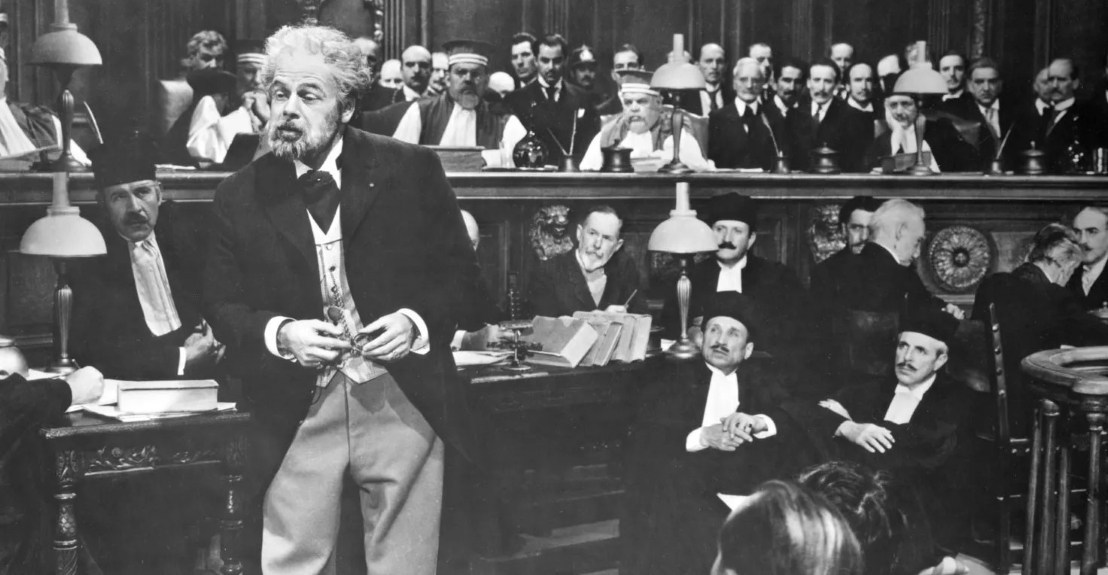
Dieterle’s movie is also one of the first courtroom dramas. A large chunk of the final third is given over to Zola’s trial for libel (after his famous J’Accuse article, denouncing the army’s persecution of Dreyfus). In a crowded courtroom, the film carefully follows the intricacies of the court case, from calling to witnesses to final speeches (all fairly accurate, even if Zola is given a larger role with a final speech). As in the trial itself, the blatant unfairness (witnesses shouted down, defence questions vetoed, evidence withheld and even invented) is hammered home with shocking regularity. Donald Crisp does fine work as the liberal lawyer, hamstrung by a crooked system.

The Dreyfus affair element is really what makes the film come to life. The French army officers are almost to a man a group of corrupt bullies, who have pre-decided the outcome of their investigation and are determined that every single element of it should support that decision. By contrast Joseph Schildkraut (winning an Oscar that feels more for Dreyfus than him, delivering an effective if rather one-note performance) is the soul of decency and nobility as a Dreyfus who is at first bewildered then fighting a manful struggle against despair. Even better is Gale Sondergaard, who gets an ahistorical impassioned speech to win Zola to the cause and carries a core of quiet anger under her shock.

The Dreyfus Affair was the struggle of Zola’s life, the crusade that would win him a place in history, perhaps even more than his books. It’s also the sort of campaigning material that gives rich rewards to actors. Paul Muni seizes the opportunity. The film was shot in reverse so Muni would need to spend less and less time in make-up as shooting went on: the old-age make-up and wigs are very effective, matched by Muni’s physicality and voice which subtly changes as the character ages.

Muni is an actor who seized any chance for a bit of grandstanding. The film gives him its best one with a five-minute monologue closing the trial, during which Zola argues with passionate but quiet reasonableness that Dreyfus is an innocent victim. It’s even more effective since Dieterle has kept Muni silently off-centre for much of the court case. Muni sometimes carries the whiff of stagey ham, but in several moments he brings both a charming cheek and strong morality to Zola. It’s a very strong performance from one of the leading actors of the 1930s.

The film itself is also a good mixture of the twee and the compelling. Most of the Dreyfuss material falls into the latter category. It’s the early days of Zola that falls into twee: Zola scrippling ideas, bantering with Cezanne on the purpose of art, playfully mining prostitute Nana for the material he will make into a hit book. There is a nice foreshadowing through the film with Zola’s obsession with blocking draughts – an obsession that will later cost him his life to a misfunctioning heater.

It’s a well directed film. Dieterle mixes in nice touches of humour (a husband and wife using subterfuge to disguise from each other that they are both buying Nana) and also effective details that speak of Dreyfus’ isolation (the letter that has been redacated into nothingness, the effective transition of several years at Devil’s Island that stresses how little has changed, Dreyfus’ giddy joy when finally allowed to walk unheeded in and out of his prison cell).

The Life of Emile Zola looks today like a surprising winner of Best Picture. But the patterns for both courtroom drama and many biographical dramas were laid down here. By the end, as the survivors pay tribute to Zola with high-blown speeches, the audience should be convinced that this was a man deserving of being honoured by a whole movie. It’s setting of a template copied many times over can make it look a little twee today, but its’ still well done, with some powerful flashes of effective film-making and great acting.