

Tag: Julia Stiles

Hustlers (2019)

Constance Wu and Jennifer Lopez head out to get what they want in Hustlers

Director: Lorene Scarfaria

Cast: Constance Wu (Destiny), Jennifer Lopez (Ramona Vega), Julia Stiles (Elizabeth), Keke Palmer (Mercedes), Lili Reinhart (Annabelle), Lizzo (Liz), Cardi B (Diamond), Mercedes Ruehl (Mama), Wai Ching Ho (Destiny’s grandmother)
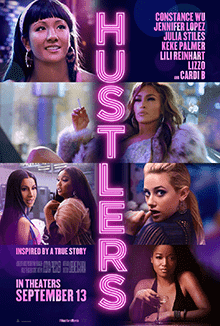
Greed. To many people, it’s what powers society. Those at the top believe anything can be bought, that they can have anything and everything they want simply because they have the money to pay for it. Hustlers suggests that nowhere is this more true, than in a New York strip club. The rich and the powerful, the masters of the universe, descend on these clubs for their after-hours play and assume their ocean-like wallets will open every door for them. Can we blame the strippers if they decide to exploit this for their own gain?

Opening in the build-up to the financial crash of 2008, Dorothy aka Destiny (Constance Wu) arrives at Moves, a prominent New York strip club, the night-time spot of choice for the super-rich from Wall Street. Money flows liberally in return for the strippers’ performances and their stroking of these masculine egos. Destiny comes under the wing of the club’s star, Ramona Vega (Jennifer Lopez), who teaches her how to manipulate men for cold hard cash. But when that financial crash comes, both women find themselves out of work. In the new atmosphere, the clubs are now staffed by dancers from Russia willing to go further with the men for money. Thrown back together, Destiny and Ramona start a new hustle – target rich men in clubs, get them drunk (and later just simply drug them), drag them to Moves and max out their cards (with the ex-dancers taking a healthy cut). But as the strippers themselves become rich, they start to get greedy. Things aren’t going to end well…

Sharply and wittily directed, Lorene Scarfaria’s film is an excellent crime movie with a little bit of social commentary thrown in. Fast paced and done with just the right amount of flash, it brilliantly rejigs the usual lens that we see strippers through in Hollywood movies. Rather than clichés, hookers with hearts of gold or props for the male characters, here the strippers are real, rounded people working a job – a job that just so happens to involve taking their clothes off. There may be fun to be had at times, but it’s a performance, a show – and a large part of Ramona’s skill is to effectively and convincingly play what she knows the men want to see.

That’s what Scarfaria’s film shows – it’s all a careful hustle, a clever series of tricks and techniques used by strippers to minimise the amount of contact with the customers (and the indignities of their lecherous hands) and maximise cash return, over the longest period of time possible. And these rich Wall Street types are too arrogant and convinced of their own excellence to even notice. The men come out spectacularly badly, a bunch of leering assholes who believe money gives them the right to do anything they like. Scarfaria shoots this with a snazzy Scorsese-ish zing which makes the entire film bounce along like a light version of Goodfellas and Wolf of Wall Street.

And the film has a great deal of admiration for these women who decided to turn the tables – who dealt with the fact that they were basically trapped into a certain role by society by using their skills to steal from the rich. The scheme of conning men is perfect at first – after all what powerful man is going to want to say that he was drugged and fleeced by a gang of attractive women? What is interesting is that the greed that corrupted the men, is gradually the thing the corrupts the women as well: the more successful their scam is, the richer they become, the more they become obsessed with status symbols, just as the men treated them. It doesn’t take long for crime to start moving on from its original Robin Hood targets into something far more indiscriminate.

Leading that charge into hitting any and every target for as much as they can get (rather than a careful but continual fleecing of a select group) is Jennifer Lopez’s Ramona. This is the role Lopez has been waiting almost twenty years for, a charismatic woman so firmly in control of her own life she doesn’t even notice when it starts to hit the skids. It’s the sort of scene stealing role that demands the energy and personality Lopez can bring to it, Ramona being part mentor and mother and part greedy livewire. If you forgot what a promising actress she was in the 90s, this is a great reminder. Ramona is a force of nature, the woman who demonstrates sex is a tool that can produce fabulous, fortune making results. But she’s arrogant enough to let greed and her innate belief in her own infallibility guide many of her decisions.

Lopez also forms a wonderful partnership with Constance Wu in the “Ray Liotta” part of the young naïve innocent, drawn under the mentor’s wings who eventually has to turn against her. Wu draws a lot of charm out of the young stripper learning the ropes, but crosses this really well with an ambition and ruthlessness that only late on finds its limits. 

Hustlers bounds along telling a winning, crowd pleasing story with a depth and emotional force that produces great results. We root completely for its female leads, keeping them relatable even when their actions become less sympathetic. Strikingly directed by Lorene Scarfaria, it’s a film about women that makes themselves firmly the authors of their own destinies – and their own mistakes.
Silver Linings Playbook (2012)

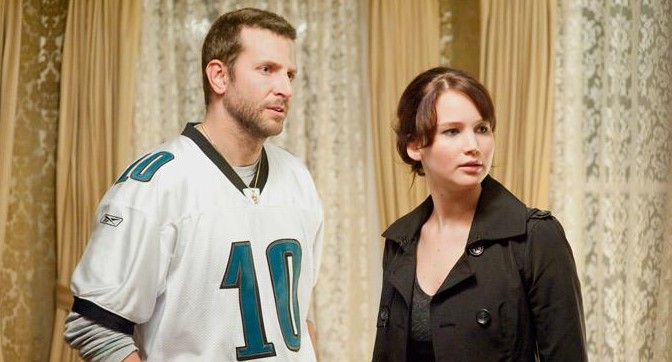
Bradley Cooper and Jennifer Lawrence in an unusual love story Silver Linings Playbook

Director: David O. Russell

Cast: Bradley Cooper (Pat Solitano Jnr), Jennifer Lawrence (Tiffany Maxwell), Robert De Niro (Pat Solitano Snr), Jacki Weaver (Dolores Solitano), Anupam Kher (Dr Cliff Patel), Chris Tucker (Danny McDaniels), Julia Stiles (Veronica), Shea Whigham (Jake Solitano), John Ortiz (Ronnie)

David O. Russell is a director it’s easier to admire than fall in love with. I can see why actors come back to work with him time and again – he’s clearly an actors’ director who crafts stories that give them chances to shine. But his films often have an archness about them, while I find too many of them settle for a sort of middle-of-the-road quirky cool. I’ve never really, truly, loved any of them – even if I have enjoyed them while watching them. The closest I think I’ve got is Silver Linings Playbook.

Pat Solitano (Bradley Cooper) is released from psychiatric hospital, after being confined for assaulting his ex-wife’s lover, into the care of his parents Pat Snr (Robert De Niro), unemployed now making a living as an underground bookmaker, and Dolores (Jacki Weaver). Suffering from a host of compulsions connected to his bipolar disorder, Pat is fixated on winning back his wife. To do so, he enlists the help of Tiffany (Jennifer Lawrence), the widow of a policeman who died in a road traffic accident, who has her own borderline personality disorder and has been dealing with her grief through a parade of casual sexual encounters. Together they enter a dance competition – Tiffany because she always wanted to, Pat because Tiffany has offered to take Pat’s letters to his wife if he says yes and because Pat wants to prove to his wife that he has changed. But is there more than mutual convenience between the two?

Silver Linings Playbook is an unusual romance, that also explores themes of mental health and compulsions and how thin the lines can be between what we consider healthy and not healthy. When does obsession tip over into something that should be treated? Pat is the sort of guy who wakes his parents up to furiously denounce the Hemingway book he has just finished reading in one sitting (a scene played exuberantly for laughs – including Pat smashing a window by throwing the book out of it) but it quickly tips into danger when in a similar mania he awakens the entire neighbourhood at 3am tearing the house apart for his wedding video, accidentally hits his mother, and ends in a tear filled scuffle with his dad. Similarly, Tiffany’s tendencies towards aggression and self-destruction frequently put her in situations both funny and dreadfully damaging.

But just as close to this, we have Pat Snr’s addiction not only to gambling, but also to a raft of superstitions designed to better his chances of winning (and which dominate large parts of his life). Dolores seems obsessed with maintaining peace and order in the family. Pat’s brother has an almost savant tendency to speak his mind, causing more harm than good. Every character in this seems to have their own psychological hang-ups, with resulting problems.

But the film marries this up with an actually quite sweet romantic story between two damaged souls, both very well played by Cooper and Lawrence. This was the film where Cooper repositioned himself as a major actor of note. His performance here is a perfect mixture of charm, pain, confusion, frustration, insight and self-destructive monomania. He’s both funny and deeply moving, sweet and also slappable, gentle but with a capacity for unpredictability. He’s a terrific performance, deeply affecting. It also helps he has fabulous chemistry with an Oscar-winning Jennifer Lawrence. Lawrence’s Tiffany is a vulnerable soul, desperate to appear as tough and impossible to harm as possible and not caring about any of the collateral damage. She’s as brittle as she seems rigid, and as desperate for affection as she pretends to be uncaring about it.

The film throws these two together with an obvious spark from the start, and brilliantly uses their preparation for a dancing contest to show them growing closer together physically and emotionally, as well as adding a purpose to their lives and giving them a common goal to work towards. There is a rather nice gentleness, amongst all the chaos of this film, that something as simple as taking up a new hobby can help to ground two people.

The film builds the romance gently, carefully showing it developing organically and leaving us to guess at what point the bond between these two enrichens and deepens from an instant connection to something more profound. It’s sure got a lot to overcome, with Pat’s obsessive focus on his wife and Tiffany’s compulsion for meaningless sex and her own desire to destroy promising relationships (she almost immediately alienates the surprisingly gentlemanly Pat with an offer of casual sex on their first meeting). With a gentle slow-burn, the film builds towards something that ends up being rather moving.

Russell’s adaptation of the original novel is well-structured and entertaining and his unfussy, stylish direction brilliantly creates an enjoyable mode. De Niro (in what many people called a joyous return to form) and Weaver are both very good as the parents (both were Oscar nominated – this is one of the few films to be nominated in each acting category) and there is hardly a weak beat in the cast. After several quirky, indie-cool, rather distant films, this is possibly the most fun and the most heart-warming Russell has ever been. It’s a career high. Heck even Chris Tucker is really good. And I’d never thought I’d say that.

Jason Bourne (2016)

Matt Damon swings back into action in after-thought Jason Bourne

Director: Paul Greengrass

Cast: Matt Damon (Jason Bourne), Tommy Lee Jones (Director Robert Dewey), Alicia Vikander (Heather Lee), Vincent Cassel (The Asset), Julia Stiles (Nicky Parsons), Riz Ahmed (Aaron Kalloor), Ato Essandoh (Craig Jeffers), Scott Shepherd (Edwin Russell), Bill Camp (Malcolm Smith), Vinzenz Kiefer (Christian Dassault), Gregg Henry (Richard Webb)

They say you should never go back. Producers had been begging Paul Greengrass and Matt Damon to get back together again and make another Bourne film. After all, there was hardly anyone asking for a sequel to that Jeremy Renner one was there? But Jason Bourne seems like a film that’s been made after Greengrass and Damon ran out of reasons for saying no. I can’t decide if we can blame them for that or not. But their making the film at all suggests they aren’t really losing any sleep about whether people feel this half-hearted effort has an impact on the legacy of the others.

Anyway it’s ten years later. The world is an increasingly technical place, with people living in an era of increasing social unrest and anti-government fury. Jason Bourne (Matt Damon), recovered from his amnesia, now lives off-the-grid – until of course he’s unearthed by his old colleague Nicky Parsons (Julia Stiles). Parsons is now working with a hacker commune in Iceland, and has unearthed more evidence about the shady CIA programme, Treadstone, that Bourne used to be a part of, and about Bourne’s own recruitment into it. Meeting in Athens in the middle of an anti-government riot, Parsons is killed and Bourne is set on a collision course with the CIA as well as finding out more about the mysterious death of his father 20 years before. 

Jason Bourne is basically going through the motions. There is an attempt to add another layer of mystery around Bourne’s background, but it barely seems to add much to the hinterland of Bourne we’ve already learned about in the last couple of films. Furthermore, I’m uncomfortable with a Bourne here who goes increasingly on a rampage of revenge. Part of the charm – or rather what makes Bourne different – in the previous films was that he was a man who lived in a world of violence, but didn’t care for it himself. He used brutal force only when it was absolutely necessary, and several times chose not to take a personal revenge. Here however, he dispatches at least three people, which doesn’t seem to square with the character as we’ve previously seen him.

Furthermore, the film seems to be struggling to reclaim Bourne as one of the formal good guys, a patriot and American hero. Again part of what made him different in the original trilogy was that he stood outside the government and nations, that (as Greengrass once said) “he’s on our side”. Here he’s clearly less than sympathetic to anti-government forces, and strongly opposed to exposing CIA secrets. In fact he ends up feeling rather conservative here to be honest, and more like the faceless killer that he started as rather than a renegade. 

It’s not helped by the fact that the plot is pretty meh, a remix of different elements from previous films, carefully ticked off to make sure we get everything we could expect. So we get a reworking of various car chases, fights, tense meetings in public locations etc. etc. The film-making is very well done – Greengrass rewrote the book on how to make films like this, and he carries that on here, brilliantly mixing twitchy editing, handheld camera work, immersive film-making and gloomy silences to create a really wonderfully done viewing experience. It’s just more of the same from the originals. The film just ends up living in the shadow of the originals, rather than really forging something out on its own.

Greengrass tries to tap into contemporary ideas. We get the sense of anti-establishment clashes and Internet data scams – but it never really feels like it goes anywhere or coalesces into any real point at the end of it. What is the actual message of this film? There are hints that Tommy Lee Jones’ gravelly CIA Director and Riz Ahmed’s Mark Zuckerberg-lite tech expert are planning some sort of mass intrusion on people’s privacy – but the film never explains this or explores it. It never even makes Bourne aware of it – and since Bourne is our “window” into this world, that means we never understand it either.

I mean, the film is fine other than that, but that’s all it really is. Matt Damon still hasn’t lost it as Bourne – and blimey he should have some inverted award for how little he speaks in this film – and he has not only the physicality but also the worn-down, haunted look of a man who has seen way, way too much. There are professional performances from the rest, but nothing that stretches any of the actors here, with Alicia Vikander particularly under-used as an unreadable CIA agent. 

But that sums up the whole film. Despite all the attempts to build in a modern “torn from the headlines” angle to the story, it feels more like Greengrass and Damon are quite happily (and with some enthusiasm at least) going through the motions in order to pick up a cheque. And I guess that’s fine. It just means we are probably not going to rush to see this again.