
Tag: Julie Delpy

The Lesson (2023)

The Lesson (2023)

Sinister family mystery, full of good moments that don’t come together into something that really works

Director: Alice Troughton

Cast: Daryl McCormack (Liam Sommers), Richard E. Grant (JM Sinclair), Julie Delpy (Hélène Sinclair), Stephen McMillan (Bertie Sinclair), Crispin Letts (Ellis)

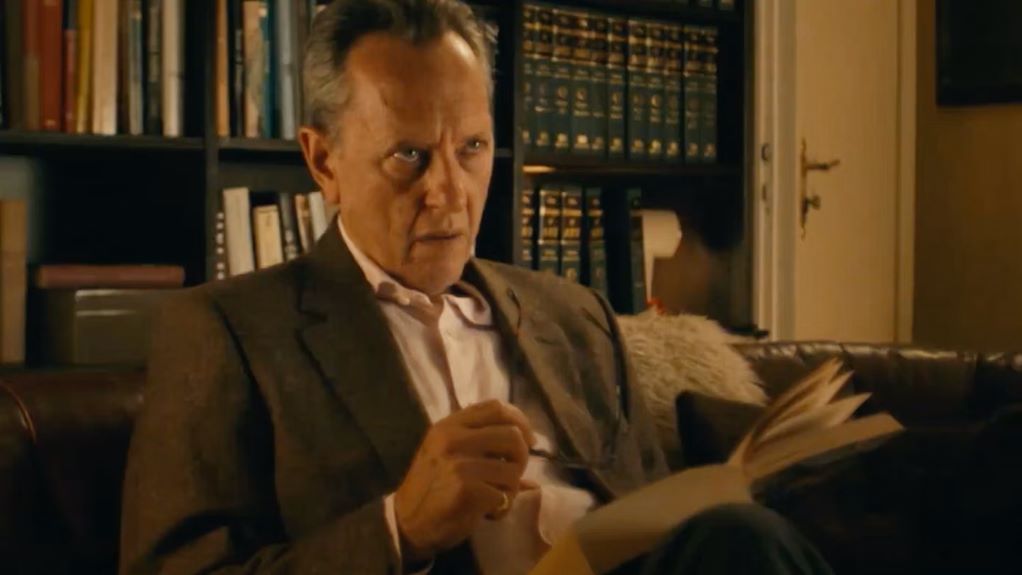
Liam Sommers (Daryl McCormack) strides onstage for an interview about his literary debut, that has set the world alight. How did he get the inspiration to write about a domineering patriarch in a rich country house? Flashback to Liam’s summer spent as an English tutor to Bertie (Stephen McMillan), who is trying to get into Oxford to impress his domineering father JM Sinclair (Richard E Grant), Britain’s leading literary novelist. The Sinclair household bubbles with suppressed grief over the accidental drowning of JM and Hélène’s (Julie Delpy) older son Archie in their private lake. As Sinclair puts the finishing touches to his new novel – and ropes in Liam to help him as “final lap amanuensis”, what secrets will Liam uncover about this family?

The Lesson revolves heavily around its oft-repeated pithy mantra from JM Sinclair – “Great writers steal”. So often is this repeated, that it drains much of what little surprise there might be about the true origins of JM Sinclair’s latest tome. It’s a fitting mantra from the film that feels like a mood piece, assembled from little touches of other filmmakers (Kubrick for starters), reassembled into something just a little too pleased with its reveals and secrets-within-secrets structure, but is well enough made that you are willing to cut it some slack.

Effectively all filmed in a single location, the Sinclair’s luscious house (a mix of the modern and the classical) set amongst rich private grounds, it’s well directed by Alice Troughton, who makes effective use of angles and transitions (particularly its cuts back and forth between the working practices of Sinclair and would-be novelist Liam, which subtly stress both their similarities and differences) to enhance mood and an air of unknowable menace. The camera drifts with a chilling intimacy across the fateful lake, giving it a sense of ominous power and mystery.

The film is at its strongest in its opening sections (like Sinclair’s novel, it is divided into three parts with short prologues and epilogues). Within a self-contained theatrical space, tensions and resentments between the family are carefully but not pointedly outlined. The father who switches between indifference, annoyance and gregarious enthusiasm. The mother who feels like both a dutiful supporter and a resentful slave. The prickly, difficult son scared of affection, who attempts (unsuccessfully) to ape his father’s authoritarianism, but is crying out to be hugged. Troughton skilfully cuts between these characters, frequently positioning them at opposing sides of the frame, setting them at visual odds with each other.

In the middle of this, Liam becomes an out-of-place, equally unreadable presence. Very well played by Daryl McCormack, full bluntness mixed with inscrutability, Liam is impossible to categorise and totally outside the upper-class formality of the Sinclair home (with its servants, home fine-dining accompanied with classical music and casually displayed artwork). He’s Irish, working-class, Black and sexually ambiguous. But he’s also hard for us to read: is his admiration for Sinclair something that could tip into resentful violence? Does he really like Bertie, or does he see him as a tedious, brattish child? As the prologue sets up, is he an innocent or a destructive, vampiric presence?

These beats are neatly set up in The Lesson’s opening parts, added to by the presence of a Pinteresque butler (a fiercely polite Crispin Letts) whose status and loyalties prove equally hard to read. Liam’s slowly becomes an intimate figure in the house, moving from a servant occasionally allowed to dine with the family, to Sinclair’s IT consultant, proof-reader and one-sided sounding-board for conversations about his novel, becoming an object of sexual fascination for Bertie and Hélène and given the late Archie’s clothes to wear (adding an Oedipal frisson to his flirtation with Hélène).

Ambiguity however slowly gives way as The Lesson continues, as it fails to weave its initial jarring mood into a reveal that feels truly satisfying, logical or surprising. This effect is magnified by the fact the more time we spend with Sinclair, the more it’s made clear he is less complex than we think, but simply an egotistical monster. Richard E Grant has huge fun with this larger-than-life braggart, a man so competitive that he feels compelled to aggressively slap down Liam’s draft novel as “airport trash” and smilingly telling him he has “done him a favour” by encouraging him not to write. But Sinclair’s monstrous, bullying self-importance sign-posts a little too clearly where the plot is heading.

The final reveal that we have been witnessing a secret plot unfold in front of us feels like a flawed attempt to add a narrative coherence to a series of events that would be impossible to pre-plan. This also relies on chance events and skills (events hinge on Liam’s near-photographic memory). The final ‘answer’ is also too clearly sign-posted from the opening, leaving you expecting a rug-pull that never comes.

The Lesson has a good sense of atmosphere in its opening half and some strong performances – Julie Delpy is very effectively unreadable as the enigmatic Hélène – but for all its sharp direction, its plot is too weak to be truly rewarding on a first viewing or give you a reason to want to return for a second lesson. Despite some good scenes, a bravura Grant and a subtle McCormack, the resolution of its quiet atmosphere of tension and inscrutability doesn’t quite ring true.

Three Colours: White (1994)

Zbigniew Zamachowski confronts the problems of revenge in Kieślowski’s Three Colours: White

Director: Krzysztof Kieślowski

Cast: Zbigniew Zamachowski (Karol Karol), Julie Delpy (Dominique Vidal), Janusz Gajos (Mikolaj), Jerzy Stuhr (Jurek), Aleksander Bardini (Lawyer), Grzegorz Warchol (Elegant man), Cezary Harasimowicz (Inspector), Jerzy Nowak (Old farmer), Jerzy Trela (Monsieur Bronek)

The second film in Kieślowski’s ambitious thematic trilogy probably couldn’t be much more different from the first. Whereas Blue was a romantic tragedy, this is a sort of bitter comedy, a kind of anti-farce if you like. Here, the themes of equality are much more about getting even rather than all men being equal. Just as Blue looked at the negativities of liberty, this looks at the dark side of equality, and the blinkered tunnel vision we follow in order to get ourselves even.

Polish hairdresser Karol Karol (Zbigniew Zamachowski) is divorced in Paris by his French wife Dominique (Julie Delpy). In quick succession, Dominique strips him of his home, access to their bank account, his passport and his share of the business, and takes another lover. Reduced to homeless penury on the streets of Paris, Karol finally finds a way to get home to Warsaw by befriending sad-sack successful businessman Mikolaj (Janusz Gajos), a fellow Pole, on the Métro. With Mikolaj’s help, Karol finds himself back home and soon in a position to start scheming his revenge.

White is, let’s be honest, a lot less of a triumph than Blue. That was a film that combined stunning visuals, directorial invention, profound depth and emotion. It was a story that looked at universal themes from a fascinating series of new angles. White,however, is more of a shaggy dog story. It feels like it’s aiming for some sort of Chaucerian fable, but it never really goes anywhere in particular, and it never really engages as much as it should while it tries to get there. While it’s not unentertaining film, it’s at best a good one rather than a great one.

My main problem is that Dominique’s character just never clicks. Why does she do the things she does? No idea. We are never given any insight into her character – she remains a cipher, bordering on a trope of the wicked beautiful seducer. Why does she jilt Karol? Surely it can’t be because of his (rather obvious) impotence ever since he arrived in France, and felt isolated in his new home? Why does she take such a delight in persecuting him, even down to audibly having sex with her lover when he calls her (“Perfect timing” she says before getting frisky)?

It’s hard not to get the sense of a film which has a slight suspicion of women. I don’t imagine that this a suspicion Kieślowski  in any way shares – sensitive and humane portrayals of women are central to his films (not least Blue) – but when the only female character in this is the distant and unknowable Dominique it’s not good. Without any sense of why she has done the things she does, it’s hard to feel comfortable with the semi-comic destruction of her Karol plans.

But then that is part of the film’s point: Karol is obsessed (without even really knowing it) with his wife. Not even so much with revenge for that matter – just getting the chance to take on his wife in a one-sided struggle makes him feel closer to her. The only possession he takes home from Paris is a bust that reminds him of his wife (and which he painstakingly repairs after it is smashed to pieces). Much as tries to build a new life, it’s a monofocus – he only gets what he gets in order to use the resources against his ex-wife. 

So equality is in Kieślowski’s design, not a good thing. Shy, sweet Karol basically ends up entrapping himself and his wife in equally frustrating positions: she in prison, he faking his own death without a penny. What was the point for Karol? No wonder he looks up at her in prison with tears rolling down his face – he’s still in love and he’s got nothing to really show for his equality, other than their joint misery.

All of this sits alongside Kieślowski’s brilliant understanding of post-Cold-war Poland, a bustling land of opportunity to make a quick buck, where simple peasant farmers can be bamboozled out of their land by smarter guys who know businesses from the West are just dying to buy up properties. Karol shares this understanding of Poland. No wonder he’s all at sea in the rest. The instant he arrives back he’s delighted, relaxed and more confident – “I’m home!” he cries joyfully, even when his first view on arriving in Poland is a mass rubbish dump. 

Moments like that show Kieślowski’s dry comedy. There are plenty of other moments, helped by Zamachowski’s pretty lovable performance of the naïve-but-growing-in-confidence Karol. Karol and Mikolaj (an excellent Janusz Gajos) put together quite an excellent double bill of bromance laced with darker themes of depression (it’s no real surprise who Mikolaj is talking about when he tells Karol that he will help him if Karol can help his “friend” who wants to die but can’t kill himself). Karol’s hapless fate in Paris raises a few smiles, as does his surreal escape stuffed in a suitcase.

But there aren’t quite enough of them. Too much of the film either doesn’t connect or hold together. I could have certainly done without Karol’s sexual prowess returning once he is confident and rich in Poland (yawn!). Dominique’s non-character remains a serious problem, and there just isn’t enough meat on the bones here. Compared to the richness of the first entry in the series, this feels remarkably empty. It’s also a lot less visually arresting and imaginatively done than the first film: I’m already struggling to remember any of the visuals.

Kieślowski may well have wanted a sort of anti-comedy to be the pivot of his trilogy, but it doesn’t really work here. He ends up with something that feels so slight and underdeveloped that it doesn’t stick with the viewer, and doesn’t engage them either. While it has moments, as you would expect from a great director, and some very good actors, it doesn’t have nearly enough of them.

Three Colours: Blue (1993)

Juliette Binoche seeks liberty from grief in Krzysztof Kieślowski’s masterpiece Three Colours: Blue

Director: Krzysztof Kieślowski

Cast: Juliette Binoche (Julie de Courcy/Vignon), Benoît Régent (Olivier Benôit), Emmanuelle Riva (Madame Vignon), Florence Pernel (Sandrine), Guillaume de Tonquédec (Serge), Charlotte Véry (Lucille), Yann Trégouët (Antoine), Hélène Vincent (La journaliste), Zbigniew Zamachowski (Karol Karol), Julie Delpy (Dominique)

There are few foreign language films that have cemented themselves in film’s cultural history more than Kieślowski’s Three Colours Trilogy. These three inter-linked films – made with French and Polish money – looked (individually) at themes of Liberty, Equality and Fraternity, while using a colour palate and design that reflected one colour of the French flag each. The first film in this interlinking trilogy is Blue, a sombre, intriguing, intimate drama that perhaps wears its intelligence a little heavily on its sleeve.

Julie de Courcy (Juliette Binoche) is the only survivor of a car crash that kills her husband, a famous composer, and her daughter. Lost in grief, Julie decides that she will separate herself from the world and live entirely independently. She rents out her home, distances herself from friends, takes back her maiden name and destroys what she believes to be the only copy of her husband’s final composition – a concert for the unification of Europe. But Julie finds that liberating herself from all worldly connections is not as easy as she hoped.

Blue is a heartfelt, gentle film that throbs with emotional intensity, much of it coming from Binoche’s searing performance of a woman consumed with a mixture of grief and survivor guilt, who sees complete isolation and “liberty” from all connections as the only chance for sanity. Kieślowski’s direction is masterful – patient, stable, quiet and with a brilliant eye for small details. The film is crammed with small moments that speak of peace and quiet reflection – from watching a lump of sugar being soaked in tea, to lingering studies of everything from rooms to streets. 

The opening sequences of the film convey this masterful confidence from Kieślowski. The camera is a still observer, alternating between subtle POV shots and gentle, perfectly placed observation of Julie. Every moment of the shocking discovery of Julie’s loss is wonderfully assembled – from the stumbling news from the doctor, to the crackling mini-TV on which she watches her family’s funeral being broadcast. Quietly we see Julie return to her own home – and Binoche bottles up emotion with a resolve that suggests as much her determination not to engage with the pain as it does self-control. No wonder her housekeeper bursts into tears at the fact that Julie isn’t crying.

This all ties in very interestingly with the film’s theme of liberty. Conventionally, we would have had Julie escaping from something to find her own life. Kieślowski’s film more interestingly explores the positive and negative of liberty. Julie chooses freedom from all of life’s connections – but this is shown constantly to be not only impossible, but also less than healthy. Her surface liberty is instead crushing her under the pressure of isolation.

At the same time, the film is partly about Julie learning to free herself from her survivor guilt. Cutting herself off from the world denies her a genuine emotional connection with her husband’s friend Olivier (a puppy doggish Benoît Régent). In the first months of her guilt she sleeps with Olivier, hoping it will get her a bit of peace (it doesn’t). Inevitably, as Julie finds out more about her husband’s life – and as we find out that his music output was heavily reliant on Julie’s secret collaboration – the film becomes a question of whether Julie will allow herself the liberty from her past to continue living.

Because in a way this is an anti-tragedy: it starts with a trauma and is about the survivor learning to continue her life. Kieślowski peppers the film with moments of falling, from items to bungee jumpers on the TV. Slowly, these images of falling progress to include being caught, or shots of the bungee cords snapping the person back from oblivion. It’s a neat, subtle continual reference to Julie’s unconscious search for support.

Particularly as it’s made clear that Julie’s entire personality is all about giving, about loving and supporting people. From her silent collaboration with her husband, to her patient caring for her mother suffering from increasing dementia (another perverse form of liberty), to her forming a reluctant friendship with an exotic dancer in her block of flats (who the rest of the tenants are trying to drive out), it’s clear that Julie’s attempt to distance herself is never going to truly work. A character late on even tells her that her husband had always described her as kind and forgiving – qualities Julie learns to re-embrace. 

The wider world that Julie is trying to escape is represented brilliantly throughout by the score of her husband’s (her?) music for Europe. This score – a richly exuberant piece of music by Zbigniew Priesner – constantly intrudes into the action, accompanied by moments where Kieślowski seems to suggest time has stopped as Julie becomes lost in her reflections. Kieślowski uses colour changes and slow zooms to suggest throughout these beats where Julie temporarily becomes lost in the past and memories. The continual presence of the music is perfectly done.

The one element I was less keen on was the over use of blue. From filters on the camera, to backlighting, to objects present in every frame, there is a lot of blue in this movie – every shot has something blue in it. Although this is clever, and clearly thematically intentional for the whole trilogy – I’ve got to be honest spotting this stuff probably took me out of the film at moments. I imagine on a second viewing this will be dramatically reduced – but it’s one of those curses of a trilogy of films that have been so hyped up on the arts circuit, that you are aware of some of its subtle tricks so much that they cease to be subtle.

But Three Colours: Blue is still a masterful, quiet study of grief, loss and yearning, that avoids the obvious and explores different types of liberty and freedom. Binoche is brilliant in the lead role, and Kieślowski sears the brains with images (I still wince remembering a sequence where Julie deliberately scrapes her knuckles over a wall she walks past) and his direction is impeccably sensitive and unshowy, letting the film speak for itself. I can’t wait to watch the other two films in the trilogy – and see how this might affect my views on this first one.