Tag: June Lockhart

Sergeant York (1941)

Sergeant York (1941)

Patriotic flag-waver with a great performance from Cooper and plenty of genuine heart

Director: Howard Hawks

Cast: Gary Cooper (Alvin C. York), Walter Brennan (Pastor Rosier Pile), Joan Leslie (Gracie Williams), George Tobias (“Pusher” Ross), Stanley Ridges (Major Buxton), Margaret Wycherly (Mother York), Ward Bond (Ike Botkin), Noah Beery Jr. (Buck Lipscomb), June Lockhart (Rosie York), Dickie Moore (George York), Clem Bevans (Zeke), Howard Da Silva (Lem), Charles Trowbridge (Cordell Hull)

In 1941, after Japanese bombs landed on Pearl Harbor, America needed patriotic big-screen heroes. Few stood out more than Alvin York. A young man (over ten years younger than Gary Cooper) who had lived a youth of drunken rough-and-tumble before he found the light. When America joined the First World War, the 30-year-old York was called up. A gifted sharp-shooter, York was perfect for soldiering – but had to wrestle with his conviction to stick to the Commandments from the Good Book. Finding a solution to his moral quandary, York fought in France where his sharp-shooting instincts saw him almost single handedly capture a German machine gun embankment and 132 Germans (it’s an achievement that sounds pure Hollywood, but is in fact entirely true).

It’s an inspiring hero story that Warner Brothers bought to the screen at the perfect time, it’s release seeing tales of streams of young men walking from the cinema straight to the enlistment office. Producer Jesse L Lasky spent no less than twenty-two years attempting to persuade the notoriously publicity-shy and modest York (just as in the film, the real York couldn’t wait to leave the glitz and glamour of his triumphant homecoming behind and return to his fiancé, farm and work with the Church) to grant him the film rights to his life. York agreed only with the advance of Hitler, a hefty payment to his Church and a promise that no-less than Gary Cooper would play.

Cooper was reluctant – pointing out he was far too old to play this national hero – but really no other actor could have done it. Cooper won his first Oscar for the role, and it’s his understated sincerity and decency that really sells the film. He turns what could otherwise by a potentially cloyingly perfect man into someone utterly sympathetic and endearing. There is an aw shucks quality to Cooper, as he captures York’s modesty, his shrugging off his accomplishments as no more than his duty, his palpable discomfort with attention (be it from congressmen or his fellow Tennessee farmers commending his shooting) and a deep-rooted genuineness in his love for his beau Gracie (Joan Leslie giving a commendable performance of endearing brightness that helps you overlook she was 24 years younger than Cooper – thankfully she doesn’t look it).

Cooper’s performance powers a sprightly, very enjoyable film by Howard Hawks (who picked up his only Oscar nomination for this) that manages to transcend the danger of being an overbearing flag-waver. (Don’t get me wrong though – this film waves the flag so much, you can practically feel the strain in its arms). Hawks produces a film that in many ways owes as much to The Adventures of Robin Hood as an heroic All Quiet on the Western Front. Despite the patriotic focus being the final few Acts, as York carries out his act of astonishing heroism, the film’s real heart is in the opening half and the conversion of a man who is never-too-naughty into one who casts aside the demon drink, works hard to earn what he has, and puts his faith and the good of others before his own concerns.

Hawks shoots this part of the film with a palpable energy and a rough-and-tumble sense of humour. It’s there from the film’s opening as Walter Brennan (in a role he invests with all his wheezy, twinkly dignity) finds his sermon constantly interrupted by the gunplay of the drunken York and his buddies. There is a light humour when Margaret Wycherly – a little too ethereal for my taste as York’s saintly mum (although her casting does make York and White Heat’s Cody Jarrett siblings) – archly observes that, even when drunk, her son’s accuracy with a shooter is second to none. That’s the skill of Sergeant York there: in it’s end is it’s beginning, York is already deeply skilled and as his slightly embarrassed reaction shows when he sobers up, reformation is not a long journey.
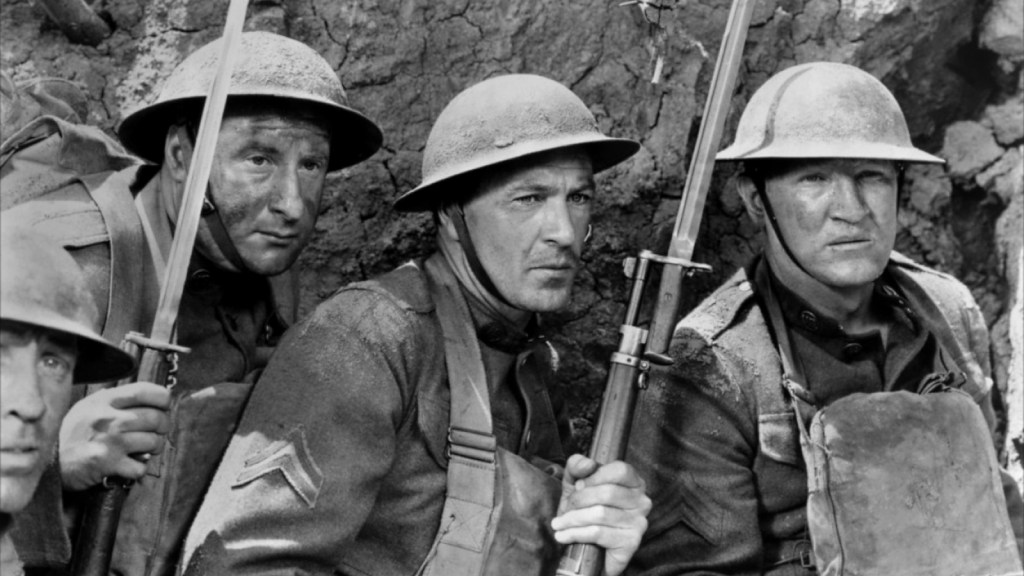
A large part of the success is making York one of us. Striving to save the money he needs to buy the farmland of his dreams, Hawks provides a sweet montage of York undertaking no end of backbreaking, thankless work and returning home to tick off his slowly accumulating dollars under the smiling approval of Ma. When, after all his work, he finds the land has nevertheless been sold (because the owner never believed this previously idle lush could hold on to his hard-earned pennies), his outrage at the breaking of another man’s word is a clarion call to all of us who have played by the rules and been shafted. When his conversion comes, it’s not as out-of-the-blue as it could seem, but a logical conclusion for a journey we’ve watched him go on.

It’s undercut with scenes that drip with Hawksian skill. A marksmanship competition is crammed with a playful Robin Hoodesque skill. A bar-fight that the drunken York gets wrapped up in is so full of comedic tumbles and prat falls it’s hilarious. York’s constantly being fetched for various tasks by his kid brother is expertly played for subtle laughs. Alongside this, the romance between York and Gracie (and the off-screen slapping he hands out to a rival who treats her with disrespect) is beautifully handled.

The only real Hawksian touch missing is that little slice of cynicism, that ability to look under the skin of a legend (like with Wayne in Red River) and see a more flawed person. York basically is perfect, and in a film dripping with patriotism there can’t be any fault with either the army or the moral question of whether gunning down your fellow humans is alright in the service of your country. There is a version of Sergeant York where his commanding officer’s invitation that he take some time and read his way through the history of America (a replacement good book) was an act of naked manipulation of a guileless man. Or where we see the sort of guilt at his taking of life that the real York felt, play out across Cooper’s face. There’s none of that here.

In fact, after the vibrant, playful, heartfelt first few acts, you feel Hawks felt less interested in the war itself. There is a functionality about the final acts of Sergeant York as York aces his shooting tests on the range (although the flabbergasted reaction of his training officer and York’s apologetic manner at his failure to only manage five dead-on bulls-eyes on his first time using an army-issue rifle are funny). Hawks spices it up with York’s turkey-shoot metaphor, and a warm supporting turn from George Tobias (as a New Yorker soldier) and York’s gobble-gobbles to distract his German opponents. But, for all the realism of the trenches, there is an air of duty about this sequence.

But then Sergeant York works not because of the deed, but the man. And the film’s success in investing us in a man who could very easily have been all-too-perfect, in a playful and energetic first half works wonders. With a very fine, perfectly judged performance by Gary Cooper, this may not be Hawks most characterful work – but as the sort of film to showcase a man who inspires you to achieve acts of heroism, it hits the target perfectly.

Meet Me in St Louis (1944)

Meet Me in St Louis (1944)

Technicolour musical delight in this unashamedly nostalgic and feel-good Minnelli musicial

Director: Vincente Minnelli

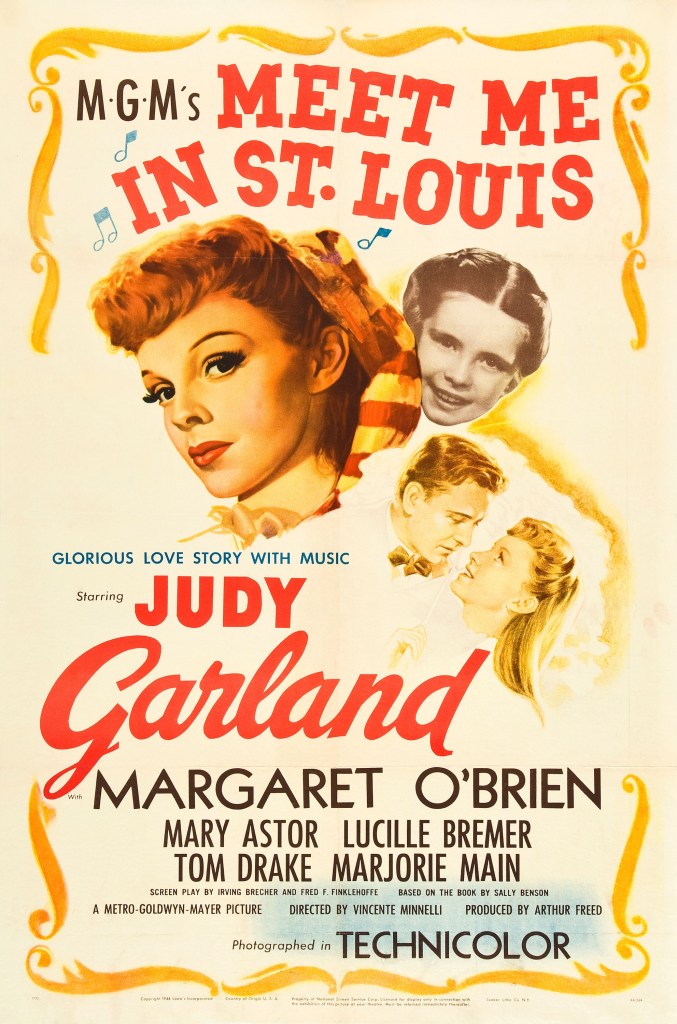
Cast: Judy Garland (Esther Smith), Margaret O’Brien (“Tootie” Smith), Mary Astor (Mrs Anna Smith), Lucille Bremer (Rose Smith), Leon Ames (Mr Alonzo Smith), Tom Drake (John Truett), Marjorie Main (Katie), Harry Davenport (Grandpa), June Lockhart (Lucille Ballard), Henry H Daniels Jnr (Lon Smith Jnr), Joan Carroll (Agnes Smith), Hugh Marlowe (Colonel Darly), Robert Sully (Warren Sheffield), Chil Wills (Mr Neely)

“There’s no place like home” is the message lying behind two of Judy Garland’s most iconic films. While it might be at the heart of Wizard of Oz, that longing may be even stronger in Meet Me in St Louis. From the Arthur Freed production stable, this technicolour delight is relentlessly gentle and optimistic. It went down a delight in a year when so many Americans dreamed of the end of a war that had separated families and kept soldiers from their home and remains a delightful paean to a lost America (that perhaps never even was).

Set, of course, in St Louis in 1904 during the build-up to the World’s Fair (the gleam of the electric lights turning at the exhibition are the film’s final shot), Meet Me in St Louis follows the lives and loves of the Smith family. Patriarch Alonzo Smith (Leon Ames) is a lawyer (or something, the film doesn’t trouble itself too much), his wife Anna (Mary Astor) a devoted home maker. They have four daughters: Rose (Lucille Bremer) hopes for a proposal from Warren Sheffield (Robert Sully), youngest children Agnes (Joan Carroll) and especially “Tootie” (Margaret O’Brien) are perpetually in trouble and Esther (Judy Garland) is just starting to make eyes at next door neighbour John Truett (Tom Drake). But their contented life could all turn upside down when father announces they will be moving to New York. Surely, they can’t leave St Louis behind?

In many ways Meet Me in St Louis is an inverse The Magnificent Ambersons. While Welles’ film brilliantly charted the decline of a family of wealthy snobs (the Ambersons would certainly recognise the Smiths as equals) with technology an intruder, upending everything they understand about the world, Meet Me in St Louis is a gloriously entertaining celebration of nostalgia with new technology either a source of jokes (scrambled long-distance calls, jolly cable-car songs) or wonder (that closing light-show). Both have stylistic comparisons: from their use of title cards to their fluid camera showcasing sumptuous sets and costumes. But only one of them is about cheering you up.

Meet Me in St Louis only barely has a plot, so concentrated is it on charm and whimsy (father’s announcement, which introduces the real drama, arrives over half-way through). Adapted from a series of short stories by Sally Benson, it’s an episodic film built around events – parties, cable-car rides, a Halloween adventure and a Christmas Eve ball – with a few threaded plotlines of flirtation, principally between Esther and John. Freed sprinkles in a series of songs from his collected rights holdings (including the title song) with a few additional tunes from writers Hugh Martin and Ralph Blane, the most notable being The Trolley Song (a ludicrously catchy-number you can’t get out of your head) and the iconic Have Yourself a Merry Little Christmas (although their original far more depressing lyrics were hurriedly re-written).

These last two are performed with astonishing bravura by Judy Garland in possibly her finest hour (until A Star is Born). Garland’s singing is almost effortlessly graceful and beautiful, and she matches it with a very warm, feisty and engaging performance. Esther lands perfectly between two stools: she can be rebellious, impatient and judgemental but also caring, sensible and forgiving. Garland is reassuringly collected, funny and luminous through-out – so much so it’s striking to read what a nightmare the shoot was, with the star frequently absent as she succumbed to the mental and physical ailments that would plague the rest of her life.

Part of the success of her performance was the closeness that developed between her and Minnelli – the first director to really treat her as an adult and collaborator (they started an affair during the film). Minnelli, in only his third film and first in colour, directs with the assurance and visual beauty of an accomplished pro. Meet Me in St Louis was his first Freed musical and it might just be his best. The sumptuousness of the visuals and design were to a large part due to him – you can see the influence this had on the later work of Visconti among others, particularly the ballroom scene – and Minnelli worked labouriously with the actors to build a sense of family between them.

This pays off in spades throughout the film, where the close chemistry between the actors only helps create a nostalgic glow for happy days gone by. Ames and Astor have a relaxed ease of a long-married couples, while the four sisters interact with each other with an easy, unstudied naturalness – sharing chairs, food from their plates and time together with an unfussy ease. In particular Minnelli helped guide Margaret O’Brien to the one of the most delightful child performances on screen: the Halloween sequence, where “Tootie” confronts a scary neighbour is a masterclass of childish excitement and fear, matched later by O’Brien’s affecting distraught tears at the prospect of leaving St Louis.

Minnelli shoots the film with a technical confidence and imagination that quickly makes you forget it’s simple plot. That Halloween sequence is an eerie wonder, shot with a low-angled, tracking shot unease that leaves a haunting impression. He and cinematographer George J Folsey deigned a gorgeous gaslight dimming sequence as Esther and John go through her house dimming the lights, the camera moving in a single, complex, take up-and-around them while Folsey adjusts the set light in sync. Later there is a brilliant shot that seems to pass through a window to lead us straight into the ball, which seems years ahead of its time in its technical accomplishment. The ‘Trolley Song’s sequence uses framing and costumes perfectly to turn a cable car into something that feels as large as a small theatre. It’s an exceptionally well-made film.

You could argue certainly that it is a conservative and unchallenging film. It’s a celebration of small-time life, an argument for staying where you are and embracing the status quo. It never crosses its mind to consider that it’s a lot easier to do that if you have a huge house and servants. Not a moment of anger or serious disagreement is allowed to enter the picture. Everyone is unendingly nice all the time. But does that matter? Sometimes you need a film like a warm hug. And, when you do, don’t you want it also to be a masterclass in filmmaking with a star like Garland at the top of her game? Of course you do.

All This and Heaven Too (1940)

All This and Heaven Too (1940)

Illicit romance, murder, scandal… it should all be so much more exciting than this film makes it

Director: Anatole Litvak

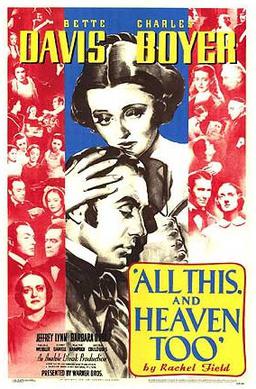
Cast: Bette Davis (Henriette Deluzy-Desportes), Charles Boyer (Duke Charles de-Praslin), Barbara O’Neil (Fanny Sebastiani de-Praslin), June Lockhart (Isabelle de Choiseul-Praslin), Virginia Weidler (Louise de Choiseul-Praslin), Jeffrey Lynn (Reverend Henry Martin Field), George Coulouris (Charpentier, Harry Davenport (Pierre), Montagu Love (Army General Horace Sebastiani), Helen Westley (Mme LeMarie), Henry Daniell (Broussais)

In the 1840s, Henriette (Bette Davis) arrives as governess at the home of the Count de-Praslin (Charles Boyer). She’s calm, collected, patient and caring: in short she’s everything that the count’s wife Fanny (Barbara O’Neil) is not, and it doesn’t take the count long to work it out. With Henriette swiftly becoming a second mother to his four children, the count and Henriette find themselves falling, unspokenly, in love. But Fanny isn’t fooled – and neither is the gutter press – and as scandal brews, the count takes drastic action to stop his wife, leading to a legal case that will shock France.

All This, and Heaven Too was conceived as a sweeping romance to rival Gone with the Wind. Money was lavishly splashed on sets and costumes (Bette Davis has no fewer than 37 costumes in the film, averaging at one every five minutes). Based on a famous murder case – that some felt had contributed towards the anti-monarchy atmosphere that led to the revolution of 1848 – All This, and Heaven Too had everything on paper to challenge Gone with the Wind in romance stakes. So why doesn’t it?

There is something too restrained, too slow and controlled about the film. It’s overlong – the original cut was over three hours, reduced to 2 hours 20 minutes – and takes a very long time to get going. The two stars underplay very effectively – with Davis cast very successfully against type as a mousey, rather timid Jane Eyre-ish figure – but it also means that the sort of grand romance the film is aiming for never quite takes fire, for all the careful shots of burning flames between the two lovers as they discuss their romantic predicaments in roundabout terms.

Litvak’s film saddles itself with a framing device that, while accurate to the real-life story, adds very little. The film opens with Henriette teaching children in America – children who have no respect for her, having heard whispers of her scandalous past – which leads into her telling the story to them (and us) about her past. The film returns to this framing device at the end, but as a whole it provides very little insight or interest to the core thrust of the film’s action. The film also wastes time on Jeffrey Lynn’s Reverend (Heinrette’s future husband), a relationship that seems largely in there to absolve Henriette of any possible indirect responsibility for the murder (she can’t be a hussy, she marries a man of the cloth!).

A large chunk of the film is designed to minimise what was a major scandal that rocked French society. This was a (possible) sexual affair between an unhappily married aristocrat and the governess to his children. It culminated in the countess being stabbed and beaten to death and her blood-stained husband found on the scene, claiming he had fought and chased away an intruder (which, writing it down, is basically the plot of The Fugitive). He never confessed, but committed suicide via arsenic in prison a few months later. Henriette was arrested as an accessory (presumably for encouraging the count to kill his wife) but released.

This should have been racy, racy stuff – but the film shies away from it. It’s probably linked to the expectation that the Hays Code would never accept the idea of Henriette as an adulteress who never goes unpunished. The possible Therese Raquin style set-up is instead translated into a more Jane Eyre model, with the employer in love but the servant too noble to act on her feelings and expose herself to disgrace. The film does pull no punches in making clear that the count committed the crime (the camera zooming in on Boyer’s starring eyes as he advances on his pleading wife) but since he was always destined to meet a historical punishment (he helpfully absolves Henriette on his deathbed) there were no concerns there.

All This, and Heaven Too can’t have a passionate, lusty drama so it avoids any overt spark between Boyer and Davis. Both actors play this unspoken attraction extremely well, but the film has to work overtime to get drama out of their several scenes of standing carefully apart or side-by-side, talking about everything except their own feelings. Boyer, as ever, is first class: his expressive eyes and beautiful ability to listen and react is as perfect for an unspoken romance, as it is for a man who becomes convinced murder is his only escape. Davis’ meeker, Joan Fontainesque role suits her extremely well, even if it disappoints those expecting fireworks.

Those fireworks come from Barbara O’Neil instead, raving and unreasonable as a woman driven to the edge by this semi-imagined affair, in an energetic performance that gained one of the film’s three Oscar nominations. But the film’s strange momentum affects her too: she is left to repeatedly hit the same notes over again, as the film repeats its established set-up over and over for 90 minutes before she is murdered (then squashes everything connected to the historical scandal and the murder trial into the final 40 minutes).

It’s productions standards are high and it’s well shot by Gone with the Wind cameraman Ernest Haller. There is some beautiful use of shadows and several ball scenes are expanded with some gorgeous use of mirrors. It ticks many of the boxes you expect a period romance to have, but is fatally hampered by its caution and by its restrictive narrative choices. It ends up feeling long and drifts too often through its build-up, forcing it to rush its pay-off. All of this contributes to its lack of challenge to GWTW in the romance stakes.