Tag: Jürgen Prochnow

A Dry White Season (1989)

A Dry White Season (1989)

A passionate, clear-eyed and largely unsentimental denunciation of Apartheid, the best of its kind

Director: Euzhan Palcy

Cast: Donald Sutherland (Ben du Toit), Janet Suzman (Susan du Toit), Zakes Mokae (Stanley), Jürgen Prochnow (Captain Stolz), Susan Sarandon (Melanie Bruwer), Marlon Brando (McKenzie), Winston Ntshona (Gordon), Thoko Ntshinga (Emily), Leonard Maguire (Professor Bruwer), Gerard Thoolen (Colonel Viljoen), Susannah Harker (Suzette de Toit), Andrew Whaley (Chris du Toit), John Kani (Julius), Richard Wilson (Cloete), Michael Gambon (Magistrate), Ronald Pickup (Louw)

The late 1980s saw a small wave of films denouncing the horrors of Apartheid in South Africa, a racist system founded on cruelty and injustice. Many of these films struggled with either being overly earnest or turning their (inevitably) white lead character into a saviour figure. A Dry White Season is perhaps the best of trend, perhaps because it focuses on a fictional story rather than real history (instantly gaining it the sort of dramatic latitude drained out of Cry Freedom) and directed by Euzhan Palcy, the first Black woman (then aged only 32) hired by a major studio, with a cast of the cream of Black South African actors, who knew all too well this world. A Dry White Season is also notable for its critical view of white South Africans who, bar a few exceptions, are presented as tribalist blind-eye-turners, furious at anyone who shakes their world view.

Ben du Toit (Donald Sutherland) is the epitome of smugly complacent Afrikaner (Sutherland even has a plump false belly, to hammer home his cosy self-satisfaction). A former rugby star, teaching white history in a private school, to him the system is always fair and if a Black man is arrested he must have done something wrong. That’s shaken when school gardener Gordon (Winston Ntshona) asks him for help, first after his barely-a-teenager son is beaten by police then again when the same son dies in custody after a protest. Ben’s first reaction is to shrug and say nothing can be done: the scales fall from his eyes when Gordon asks the wrong questions and is in turn murdered in custody by brutal Captain Stolz (Jürgen Prochnow). Working with campaigner Stanley (Zakes Mokae), Ben finds his entire world view falling apart as he is compelled to uncover the truth – to the fury of his wife, daughter, in-laws and colleagues who increasingly see him as a traitorous boat-rocker.

A Dry White Season doesn’t shirk on the violence of Apartheid. It says a lot that an early truncheon-wielding police assault on a township, and the scarred backside of Gordon’s son soon feels everyday. The student protest – many of its attendees literally no more than children – is met with lethal force from white soldiers carrying machine guns, indiscriminately shooting down children at point-blank range. Gordon is waterboarded and brutally tortured. Anyone who crosses the security forces faces violent assassination or fatal beatings. Palcy unflinchingly shows this horror – and frequently cuts away from atrocities to shots of the du Toit’s enjoying their wealthy, contented life of sports and garden parties. The impression is clear: underneath this contented life for the whites is a brutal, violent, repressive system supressing all rights for the many.

Palcy brings the sort of perspective perhaps only a Black film-maker could. There is no attempt in A Dry White Season to shelter the audience. Instead, we are exposed to the worst the system has to offer. Palcy adds impact with her casting of several extraordinary South African actors. Ntshona, Mokes and Kani among others had all experienced this themselves (Kani lost an eye in a police beating). Their performances are superb. Ntshona’s simple, honest bravery is deeply moving while Ntshinga is heart-breaking as his wife. Kani drips moral authority as a solicitor. Best of all Mokae’s activist Stanley is a superb portrait of warm, world-weary wit barely covering a life of fury.

What’s really refreshing is we expect the white characters to feel shame or guilt as the truth edges into their lives. This doesn’t occur: in fact, bar Sutherland’s du Toit and his young son (the same age as Gordon’s child – the film opens with the two of them playing together) all the white characters furiously protect the system. Sides are firmly picked and no blurring of the lines is tolerated. His daughter (Susannah Harker at her most Aryan looking) just wants him to shut up and stop spoiling things. Richard Wilson’s avuncular headmaster can’t hide his anger at du Toit’s ‘treason’. The police’s deference evaporates the second du Toit asks the wrong questions about the wrong people.

Even du Toit’s wife – memorably played with a raw harshness by Janet Suzman – progresses through irritation, horror to outright disgust at du Toit. Suzman – a South African who fled the country and long campaigned against Apartheid – pours all her anger into a show-stoppingly racist speech where she claims Black people are dangerous and don’t deserve any rights, that the Afrikan’s own South Africa and any violence against Black people doesn’t matter so long as the whites continue to live well. She represents a system supporting a boot stamping on Black faces for the rest of time.

It takes time for du Toit to realise there is no justice. Even after Gordon is murdered, he is convinced a trial will reveal the truth. He is of course, fantastically wrong – the trial being rigged from the start to produce a ludicrous suicide verdict. The trial is conducted by human rights lawyer McKenzie, played in a show-stopping cameo by Marlon Brando. Coming out of retirement to support the project (and working at union rate), Brando flexes his muscles one last time to deliver a charismatic, witty turn as a shambling Rumpole-like barrister who knows from the start his only result will be making the powers-that-be faintly embarrassed at their blatant injustice. If Brando’s support didn’t extend to learning his lines – he’s blatantly reading them from off cue cards or having them funnelled to him through a visible ear-piece – he’s still a stand-out in a sequence that makes abundantly clear just how complicit the whole system is in murder.

Sutherland – a fine performance of stunned, sad-eyed bemusement – makes du Toit a well-meaning men who realises he can never go back to his old life after peaking behind the curtain. It’s a nice touch in A Dry White Season that he never becomes a conventional white saviour: most of his actions lead to disaster, he’s reliant on Mokes’ Stanley and (other than his son) he fails to persuade anyone. But what chance does he have? Placy even shows many Black people have given up. At least one of Gordon’s torturers is a Black police officer and Gordon’s son and his friends open the film berating Black workers in a boozer that their apathy only props up the system. After Gordon’s death, a Black priest counsels turning the other cheek. But then the courage needed to protest is immense: Stanley smilingly states he long-ago accepted he was a dead man and it’s that which keeps him going.

A Dry White Season ends with a touch too much melodrama and a slightly too ‘Hollywood’ ending – but then it’s so relentlessly depressing that even a small victory is a relief. But, in the main, while sometimes rough and ready, it actually presents an important message with real dramatic force, stuffed with fine performances and a brutally realistic view of South Africa. It does give us some hope for the future: the only other white persuaded is du Toit’s young son: and it’s the young who are only hope for long-term change.
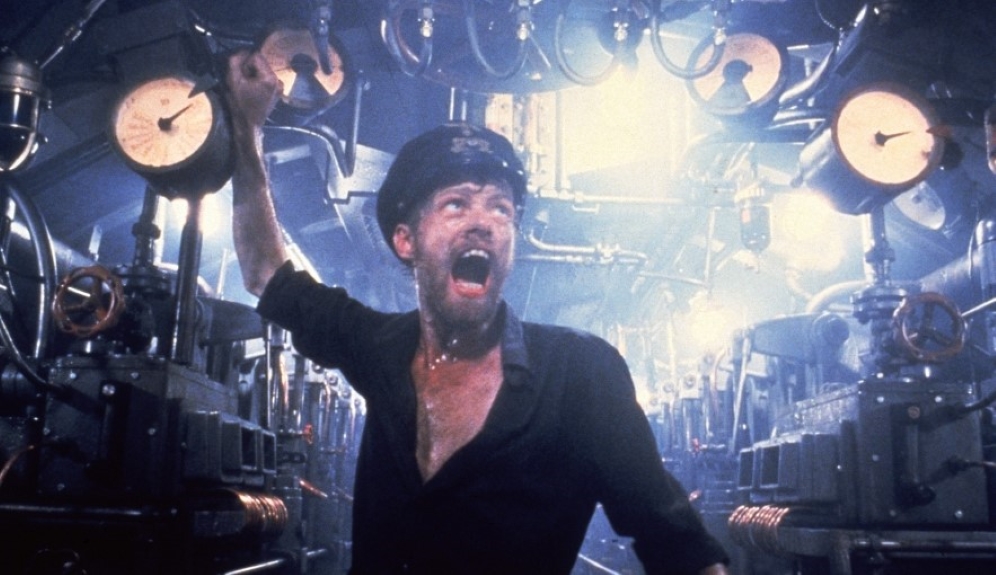
Das Boot (1982)

Das Boot (1982)

Perhaps the definitive submarine film, a terrifying masterpiece of claustrophobia and suspense

Director: Wolfgang Petersen

Cast: Jürgen Prochnow (Kapitänleutnant), Herbert Grönemeyer (Leutnant Werner), Klaus Wennemann (Chief engineer), Hubertus Bengsch (First watch officer), Martin Semmelrogge (Second watch officer), Bernd Tauber (Chief HelmsmanKriechbaum), Erwin Leder (Chief Mechanic Johann), Martin May (Ullmann), Heinz Hoenig (Hinrich), Uwe Ochsenknecht (Boatswain Lamprecht), Claude-Oliver Rudolph (Ario), Jan Fedder (Pilgrim), Ralf Richter (Frenssen)

In the annals of submarine movies, few have taken such a hold of the imagination than Das Boot. This is particularly remarkable since it follows the struggles not of Allied sailors but members of the German Kriegsmarine, the U-Boats who patrolled the Atlantic to sink as many merchant ships as they could, all in the service of aiding the Nazi war effort. But the sea knows no flags and holds no allegiances: to the watery deep, men are just men, and a small, rusty metal box is fragile at 280 metres no matter who sails in it. And the men sailing U-96 are just ordinary, regular men, with wives, girlfriends and regrets back home who above all just want to survive to see them again.

Wolfgang Petersen’s is a masterclass in immersing us in a claustrophobic world. The crew of U-96­ are led by the captain (Jürgen Prochnow), a hardened, cynical veteran is out here to do a job, not fight for radical cause he has little time for. Instead, his concern is to preserve the lives of his men, all younger (in most cases almost twenty years so) than him, during their time at sea where days (and even weeks) of bored inaction are interspersed with interludes of sheer terror as the submarine desperately runs from depth charges and dodges Allied destroyers.

Das Boot was filmed over almost a year, in chronological order. The actors practically lived in their confined set (deafened by the sound of its mechanics), their hair growing out to match their characters and their skin taking on a pallor from not enough time in the sun. For hours at a time we never leave the confines of the submarine – if you don’t count the odd trip to the ship’s bridge, where those lucky enough to venture up-top are lashed with salty sea water from near constant Atlantic storms. Aside from that, they are in what is effectively a 60m metal corridor, a specially designed camera operated by cinematographer Jost Vacano, tracking swiftly behind the frenetic pace of the sailors as they dive through hatches and pound along dripping quarters.

It’s a film where you cannot escape the tight confines of this boat, the sound track filled with groans and shudders as the boat cracks under the weight of water or buckles from high-pressure depth charges. When under attack, bolts burst out of pipes like machine gun bullets and water (which is obviously freezing) gushes through opened valves. It mixes with the sweat in the characters tension-filled faces. There is no comfort and no privacy under the water, bunks positioned on the edges of the ship’s corridor. The only food is whatever was taken aboard last time the ship was at shore – and if that means cutting layers of green mould off weeks-old bread, so be it.

Petersen’s capturing of this sense of a tiny, pressure-filled world is superb and he succeeds masterfully in getting the audience to feel the character’ stress and fear. When the film opened in America, crowds cheered an opening caption which details the losses the Kriegsmarine suffered during the war: at the end, the same audiences were reported stunned into sympathetic silence. None of these men are detestable Nazis. One man writes never-ending letters to his French fiancée. Another is a devout Christian. The Chief Engineer clasps tight photos of a skiing holiday with the wife he has not seen in months. Another is frustrated at radio reports of his football team losing a key match. All of them are haggard, unshaven and scruffy. None of them feel safe for a moment.

Only the first watch officer utters anything approaching true believe in the Nazi regime (he is also the only man to try and maintain some semblance of military smartness – at an encounter with a German merchant ship, he is inevitably mistaken for the captain). But his belief comes from naïve optimism: he has no wider idea of the world around him and his statements of trust in the regime noticeably dry up over time. For the rest: who has the time for ideology when you could be crushed by a mountain of water at any time? Captain Thomson (Otto Sander) opens the film by making a drunken speech at the launch of U-96, lambasting Hitler – a speech that is met with shocked silence because its being said rather than because of the content.

The sea also builds subconscious bonds for those who share its dangers, even with enemies. After returning later at night to the scene of a sinking ship (their only successful operation throughout the whole film), the Captain and his officers are horrified to find the Allied ship has not had its crew evacuated – a fact they notice too late, having already sent two more torpedoes into the water to finish the ship off. Haunted, the Captain orders U-96 to back off: after all, he knows (as we do) it will be impossible to take any survivors aboard his tiny boat. Even this successful mission is tinged with horror: the rest of their encounters mostly feature desperate attempts to dodge British destroyers.

It’s relentless. Life under water is dull, but inescapable but could be broken at any moment by life-threatening terror, perhaps hours of shaking and leaking under depth charges explode around them. Even the most experienced can crack – Johann, the ship’s chief mechanic, at one-point breaking under the pressure, his wide-eyes desperately searching for some escape as he ignores orders. War correspondent Lt Werner (Herbert Grönemeyer) goes through the same experiences we do: his assumptions about brave soldiers and ice-cold professionals, breaking down as he and we realise these are ordinary people just trying to stay alive.

Their lives are the principle concern of the Captain, superbly played by a stoic Jürgen Prochnow, as a man who keeps his emotions on a tight leash because letting them slip may see them never getting under his control again. The Captain is a default father to his men, concerned above all with preserving their lives, over and above the war he is bitter and cynical about. Now of course, you can argue Petersen is stacking the deck by presenting a German crew with not a (determined) advocate for Nazism among them: but so superbly does the film bring-to-life the pressures, risks and terror of U-96, you fail to be surprised that they would come to focus overwhelmingly on their own survival rather than the gnomic ideology of the murderous dictator who started the whole thing.

By the time the film has send U-96 to the near bottom of the ocean, forcing the crew to battle against the odds to restore power and save it from sinking (it’s the golden rule of all submarine films, that the recommended depth should be exceeded and for the ship to sink like a stone), you will be rooting for these pressured-but-capable professionals to save themselves. The overall feeling you take from Das Boot is the futile, pointlessness of it all: months at sea almost for nothing, acts of extreme bravery rendered moot by flashes of ill luck and chance, the utter lack of having any to show for it when the boat returns to port. Das Boot understands the futile horror, the grim pressure and punishing impact of war, placing people into terrible situations for no real purpose. It’s that which helps make it one of the defining war films – and the great submarine film.

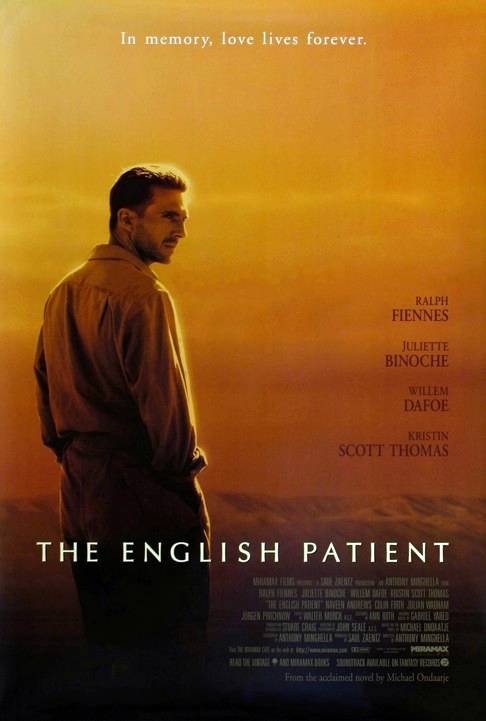
The English Patient (1996)

Ralph Fiennes excels as the tragic The English Patient

Director: Anthony Minghella

Cast: Ralph Fiennes (Count Almasy), Juliette Binoche (Hana), Willem Dafoe (David Caravaggio), Kristin Scott Thomas (Katherine Clifton), Naveen Andrews (Kip), Colin Firth (Geoffrey Clifton), Julian Wadham (Maddox), Jurgen Prochnow (Major Muller), Kevin Whatley (Sergeant Hardy), Clive Merrison (Colonel Fenelon-Barnes), Nino Castelnuovo (D’Agostino)

Sweeping, luscious, beautiful and an epic translation of an almost unfilmable novel into something supremely cinematic, The English Patient swept the board with nine Oscars at the 1996 Academy Awards. The English Patient has sometimes had a rocky reputation (not helped by an episode of Seinfeld where Elaine was famously non-plussed by the film). Like some of Minghella’s later work, it’s almost too well made for some to get past, looking like prime award bait. I didn’t “get it” the first time I watched it. But I – and the naysayers – were wrong: The English Patient is rich, rewarding and throbbing with a very British sense of repressed emotion and slow embracing of dangerous passions.

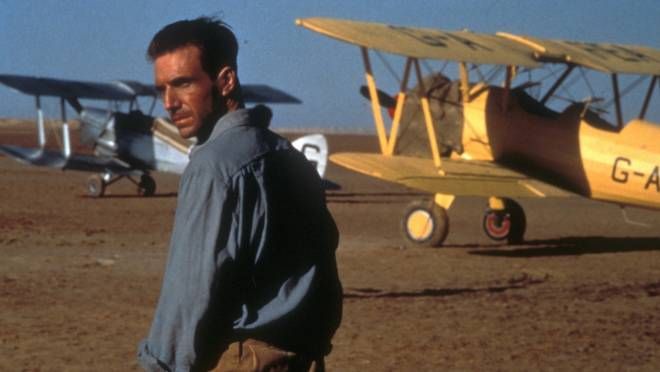
Adapted from Michael Ondatje’s multiple-award-winning novel, it unfolds across two time frames, hinging on a plane crash in the Sahara in 1942 that opens the film and leaves its pilot, Hungarian Count Almasy (Ralph Fiennes), hideously burned beyond recognition. The entire film is both an epilogue to that crash and a prologue explaining how we got there. In 1945, Almasy asserts he remembers nothing, even his own name. In what we later learn is a bitter irony, he is mistaken for an Englishman due to his perfect English. He is nursed through the final days of his life in an abandoned Italian monastery by a Canadian nurse Hana (Juliette Binoche), who has lost nearly everyone she loves in the war. Through Almasy’s memories, we see his life before the war as part of an international society of cartographers. In particular, the love affair that grows between him and Katherine Clifton (Kristin Scott-Thomas), the wife of another member of the society – an affair that will have life-shattering repercussions.

Appreciation for Minghella’s film must start with his ingenious screenplay. The English Patient, a book that moves eclectically between multiple timelines, shifting perspective frequently, and delivers its story in almost impossibly rich prose, should have been unfilmable. Minghella creates something which is both a mirror of the book’s intention, but also a cinematic text. You could use this as a teaching tool for adaptation (bizarrely one of the few Oscars it didn’t win was for Screenplay!). Working in close partnership with editor Walter Murch, Minghella’s film effortlessly cuts back and forth between at least three timelines, but never once confuses or jars. With (according to Murch) over 40 time transitions (that’s one almost every 3-4 minutes, fact fans), this could have been a jarring, impossible to follow mess. Instead, narrative clarity is its watchword.

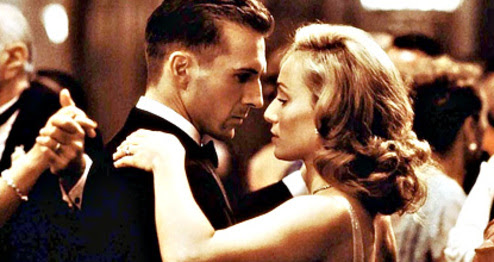
But the film also succeeds because it’s the apex of Minghella’s ability to combine luscious, poetic story-telling with acute emotion and passion. It shouldn’t be a surprise that someone who showed such understanding of grief in Truly, Madly, Deeply acutely understands how joy and pain can go hand-in-hand in love. Perhaps one of the reasons people found this a difficult film is that Almasy and Katherine are not a traditional romantic pairing. Both guarded, sometimes even cold and distant people, they are tentative, perhaps even scared, of the deep bond they immediately feel. A bond that burns all the more brightly because of the compromises and barriers in their emotional lives.

Almasy is distant, aloof, a man easy to know but impossible to understand. Katherine has a very English reserve behind a certain patrician warmth, playful at times but very aware of duty. What’s fascinating – and moving – about the film, is that these two people actually have a huge groundswell of passion between them. They are besotted with each other, but for reasons ranging from background to their own fears of emotional involvement, struggle to admit it to each other. They fling themselves at each other in romantic couplings with an almost animalistic longing. They make each other laugh. They allow themselves to speak of deep feelings, experiences and thoughts that they would not express to others. And they are also able to hurt each other through resentments, distances and shunnings in a way no one else could.

It’s a decidedly unconventional romance – compare it to, say, the next year’s Oscar winner Titanic with its far more conventional love story – but it works wonderfully. The slight air of repression also means that the confessions of deep-rooted feelings – Scott Thomas’ reveal of a gift she has never parted from, or Fiennes’ face twisted in emotional anguish – carry huge impact.

It also helps that the film is set in the sort of grand vistas that David Lean would be proud of. While you can certainly argue (with some justification) that The English Patient is a picture postcard film, its perfect visuals of the desert, the stunning beauty of so many of its shots, add to the extraordinary luscious old-fashioned 1930s romance of its setting. It could all be taking place in a world of von Sternbergesque romanticism.

Minghella’s film also interweaves skilfully the 1945 story line, revolving around Juliette Binoche’s Hana. Binoche won a deserved Oscar for a sensitive, vulnerable performance as a woman terrified of emotional commitment (sound familiar?), scared anyone she grows close to is doomed to die. Her romance with bomb disposal expert Kip (a strikingly delicate performance from Naveen Andrews, with just enough hints of anti-colonial tension mixed in) seems ready to fit this trope, but instead develops in unexpected ways. It also contributes perhaps the film’s most sweepingly romantic moment when Kip uses a pulley system, a flare and a bit of muscle to give Hana a sweeping up-close look at some Renaissance frescos. But while our flashback romance has the foreboding of doom to it, this one instead shows us the hope of a life restarting.

The English Patient also makes some striking points about the insane foolishness not just of war, but nationalism and Empire. The cartographers are a pan-European group who come together as equals, disregarding all concerns of nation. Instead they find a freedom to behave – intellectually, emotionally and sexually – in a way they never could “at home”. They represent a chance of being free to make our own choices, rather than dictated by arbitrary borders. Problems of nationhood are what will bring disaster. Colonialism is viewed equally critically: Kip gets sharp digs in at Kipling and also makes clear that his status as an Indian officer in the British Army is one of uncertainty.

Minghella’s film also works because of the mastery of the performances. Fiennes is in nearly every scene (many of them under a layer of make-up), and the role is a perfect match for the surface coldness in his performance style, which hides his wit and sensitivity. Cheated of the Oscar, Fiennes has rarely been better – his clipped romanticism mellowing in the 1945 section as a gentler but broken man. Scott-Thomas is perfectly cast – I’m not sure any other film has used her skills better – as a woman who compromised on happiness at the wrong time, and now cannot express herself.

The English Patient is a romance of slow moments, of inferred passions, which only at a few points before the end flower into something intimate. But it carries a huge emotional force, precisely because of this. Its technical work is faultless – Gabriel Yared’s score is a sumptuous mix of inspirations – and the acting superb (as well as the stars, Firth is marvellous as a decent but dull man cuckolded, Dafoe adds a layer of unpredictability as a 1945 houseguest and Whatley is the picture of working-class decency in a rare film role). The English Patient is Booker-prize film-making in its depth, richness and the work it asks you to put in, mixed with a David-Lean-meets-Mills-and-Boon pictorial loveliness, where each frame is a sun-kissed example of pictorial perfection. Mixed together, it makes for a sumptuous and deeply emotional package that I find more and more rewarding with every viewing.

The Da Vinci Code (2006)

Tom Hanks and Audrey Tautou stumble through the dire The Da Vinci Code, possibly one of the dullest films ever made

Director: Ron Howard

Cast: Tom Hanks (Robert Langdon), Audrey Tautou (Sophie Neveu), Ian McKellen (Sir Leigh Teabing), Jean Reno (Captain Bezu Fache), Paul Bettany (Silas), Alfred Molina (Bisoph Aringarosa), Jürgen Prochnow (André Vernet), Étienne Chicot (Lieutenant Jérôme Collet), Jean-Yves Berteloot (Remy Jean), Jean-Pierre Marielle (Jacques Saunière)

In 2003 the world went a little crazy. Maybe it was all the buzz of conspiracy that seemed to be everywhere. Maybe people wanted a bit of escapism from the misery of our post-9/11 world. Or maybe there is just no accounting for taste. But inexplicably, a staggeringly poorly written thriller by a hack author, peddling a tired old conspiracy, became one of the most popular books of all time. Yup, ladies and gentlemen, it was a time of silliness, paranoia and poor taste. It was the time of The Da Vinci Code.

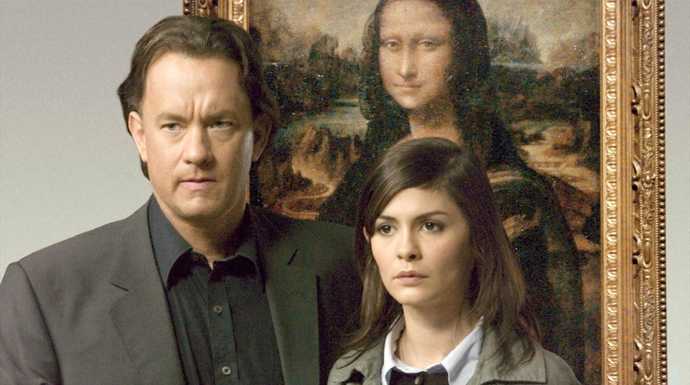
When the curator of the Louvre (Jean-Pierre Marielle) is found dead in the museum, with his body covered with bizarre self-inflicted wounds and symbols, visiting Professor of Symbology from Harvard Robert Langdon (Tom Hanks) is called in to consult. Langdon quickly finds himself the main suspect and on the run, aided only by the victim’s granddaughter Sophie (Audrey Tautou in a truly thankless part of continual question asking, devoid of any agency). Following a trail of bizarre clues, Langdon ends up investigating a conspiracy that leads to the heart of the Catholic Church – could the Church be founded on a lie? Could Jesus Christ have in fact been married to Mary Magdalene? Could she have been his intended heir? Did she have a child? Has a secret society run (at various times) by the Knights Templar, Leonardo Da Vinci and Isaac Newton worked since the dawn of time to protect the secret? Of course they haven’t, but that’s not going to stop the film.

Okay let’s get the main event out of the way. This is a terrible film. But it’s not terrible for the reason you might think. I mean, sure, it’s poorly scripted bobbins, with poorly developed ciphers for characters, and it peddles a conspiracy theory which is total, illogical nonsense from top to bottom. But that’s not the main reason. The main reason this film is terrible is that it is so unbelievably fucking boring.

The film is an utterly faithful, practically scene-by-scene reproduction of Dan Brown’s book. And it immediately reveals how little Brown knows about how to write a good thriller. The film has two or three action “set pieces” or moments of tension – at least, they would be tense, if only there were any stakes to the situation, or the characters’ motivations or the peril they’re in made the slightest bit of sense. They don’t. You’ll barely remember the car chase, or any of the moments where the heroes are held at gunpoint. None of the characters have any definable personalities, other than what they are invested with by the actors playing them. But then that’s no surprise from a novel where the lead character is defined solely by being brainy, having a Mickey Mouse watch (such a character!) and (film rights pleading ahoy) looking like Harrison Ford.

Just like Dan Brown’s turgid original, this film quickly turns into a series of scenes where characters fling exposition at each other to whizz us through a series of sub-par brainteasers and anagrams, which are only solvable with information the characters have but the audience doesn’t (hardly making it a fun thing to play along with). You’ll find yourself wishing for those anagrams back though, once they move on to spunking the novel’s bizarre conspiracy theory into our ears. The low point of this is when Ian McKellen’s polio-suffering billionaire historian (a billionaire historian! Who has a private plane! Of course he does…) tees up a handy PowerPoint presentation he just happened to have sitting around ready, and regurgitates all the mystic mumbo-jumbo that the film tries to pass off as fact.

I’m sure I don’t need to recap the nonsense of this film, but seeing it boiled down from the book is a real reminder that Brown clearly read widely but with no depth. For starters, most of his understanding of everything from the church, to the Templars, to the history of Europe is bogged down in inaccuracy and misinterpretation. By the time the film is claiming that Isaac Newton’s discovery of gravity angered the church you’ll have lost all ability to take anything the film says seriously (for the record, the Catholic church didn’t have a problem with gravity, and even if they did, as an Anglican living in a Protestant country, Newton wouldn’t have given a damn anyway).

None of the film’s (or book’s) ideas are even that original – it was all spewed forth in a book called Holy Blood, Holy Grail (several characters here have names that are anagrams of the writers and editors of these books) in 1982. The idea of Jesus having a whole line of secret descendants is arrant bollocks. The idea of a secret society working to protect this secret is even more stupid (it was revealed after the publication of Holy Blood, Holy Grail to be a total hoax, swallowed whole by that book’s writers). There is not a shred of reality here – rather, it’s typical paranoia and anti-establishment bollocks repackaged as dark reveal.

This is before we even touch on the – heaven help us – “art analysis”. The dark hints of conspiracy in The Last Supper by Da Vinci boil down to: (a) there is no Grail in this painting, (b) the bloke to the left of Jesus looks a bit like a girl so must be Mary Magdelene (“a hint of bosom” McKellen tells us playfully), (c) there is an inverted triangle between Christ and this man/woman – so surely a sign of the female dominance! The fact that the painting shows only 12 disciples and Jesus – meaning that if Mary was there, it should show 14 people not 13 – isn’t considered worth mentioning. But then that’s par for the course for the film’s bullshit clues “discovered” in works of art to support the film’s bullshit, anti-Catholic agenda (the church being staffed in this film exclusively by shadowy, Bond-villain types, with a ruthless agenda for extremist Catholicism and murderous Albino hit-monks they dispatch at will). Give me a break.

But if the film had packaged this all up in a gleefully silly, high energy story, it could still have been an entertaining watch. Unfortunately, it’s completely and utterly boring. It goes on (and on) for almost two and a half hours, and in between unengaging lectures and tedious dialogue scenes it drags like you wouldn’t believe. It’s almost impossible to get engaged in anything at all, and it’s really not helped by the flat, dimly lit, for-the-money direction from Ron Howard. There is no zip or fun about the film whatsoever, as if the book’s massive popularity made the producers worried that if they treated the book like an action adventure yarn, or a fun bit of nonsense, then it might offend people. Instead they treat this nonsense with a deathly reverence usually reserved for Biblical epics that’s fatal for the viewing experience of the entire film. 

It’s supremely dull, very self-important, and for all the hard work of an interesting cast of actors (who do their very best) it’s a complete, yawn-filled, pile of stinking crap. As the man said: “Holy Blood? Holy shit.”