Tag: Keanu Reeves

Parenthood (1989)

Steve Martin struggles with the demands of fatherhood, in the rather sweet Parenthood

Director: Ron Howard

Cast: Steve Martin (Gil Buckman), Tom Hulce (Larry Buckman), Harley Kozak (Susan Huffner), Jason Robards (Frank Buckman), Rick Moranis (Nathan Huffner), Martha Plimpton (Julie Buckman), Keanu Reeves (Tod Higgins), Eileen Ryan (Marilyn Buckman), Helen Shaw (Grandma), Mary Steenburgen (Karen Buckman), Dianne Wiest (Helen Buckman), Joaquin Phoenix (Garry Buckman-Lampkin)

If there is one thing everyone knows, it’s that families can be complex. That’s why good films about family life resonate so well – everyone (and I mean everyone) can find something in it that echoes with their own experiences. Parenthood is very good at this sort of thing, an entertaining but also tender and rather sweet comedy-drama about an expansive family and their many triumphs and problems.

Frank Buckman (Jason Robards) is the patriarch, a distant father with four children all now raising families of their own. Gil (Steve Martin), married to Karen (Mary Steenburgen), desperately wants to be the perfect dad he feels his own never was, but is struggling with the increasingly apparent emotional problems in his oldest son, 12-year-old Kevin. Helen (Dianne Wiest) is divorced, her ex-husband wants nothing to do with their children. Her son Garry (Joaquin Phoenix) is a socially withdrawn teenager, while her elder daughter Julie (Martha Plimpton) isn’t interested in education only in her relationship with gentle but useless Tod (Keanu Reeves). Susan (Harley Kozak) is married to Nathan (Rick Moranis) who is obsessed with turning their young daughter into a child prodigy. Frank’s favourite son is the feckless Larry (Tom Hulce), a wastrel sponger who turns up after years with an unexpected young son, Cool, in tow, in whom he shows little interest.

You can see just in that quick summary you’ve got a huge array of issues for the film to tackle, all of which it manages to do with sweetness, humour and also a certain amount of emotional truth. The film manages the ups and downs, the flat-out comedy and the heartbreak with real confidence, meaning you are moved smoothly from broad laughs to genuine “ahs” of sweetness. 

With the exception of the shallow and selfish Larry (every family has that black sheep), each of the characters has moments to demonstrate their depth and truth, showing sides of themselves you wouldn’t expect. In a large-cast film that delivers in a tight, well-structured two hours, that’s quite an accomplishment to be honest.

Ron Howard directs all this with fabulous control, a reminder that he’s actually quite a skilled director of comedy, with a good sense of timing and pacing. He’s also a superb director of actors, and there isn’t a weak link in the whole cast, from the youngest child actor to the most experienced Broadway veteran. 

Steve Martin is fabulous as the centre of the family saga, the dad desperate to be the best dad he can be, but who overly worries and obsesses about every detail to try and be as perfect as possible. Martin is ace at this sort of stuff, this gentle comedy grounded in reality, and totally understands how to make a character feel real and grounded. Combine that with his natural comic chops and willingness to embrace the absurd at moments – showcased here in a sequence where he desperately has to cover for a missing entertainer at his son’s birthday party – and he supplies many of the film’s stand out moments. 

Dianne Wiest (Oscar nominated) also manages a difficult balancing act in perhaps the film’s most interesting set of plotlines. Helen’s family covers the full range of teenage trauma, from a loving son who seems to turn overnight into a monosyllabic stranger to a daughter who rejects all her mother’s hopes for the future in order to spend time with a boy she doesn’t approve of. Wiest is not only extremely funny in some of her responses to these problems, but also heartrendingly real in her pain, confusion and frustration at not being able to help her children (or herself) as much as she wants, as well as the clear feeling that her life is somehow a failure compared to her two elder siblings. 

What’s also beautiful about the film is that none of these events or storylines work themselves out quite as you might expect. Young Garry (played excellently by an impossibly young Joaquin Phoenix, here billed as Leaf) has clear reasons for his feelings and is dealing with complete lack of interest his father shows in his life. Julie (Martha Plimpton, very good) isn’t the layabout teen you might expect, and has genuine feelings for Tod – who, under Keanu Reeves’ sweet, slacker style, is a man of far greater emotional depth than might be expected.

The other plotlines of the film are secondary to these, but are still wonderfully played and put together. The Moranis/Kozak plotline of “I’m an ignored wife who wants another baby” v “I’m trying to turn our daughter into a genius” is a bit more played for laughs, but the two actors know their stuff and deliver. Tom Hulce channels Mozart as the irredeemable Larry, but works very well with Jason Robards, who expertly portrays a man aware he was not the perfect dad. Again these scenes develop in ways you might not expect – particularly as regards Robard’s character.

The final sequence of the film, showing how the events and lessons of the film have changed the family but brought them together in different ways, and how they have changed and learned, should feel manipulative and pat, but because the whole film is done with generosity and warmth it actually brings a small tear to the eye with its sweetness and warmth. Parenthood isn’t perhaps remembered quite as well as it should be – but it’s a film that never fails to deliver and always leaves you feeling better about yourself. And you can’t ask more than that.

Much Ado About Nothing (1993)

Kenneth Branagh and Emma Thompson triumph in this brilliant adaptation of Much Ado About Nothing

Director: Kenneth Branagh

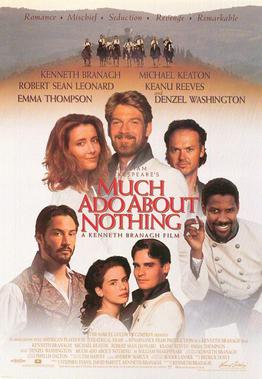
Cast: Kenneth Branagh (Benedick), Emma Thompson (Beatrice), Denzel Washington (Don Pedro), Michael Keaton (Dogberry), Keanu Reeves (Don John), Richard Briers (Leonato), Robert Sean Leonard (Claudio), Kate Beckinsale (Hero), Gerard Horan (Borachio), Imelda Staunton (Margaret), Brian Blessed (Antonio), Ben Elton (Verges), Jimmy Yuill (Friar Francis), Richard Clifford (Conrade), Phyllida Law (Ursula)

Branagh’s Much Ado About Nothing was his second Shakespearean directing gig, but his fourth film – and it’s clear from the first frame what a confident director he has become. Much Ado is one of the best Shakespeare films ever made, and certainly the greatest film version of a Shakespearean comedy, largely because it’s not only charming and hugely enjoyable but also actually funny – a pretty rare feat for any filmed version of a Shakespeare comedy.

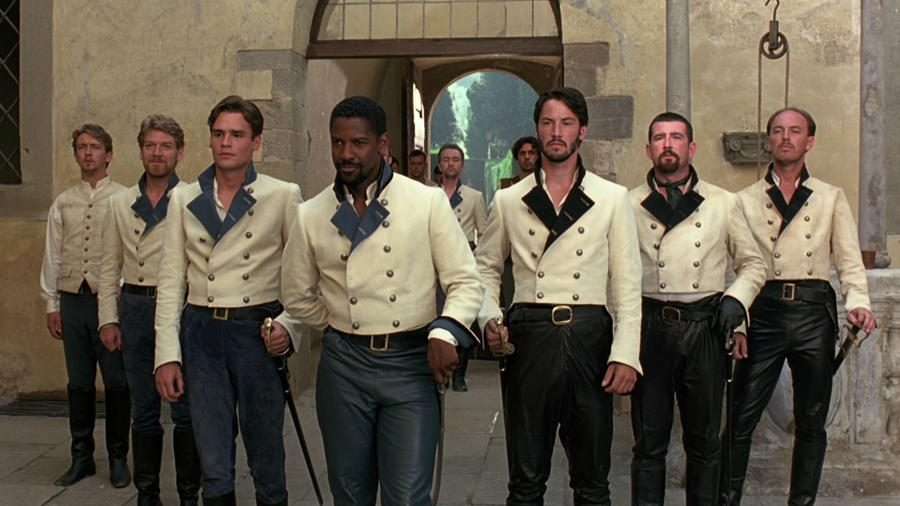
From the opening you pretty much know you are in safe hands. Branagh loves the vibrant excitement of cinema, and delights in bringing the meaning out of Shakespeare’s text. Both ideas are central to the opening of the film, with Emma Thompson’s luscious reading of “Sigh No More”, while the camera pans across a bucolically blissful Tuscan setting. This feeds straight into Beatrice’s playful banter with the messenger – and Richard Briers gives the first indication of the film’s attention to small character details with his “don’t go there” look when the messenger tries to correct Beatrice’s teasing defamation of Benedick. From there the film explodes into a triumphant Magnificent Seven style arrival of Pedro’s lords on athletic horseback (backed by Patrick Doyle’s inspiring overture), while Leonato’s household excitedly (in a typical Branagh tracking shot) prepare to greet them, before an overhead crane shot introduces the two groups meeting in a courtyard. Everything you need to know about the sort of film you are getting – and Branagh’s ability to marry the language of cinema with the language of Shakespeare – is right there.

Branagh’s setting of the play in a golden Tuscan villa is perfect for both its playful, relaxed, soldiers-back-from-the-war plot line and the heated romances and jealousies that fuel the plot. Is it any surprise feelings are running high in such a sultry and hot climate? The two worlds – the army men and the people of Leonato’s household – are immediately clear. And the setting communicates the film’s mood – fundamentally bright, sunny, cheerful. Kick back your heels, you are being taken on a high-spirited, exotic holiday.

In this playful setting, Branagh invariably gets the tone just right. Shakespearean comedy is so reliant on live audience reactions, on bouncing off the audience, that creating this on film without that live element is really difficult. Trust me, watch any number of BBC Shakespeare comedies (don’t worry I’ve done it for you) and you will see immediately how hard it is to get that bounce and comedic juice out of these shows. Branagh gets it spot on here – the characters are so likeable, the delivery of the actors so assured, the spirit of the film so light yet perfectly controlled, that the comedy lands nearly every time. Above all, the actors look like they had a whale of a time making the film – and that enjoyment completely communicates to the audience.

The gulling scenes of both Beatrice and Benedick are expertly played and hugely entertaining: Branagh skilfully cuts them to fast-paced essentials, and then gets the best possible comic mileage out of them – from skilled cut-away shots for reactions to wonderful ensemble playing (Briers in particular is superb as a Leonato slightly out of his depth in trickery). It’s easy for the Beatrice gulling scene to fall a little short after the Benedick one – but, largely thanks to Emma Thompson’s excellent performance, that certainly doesn’t happen here.

But Branagh understands Much Ado is not just a comedy: it comes perilously close to being a tragedy. For at least an act of the play, our heroes are at loggerheads, and murder and death are almost the end results. From Claudio’s explosively violent reaction to Hero’s perceived betrayal at the wedding to Leonato’s furious denunciation, horror and danger are ever-present. This then leads us into Beatrice and Benedick’s wonderful post-wedding. Branagh sets this in a small chapel – adding an echo of marriage vows to the understanding the pair reach – and Thompson’s passion, fury and pain are met (for the first time) with quiet, mature understanding from Branagh’s Benedick. Thompson’s order for Benedick to “kill Claudio” carries a fiery conviction that chills. It’s a brilliant scene.

A lot of this works so well because of the brilliance of the acting. Branagh is charming, very funny and mixes this with a growing emotional depth and maturity as Benedick. But the film belongs to Emma Thompson who is quite simply astounding as Beatrice – surely one of the greatest performances of the role you will catch. She is the soul of the movie, at turns playful, frustrated, joyous and consumed with grief and rage. She speaks the lines (needless to say) with absolute clarity and emotion, but even more than that her intelligence dominates the movie. You can’t take your eyes off her.

But this is a very strong cast of actors, the best mix Branagh got between Hollywood stars and his regular players. Denzel Washington is simply perfect as the noble but strangely distant Pedro (his moments of isolation at the close of the film are as touching as they are unsurprising). Richard Briers gives some of his best work in a Branagh film as a Leonato, moved to great emotion and feeling. Leonard and Beckinsale are perhaps not given huge amounts of interpretative depth, but are very lovable. Gerard Horan is very good as a swaggering Borachio.

It’s easy to knock Keanu Reeves but – aside from his untrained voice, which makes him sound duller and flatter than he actually is – his Don John is actually pretty good. As a physically very graceful actor he completely looks the part, and he glowers and fumes with all the intensity you could require – and after all, Shakespeare didn’t give Don John much more to do than that.

No the real problems with the production – and the parts that don’t work – are Dogberry and Verges. Now I can see what Branagh is trying to do here: the malapropisms of Dogberry’s dialogue are rarely, let’s be honest, that funny, and would work even less well on film. But the decision to make Dogberry and Verges a cross between Monty Python and the Three Stooges doesn’t really work. Michael Keaton is giving it his all here to try and get some humour out of this – but his straining for every laugh, combined with gurning over delivery, bizarre accent and physical over-complications, just deaden every single Dogberry scene. These scenes largely flop.

But it doesn’t matter when every other scene in the film works so damn well. And, however much you might drift away during the Dogberry moments, the rest of the film will capture your heart and mind every time. Filmed with a luscious richness and stylish confidence, this is a ravishing and flamboyant film that will never fail to entertain. By the time the final reconciliation has happened, and the house erupts into a joyous celebration party – filmed, with astonishing chutzpah, as a single take, staggering in its complexity, that covers close-up, tracking shot and huge crane shot – while Patrick Doyle’s score gives a swelling version of Sigh No More, you’ll be in love yourself. And if not – well look to yourself.

John Wick (2014)


Keanu Reeves: Architect of violence in this witty pulp thriller

Director: Chad Stahleski, David Leitch

Cast: Keanu Reeves (John Wick), Michael Nyqvist (Viggo Tarasov), Alfie Allen (Iosef Tarasov), Adrianne Palicki (Ms. Perkins), Bridget Moynahan (Helen Wick), Dean Winters (Avi), Ian McShane (Winston), John Leguizamo (Aurielo), Willem Dafoe (Marcus), Lance Reddick (Charon)

When B-list movie-making works, it can be a treat. John Wick is such a film. Set in a very distinctive criminal underworld, the recently widowed super assassin John Wick (Keanu Reeves) has left the life of crime behind but is dragged back in when the son (Alfie Allen) of a Russian mafia kingpin (Michael Nyqvist) murders his dog, a final gift from his wife. Wanting revenge for the loss of his last link with his wife, Wick undertakes a roaring rampage of revenge.

John Wick is a film all about momentum. It’s sharp and brutal, with fights and events piling on top of each other. However, it’s also a film told with quite a bit of wit and imagination – it’s got a cool sense of humour, and presents a tongue-in-cheek view of its super assassin story. The film’s pace and immersive action is punctured regularly and very effectively with amusing moments that really hit home. The idea of the criminal underworld having its own secret code, rules, havens and even currency is several times expanded wittily to bring an everyday element into the extraordinary. As an exercise in briefly and simply “building a world” you could look at few better examples than the script for this film.

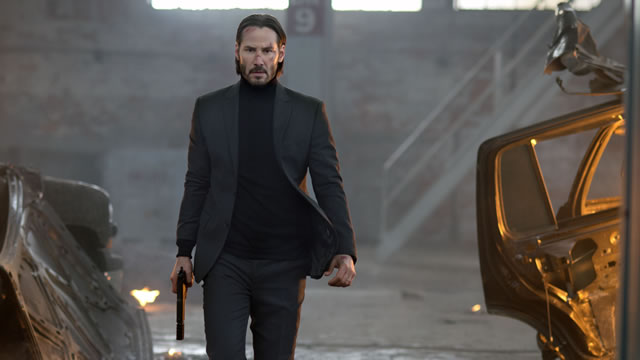
Keanu Reeves is actually a fine choice for the lead role. His limitations as an actor have always been based above all in his flat and unmodulated Dude voice, so it’s only at moments of vocal emotion (there is one such angry outburst that he struggles with in the film) where even the audience feels that awkwardness of watching an actor at the limits of their range. But his best quality has always been his inherent lovability. As an audience member, you can’t help but care about him. Combine that with his physical brilliance and you have the perfect combination required for this role: you can believe totally in him as a ruthless killer, while also feeling a great deal of affection for him.

With Reeves’ physical abilities, the fights are then very well framed to showcase the fact that the actor is doing the stunts himself. If Quantum of Solace is perhaps the most inept example of high-cut frenetic action, this is at the other end of the scale totally. Simple, clear camera set-ups allow us to follow what happens at all times. Establishing shots and tracking shots show us exactly what is going on and where. This means you can relax and settle into the crackingly efficient violence that fills the film. The fights are inventive, shot with wit, and highly enjoyable in their execution without being excessively bloody or violent. The calm angles and stable camera serve to really accentuate the speed of those in the fights, making the fights visually very original. Despite the enormous body count, it never revels in violence. The patient build up to the first burst of violence also serves to really bond us to Wick’s backstory and his grief at his loss.

However, it’s not perfect. Strangely, despite the fact that the film is quite short, it’s still too long. There is a natural culmination point in the film at the end of Act Two that feels like a very natural, thematic stop point. Act Three resets the table hurriedly to reposition another character as a principal villain and to bring us another confrontation: this time however, the motives are less clear, and the action  just a little too much more of the same. It feels less witty and original than some of the other sequences in the film and to be honest I felt my attention drifting it a bit; the motivation for the final clash just isn’t there in the way it is with the initial enemies.

But this is a very enjoyable piece of pulpy film making, its wit and imagination embraced by some very enjoyable performances from the actors. The fight scenes not only have a unique look to them, they get the balance exactly right between violence and enjoyment. It’s almost the definition of a guilty pleasure .