Tag: Keenan Wynn

Dr Strangelove; or How I Learned to Stop Worrying and Love the Bomb (1964)

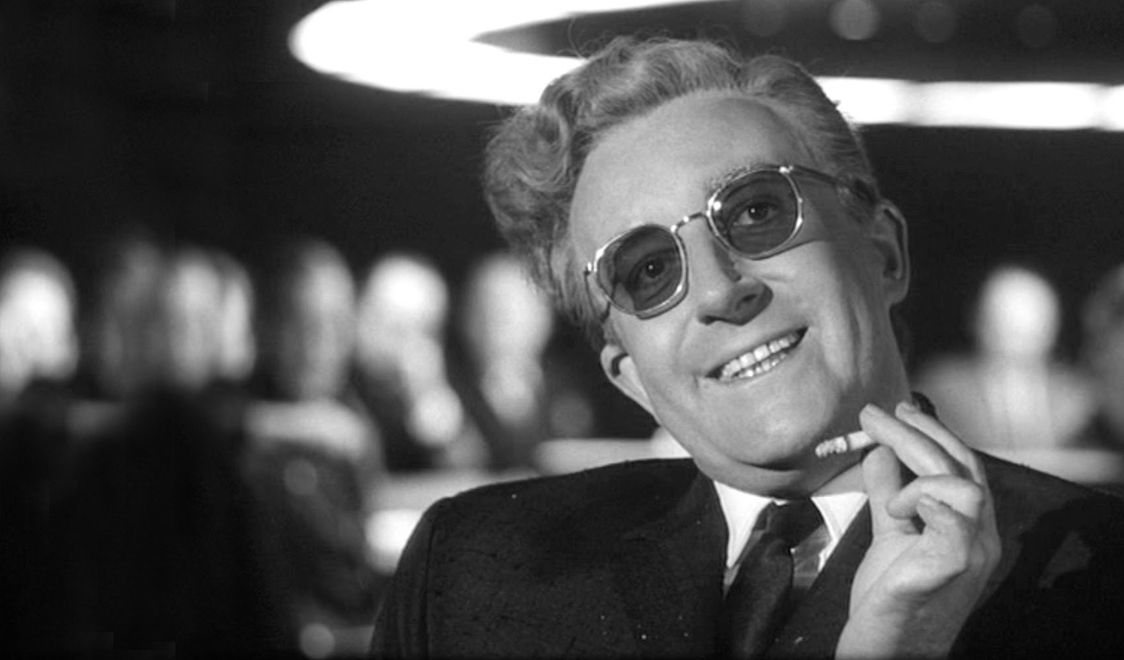
Peter Sellers tries to stop the end of the world in the terrific satire Dr Strangelove

Director: Stanley Kubrick

Cast: Peter Sellers (Group Captain Lionel Mandrake/President Merkin Muffley/Dr Strangelove), George C. Scott (General Buck Turgidson), Sterling Hayden (Brigadier General Jack D Ripper), Keenan Wynn (Colonel Bat Guano), Slim Pickens (Major “King” Kong), Peter Bull (Russian Ambassador), Jack Creley (Mr Staines), James Earl Jones (Lt Lothar Zogg), Tracy Reed (Miss Foreign Affairs)

“Gentlemen you can’t fight in here. This is the War Room!” Kubrick’s hugely influential satire helped shape our perceptions of the Cold War and its mantra of mutually assured direction. Showing no mercy to its targets, it mixes Goonish schoolboy humour with moments of genuine tension and rising horror. Sure it features some of the faults of its director –self-importance, cold distance and much of the wit is due to Sellers and the performers rather than the not-particularly-witty-Kubrick – but there is no doubt it remains a seminal classic.

General Jack D Ripper (Sterling Hayden – excellent) orders his planes to drop their nuclear bombs on the USSR. Ripper is launching a pre-emptive strike to protect the American way of life from the Commies and, most importantly, to protect our precious bodily fluids. Yup he’s crazy, something his second-in-command RAF Group Captain Lionel Mandrake (Peter Sellers) quickly realises, but can’t do anything about. US President Merkin Muffley (Sellers again) reacts with horror at the prospect of all-out-war, negotiating with the Soviets to co-operate in shooting down the planes, while some of his advisors such as trigger-happy General Buck Turgidson (George C Scott, hilariously OTT) argue perhaps there is some merit in striking first. And sinister former-Nazi scientific consultant Dr Strangelove (Sellers one more time) spells out the impact of nuclear war.

Kubrick quickly came to the conclusion that if you were going to make a film about nuclear war, it almost couldn’t be anything buta comedy: after all the idea of two sides building a huge arsenal of weapons capable of destroying the world was so crazy, you wouldn’t believe it if you were told it. Dr Strangelove therefore ends up taking place in a world that’s one third grounded and two-thirds heightened reality. There is a great deal of college-style humour in the film (you can see it in those characters names which reference everything from the Whitechapel killer to female genitalia and excrement), but it works because its (mostly) played dead-straight.

Part of the film’s appeal was the number of sacred cows it slays. All the things that, at the time, America was meant to respect were ridiculed. The military, politicians, the Presidency, America’s moral authority, the ingenuity of American science and engineering. It’s all shown to be ineffectual, misguided, underpinned by fascist-tinged insanity, myopically obsessed with big bangs over humanity or plain ridiculous. Every single authority figure in the film is deconstructed over its course as some combination of childish, empathy-free or useless. You can’t come out of this film and every again have an unquestioning assurance our leaders know what they are doing.

This works, because it’s placed in a film that in many ways has the plot of a far more serious film (its very similar of course to Fail Safe). Chunks of it are played completely straight, or with just the merest touch of the surreal. In particular the sequences set on the bomber, commanded by Major Kong (played at short notice by Slim Pickens after injury prevented Sellers taking on that role as well) have that true sense of Kubrickian detail in their careful staging of all the procedures a bomber crew would follow (even if it still allows some fun to be poked at the expense of the survival kit, the contents of which would give a fella “a pretty good weekend in Vegas”).

Those bomber scenes sometimes outstay their welcome in their cold technicality (it’s odd to say that a film as short of this sometimes feels a little overlong), but that’s largely because in a film that is clearly demanding us to shake our heads at the madness, it struggles to get us invested in a more conventional heroic story (especially as success there is starting a nuclear conflagration).

Perhaps that’s because of the coldness in Kubrick’s style – emotion doesn’t often find its way into his greatest works, and he was often reliant on working with the right people (get a McDowell in it or a  Nicholson and things can click, get an O’Neal and you can get a different story). Humour isn’t his strong suit, but fortunately he worked with Sellers at his finest hours. Sellers takes on three roles, all of them a sharp contrast, and he’s masterful in all of them. There were fewer more gifted improvisational performers than Sellers, and each of his parts benefits hugely from the dynamism (of various sorts) he gives them. It’s also interesting that two of them are actually the “one sane man” (Muffley and Mandrake) while Strangelove is a pantomime monster of insanity (introduced late in the film, he’s the final indicator that our fates are in the hands of complete lunatics).

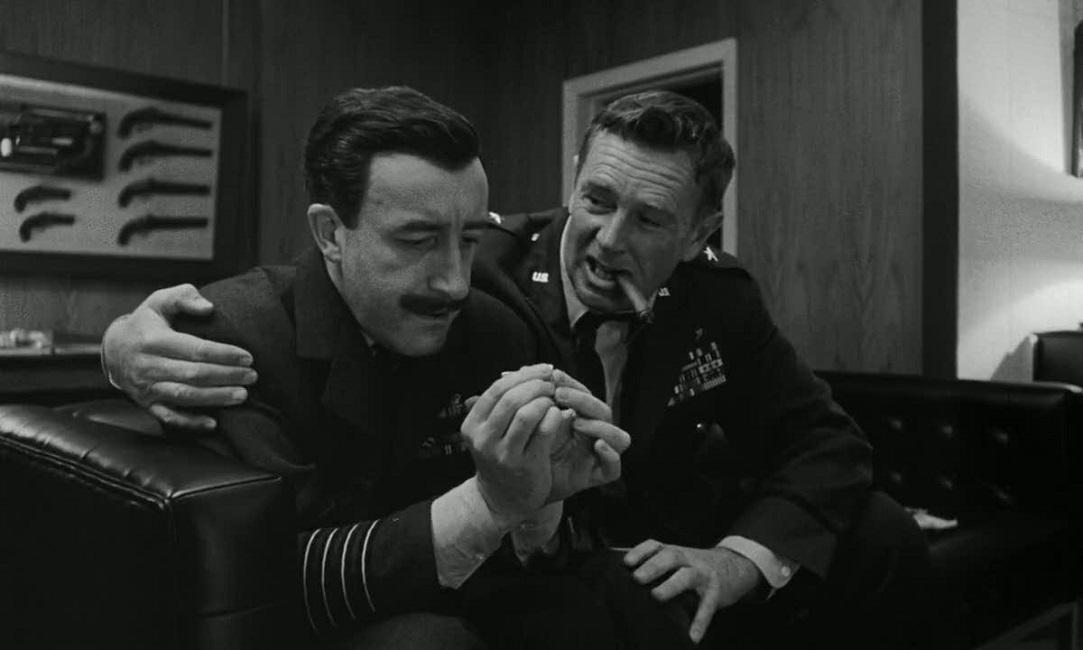
For Mandrake, Sellers parodied the stiff-upper lip upper class, with Mandrake a stuffed-shirt, attempting to wheedle recall codes out with Ripper with a clumsy bonhomie. Muffley is played almost dead-straight as a weak man out of his depth. But he does have a phone call monologue with the Russian premier (largely improvised with Sellers) that is one of the funniest things you’ll ever see. There’s no restraint in Strangelove, a wheel-chair bound grotesque with a phantom (hardcore fascist) hand, constantly suppressing involuntary Hitler salutes and trying to hide his mounting excitement at the prospect of worldwide annihilation (“Mein Fuhrer! I can valk!”).

Kubrick’s directorial approach – wisely – seems to have been to acknowledge that Sellers was providing so much of the madness and dark comedy the concept demands, that he could be more restrained. Interestingly, for being his most famous film, it often feels like one of his least personal ones. It stands outside much of the Kubrick cannon – it’s short, its often brisk, technically it’s unflashy and often unobtrusive – and it plays on the director’s weakest vein, comedy.

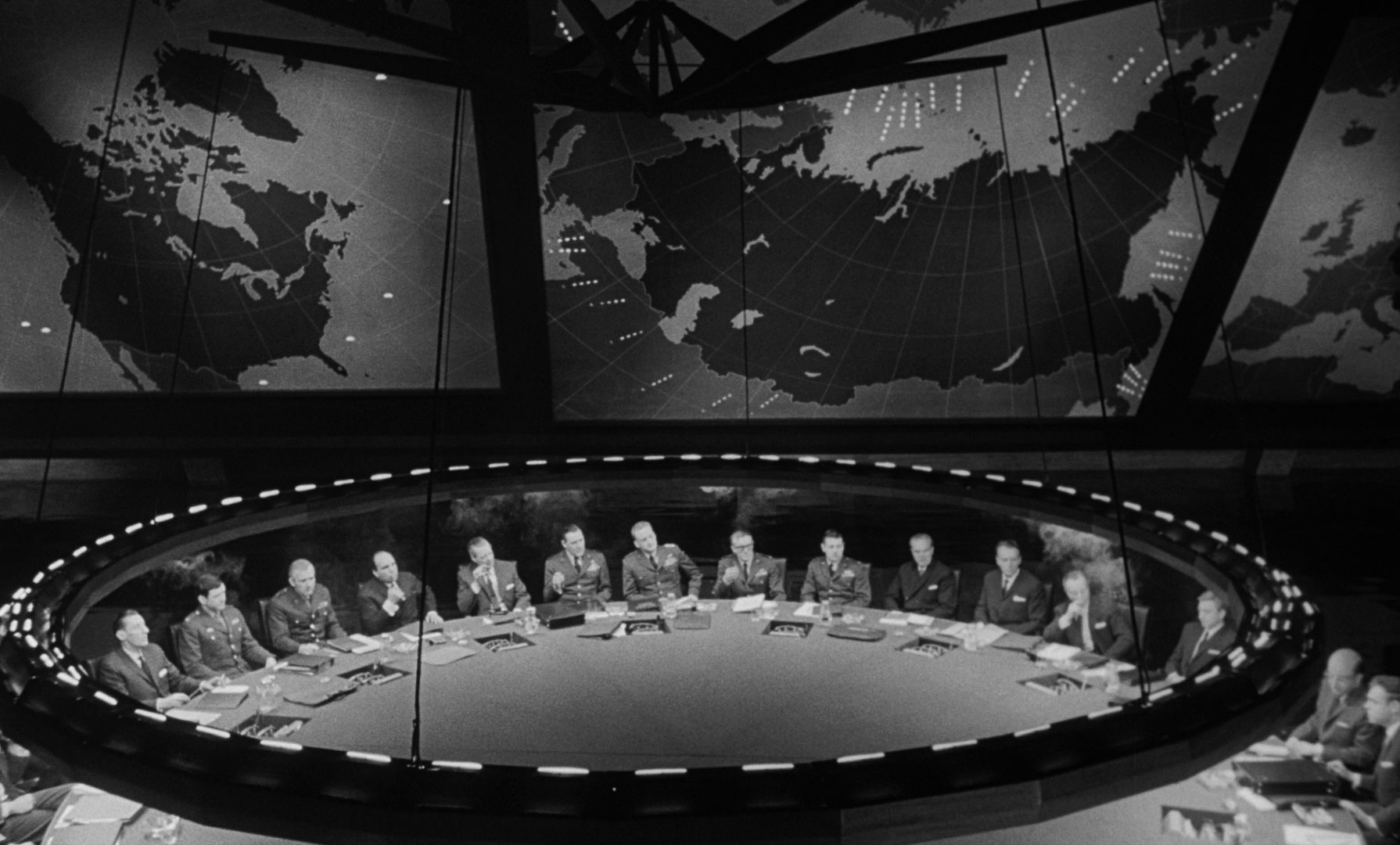
But it’s got his mastery of detail – partly also due to its faultless set design by Ken Adam. The reconstruction of the bomber interior is overwhelmingly convincing (the Air Force was amazed at how accurate it was). Ripper’s low-ceilinged office is a visual metaphor for the character’s insular insanity. Most influential of-all, the Bond villain-ish War Room, with its vast circular table and huge screens was so perfectly conceived, it cemented the idea for generations of what war planning rooms should look like (Reagan even asked where it was when he took office). The film may be darkly surreal, but its surroundings give it an authority that is essential for its success.

Authority is what the film needed to work. Perhaps that’s the greatest contribution of Kubrick, to create a structure of convincing reality, allowing the surreal and insane actions to work. From Ripper’s clear fixation on his own impotence (“I do not avoid women but I do deny them my essence”) – to Turgidson’s increasingly bombastic militarism (“I don’t say we won’t get our hair mussed, but I do say no more than 10 to 20 million killed. Tops.”), they all work because they contrast with a setting soaked in reality and detail. It also adds the important depth that gives the film impact: sure it wouldn’t happen like this, but something like this could happen.

Dr Strangelove’s humour has at times dated – there’s something undeniably schoolboyish about its tone. Stretches showing the detail of the bomber’s operation go on way too long. The film itself also takes a while to get going, and like many Kubrick films it has an air of being pleased with itself. But in Sellers it has a comic genius at the height of his game and its impact in changing the way we think about the world can’t be denied. Still a classic.

Nashville (1975)

nashville header
Robert Altman’s sprawling classic takes on a whole city in the brilliant Nashville

Director: Robert Altman

Cast: David Arkin (Norman), Barbara Baxley (Lady Pearl), Ned Beatty (Del Reese), Karen Black (Connie White), Ronee Blakley (Barbara Jean), Timothy Brown (Tommy Brown), Keith Carradine (Tom Frank), Geraldine Chaplin (Opal), Robert Du Qui (Wade Cooley), Shelley Duvall (Martha), Allen Garfield (Barnett), Henry Gibson (Haven Hamilton), Scott Glenn (Pfc Kelly), Jeff Goldblum (Tricycle Man), Barbara Harris (Winifred), David Hayward (Kenny), Michael Murphy (John Triplette), Allan F. Nicholls (Bill), Dave Peel (Bud Hamilton), Cristina Raines (Mary), Bert Remsen (Star), Lily Tomlin (Linnea Reese), Gwen Welles (Sueleen Gay), Keenan Wynn (Mr Green)

Robert Altman’s magnum opus, Nashville has the city has its set and, seemingly, its entire population as the cast. Over the course of a few days, Nashville charts the interweaving lives of a host of people making (or trying to make) a living in the home of country and western and the hangers on and fans flocking around the edges. Meanwhile a presidential campaign plays out, trying to recruit stars as fund-raisers.

You could say that, on the surface, Nashville isn’t really about anything. Certainly, it’s plot (such as it is) is more based on observing our characters interacting with and responding to events. Wonderfully rich short stories overlap each other, the focus mothing smoothly from one and another. It’s not really grounded in an overarching plot, such as McCabe and Mrs Miller or The Long Goodbye. In many ways its more similar to M*A*S*H, an experience piece trying to capture the thoughts and emotions of a particular moment of time. It’s that which I think is the heart of it. Nashville is about very little, but really it’s about everything – and it’s one of the most enlightening and vital studies of twentieth century America you are ever going to see. A rich and fascinating insight into a particular point in history, in a country rife with tensions.

You can’t escape that Nashville takes place in an America under the shadow of traumatic events. The 1970s (and the legacy of the 1960s) has pulled America further apart than ever. It’s a country struggling with a wave of assassinations, still deeply scared by the sacrifice of JFK (several characters, most notably Barbara Bexley’s permanently intoxicated Lady Pearl, reflect on the loss of innocence that came with it). Scott Glenn’s uniform clad army private is only the most visual reminder that the country is being ripped apart by Vietnam. Bubbling racial tensions are captured by short-order cook Wade (a lovely performance by Robert Du Qui) who angrily denounces black country singer Tommy Brown (a suave Timothy Brown) as an Uncle Tom.

Politically, America isn’t heading anywhere. The film is continuously framed by a car literally driving around in circles, blaring out meaningless platitudes straight from the lips of Hal Phillip Walker a third-party Presidential candidate who is against a lot of stuff (lawyers in congress and the Election College) but doesn’t seem to be ‘for’ anything. His smooth advance man John Triplette (Michael Murphy, quietly unimpressed by the music stars around him) drums up musicians to appear at a benefit – not one of whom even ask about the politics of the man they are being asked to endorse. Nashville isn’t a film that feels particularly enamoured either with politics or the level of our engagement with it.

Instead there is a new religion in town: fame. The musicians of Nashville at the time were unhappy with the film, feeling that Altman planned an attack on their industry. Altman is, of course, smarter than this. Of course, there are some satirical blows landed – but the film has respect and admiration for artists with genuine talent. Its real criticism is for fakes and poseurs (of which more later). But for the talents at the centre, sure they are flawed – but there is a respect for their skills and genuineness that keeps the film relatable. (Altman would be far more vicious when he turned his eyes to Hollywood with The Player).

The artists at its heart are flawed but human. Haven Hamilton (a grandiose Henry Gibson) may be a blow-hard reactionary, but his patriotic pride and sense of personal responsibility is genuine (late in the film he will ignore a serious injury to show concern for others). At the film’s centre is fragile super-star Barbara Jean (a delicate Ronee Blakely), the beloved super-star teetering on the edge of a dangerous breakdown, overwhelmed with the pressures of fame and expectation. A lonely person, reduced to trying to communicate her unease to her audiences in rambling monologues. Looking for a human connection she’s unable to make elsewhere (this makes for a neat contrast with her rival, Karen Black’s bubbly but coolly distant Connie White who knows where to draw the line between public and private).

This humanity also makes for intriguing personal dilemmas. Singing trio Tom (a swaggering Keith Carradine), Bill (a frustrated Allan F Nicholls) and Mary (a saddened Cristina Raines) are in the middle of a love triangle (caused by Mary’s love for Tom, who loves the attention but doesn’t return the favour). Made more tense by Tom’s desire to go solo, the couple’s tensions are never firmly resolved – part of Altman’s avoiding of neat endings. Tom himself, in many ways a shallow lothario, is also shown to be feeling the same loneliness and emptiness as others.

It’s interesting that the film’s warmest character, Lily Tomlin’s Linnea, lies half-way between the world of the music and the world of normal life. A dedicated performer of gospel with an all-Black choir, Linnea also works tirelessly at home to support her two deaf children (who attract very little interest from their father, would-be fixer Ned Beatty). Linnea though is never portrayed as someone trapped in her life, in the way others are, but in complete acceptance – and even contentment – with her lot. Similar to Keenan Wynn’s grieving husband, desperate for his niece to engage with her aunt’s illness, the film’s real warmth is for those people grounded in real-life worries.

The film’s real fire is saved for the shallow wannabes that flock around the edges. The music stars may be flawed but they have talent (as witnessed by the film showcasing almost an hour of musical performance in its runtime – all the songs written and performed by the stars). Shelley Duvall’s would-be groupee is hilariously empty-headed and selfish. Ned Beatty’s greasy-pole climbing political animal is ridiculously pompous. At the top of the pile is Geraldine Chaplin’s reporter, an empty headed fame obsessive, hilariously fawning to the rich and famous and abrupt and rude to ‘the staff’, pontificating emptily in a car junkyard. Is she even a real reporter or just a fantasist?

Altman’s film also finds time for two very different women trying to find fame in this heartland of country and western. Sueleen Gray (Gwen Welles) is a waitress carefully cultivating all the patter of a star, but lacking the key attribute – talent. So desperate is she to ‘make it’ that she is willing to be exploited for a big chance, with only Wade having the decency to tell her she should cut her losses (advice she bats away in anger). By contrast, Barbara Harris’ Albuquerque, running from her husband to find fame, has the talent but never gets the opportunities – until of course at the very end (and it’s the result of the tragic fate of another woman whose doomed fate hangs over the film).

Nashville is a rich character study, but all these characters link back into an America at a turning point in its cultural history. Detached and disillusioned with politics, this is a country that is starting to see fame – and the indulgence of your own passions and desires – as the new religion. A religion that attracts both wannabes and also stalkers and dangerous obsessives (at least two of whom populate the film, one with fatal consequences). In this world, as idealism dies and is replaced by cynicism, people start to check out and either engage more with their own problems or yearn to change their lives and become something else. Altman’s film captures this moment in time personally, as well as being a compelling melting pot of stories. A rich, multi-layered tapestry – of which a review can only scratch the surface – it’s a great film.

Once Upon a Time in the West (1968)

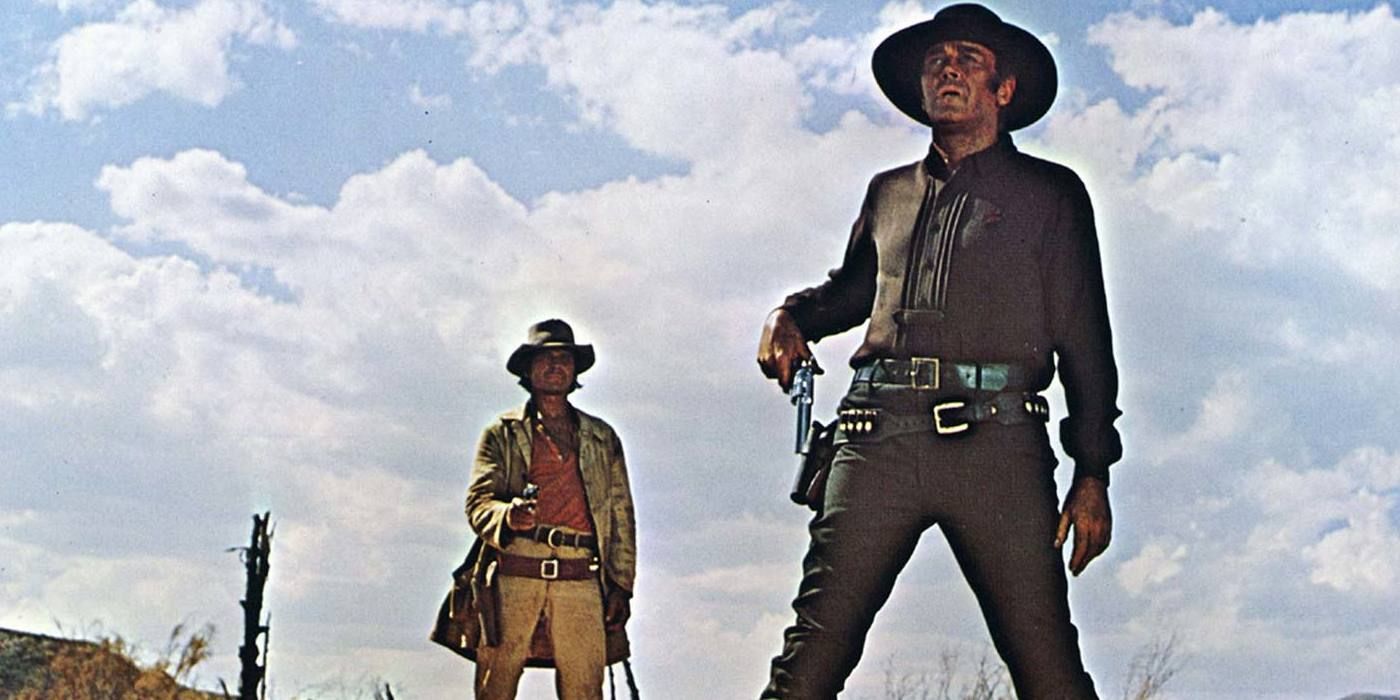
Fonda and Bronson prepare to face off in Leone’s epic Once Upon a Time in the West

Director: Sergio Leone

Cast: Henry Fonda (Frank), Claudia Cardinale (Jill McBain), Charles Bronson (“Harmonica”), Jason Robards (“Cheyenne”), Gabrielle Ferzetti (Morton), Paolo Stoppa (Sam), Marco Zuanelli (Wobbles), Keenan Wynn (Sheriff), Frank Wolff (Brett McBain), Lionel Stander (Barman), Woody Strode (First Gunman), Jack Elam (Second Gunman), Al Mulock (Third Gunman

Sergio Leone’s Westerns were always based, first and foremost, on his own love for the genre – and the great filmmakers, from John Ford onwards, who made them. Returning to the genre for the final time – putting on hold (for what turned out to be nearly fifteen years) his plans for a New York gangster film – Leone wanted to make his final, and ultimate, tribute to the Hollywood western. Collaborating with Bernardo Bertoloucci and Dario Argento (now there is an odd trio!) on the scripting, Leone’s final Western is a sweeping, grandiose, operatic Western littered with visual quotations from films he loved.

The story rather takes second fiddle to the general ambiance and visuals, but it never bothered Leone to have only the sketchiest of plots stretched across the many hours of his movies. The railroad is being built across America – changing the face of the West as it goes. Frank (Henry Fonda), hired gun of crippled railway tycoon Morton (Gabrielle Ferzetti), guns down farmer Brett McBain and his children. He had been sent to threaten them to clear off the land of Sweetwater. But why? And how will the return of McBain’s new wife Jill (Claudia Cardinale) – now heir to all of Frank’s holdings – affect their plans? And why does the mysterious “Harmonica” (Charles Bronson) – a shadowy gunman with no name have such an interest in events, and in Frank in particular? And will criminal gunman Cheyenne (Jason Robards) and his gang – blamed for the McCain killings – be able to establish their innocence?

The answers to all these questions come slowly – and often confusingly – in this long, slow but – as with many Leone films – engrossing Western, which features 3-5 minutes of Morricone build-up and extreme close-up before even the slightest action. This makes it very easy to mock, and perhaps by this point Leone had started to believe too heavily that he was an artist daubing in genre, rather than a purveyor of entertainments. Certainly, Once Upon a Time in the West is consciously weighted down with its own importance, it’s ominous sense of events heading to a pre-ordained conclusion and its half-hearted attempt to depict itself as sitting at a crossroads in American history, as technology squeezed out the old West.

But somehow you give Leone’s film a pass for all its many faults because it’s assembled with such unrivalled skill and breathtaking pizzazz. Sure the film is only half as smart as it thinks it is, but when at its strongest it offers unrivalled entertainment. Leone also mastered here his balance between the slow, tense, agonising build-up to violence – followed by its sudden and brutal enactment. 

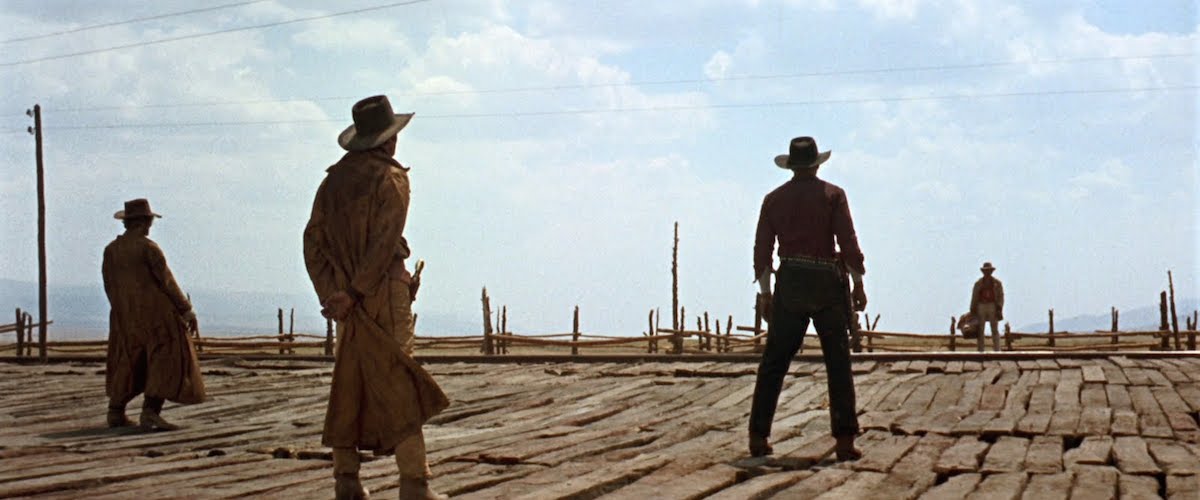
Never is that more clear than in the film’s opening ten minutes which features three gunmen (among them Ford favourite Woody Strode and reliable minor bad-guy Jack Elam) waiting at a train station for what turns-out to be the arrival of Charles Bronson’s “Harmonica”. The three gunmen sit, waiting, in silence. Around them the everyday sounds of windmills, buzzing flies and dripping water builds and relapses with all the dread of distant thunder. Leone’s camera crashes in for long, intense close-ups, as if drilling down into the souls of these bored men, the camera studying every detail of their faces. After almost ten minutes – during which the credits roll – “Harmonica” arrives. And promptly shoots all three men dead in seconds. You know it’s coming, but the tension and expectation of this confrontation makes the entire sequence compelling. 

It’s a trick that Leone repeats time and time again. Effectively the whole film is only prolonged extension of this sequence – the inconsequential back-and-forth of the lacklustre plot all really about giving us a chance to drill down into the character of Henry Fonda’s bad-to-the-bone Frank, while we wait for the inevitable gunfight between him and “Harmonica”. Leone’s film is a triumph of mood, filled with sweeping beautiful camera shot and luxiously paced editing, all mixed down with some stunning scoring from Ennio Morricone.

Once Upon a Time echoes a fairy tale in its title, and that’s what it is. For all that Leone attempts to throw in plotlines around progress, the influence of big money and the new order leaving gunmen behind, really everything it knows about America is taken from movies. Leone litters the film with visual quotes from High Noon, Shane and dozens of others, most especially Ford (he even insisted in transplanting some of the scenes to be shot at Monument Valley, which led to merry hell trying to get the other Spanish-shot locations to visually match). The entire film unfolds like a dream. At about the half way mark in particular – this might be due to cuts to be fair – the narrative suddenly becomes almost deliberately unconnected, key events seemingly skipped over and sudden character reversals taking place. There is a rumbling sense of everything in the film being artificial and the characters themselves being manipulated by something larger than them (like a film director!).

This is further heightened by “Harmonica” himself. Played with an empty blankness by Charles Bronson – the camera zooms into his expressionlessly craggy face endlessly as if searching for meaning – “Harmonica” is an almost mystical presence. He’s always in the right place at the right time, seems to be the only person in the film who knows what’s going on and Leone even shoots him regularly sliding into frame, as if the camera has stumbled upon him at the least expected times. Perhaps Bronson’s lack of real character helped make him perfect for this near-mystical presence. It also fits in with the shamanic feeling of a film where frequently not much happens at great length, but the inconsequential moments of events are filmed with a pregnant importance.

Compared to him the other principles are painted in earthy tones. Robards makes his bandit – who switches allegiances and escapes from undefined imprisonment several times in the movie – a jovial, grimy figure with a rogueish temperament. Claudia Cardinale – in what passes for a strong female character at the time – is a whore with a heart of gold who may, or may not be willing to do anything to ensure her own survival (the film is unclear). Is she a ruthless woman using sex as a weapon? Or is she the sort of radiant Earth-mother that the new West needs? Or is she a bit of both? The film isn’t really sure.

What it is sure about is that Fonda’s Frank is the meanest of the mean. Looking lean and tough, Fonda revels in the chance to play a villain – and not just any villain, this grinning sadist is so mean the first thing he does is gun down a child on screen. Leone loved Fonda – and above all he wanted those “baby blue” eyes to be the thing the viewers see as unspeakable deeds take place, expecting the cry of “Jesus Christ, that’s Henry Fonda!” Frank is a bully and tirelessly ambitious, and if we never get a real sense of what motivates him, it’s balanced by Fonda’s charismatic viciousness in the role.

It’s a pointer though to the fact that this is not a film about the West – as always the strange mixture of accents, faces and locations never makes the film feel for one moment like a real slice of America – but rather a film that is aiming to reflect the romance of movies. It’s a piece of Americana, that is really a love letter to other films. Perhaps it’s one of the first post-modern films ever made? But really your appreciation of the film can only really be complete if you have seen a lot of Westerns. Then it’s fairy tale like logic, and Leone’s operatic style and languid pace suddenly make sense. It’s not a film deep in meaning, other than perhaps our own love for cinema and the story it tells.