Tag: Kenneth More

A Night to Remember (1958)

A Night to Remember (1958)

Still one of the definitive Titanic movies, a compelling documentary-influenced look at the disaster

Director: Roy Ward Baker

Cast: Kenneth More (Charles Lightoller), Michael Goodliffe (Thomas Andrews), Laurence Naismith (Captain Edward Smith), Kenneth Griffith (Jack Phillips), David McCallum (Harold Bride), Tucker McGuire (Molly Brown), Frank Lawton (J Bruce Ismay), Richard Leech (William Murdoch), John Cairney (Murphy), John Merivale (Robbie Lucas), Honor Blackman (Liz Lucas), James Dyrenforth (Colonel Archibald Gracie IV), Anthony Bushell (Captain Arthur Rostron)

The sinking of the Titanic on 14 April 1912 is one of the most iconic events in twentieth century history. A Night to Remember brings the ship’s final hours to life in forensic detail, based on Walter Lord’s carefully researched book. Told with documentary-style distance, mixed with admiration for stiff-upper-lip British pluck, the film cemented many people’s perceptions of the night of the sinking and remains one of the best-known films about the disaster.

To tell the story, the production decided it needed a central figure and selected Second Officer Charles Lightoller, recruiting a British star to play the role. And no one did bluff, charismatic middle-class decency better than Kenneth More, born to play roles like this. Lightoller would be placed at the heart of the keep-calm-and-carry-on evacuation of the ship, More’s reassuring presence letting the audience know everyone involved was doing their best under impossible circumstances.

A Night to Remember remains very effective. It’s special effects and recreation of the ship are highly impressive. Even tilting sets were built to replicate the ships list, meaning drinks tilt in glasses and the careering skid of a dinner cart in the dining room was done for real. But where it really scores is its effective capturing of a very particular British mood: the determination to carry-on in terrible, appalling circumstances. While it’s easy to look at this unflappability in the face of disaster as almost comic, what’s so effective in A Night to Remember is that below the surface it’s clear almost every single character is screaming in terror.

You can see it in the shell-shocked disbelief of Captain Smith (a very effective Laurence Naismith, an excellent portrait of man in ultimate authority with no power at all to affect the situation) who stares with shame at the hundreds of people he can’t save. It’s in the guilt of Thomas Andrews (Michael Goodliffe, full of wry humour that slips away leaving him a shell) who blames himself and vainly tries to save others without creating panic. The grim-faced determination of radio operator Jack Phillips (a remarkably restrained Kenneth Griffith) who taps out the SOS until the bitter end. These feelings are carefully hidden and suppressed – for the good of morale – but the screaming panic and despair of the passengers in the final moments of the ship are simply giving voice to hidden feelings earlier.

What comes across very well in A Night to Remember is the utter powerlessness of the situation, matched with the bad luck and poor preparation that condemned more to death. It’s clear to everyone in authority, from the start, that there are insufficient lifeboats and quickly becomes apparent no help is not coming. While not raising enough urgency around the evacuation did contribute to deaths, it’s also clear to the officers it’s the only way they can hope to maintain any sense of order for as long as possible. If they fronted up on the real disaster heading their way, those guns they grab from the armoury would have all been exhausted keeping control.

A Night to Remember subtly suggests the fault is not personal, but somehow systemic: that Titanic is just the rash a whole host of societal problems have come out in. You can see the arrogance and unwillingness to question in the huffy pretension of the man on the train who pulls Lightoller up for mocking a soap advert that celebrates the ship. The behaviour of many of the passengers that safety precautions are at first an imposition, then that their class and position should automatically entitle them to particular treatment. The thudding refusal of many to accept the reality that the unsinkable ship can go down. The stunned look on people’s faces when the truth hits them and, as Lightoller says late in the film, it suddenly feels like they can never trust so blindly again.
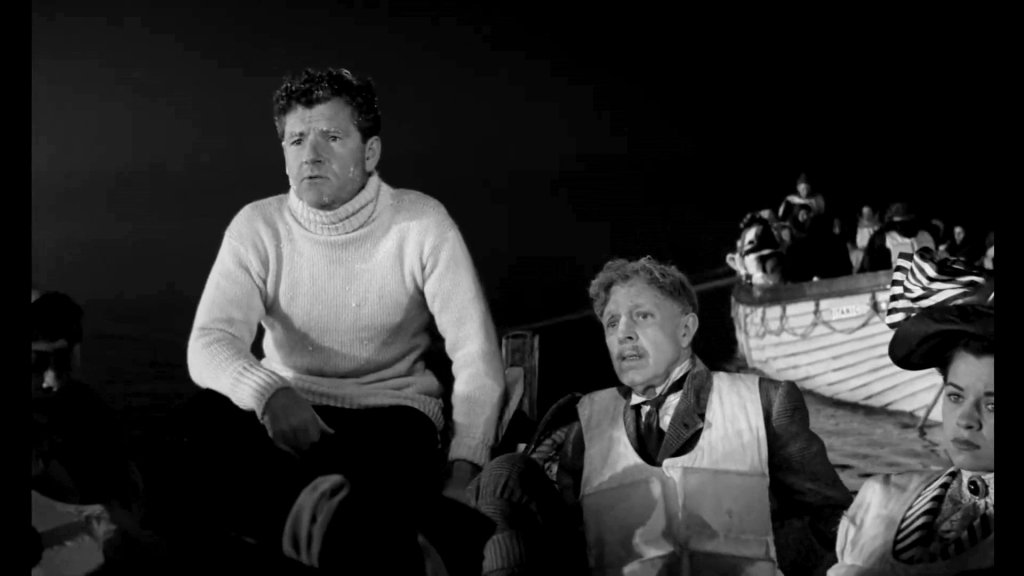
Alongside this, it’s a tribute to bravery and self-sacrifice, often expressed with that classic British reserve and dry humour in the face of imminent disaster. From Lightoller and the sailors who fight, up the final moment, to assemble two collapsible boats even as the deck sinks under water around them to the engineering crew who willingly agree to stay below deck to keep the power on – a certain death sentence (“And it’s my birthday today and all” someone good naturedly moans, while the others gather a water-logged cup of tea). Perhaps uniquely for Titanic films, there isn’t even a villain: it’s one of the few adaptations that doesn’t show Ismay (a never-the-less pompous and weasily Frank Lawton) ordering the ship to go faster. In fact Ismay is shown energetically throwing himself into the evacuation (even told to stop trying to help by Lightoller) who steps into a boat (self-loathing covering his face) only when no one else tries to take one of the available seats.

Despite which, the film doesn’t avoid the fundamental errors. The treatment of the second and third-class passengers is shockingly abrupt and impatient, as if the saving of their lives is an inconvenience on a busy night – by the time they are allowed on deck, one plaintively moans that the lifeboats have already left. A group of bellboys are ordered to remain where they are (and instructed to not smoke!) condemning them. As the scale of the disaster grows, several passengers in under-filled boats complain that they are ‘already too full’ to go back for survivors. Even Lightoller’s decisions (interpreting ‘women and children first’ as ‘women and children only’, a decision that led to half-full boats sent away) are criticised.

A Night to Remember also sprinkles itself with several touching personal stories that carry real impact. The first-class passenger who asks Andrews for a no-bullshit appraisal, then quietly ensures his wife and sleeping children board a lifeboat. The Stausses who refused to separate and go down with the ship. A lost child saved from trampling by a steward, who promises him it will all be over soon as they sink. The young couple crushed by a falling funnel. The heartless card sharp who turns out to have a capacity for calm self-sacrifice.

And it could all have been avoided. More than any other film A Night to Remember focuses on the unquestioning crew of the Californian who watch the sinking from ten miles distance (including the never-ending launch of emergency rockets) but having no instructions or initiative don’t do a thing (they switch their radio off rather than try and find out more). The rigid mindset of the system right there: disasters just don’t happen to British ships (Britannia rules the waves after all) so no reason to rock the boat. They are contrasted with the professional urgency of the Carpethia (who did leave their radio on) who race against hope to help.

A Night to Remember captures this all extremely effectively, remaining a powerful and documentary look at the simple facts of the world’s second most iconic (after Pompeii) disaster. Full of some very fine performances and shot with a pacey assurance by Roy Ward Baker, it remains one of the definitive studies of the diaster.

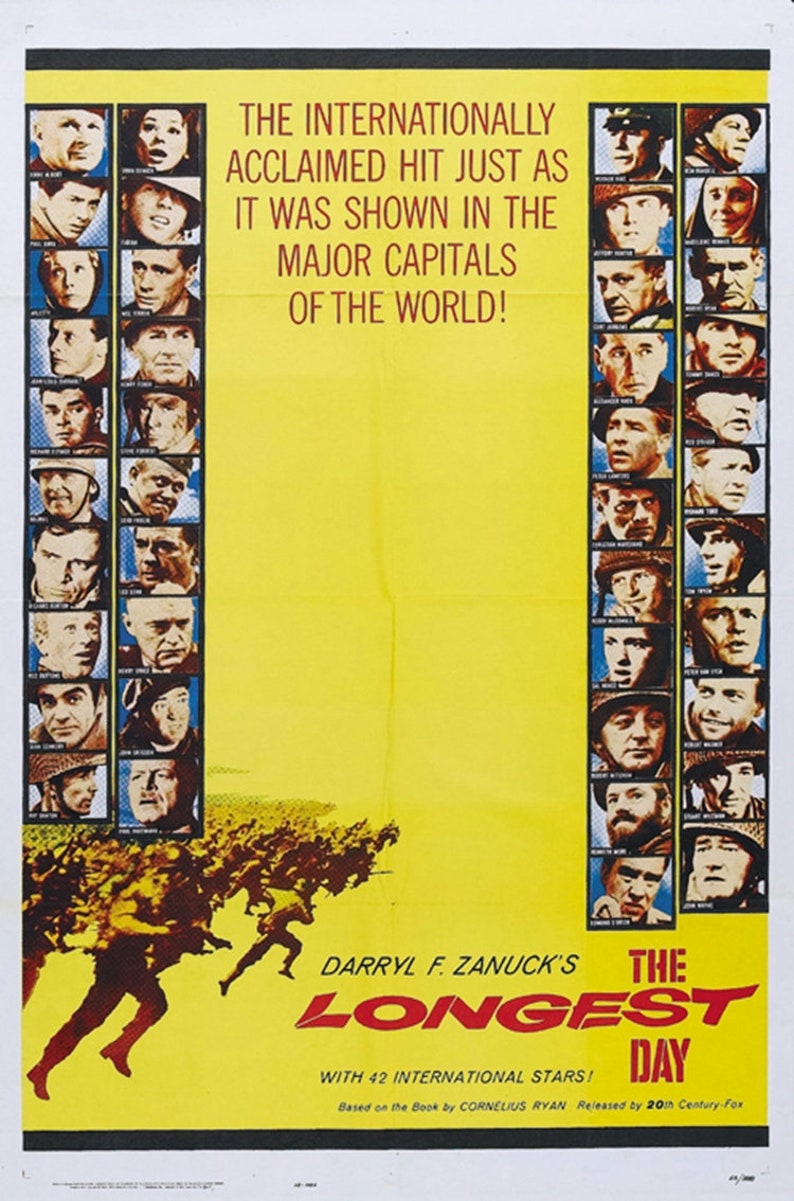
The Longest Day (1962)

John Wayne leads the charge on The Longest Day

Director: Ken Annakin, Andrew Marton, Bernhard Wicki

Cast: John Wayne (Lt Col Benjambin Vandervoot), Henry Fonda (General Theodore Roosevelt Jnr), Robert Mitchum (General Norman Cota), Richard Burton (FO David Campbell), Eddie Albert (Col Lloyd Thompson), Sean Connery (Pvt Flanagan), Curd Jurgens (General Gunther Blumentritt), Richard Todd (Maj John Howard), Peter Lawford (Brig Lord Lovat), Rod Steiger (Lt Com Joseph Witherow Jnr), Irina Demick (Jeanine Boitard), Gert Frobe (Pvt “Coffee Pot”), Edmond O’Brien (General Raymond Barton), Kenneth More (Capt Colin Maud), Robert Ryan (Gen James Gavin), Red Buttons (Pvt John Steele), Christian Marquand (Cpt Philippe Kieffer), Jean-Louis Barrault (Fr Louis Rolland), Arletty (Mdm Barrault), Paul Hartmann (Field Marshall Gerd von Rundstedt), Werner Hinz (Field Marshall Erwin Rommel), Wolfgang Priess (General Max Premsel), Peter van Eyck (Lt Col Karl Williams Ocker)

Darryl F Zanuck wanted to make the War Film to end all War Films. So, what better way than to restage D-Day itself, with a cast (as the poster brags) of 42 International Stars, playing out almost in real-time. It’s a grand ‘mock-documentary’ shot in black-and-white (so that actual war footage can be integrated into the film) and aims to show the perspectives of the four main combatants (the Americans, the British, the French and the Germans – with all their scenes played in their respective languages). Adapted from a definitive D-Day book by Cornelius Ryan, it makes for huge, now slightly old-fashioned, Sunday afternoon fun and one of the most iconic second world war films.

To make his dream come true, Zanuck left no stone unturned. Pretty much every single part is played by a ‘name’ actor (although, rather like Around the World in 80 Days, time has left some of them less recognisable than others) no matter how small the role. And I mean no matter how small. Many of the actors appear in no more than one or two scenes. Steiger chips in a brief speech as a Naval officer. Burton has two scenes as an RAF officer, one of the last of the “Few”. Fonda contributes a few minutes of heroism as Theodore Roosevelt Jnr. Robert Ryan briefs The Duke as General Gavin. Jean Servais makes a grand speech as a French Admiral. Gert Frobe doesn’t even speak as a (what else?) bullying German soldier. This parade of stars does though does mean you pay a lot more attention to every single part and it makes it a lot easier to keep track of who’s who.

It’s certainly a ‘producer’s’ film. Zanuck held complete creative control, splitting the directorial duties between three hired hands. Annakin directed all the British and French scenes (and most of the American ‘briefing room’ scenes). Martan, an experienced second unit director, was hired to shoot most of the battle sequences. Wicki looked after the German sequences. With the brief being to replicate the documentary style of actual footage, naturally this basically led to a film that doesn’t have the feel of being ‘authored’ (in the way, say, Saving Private Ryan does), but it’s functional shooting style and design does make it fairly easy to follow.

And it needs to be easy to follow, as this is a very long film indeed – and with the cast frequently changing from scene to scene, can become overwhelming. The quick changes of location – and the lack of time spent with any single character – often means it’s hard to connect to strongly to any of the individual characters. Most of the more prominent characters gain their personality solely from the actors playing them: so I don’t really know what the real Colonel Vandervoot is like, but I know his character here is basically ‘John Wayne’.

The more prominent roles in the script rely on these personality parts. Wayne probably has the largest individual role as the Paratrooper commander who breaks his ankle on landing, but doesn’t let that slow him down from hitting his objective. (Wayne also gets a great little speech, the sort of thing much missed in Ryan, where he praises Brit fortitude under the Blitz, which is a lovely moment of Allied brotherhood). Mitchum gets the juiciest action as General Cota, the highest-ranking soldier on Omaha Beach, who leads the first break out. At the other end of the ranking, Red Buttons brings charm and heartfelt emotion to the most memorable sequence as Pvt John Steele, the paratrooper who landed on top of the church spire at Sainte-Mère-Église, deafened by bells and forced to watch the rest of his platoon slaughtered on landing.

The scale is really what it’s all about. The recreation of the D-Day landings is stunning (the first boats, though, don’t hit the beaches until well over two hours into the film), and its genuinely hard to tell the difference between what is recreated and what is actual war footage. The film doesn’t shirk from showing the cost of war, or the slaughter on that beach (although of course, it looks reserved compared to Ryan). But the combat and operations elsewhere are also perfectly recreated. Richard Todd is very good as Major John Howard, in an expert reconstruction of the seizing of the Orne Bridges near Caen (in real life, Todd himself was one of the commandos serving under Howard and even has a scene where Todd as Howard talks to another actor as Todd).

These battle sequences make for compelling viewing. Slightly less so is the long build-up of the Allies to the attack. There are many, many scenes in various briefing rooms and for every delight (such as Jack Hedley’s briefing around “Rupert” a model paratrooper, dropped as a distraction) there are po-faced actors staring into the middle distance and discussing how important everything is. By far and away the most interesting content in the first half is less the Allies (waiting to leave) than the Germans (trying to work out how and where the Allies will arrive). These scenes feature a range of German officers, from the quietly resigned to die-hard, head-in-the-sand Fascists, and revolve around a series of fascinating debates on where, when or even if at all the Allied attack will come. With a cast of excellent German actors – Jurgens, Preiss, Hartmann, Hinz and Wolfgang Buttner are particularly fine – these scenes stand out as they present a perspective we don’t often get to explore. (Even though the film squarely accepts the German military view that the defeat was all Hitler’s fault and the army was completely blameless of any of the crimes of Nazism.)

After the slow-build, the explosion of tension and action is done really effectively. Sure, the film is long and episodic, but the ever-changing locations do frequently help with the pace. The film’s documentary style also lends it a great deal of authority that a more ‘fictional’ film would not have. After all, pretty much everyone in the film is ‘real’ and while the film could be seen as a collection of D-Day anecdotes, strange moments – such as a platoon of Germans and Americans passing each other on opposite sides of a low wall without noticing each other – have the ring of truth. The script was doctored by a host of major novelists and playwright (including Noel Coward) to brush it up, but really this is a producer’s triumph.

And it is a triumph for Zanuck. Everything he sought to do, he accomplished here – and the doubts that he could pull it off were moved as wrong, as those who doubted whether the Allied plan to cross the Channel would work. Hugely impressive in its staging, detailed in its recreation and with a cast of stars and top actors giving every scene a fresh bit of life, this makes for one of the all-time classic war films.

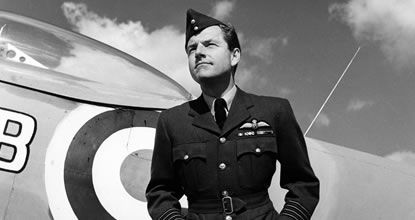
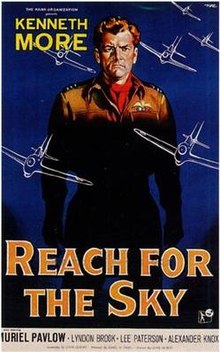
Reach for the Sky (1956)

Kenneth More fights disabilities and the Gerries in Reach for the Sky

Director: Lewis Gilbert

Cast: Kenneth More (Douglas Bader), Muriel Pavlow (Thelma Bader), Lyndon Brook (Johnny Sanderson), Lee Patterson (Stan Turner), Alexander Knox (Dr Leonard Joyce), Dorothy Alison (Nurse Brace), Michael Warre (Harry Day), Sydney Tafler (Robert Desoutter)

There are few stories of the Battle of Britain that captured the public imagination than Douglas Bader, fighter pilot ace whose exploits in the battle – and later in Nazi captivity – were all the more extraordinary because he had no legs. It’s one of the best examples around of good old fashioned British pluck helping overcome something – and Bader is without doubt a stirring hero, whose inspiration was so great he still frequently pops up in longlists of Greatest Ever Brits.

At least part of that continued inspiration is probably connected to this film. In fact Bader himself said his own public persona had been almost completely consumed in the public perception by Kenneth More’s performance of him. Needless to say Bader’s foul mouthed real personality (which left the briefing room littered with f-bombs) and abrasive difficultness (he refused to watch the film for almost ten years after a trivial dispute during its making about whether he would be allowed to double for More in long shots) was largely forgotten.

Indeed, the real Bader is washed away in Reach for the Sky by Kenneth More at his most charming, rogeuish and light. More (by his own admission) was not the actor with the greatest range in the world, but he was perfect for the sort of maverick, plucky, never-say-die Brit Bader was presented as in the film. Reach for the Sky ticks all the boxes of the events in Bader’s life as you might expect. From initial accident, to learning to walk again, to getting back in the sky, More plays it all with a brash bonhomie and British character that makes Bader charming and engaging – rather than the difficult egotist he reportedly was in real life. So much so that you kind of forget that Bader’s initial accident is largely caused by his own arrogance and stupidity attempting a dangerous manoeuvre to show off to a range of new pilots. 

But then that’s because Bader’s ruthless determination to get back in the sky is inspiring. Reach for the Sky isn’t the film that’s going to make you question anything to do with the war or the dangers or costs of the work we do. Putting it simply, this is practically an advert for the British war effort made ten years after the war finished. It actually feels a bit odd that this film hit the cinemas and because a smash hit in the same year as Suez showed Brits that all the Empire-first, Britannia rules the wavesness the film celebrates was a pile of outdated guff. 

But that isn’t to say that what that this film tries to do, it does badly. It lacks the sense of narrative adventure as stuff like, say, The Dam Busters or the importance of working together like Ice Cold in Alex or the bitter cost of war like The Cruel Sea. But as a portrait of a maverick doing his own thing and keeping the British end up its pretty much bang on. There isn’t really room for any other characters in the film’s narrative. It’s nominally narrated by a training colleague of Bader, but he’s barely a presence – the film zeroes in on Bader alone.

It makes for some decent scenes and there is a fair bit of inspirational feeling from watching Bader persevere – while never losing his temper – with walking again or taking up golf with a bullish determination. More’s Bader never shows a flash of anger or bitterness at things that have happened to him, instead carrying on with a jolly “Britain can take it” matey-ness. It makes him an entertaining person to follow around, even if the film itself isn’t particularly dramatic and offers a fairly safe version of an age-old “overcoming all odds” plot. Certainly enough to explain the films continued popularity and lifespan on Sunday afternoon TV. 

And it touches a nerve because, even if he was a fully paid up member of the awkward squad in real-life, what Bader did – and the force of personality required to do it – were extraordinary, the sort of thing only 1 in a hundred could even consider doing. To not only walk again having lost both legs, but to fly – and to become a decorated war hero – is way beyond (thankfully!) the imagining of almost everyone watching the film. And, for all the weaknesses of the film, you can’t ignore or disregard the fact that Bader is an inspiration. More is excellent in a lead role tailored completely to his strengths, and the film has a charming boys-own adventure feel to it. It’s not a smart film, but it’s a crowd pleaser and nothing wrong with that.

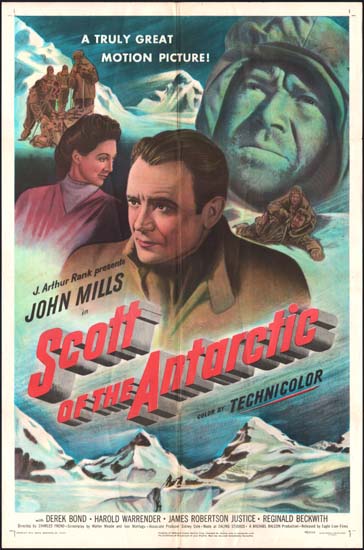
Scott of the Antarctic (1948)

Scott of the Antarctic (1948)

Captain Scott’s tragic end is bought to life with low-key hero worship

Director: Charles Frend

Cast: John Mills (Robert Falcon Scott), Diana Churchill (Kathleen Scott), Harold Warrander (Dr Edward Wilson), Anne Firth (Oriana Wilson), Derek Bond (Captain Laurence Oates), Reginald Beckwith (Lt Bowers), James Robertson Justice (PO “Taff” Evans), Kenneth More (Lt Teddy Evans), Norman Williams (William Lashly), John Gregson (Tom Crean), James McKechnie (Dr Edward Atkinson), Barry Letts (Apsley Cherry-Gerrard), Christopher Lee (Bernard Day), Clive Morton (Herbert Ponting)

There are perhaps few more controversial figures in historical discussion than Robert Falcon Scott. The great polar explorer was, for most of his career, and for a long period after his death in 1912, a national hero, the man who – with stiff-upper-lip bravery – gave his life struggling against the elements to conquer the South Pole. Scott’s reputation only began to be questioned in the late 1970s, with a series of biographies culminating in a near-vicious – but compelling – anti-Scott argument laid out by Roland Huntford in his book Scott and Amundsen. Scott’s many flaws – both personal and in planning – set a new landscape for seeing his achievements as carrying too high a cost, especially in an atmosphere where the extreme sacrifice was seen as something to be avoided if at all possible, rather than an everyday fact of life for post-war generations.

In this context, watching this Ealing Studios 1948 Scott biopic – one of the biggest box-office hits of its year in the UK – is an interesting experience. While the film’s tone and its depiction of Scott are essentially fairly heroic, the film flirts at points with the errors and misjudgements that led to Scott leading himself and his companions into an icy immolation in a tent eleven miles away from a depot that could have given them a chance to survive.

Frend’s film is very well made and beautifully shot – so perfectly does it capture the look and feel of the Antarctic, and the extreme cold, that you overlook the fact that at no point can you see the actors’ breath – and it covers the main points of the expedition very well. It’s in some ways, today, almost hilariously stiff-upper lip, with the expedition members marching dutifully (and with a self-deprecating smile) to certain death, and the ladies at home speaking with such cut-glass primness you have to keep checking that Celia Johnson isn’t in the film.

There are some strong performances, not least from Mills (a very close physical likeness for Scott himself). Mills was the perfect choice for this role –overflowing with a sense of duty, but with a slight edge of idee fixe pride where it’s clear that he’s not willing to budge from anything to do with his mission. Harold Warrander also makes a strong impression as an artistic spirited scientist, Dr Wilson, who quietly hides his premonitions of disaster and later feelings of regret due to a sense of personal loyalty to Scott. Reginald Beckwith, James Robertson Justice and Kenneth More also give decent performances.

But the main appeal is the glorious technicolour look of the film. The film used no fewer than three photographers and brilliantly mixes together painted backdrops, studio locations and some genuine location footage with skilful and glorious aplomb. The technicolour tinge to the shots is wonderful – watching it in high definition, it’s like a series of polar expedition photos brought skilfully to life. The film in fact apes several of the famous photos from the expedition with such beauty that you feel like they could be printed and framed.

The plot however is more concerned with checking off the events of the expedition – from its conception, through its financing and recruitment, initial excursions and the final (futile?) march to the pole and the death march home. Frend’s film is clearly largely intended to be hagiographic – the men are by-and-large totally committed to the journey, there is nary a cross word between them, and the film never really questions the point or purpose of the journey – or if it was worth the lives of five men to achieve it.

However, there are moments where the film leans towards a more interesting criticism of Scott’s planning and leadership. The funding campaign is largely a disaster, bailed out only by a last minute donation. Scott ignores advice from famed explorer Nansen to take dogs (man hauling is of course more noble) and places far too much faith in motor sledges (he is shown ruefully staring at one after it breaks down). Equipment – not least the vital fuel canisters kept at depots – is shown to be inadequate. The dogs perform extremely well – far better than the horses. The film doesn’t avoid the grisly fate of the horses either – I’ve never understood Scott defenders who claim it would have been cruel for Scott to take dogs to the pole, but never question the working to death and shooting of ponies in conditions they were totally unsuited for. 

The film skirts around the moral responsibility Scott bore for the death of the men who entrusted their lives to his planning. It does show – faithfully – the final depot being placed one degree less further south than originally planned (a shortfall that would contribute heavily to dooming the men later on). But as first Evans then Oates pass away, the film focuses on the tragic loss rather than the planning, preparation and “cut to the wire” contingences Scott was working with that contributed to this (not least his last minute decision to expand his polar party to five from the original number of four, sending three men back to base – with all rations and provisions having been packaged for two teams of four). 

The film is less interested in this, more keen on showing the heroic progression of events. It gives us moments, but the main purpose of the film is to sing the praises of Scott. This means, for me, the film becomes more and more deficient as time goes on and the histographical debate around Scott becomes all the richer and more engaging. For all the qualities of the film itself technically, it doesn’t have anything to contribute towards this and just offers up the straight printing of the legend.

For me, by the way, Scott is almost the ultimate expression of Edwardian amateurness, taking on the most challenging environments of the world with a superb confidence in a “special role” for the British in history. While Huntford’s personal dislike for Scott stings too much, there are legitimate points to be made about Scott’s poor planning, his obsessive disregard for learning from his mistakes and his refusal to engage with or embrace the sort of Inuit techniques that Amundsen learnt from. And, at the end of the day, while you could say Scott was unlucky compared to Shackleton, whose equally disastrous expedition at least saw all his men return alive, the fact remains that Scott’s old-school, old-fashioned, Britain-shall-prevail-attitude led not only to his own death but the deaths of four other people in hellishly cold conditions thousands of miles away from their families. Say what you like for his bravery, but don’t forget the price that others also paid for it.