Tag: Kevin Bacon

Apollo 13 (1995)

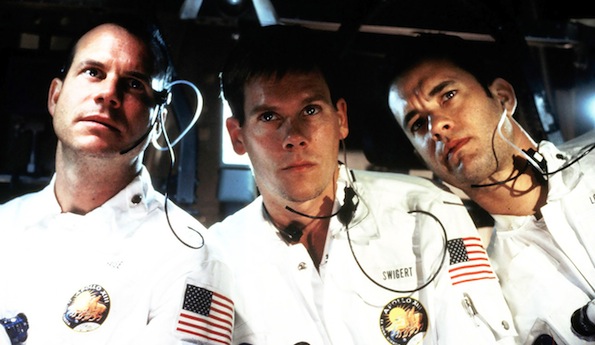
Bill Paxon, Kevin Bacon and Tom Hanks are stranded in space in Apollo 13

Director: Ron Howard

Cast: Tom Hanks (Jim Lovell), Kevin Bacon (Jack Swigert), Bill Paxton (Fred Haise), Gary Sinise (Ken Mattingly), Ed Harris (Gene Kranz), Kathleen Quinlan (Marilyn Lovell), Chris Ellis (Deke Slayton), Joe Spano (NASA Director) Xander Berkeley (Henry Hunt), Marc McClure (Glenn Lunney), Clint Howard (Sy Libergot), Ray McKinnon (Jerry Bostwick), David Andrews (Pete Conrad), Christian Clemenson (Dr Charles Berry), Brett Cullen (CAPCOM1)
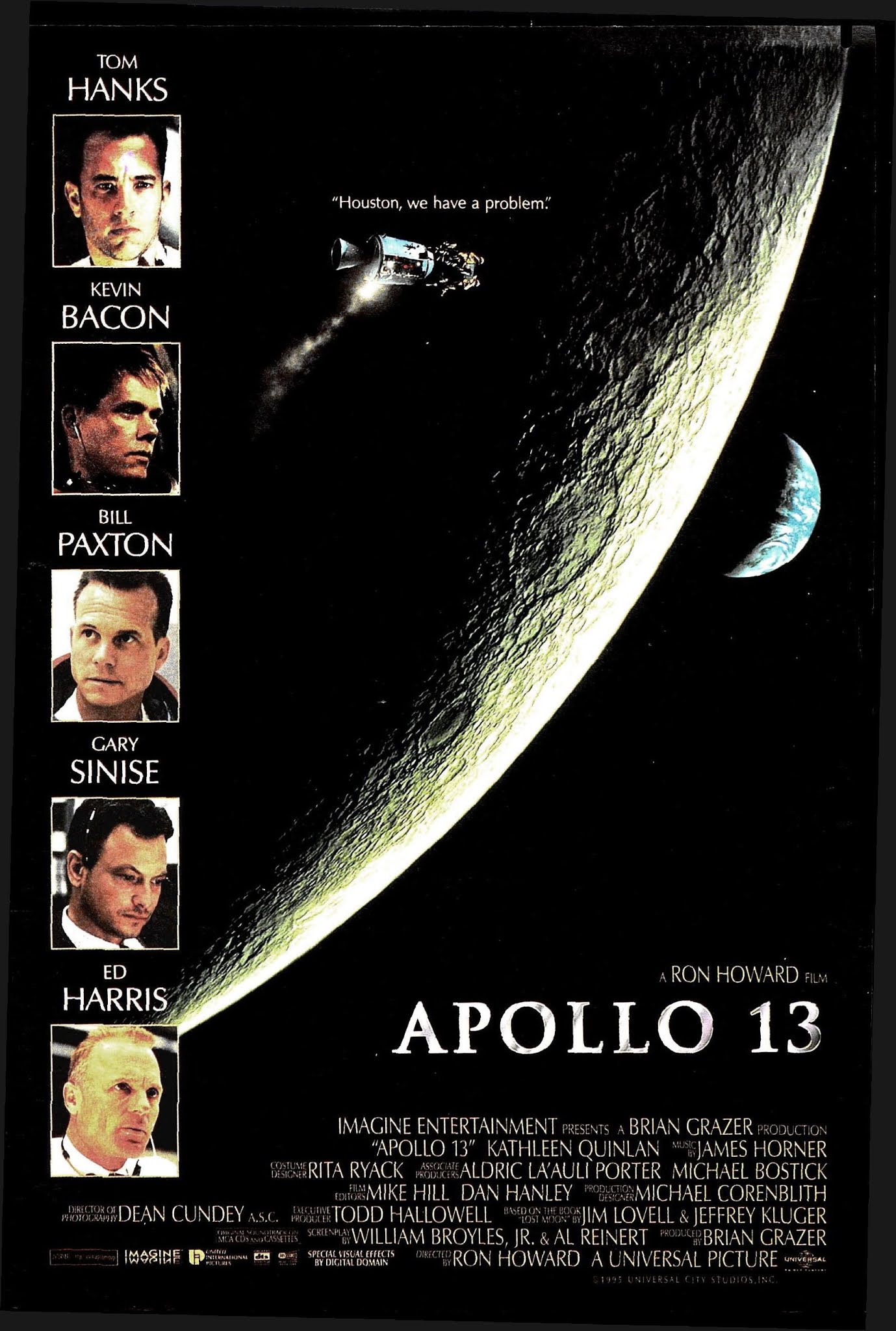
“Houston we have a problem”. Those calmly spoken words coat an ocean of disaster in Ron Howard’s brilliant reconstruction of the disaster-that-very-nearly-was, Apollo 13. Without a shadow of a doubt Howard’s finest film, this is brilliantly tense and hugely engaging that builds an edge-of-the-seat tension around a true story. You can’t watch it without being filled with breathless admiration for the ingenuity of those in mission control and the courage of those in space as they worked together to bring the mission home. Truly “Failure is not an option”.

On a mission to the moon, Mission Commander Jim Lovell (Tom Hanks) and crew Fred Haize (Bill Paxton) and late replacement Jack Swigert (Kevin Bacon) are left desperately trying to salvage their ship after an accident strikes. Meanwhile back in Houston, Flight Director Gene Kranz (Ed Harris) and replaced crewman Ken Mattingley (Gary Sinise) lead a dedicated team juggling every inch of mathematical, scientific and practical knowledge they have to bring the ship home.

Apollo 13 is a masterpiece of reconstruction. Every inch of the NASA space programme is reassembled in perfect detail. Every nut and bolt, from procedures to the interplay between the astronauts and Ground Control. There isn’t a single false note, and every single element of the production, photography and editing is carefully placed to support this total immersion in period. Howard’s technical direction is brilliantly done, intercutting with a fabulous sense of pacing between the crew in space and Ground Control back here on Earth. It becomes one of the most engrossing and involving true-life stories you can imagine.

I love this film. I love every second of it. Every single time I see it – and I must have watched it at least once a year since 1996 – I get wrapped up in the tension and, perhaps even more than that, the inventiveness needed to solve problems in space. The film throws conundrums at us time and time again. The command module needs to be restarted to land the ship – but only has enough power to keep a coffee machine running for a few hours. A vital course correction, that a computer could calculate and perform, needs to be carried out by hand. The weight of moon rocks needs to be replicated in the landing module. And, most brilliant of all, the NASA boffins need to work out literallyhow to fit a round peg into a square hole in order to replace a CO2 filter – using nothing but the pile of equipment on the spaceship.

These problems all need to be solved by people low on sleep, high on stress and – in three obvious cases – stranded, cold and alone in space, and each one is carefully explained by the film’s very natural but highly detailed script and then relayed into nail-biting efforts to solve them. (James Horner’s score also works wonders here, communicating the awe of space and our vulnerability in that black void expertly.) In no other film can the tearing of a plastic bag have you gasping at the impact it could have on life or death.

Added to the impact of this, is the engrossing excitement of watching brilliantly trained professionals tackle the sort of situations that would reduce you or I to sweaty panic. Other than a brief moment of recrimination between Haise and Swigert (authoritatively quashed by Lovell’s “Gentlemen, we are not doing this”), everyone stays more cool, calm and collected than you could possibly expect. This also means that flashes of urgency or emotion carry huge impact in communicating stress: when Libergot stresses powering down the ship is the only way for the crew to survive or Lovell is caught on radio ranting he is “well aware of the Goddamn gimbels” while trying to pilot a ship leaking oxygen through a barrage of debris to a soundtrack of alarms, the pressures they are trying to cope with come thundering home to us.

The extraordinary work of the actors also goes a long way towards the film’s success. If any film cemented Tom Hanks’ everyman quality, it was this one. His Jim Lovell is calm, controlled and extremely grounded, a professional with a realistic outlet, a devoted family man and overwhelmingly ordinary for all the extraordinary things he’s done. Hanks brings the role a huge authority and acres of empathy and relatability. He seems both vulnerable, human and professionally assured. I’d trade both his Oscar-winning performances for this one.

The whole cast follows his lead. Bacon and Paxton are very good as the rest of the crew, juggling moments of fear, frustration and black humour. Ed Harris became a star character actor overnight with his brilliant performance as Kranz, another committed professional who refuses to countenance failure and guides the ground team through super-human efforts, while keeping his own emotions carefully under control. Kathleen Quinlan is impressive as Lovell’s wife, keeping the morale of those left behind as high as she can while barely controlling her own fear. Gary Sinise’s Ken Mattingley channels his resentment at being benched from the mission into a Herculean commitment to bringing them home.

It’s that commitment on the ground that Howard’s film so brilliantly understands. A lesser film would have focused overwhelmingly on the courage of the astronauts alone, and heightened their struggles to pilot the spacecraft and survive. Apollo 13 understands above all that this was a team effort – and the casting and scripting feeds brilliantly into this. No one is the “hero”, no one “saves the day”. Every character focuses on their own small piece of the puzzle and has to trust all the others worked out. The film gives huge amounts of time over to the boffins and geniuses of Mission Control – all brilliantly played by a host of character actors – and its respect for these unsung heroes is as great as it is for Lovell and his crew.

Howard also understands exactly when to up the music, editing and effects and when to slow the film down and let events quietly play out. Moments in space where the actors have to quietly reflect, or when we check in on the fears and concerns of the families back home, contrast perfectly (and carry even more impact) when they sit alongside the scenes of failures and rushes to save lives. As for that re-entry scene… is there any more tense scene in a true story film than that long, long wait to see if Apollo 13 will return from space? There are certainly fewer moments that will get those specks of dust irritating your eyes – I get a lump in my throat just thinking about it.

Everything in Apollo 13 is spot on. I would go further and say I’m not sure there is a single wrong beat in it. It’s Howard’s masterpiece – his infamous snubbing for an Oscar nomination is inexplicable, his direction here is vastly superior to winner Mel Gibson’s work on Braveheart. It turns a true-life story into an impossibly tense, deeply involving, hugely emotional story. The actors – some of whom shot for weeks in a “vomit comet” plane to replicate weightlessness, an effect that works superbly – are outstanding. Every single technical aspect of the film is spot on. Its emotional impact is as absolute as the admiration and respect you’ll feel for the real NASA crews that guided this mission home. Apollo 13 is a classic. I can’t imagine anyone not finding something in it to like – not many films you can say that about.

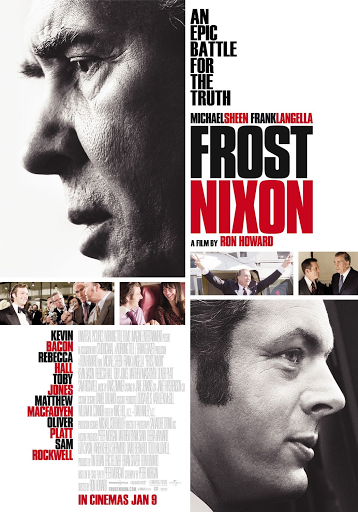
Frost/Nixon (2008)

Frost Nixon header
Frank Langella and Michael Sheen face-off in famous interviews in Frost/Nixon

Director: Ron Howard

Cast: Frank Langella (Richard M Nixon), Michael Sheen (David Frost), Kevin Bacon (Jack Brennan), Rebecca Hall (Caroline Cushing), Toby Jones (Irving “Swifty” Lazar), Matthew MacFadyen (John Birt), Oliver Platt (Bob Zelnick), Sam Rockwell (James Reston Jnr), Clint Howard (Lloyd Davis)

If there is a bogeyman in American politics, it will always be disgraced President Richard Nixon. Because, however divisive Donald Trump is, Nixon will always be the king who was toppled, the man some consider a crook and a war criminal, others a gifted politician and negotiator. The truth is somewhere, as always, in the middle – but what seems inarguable is that Nixon was a man of deep personal flaws, which contributed considerably to his fall. Peter Morgan’s play explored the complexities of Nixon’s character through his famous TV interviews with British talk show host David Frost, a man with a few chips of his own. Ron Howard takes what was already a fairly cinematic script by Morgan, and produces a smoothly professional, entertaining and very well acted film.

After Richard Nixon (Frank Langella) has been forced into resigning, he is in the political wilderness. Watergate engrossed the world, with hundreds of millions of people tuning in to follow every detail. Who in television could resist those numbers? Certainly not David Frost (Michael Sheen), who believes if he can secure an exclusive interview with Nixon he could have a television package that could pull in millions of viewers, make Frost a fortune, and catapult him into the front ranks of TV interviewers. Slowly the project comes together. But both participants have a lot to prove: for Nixon this could be a chance of redemption; for Frost to prove he is more than a chat show host better suited to grilling the Bee Gees than the President. With both men underestimating each other, who will emerge on top in the interviews?

One of Ron Howard’s greatest strengths as a director is his ability to elicit fine performances from good actors. This is the real bonus he brings to this faithful adaptation of Morgan’s award-winning play. He presents it with a highly skilled professionalism and a refreshing lack of distraction that allows the audience to focus on the acting and the dialogue, its real strengths. Frost/Nixon is sharply written – with Peter Morgan’s expected mix of careful research and dramatic licence (most especially in a late-night phone call between the two men before the final day’s filming) – crammed with fine lines, well drawn characters and fascinating insights into both politics and television.

Perhaps Howard’s finest decision was to ensure the two stars of the play (in both the West End and Broadway) were retained for the film. Langella and Sheen’s performances – already brilliant in the stage version, which I was lucky enough to see – are outstanding here, both of them completely inhabiting their characters. The comfort and familiarity between the two performers are crucial – and ensure that the vital scenes between the two characters carry an electric charge.

Langella brilliantly captures the physicality and voice of Nixon, but also finds deep insights into the President’s tortured soul. He communicates Nixon’s sense of inadequacy and bitterness, his resentment at having to fight all his life for things others have been gifted. He balances this with Nixon’s pride and paranoia that constantly leads him to cheat others first. Langella’s Nixon, lost and bored in retirement, is desperate to regain his statue, but also tortured by a guilt and regret he can hardly bring himself to name. Under his robustness and confidence, lies deep shame and sorrow. It’s a brilliant capturing of perhaps the most psychologically complex leader America ever had.

Sheen is just as superb as Frost. As you would expect from an accomplished mimic, the voice is almost alarmingly accurate (he makes a better Frost than Frost did!). But just as insightful is his understanding of Frost’s psychology. Just like Nixon, Frost is a hard-working lad from a poorer background who has had to fight for everything he has. Sheen’s Frost is a phenomenal hard worker – producer, financier and star of his own career – who works hardest of all to appear an effortlessly confident dilettante. Sheen’s Frost balances immense pressures – facing personal and financial ruin – with an assured smile, keeping every plate spinning by never allowing a moment of doubt.

It leads into fascinatingly different attitudes to the interviews themselves. Nixon prepares in detail – and determines his best strategy is long winded answers that present his case and prevent attack. Frost is so focused on delivering the interviews that he sacrifices his actual interview preparation (certainly more so than he did in real life). Morgan uses the conventions of boxing dramas – corners, breaks between ‘rounds’, advice from their trainers – to capture a sense of gladiatorial combat.

However, the play is more complex than this. The reason why Frost struggles to land a glove on Nixon in earlier interviews on his domestic and foreign policies is that Nixon genuinely believes he is in the right – but (perhaps as Frost understood) the final interviews based on Watergate will see a more vulnerable Nixon as on that subject he knows he’s in the wrong. I suspect the real Frost knew that to get to Nixon on that final topic, he needed to be ‘softened up’ first to feel comfortable and produce a revelation.

Because the film is refreshingly positive in its view of television. A medium that films often attack for being trivial and boiling things down to soundbites and snippets, here acknowledges the strengths that can bring. A single snippet of an apologetic and crushed Nixon is worth thousands of words – and small moments can turn a TV programme from a failure to an event. Howard uses the power of the close-up at these moments to demonstrate how TV can zero in with a merciless gaze on a single moment. It’s a defence of the power of TV and its ability to reduce things down to moments.

Howard’s understanding of the strengths that lie at the heart of the play – and to tell the story simply – is what makes an already cinematic play translate wonderfully to the screen. With Langella and Sheen outstanding (with the supporting cast all equally excellent), the film entertainingly demonstrates the preparation and delivery of the interviews, while offering shrewd psychological insights into two men who had a lot more at a stake – and in common – than at first appeared. Professional, handsome and captivating, this is Hollywood movie making at its best.

JFK (1991)

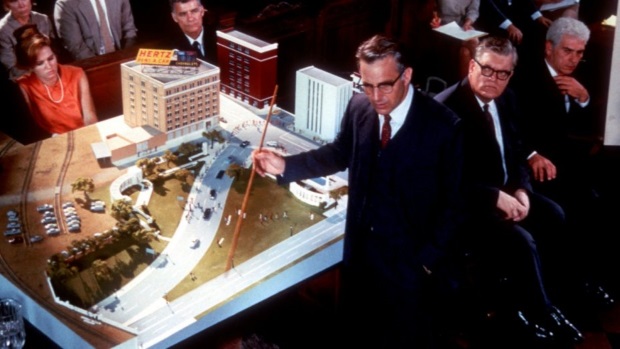
Kevin Costner goes on a quest for the truth in Oliver Stone’s crazy but brilliant JFK

Director: Oliver Stone

Cast: Kevin Costner (Jim Garrison), Sissy Spacek (Liz Garrison), Kevin Bacon (Willie O’Keefe), Tommy Lee Jones (Clay Shaw), Jack Lemmon (Jack Martin), Walter Matthau (Senator Russell B Long), Gary Oldman (Lee Harvey Oswald), Joe Pesci (David Ferrie), Donald Sutherland (Colonel X), Laurie Metcalf (Susie Cox), Michael Rooker (Bill Broussard), Jay O. Sanders (Lou Ivan), Edward Asner (Guy Banister), Brian Doyle-Murray (Guy Banister), John Candy (Dean Andrews), Sally Kirkland (Rose Cheramie), Wayne Knight (Numa Bertel), Priutt Taylor Vince (Lee Bowers), Tony Plana (Carlos Bringuier)

When great events happen, it’s hard for us to accept they might take place for random reasons. Rather than freak occurrences or boring individuals, we’d rather see them taking place due to an impenetrable web of shadowy figures. There is something in us that rejects randomness and embraces order. Conspiracy theories are the (ironic) result of these, with their exponents often the most passionate believers in the all-pervading genius of big government. Events like the death of President Kennedy can’t be because some nobody shot him. Instead it must be part of a wider junta of baddies, with every man you see merely a front for a cabal of the wicked. It’s hard not to be swept up by the lure of the conspiracy theories (they invariably have the best stories after all) – and Oliver Stone’s JFK is perhaps the definitive mainstream conspiracy theory essay.

Taking the campaign of Louisiana DA Jim Garrison (Kevin Costner) to find out the “truth” about the murder of President Kennedy, Stone’s film is part a fascinating presentation of half-truths and “might-have-beens” and part a sprawling mess of irresponsible nonsense. Either way it’s assembled with astonishing panache, a level of filmic skill that makes it (literally) almost impossible to tell whether what you are seeing is true and what is invention. Stone’s film superbly interweaves a variety of film stocks and effects to seamlessly splice together newsreel footage, Zapruder film and his own reconstructions so brilliantly it frequently becomes hard to tell which is which.

The same logic also applies to the script. JFK is frequently engaging and fascinating. But you have to remember that it is the equivalent of meeting the most literate and articulate street corner “End-of-the-Worlder”. Such is Stone’s skill he could, I am sure, have created an equally compelling film which would have you questioning the Moon Landings or the shape of the Earth. JFK throws an army of questions, objections and theories at the screen. And while it rarely provides much in the way of answers, only points that it wants you to think about, these theories frequently fascinate. Imagine JFK as a sort of video essay, linked together with dramatic scenes, with its points delivered by authoritative and trusted actors like Donald Sutherland, Jack Lemmon and Walter Matthau.

There is absolutely no doubting the technique of Stone here, or his mastery of the language of cinema. The work of Robert Richardson’s photography, with its myriad styles, and of Joe Hutshing and Pietro Scalia’s editing, pulling together a host of images, snapshots and flash cuts into an insidiously convincing whole, is breathtaking. Light in particular is superbly used, casting some characters in shadow, flaring up to (literally) blind others – light frequently plays across Garrison’s glasses, a visual metaphor for his own struggle to see the light. The speeches he writes for his characters are superbly done, and make their points with great skill – Sutherland (superb) has a hugely convincing story of military black ops action (and inaction) before and after the assassination that fills almost 20 minutes of screentime.

There are compelling arguments made about the ability of Oswald to fire the shots, the triangulation of fire, the spurning of an easier shot before the fateful turn, Oswald’s seemingly illogical movements after the shooting etc. etc. There is decent reasoning behind all of this, and the points are marshalled very well. But, like all extremist theories, suddenly it will turn into something just a little batshit (Lyndon B Johnson ordering the hit or some sort of cabal of Cubans, CIA, FBI and Secret Service working together to conduct a coup).

Much of Stone’s passion for finding the truth (the film’s mantra) is rooted in his own romantic view of Kennedy, as some sort of lost “Prince Who Was Promised”. To Stone, Kennedy would have withdrawn us from Vietnam (news I am sure to the President who started and escalated America’s involvement in it), ended the military industrial complex (contrary to his platform when elected of a stronger US military), bought the Cold War to an end (again, running against his sustained opposition to the Soviet Union) and introduced full Civil Rights (a cause he was lukewarm on at best – unlike his brother or his successor Johnson).

But Kennedy was a romantic figure who had the ability to invite people to invest him with whatever qualities they wanted (both good and bad), a magic cemented forever by his untimely murder. In reality there is no indication that JFK would do (or want to do) any of the things JFK argues he was assassinated for. But that’s all part of the magic of the conspiracy. Facts and events can be marshalled into whatever you want them to be. (Tellingly the only member of Garrison’s investigative team who questions these theories is shown to be a creep in the pay of the conspirators.)

So Kennedy can be a saint, and the film can outline (with no evidence at all beyond a series of coincidences and unlikely or random events) a grand vision of master schemers reshaping America over the body of a dead President. Does it really stand up? Well no of course not. But I will say it is compelling viewing – even if it is essential to keep an open mind about it. Stone later wished he had made clearer that much of the work here was pure fiction (and speculative at best). Certainly it’s a point to keep in mind.

Perhaps Stone should also have looked again at some of the other beats in the film. The film’s version of Jim Garrison as a kind of saintly campaigner for justice flies in the face of many (then and later) who believed the Louisiana DA a shameless self-promoter – an argument made easier to believe by the real Garrison’s cheeky cameo in the film as his ‘nemesis’ Earl Warren. No mention is made in the film that the case he brings against Clay Shaw was dismissed by the jury after less than an hour, and the film avoids explicitly showing his lack of evidence. Costner delivers the final speech, with its famous “back and to the left” commentary on what seems like Kennedy’s unnatural movement after being hit by a bullet and breakdown of the “magic bullet” (both theories now largely discredited), with aplomb, but the film puts a halo on Garrison which doesn’t really stand up.

But again at least it’s entertaining. Other parts of the film don’t even manage that: the baseline narrative that links up the various compelling conspiracy lectures is frequently dull, insipid and lamely written. Sissy Spacek has perhaps the most thankless role in film history as Garrison’s wife whose nearly every line is a variation on “Honey please stop reading the Warren Report and come to bed”. Even that though pales against the exploration of the 1960s gay scene in Louisiana (which Clay Shaw and his “fellow conspirators” were leading members of) which has an unpleasant stink of homophobia, playing into a host of deeply unpleasant (and false) stereotypes of gay people as perverted, promiscuous and preying on the straight. One suspects there was more than a little truth in the idea that Garrison’s fury at Shaw was at least partly motivated by homophobia.

These sequences work considerably less well today – and frequently go on far too long – but when the film focuses on its Kennedy theories it is at least compelling, even if it’s all rubbish. The film made it mainstream to believe Kennedy was killed by a conspiracy in which Oswald was, if he was involved at all, only a patsy. How different would the world have been if Oswald had lived and been made to explain why and how he killed Kennedy? But then chances are, being such an average an unremarkable man, people wouldn’t have believed him anyway.

Stone’s film is a triumph of agenda-led fantasy. Stuffed with faults it makes you at least ask questions – even if you wisely use those questions to affirm many of its points are questionable at best. But any film buff will love the skill it’s told with and the beauty of its technical assembly. Costner was perhaps a little too bland to drive the thing along (although the film uses his innate morality very well), but there are several good performances not least from Gary Oldman who is brilliant as put-upon, used but unknowable Oswald. Nuts, crazy and packed with compelling nonsense, it at least always encourages you to find out more about the actual history.

Black Mass (2015)

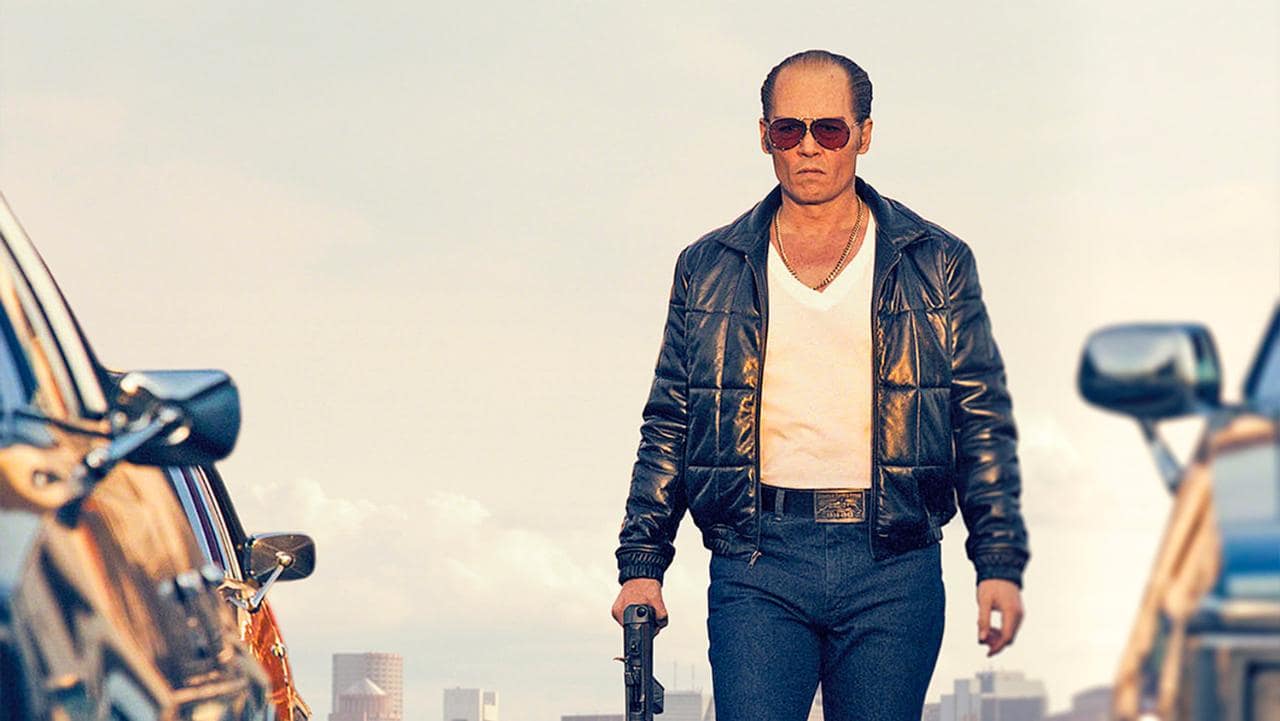
Johnny Depp dives into his make-up box in this sup-par wannabe Goodfellas

Director: Scott Cooper

Cast: Johnny Depp (James “Whitey” Bulger), Joel Edgerton (John Connolly), Benedict Cumberbatch (William Bulger), Rory Cochrane (Stephen “The Rifleman” Flemmi), Kevin Bacon (Charles McGuire), Jesse Plemons (Kevin Weeks), Peter Sarsgaard (Brian Halloran), Dakota Johnson (Lindsey Cyr), Corey Stoll (Fred Wyshak), David Harbour (John Morris), Julianne Nicholson (Marianne Connolly), Adam Scott (Robert Fitzpatrick), Brad Carter (John McIntyre), W. Earl Brown (Johnny Martorano)

Well Goodfellas casts a long shadow doesn’t it? Certainly long enough to completely drown Black Mass which, despite some good acting and period detail, never really comes together into something compelling or engrossing or even really that interesting. But you’ve got to admire how often Scott Cooper must have watched Scorsese’s classic. Shame he didn’t bring anything new to the table.

In South Boston in the mid-1970s, James “Whitey” Bulger (Johnny Depp) controls organised crime. With his rule under challenge from rival gangs, Bulger turns informer to the FBI – specifically agent and childhood friend John Connolly (Joel Edgerton) – offering information on his rivals in return for being allowed to take over their business. Inevitably, Bulger exploits the relationship for his own gain – with the increasingly blind-eye of Connolly who becomes more and more embroiled in the underworld. 

So there are good things in this. The period detail is pretty good. There are plenty of good gangster moments, even if they’re the reheated leftovers from everything from The Sopranos to Goodfellas. The low-level gangsters we follow have a slightly different perspective – even if most of their characters are completely interchangeable. It’s interesting that Bulger moved in such legitimate circles as the FBI and his State Senate President brother (well played by Benedict Cumberbatch). But the film never really makes this come together to mean anything. You don’t learn anything, you don’t understand anything new – it’s just a series of events.

That’s despite, to be fair, a very good performance by Johnny Depp. Sure the part caters to Depp’s Olivier-like love of the dressing-up box – here he sports bad teeth, a bald patch, a paunch and a pair of searing bright-blue contacts that make him look like a Muppet demon – but for all that, he is very good. His natural presence works to make Bulger a leader and he has a swaggering, dry, cruel quality to him that never makes him anything less than unsettling. He also conveys the monstrous moral blankness behind Bulger, using a fig-leaf of loyalty to cover his destruction.

It’s a shame then that he’s not really given anything to do. Too much of the part is reminiscent of other things: from Jack Nicholson in The Departed (to be fair, Bulger was the inspiration for that character), to Joe Pesci’s “Do I amuse you?” speech or his insanity from Casino. Montages as tired as a sleepless night run through the collection of funds and the beating of rivals. It’s just all so predictable. It’s a box ticking exercise. Yawn.

The biggest shame is that, in Connolly, the film has a far more interesting potential lead character. Imagine it repositioned to follow him instead: the semi-chancer, semi-star-struck kid swept up in the glamour of crime. So much more interesting. How far did he turn a blind eye? How far was he essentially an accomplice? Did he feel or know he was doing the wrong thing? Consider Depp’s brilliance in Donnie Brasco and then imagine what he could have made of this Faustian figure: and what an interesting film we could have had.

Instead, good as Edgerton is, the film barely scrapes the surface of his thoughts or motivations. We get beats – and his wife (excellently played by Julianne Nicholson) is clearly disgusted by his gangster friends – but it constantly falls flat as we keep pulling back to Bulger, or internal FBI arguments that tell us nothing. On top of this Bulger’s empire is ham-fistedly explained: it’s never clear what his reach is, what his main crimes are or what his aims are. We see killings but don’t often know why – and a sequence in Miami is so poorly explained I still don’t know what it was about.

The film introduces Bulger’s lieutenants – but reduces them to identikit hangers on. All the flash-back retrospective confessions (a framing device the film uses to very mixed effect) in the world can’t turn them into characters. Even Bulger’s relationship with his patrician brother gets lost in the shuffle – again a film focused on a crime lord and his State Senator brother would have been more interesting.

Black Mass is well made – but its problem is that there is on the edges a far more interesting film that never comes into focus. If they had chosen a different focus we could have had a film worth watching. Instead, like Connolly, the film is seduced away by the dark soul of Bulger. Depp is great – but the film is so in love with him and his transformation that it becomes something completely forgettable.