
Mizoguchi’s masterpiece, a stirring, humane fable tinged with the tragedy of the real world
Director: Kenji Mizoguchi
Cast: Kinuyo Tanaka (Tamaki), Kyōko Kagawa (Anju), Eitarō Shindō (Sanshō the bailiff), Yoshiaki Hanayagi (Zushiō), Ichirō Sugai (Minister of Justice Niō), Ken Mitsuda (Fujiwara no Morozane), Masahiko Tsugawa (Zushiō as a Boy), Masao Shimizu (Taira no Masauji), Chieko Naniwa (Ubatake), Kikue Mori (Priestess), Akitake Kōno (Tarō), Ryōsuke Kagawa (Donmyō Ritsushi)
You could imagine the lead characters of Sansho the Bailiff as Hansel and Gretel. There is a fairy tale quality to Sansho the Bailiff, combined beautifully by Mizoguchi with a throbbing humanism. Imagine a fairy tale named after The Wicked Witch of the Gingerbread House then spliced with the trauma of captivity. Mizoguchi’s film is a gorgeous, deeply moving and heartbreaking fable, that yearns for us to hold to our inner goodness but shows the terrible struggle to sustain this in a cruel world and the terrible costs we go through for glimmers of hope.
Based on an old Japanese folktale, an eleventh century feudal official is unjustly dispatched into exile. He leaves his family with a mantra: “without mercy, man is a beast. Even if you are hard on yourself, be merciful to others.” A few years later, while travelling, his wife Tamaki (Kinuyo Tanaka) and children are tricked and sold into slavery. Tamaki becomes a prostitute on the island of Sado, her children slaves on the estate of the brutal Sansho (Eitarō Shindō). As young adults, the son Zushiō (Yoshiaki Hanayagi) has buried his humanity as a cruel overseer but his sister Anju (Kyōko Kagawa) still clings to hope and her father’s principles. Can Zushiō’s principles be reborn, despite the brutality of their surroundings?
Mizoguchi’s film is a masterpiece on man’s capability to inflict suffering and cruelty, most particularly on women. Although full of qualities of a classic folk tale, Sansho the Bailiff is grimly realistic and unflinching about the suffering that slavery can inflict and remarkably unblinking in the human cost escaping from such a world can be. There are no fairy tale endings in Sansho, no clear victories, no satisfying conclusions. For every flash of hope, there is the grim realisation of the cost others have paid to achieve it. In particular, women carry an appalling burden of sacrifice.
The family is cruelly invaded in Sansho suffering a double separation – first the other members from the father, then the wrenching separation of mother from children. Shot throughout with a calmly controlled focus by Mizoguchi, with long takes combined with carefully controlled angles that frequently give a terrible distance to events, making the viewer feel powerless to prevent them. Tamika – played with extraordinary humanity and depth of emotion by Kinuyo Tanaka – suddenly understands what is happening and responds with a desperate struggle (which sees her faithful servant unceremoniously dumped off a boat to drown) while her children struggle hopelessly on land. Superbly subtle editing and framing that stresses distance (placing mother and children at opposing ends of the frame in alternate shots) only add to the sense of a family being torn apart.
This is as nothing to the grim world of Sansho’s estate. Slaves who do not work are beaten. The children are thrown into a shack and bluntly told to work or die. Anyone attempting to escape the estate is brutally branded. Old retainers at the end of their working life are expelled to die in the hills. Even Sansho’s son Tarō (Akitake Kōno) can’t bear life on the estate, refusing to brand recaptured slaves (much to the contempt of his father) and leaving for a life as a priest. Mizoguchi wants to show us a world where humanity has no concern for its brothers and sisters. Later we will see no one in power really gives a damn about the morality of estates like Sansho.
In this environment, the son gives up and makes the sacrifices he needs to survive. He becomes dead-inside, forgetting his father’s words and killing his humanity, the man Tarō refused to be. He will brand a recaptured slave (an old man who welcomed him on his arrival years ago) without a second glance. Yoshiaki Hanayagi’s eyes are dead, his spirit a curled animal which has forgotten itself. It’s his sister Anju, beautifully played with sensitivity and hope by Kyōko Kagawa, who clings to their past life and the belief that they can return to it.

To make that return, it’s Anju who will make terrible sacrifices. Sansho the Bailiff is awash with the cost of the world’s cruelty and lack of humanity on women. Tamika is torn from her children, her faithful servant drowned. On Sado, Tamika’s desperate attempt to escape and find her children sees her dragged back to the brothel and hamstrung to prevent her trying again. The dream of seeing her children again – captured in a beautiful sequence as she hobbles to the top of a cliff and sings notes of her sad song of longing for her children – becomes almost a curse, a continual beating on a bruise that will never heal, a longing others will taunt her with.
Memory lies through Sansho the Bailiff like a golden thread. Moments of quiet nature remind Tamika of her husband. His words will be constantly repeated by his family, the last-remaining link to an old life and principles that feel impossible to sustain in their new one. To close your mind to memory and the past, as Zushiō does, is to kill part of yourself. Tamika’s song of yearning is a new memory link. These memory links are strong – they have to be to try and sustain us.
And the words of her song travel. A new slave in the estate speaks of the sad song, to Anju’s delight – finally contact of a sort with her mother. In a moment of magical spiritualism, the words Tamika sang on the cliff seems to travel across the wind to be heard by her children at their lowest point. Zushiō in particular seems to wake from a deep sleep, and suddenly finds the humanity he had so brutally repressed. Mizoguchi shoots these moments with the same affecting simplicity – but it’s that carefully composed, painterly minimalism that gives them such huge power.
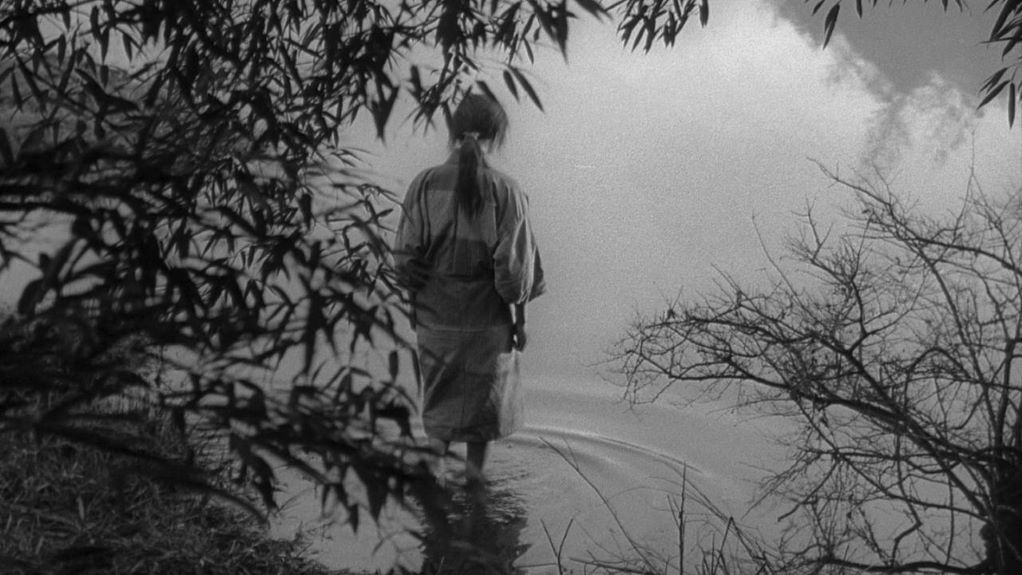
This powerful minimalism is nowhere more effective than Anju’s supreme sacrifice (the fate of women in Mizoguchi’s world). Giving Zushiō the chance to escape, Anju becomes aware that torture for knowledge of where her brother went is inevitable. With serene certainty she walks into the river to drown herself, moving with a sense of freedom she has not known for years. In a single shot we see her walk until Mizoguchi cuts away then back to show bubbles calmly rising to the surface of the water. It is an act of love, stunningly simple and hugely moving – and apiece of a world where freedom and any trace of goodness can only come about through irreversible sacrifices.
Like a folk tale Zushiō is restored to his father’s office, but finds he can make few changes. Slavery is abolished at Sansho’s estate – but the system cannot really be changed. The slaves know this to – they take their chance to sack the estate, aware that fortune’s wheel could return them once again to servitude. Sansho learns nothing from the events, and the suspicion is the next governor will pardon him (after all he brings more revenue in than anyone else). Sansho is the real world and he is inescapable – so much so he even owns the name of a film in which he is a minor player.
It builds towards the final conclusion on a windswept beach, perhaps one of the most heart-rending moments on film. In a Western film, this would be a scene of joyful reconciliation in which two damaged people heal through sharing grief. Mizoguchi had lived through the horrors of war and knew this would have been a lie. Reuniting doesn’t wash away the pain or heal the wounds – physical or spiritual – and doesn’t change the world. It’s just two people on a beach, clawing towards a moment of peace in a difficult world.
Sansho the Bailiff is clear-eyed and realistic about a world where people hurt each other and care nothing. Told with a classic, artistic simplicity, it is both a deeply moving and deeply spiritual piece, a great humanistic artist making his ultimate statement on the nature of the world. An essential film.
 Movie Musings