
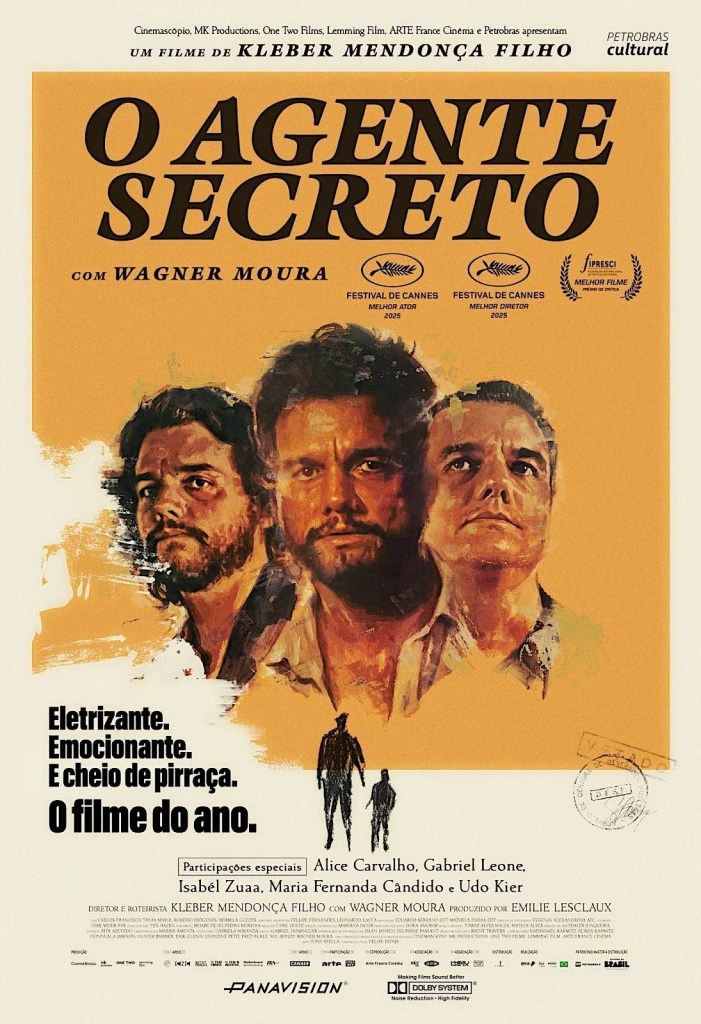
Dark political drama, with a surreally multi-layered construction, challenging but rewarding
Director: Kleber Mendonça Filho
Cast: Wagner Moura (Armando Solimões), Carlos Francisco (Senior Alexandre), Tânia Maria (Dona Sebastiana), Robério Diógenes (Euclides), Gabriel Leone (Bobbi Borba), Roney Villela (Augusto Borba), Kaiony Venâncio (Vilmar), Maria Fernanda Cândido (Elza), Thomás Aquino (Valdemar), Udo Kier (Hans)
For decades, Brazil lived under a military dictatorship which controlled the country with a brutal, often hidden, hand, spinning a web of tall stories and mythologising to hide its ruthlessness and corruption. This forms the backdrop of Kleber Mendonça Filho’s dark shaggy-dog story of the ‘mischief’ (as the film puts it) of this terrible time, where truth was a hostage of fortune and violence and death could be dealt out at any time by corrupt forces and their accomplices in law enforcement.
In 1977, Armando Solimões (Wagner Moura) arrives in Recife during carnival season under the name of Marcelo. It slowly becomes clear he is a former university professor of engineering, on the run from a contract on his life taken out by the corrupt businessman appointed to run his department. In Recife, Armando hides out at a refuge run by former anarcho-communist Dona Sebastiana (Tânia Maria) and reconnects with his son Marcelo who is being raised by Alexandre (Carlos Francisco), father of Armando’s murdered wife Fátima (Alica Carvalho). A sympathetic contact lands him a role in the police records office, giving Armando opportunity to search for the file of his mother, a woman ‘disappeared’ and murdered by the junta. Meanwhile, two hitmen Bobbi (Gabriel Leone) and Augusto (Roney Villela), hunt him down.
Mendonça’s film is put together with the moody leanness of a 1970s conspiracy thriller, mixed with the portmanteau scope of Altman. In its muted colours it has a grim sense that unseen forces watching around every corner. At the same time, it’s a snapshot of a moment in time, presenting events in Brazil from a range of perspectives, from the casually corrupt police, to campaigners for justice, to the smorgasbord of refugees in Dona Sebastiana’s commune, including Ghanian immigrants and a persecuted female dentist. These events move smoothly, sometimes with surreal touches and moments of black comedy, with Mendonça not letting us forget that in a country as ill-organised and idiosyncratic as this one, bizarre events and brutal killings are everyday events.
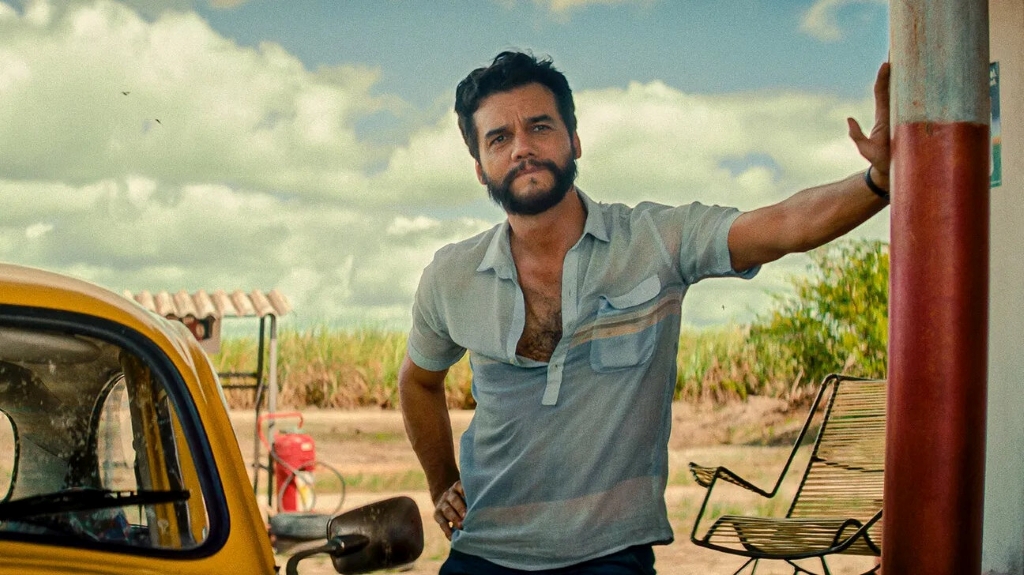
An idea of the sort of country Brazil is, is established from the start, with the film’s atmospheric, tense and darkly funny opening, set in a country-side gas-station. On the forecourt, under a piece of cardboard, lies a slowly rotting corpse of an attempted shoplifter, shot several days ago. When Armando stops for petrol, he’s told the authorities have been informed but have dragged their heels about collecting the body. At which point the police arrive… but have no interest in the body (from which, wild dogs need to be constantly chased away from) instead intimidating Armando, attempting to extract a bribe (he hands over his cigarettes) before disappearing over the horizon. As Armando drives away, the dogs return.
That’s Brazil, it seems, in a nutshell. As well as being expertly filmed, acted and staged, that opening captures the entire mood of black, hopeless, humour in a perfect fusion of Altman and Leone. The more we see of the authorities, the more it confirms our impression of them as greedy, useless bullies interested only in puffing their own position and slapping down anyone who looks like a lefty troublemaker.
The leading cops at the station Armando works at are lazy, racist egotists who idolise a German tailor, played in a fine cameo by Udo Kier, they think is a Nazi war veteran (oblivious to the fact he is a Jewish Holocaust survivor who despises them) and don’t think twice about tossing the bodies of internees into the sea. A severed leg, discovered in the belly of a shark by a marine biologist, is just such a victim – and the cursory (and, for them, unnecessary) attempts to identify this leg’s owner (and to dispose of it a second time) forms another darkly comic thread to the film.
This leg becomes, itself, the centre of the sort of absurdist fantasia that the authorities use to hide their own brutality. In Mendonça’s Carpenter-esque scene of bizarro body horror, we watch a staging of the media’s own report that a series of brutal beatings of gay men in a public park was carried out by this leg (as opposed to, obviously, the police). The police are, of course, fully clued up about the real cause of any violence, just as they have no problem palling around with the cashiered military officers who are now working as private hitman – and are happy to give them tips to their target.
In all this dark corruption, any splash of hope is welcome. Much of this comes from Wagner Moura’s toweringly committed performance as Armando, full of world-weary frustration and bubbling resentment at injustice and a desperate commitment to try and pluck escape from this life of fear. Moura’s Armando is a man of quiet reserve, decency and goodness who has had to become hardened to the circumstances he is in – who finds himself full of rage in a way he never dreamed possible. He carries burdens of grief and guilt at the loss of his wife (unaffected by his father-in-law’s correct suspicions that he was not always faithful) and his attempt to gain details about his mother from the labyrinthine police records he works among gives him some sort of hope of inner peace.
Testimony and the struggle for truth becomes a key theme in The Secret Agent which suddenly surprises us to a flash-forward framing device that shows a modern-day research volunteer transcribing recorded audio conversations between Armando and his resistance group contacts. The truth remains as elusive today as it does in Armando’s time: events unclear to the researchers are clearer to us (as we can see them not just hear them), but many mysteries and questions remain hazy today, with memories and half-truths often the only answers we have.
This is reflected as well in the film’s structure, which drip feeds information slowly. It’s nearly two thirds into the film, until Armando’s full background is made clear, and several events early in the film are only explained into any form of coherent sense by the context provided much later. This can make The Secret Agent a challenging watch: it’s a film that can slip through your fingers as easily as an eel. But it’s reflective of a country where reality itself is hard to grasp: where people can disappear without trace, life can end out of nowhere from an officially sanctioned bullet on the street, your entire life story can be altered by the press and tall tales reported as gospel.
Through it all, The Secret Agent is perhaps striking because (despite its title) it has no espionage in it at all. Only the desperate wading through a swamp of secrets and lies with no clear answers, where truth and humanity can be easily lost. The fact it manages to do this while not losing a dark wit – and powered by Moura’s deeply humane performance – is a testament to Mendonça’s graceful direction, which in its simplicity makes a lasting impression of a world where truth and reality are as much in flux as peace and justice.
 Movie Musings