Tag: Kristen Wiig

Wonder Woman 1984 (2020)

wonder woman 1984
Gal Gadot is delightful again in superior sequel Wonder Woman 1984

Director: Patty Jenkins

Cast: Gal Gadot (Diana Prince/Wonder Woman), Chris Pine (Steve Trevor), Kristen Wiig (Dr Barbara Minerva), Pedro Pascal (Maxwell Lord), Robin Wright (Antiope), Connie Nielsen (Hippolyta), Kristogger Polaha (Handsome man), Lucian Perez (Alistair), Ravi Patel (Baba Jide), Oliver Cotton (Simon Stagg), Stuart Milligan (President of the United States)

Wonder Woman in 2017 received the sort of rave reviews superhero films dream of. It was refreshing to have an action flick with a woman as the driving force. But Wonder Woman was, aside from that, very much a conventional superhero origins movie, with little truly original about it. Perhaps memories of it as being more revolutionary than it in fact was, lie behind the more hesitant critical reaction to Wonder Woman 1984, in many ways a more entertaining and smarter film.

In 1984, Diana Prince (Gal Gadot) works at the Smithsonian, and fights for justice in her spare time as Wonder Woman (it’s not clear how she this striking woman manages to keep her identity secret bar smashing a few CCTV cameras). However, she leads a private and lonely life, still mourning the death of Steve Trevor (Chris Pine) during the First World War. Her confidence is admired by her ditzy and nervous (and clearly smitten!) colleague Dr Barbara Minerva (Kristen Wiig), who longs to be like her. An exhibit arrives at the Smithsonian – a mysterious stone that legend has it will grant any wish that the person holding it asks. Diana, in a whimsical moment, wishes for the return of Steve – and is shocked when a man claiming to be Steve appears in her life. Dr Minerva meanwhile wishes to be like Diana in every way – little knowing her secret powers. But the stone has other people interested in it: it could be just the tool that ambitious, but failed, entrepreneur Maxwell Lord (Pedro Pascal) needs to turn his life around. But is there a cost for all this gift giving? What will the stone take in return – and can humanity survive a world where the slightest wish could come true?

Wonder Woman 1984 has a clear theme: taking the easy path might help you to get what you want, but an unearned victory is never a true one. It’s a concept introduced from the start, in an opening flashback section where a child Diana takes a shortcut in an Olympics race, and is denied victory by her mentor Antiope (Robin Wright in a welcome cameo). Antiope, in the way of all mentors, reminds her we learn lessons from loss and defeat, and short-cutting around failure never pays off in the end. It’s a clear message that being granted your wishes without working for them is empty.

And of course there is a cost! The stone takes from you the thing you value most, in exchange for what you want the most. In Diana’s case – having made her wish unknowingly, in a single moment of whimsy – what she loses is her strength, the thing that makes possible the thing she values most: her ability to change the world for the better. In turn, when Barbara wishes to be like Diana, the stone takes from her the very humanity that made her such an endearing and sweet person.

These sort of exchanges are not new to anyone who has ever read a fairy tale. But they are told here with refreshing honesty, not to mention a certain level of charm. Above all, this simple morality tale works because we are invested in the characters. Even without the memory of their relationship from the first film, Gadot and Pine are so likeable and charming in this film (Pine in particular is a delight, his eyes filling with wonder at the modern era – from a childish glee at escalators to tear-filled awe at the space programme) that, even though you know from the start what they are doing is “wrong” (after all Steve is inhabiting another man’s body, and every audience eventually the hero needs to do the right thing and give that body back), you still feel their joy at being together and Diana’s anguish at the thought of giving up the only (selfish) thing she’s ever wanted.

The same is true for the other two characters affected by the stone. Although nominally villains, both Wiig and Pascal play characters who, if anything, are deeply-flawed anti-heroes. Wiig is absolutely endearing as the gentle and shy Barbara, so much so it’s heartbreaking to see her freeze up as the film progresses. Pascal is hilariously overblown as a wannabe Gordon Gekko, but his relationship with his son is nicely drawn and his character is tinged with an underlying insecurity. Wonder Woman 1984 is refreshing in that it doesn’t present heroes and villains, but ordinary people needing to find the courage to reject their dreams for reality. Some do, others don’t.

It’s not a perfect film by a long stretch. As with the previous film, a final act fight scene lacks humanity and is dull. The film is probably fifteen minutes overlong. The various action scenes are well staged, but lack freshness. Some of the humour doesn’t always land. It’s hard not to snigger at a late act revelation of a new power for Wonder Woman. And while the film thankfully avoids the crassness of the first and its trenches setting, a photo of Wonder Woman helping to liberate concentration camps feels horrendously out of place (it’s meant to show her goodness, but I just wondered why on earth did she wait so long to do anything about the Holocaust?).

But the bad is outweighed by the good in a genuinely entertaining and charming movie whose freshness and lightness exceeds the original. Gal Gadot is still wonderful in the lead role – determined but sweet – Chris Pine does some of his best work and Wiig and Pascal are very good. I’d confidently say this is a better film than the first, a richer character study inspired by fairy tales, that really gets to the emotional heart of its lead character. I may be alone in that, but that’s what I think.
Her (2013)

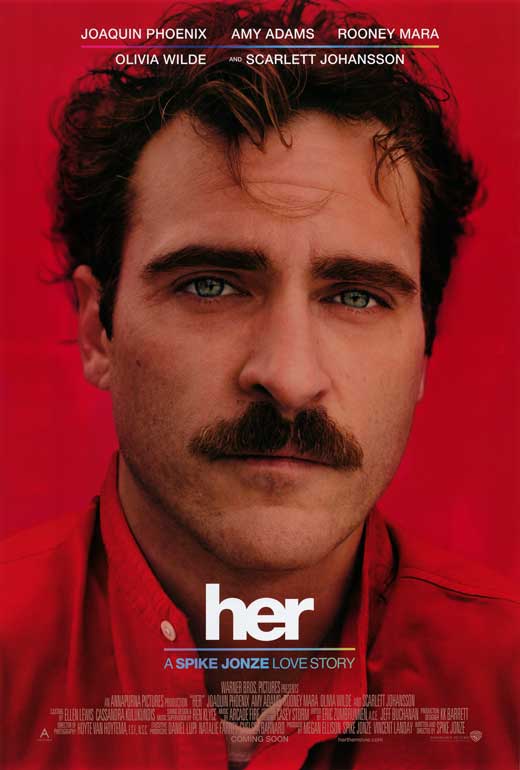
Joaquin Phoenix plays a complete prick in this unbearably pleased with itself satire Her

Director: Spike Jonze

Cast: Joaquin Phoenix (Theodore Twombly), Scarlett Johnasson (Samantha – voice), Amy Adams (Amy), Rooney Mara (Catherine Klausen), Olivia Wilde (Blind Date), Chris Pratt (Paul), Matt Letscher (Charles), Lukas Jones (Mark Lewman), Kristen Wiig (Sexy Kitten – voice), Brian Cox (Alan Watts – voice), Spike Jonze (Alien child – voice)

Every so often you start off engaged with a film and then, the longer it goes on, the less and less you like it. I couldn’t put my finger on the exact moment where I started to really take against Her, but I certainly had by the end of it. As someone once famously sort of said about Kriss Akubusi: “hard to dislike but well worth the effort”.

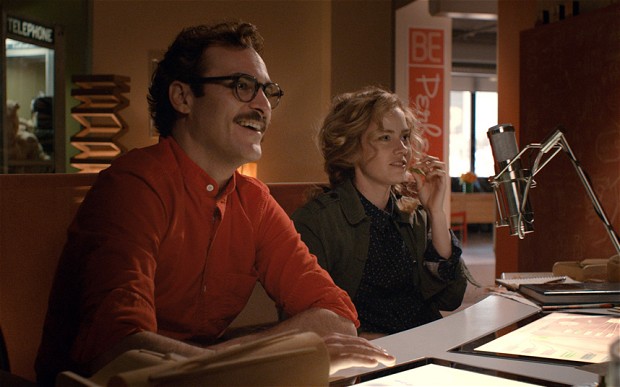
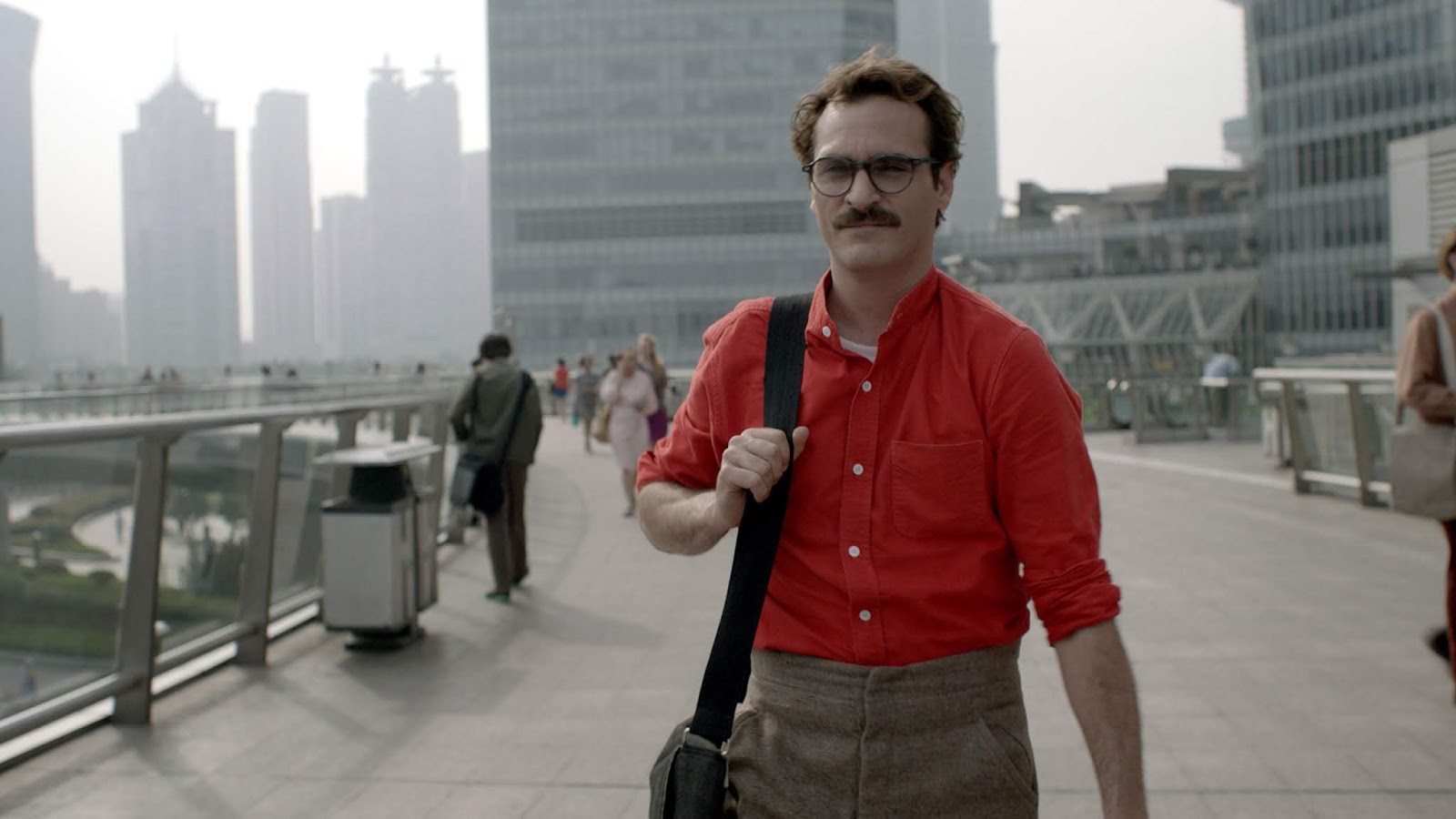
Anyway, Her is set in the near future. Theodore Twombly (Joaquin Phoenix) is a sensitive, insular man who writes personal romantic letters for other people who aren’t articulate enough (or bothered) to do it themselves. Getting divorced from his childhood sweetheart Catherine (Rooney Mara), Theodore downloads a new Artificial Intelligence Operating System for his computer. The system is designed to create a personality that appeals to the customer – and that is certainly the case here with this system, Samantha (voiced by Scarlett Johansson). Theodore, finding it hard to connect with the real world, is drawn to Samantha and, as she grows and develops, they start a relationship. But can the relationship survive the divide between realities and Samantha’s growing self-awareness and personality?

Okay. I’m going to swing hard for this film, so let’s start with what’s good shall we. Spike Jonze directs very well. It looks beautiful. There is some lovely music. The future world it shows is close enough to our own to still feel connected. Amy Adams is rather good as Theodore’s old college friend, and Rooney Mara turns in a very good performance as Theodore’s wife, a woman who doesn’t let Theodore get away with his excuses. Scarlett Johansson is perfect casting as the alluring and engaging voice of Samantha (much as I was primed to be annoyed by her post-production replacement of Samantha Morton, who had been on set with Phoenix). There are some sweet and even romantic moments.

Okay that’s it. This is a film overwhelmingly, unbearably, unbelievably pleased with the cleverness of its own concept and trite ideas (a man loves his computer – take that our modern consumerist world!). It then goes on to tell us almost nothing, bar the most basic statements about our struggles to interact with, and relate to, each other in this technology-filled world. Apparently it’s hard to create bonds with real people where we are viewing everything through our phones. Bet that has never occurred to anyone before right?

But my main problem with this film is the lead character. Now I will say that Joaquin Phoenix does a good job with this role, and his skilful acting brilliantly holds the story together. He does extremely well with a part that is almost exclusively reacting to someone not actually there. But my problem is with this characterisation of Theodore. To put it bluntly, he’s a prick.

In fact, he’s the sort of quirky nerd beloved of this genre, but take a long look and he’s basically a complete creep. And all his relationships with women seem to be based on him not wanting to engage with the problems of the other person. He requires the focus to be on his wants and needs, as if he is the only person in the world who can be sensitive or sad – no wonder he falls in love with a computer programme designed to reflect the behaviours he finds appealing.

“You want a wife without the challenges of dealing with something real” his wife accuses, eagerly pointing out his inability to deal with or even want to engage with human emotions. The film wants to give him a pass, because he is such a sensitive soul, but it’s bullshit. Theodore is a deeply selfish person, despite what the film wants, who has that geeky, arrogant, self-satisfied sensitivity that blindly says “if I struggle in the world, then it’s the fault of the world not me”.

Theodore is a constant happy victim, a whining, softly-spoken, guilt-tripping prick who only sees himself as a victim and makes no effort to change or understand his behaviour to other people. The film wants us to think that the world is a puzzle to his poetic soul, but it’s actually a maze he doesn’t want to find a way out of. He doesn’t want to engage with it and only feels justified and reinforced in these feelings by everything he does.

He is like the perfect ambassador for passive aggressive guys: “Oh I don’t get the girls because they don’t want to open themselves up to my sensitivity blah blah blah”. Theodore goes on a blind date early in the film: it goes well, they make out, sex is on the cards and then she asks “Before we do anything, will you see me again?”. Theodore can’t even bring himself to make even the smallest offer, meekly babbling about having a busy weekend. When she reacts angrily and leaves, the film wants us to side with Theodore’s timidity, rather than say “yeah it is a bit shitty to let a girl put her hand down your pants and then not even show the slightest interest in seeing her again, and then call her unpleasant”. Fuck you Theodore.

Theodore is basically a controlling arsehole and it’s where the romance of the film drains out. He clearly has no idea why his marriage ended, but while the film wants us to think he’s too sensitive for the rough and tumble, it seems clear he had no interest in, or comprehension of, his wife’s life. She is constantly subtly blamed for not having patience with Theodore – the film ends with him writing her a cathartic e-mail saying he will always love his memory of her and thanking her for being part of his life, forgiving her from leaving (again, screw you film). Instead she, like other people, doesn’t deserve Theodore because she doesn’t have the patience to delve into his life.

Theodore, though, has no depths. He’s a bland, faux-poetic guy with a nervy disposition and a disinterest in other people’s emotions, focused only on his own gratification. He wants his relationships to adjust to what he needs them to be. As Samantha grows and develops into a more fully rounded personality, his first reaction is hostility and jealousy at the thought of her talking to other people and operating systems. It’s not sweet and endearing – or Theodore again being taken advantage of, as the film wants us to think – it’s creepy, and Theodore is the sort of passive aggressive gentle guy who ends up stalking and murdering the girl who rejected him.

How can you engage with the points of this film, when the central character through whom everything is filtered is so awful? Distance in relationships in this modern world – and the lack of genuine interaction – is a point that hardly needs hammering home as it does here. The trite points about love and relationships the film makes are all wrong. The film is so on the nose about distance between people and the artificial nature of our interactions, the hero even writes other people’s love letters for them. It’s subtle as a sledgehammer.

Computers and phones are everywhere and everyone uses them, but there is less insight and heart in this story than an average episode of Black Mirror (which would have done the same thing in half the time). The film does its best to build a romance between the two, but it never quite lands or has the impact it should, because it never feels like an equal relationship: first Theo has the control, then Samantha grows beyond anything Theo is capable of but is still trapped by her initial programming of devotion to him. What point is this meant to be making about romance and commitment? Theo lives in a dream-world and does so until the end of the film. 

Her is the sort of film lots of people are going to love. It uses the conventions of romantic films very well. It has darker moments, such as a sequence where Theo and Samantha try to use a surrogate for sex (a scene where to be fair I could understand why Theo is creeped out and disturbed), but none of these ever comes together into a coherent point. And Theo remains, at all times, a block on the enjoyment of the film, an unpleasant figure hiding in plain sight that stops you from falling for the film. In love with itself, in love with its idea, in love with its cleverness, this is a film that tells you everything about the smugness of the geek and nothing about the subjects it actually wants to get you thinking about.

The Martian (2015)

Matt Damon is Lost in Space in The Martian

Director: Ridley Scott

Cast: Matt Damon (Mark Watney), Jessica Chastain (Commander Melissa Lewis), Jeff Daniels (Teddy Sanders), Kristen Wiig (Annie Montrose), Chiwetel Ejiofor (Vincent Kapoor), Sean Bean (Mitch Henderson), Michael Peña (Major Rick Martinez), Kate Mara (Beth Johansson), Sebastian Stan (Dr Chris Beck), Aksel Hennie (Dr Alex Vogel), Mackenzie Davis (Mindy Park), Donald Glover (Rich Purnell), Benedict Wong (Bruce Ng)

Imagine being abandoned somewhere really difficult to get out of. Now how about being abandoned somewhere where it’s literally impossible to escape? Well you can’t get much more impossible than Mars, a place so bloody difficult it doesn’t even supply you with such luxuries as oxygen, water or food. But that’s exactly what happens to astronaut Mark Watney.

Part of the first manned mission to Mars, Watney (Matt Damon) is struck by debris and presumed killed after a storm forces the crew to abandon their planet. With no one on Earth aware he is alive, Watney faces huge difficulties: the next Mars mission isn’t for four years, and will land over 2,000 miles away. He has only enough food for at best a couple of years, and his Mars Rover can only travel 70 miles before it needs to be recharged. Fortunately, Watney (as well as being incredibly inventive) is a botanist – and works out a complex improvised farm in the base to grow potatoes (the only potential crop he has) as well beginning to modify the Rover to drive to the next mission site in four years. But things change when NASA (after holding his funeral) spot his movements via satellite – and now the race is on to organise a rescue mission.

The Martian perfectly works out what we find appealing about survivor stories: a charming, easy to relate to, protagonist who inspires with his never-ending MacGyver-ish invention. The best sequences by far focus on this, as Watney uses whatever he has available, from radioactive waste to his own shit, to try and save his life. There is something hugely compelling about seeing such inspiration in the face of adversity – perhaps because you want to believe “heck that’s what I would do…”

The first half of the film is crammed with these moments, made even more enjoyable by Watney’s off-the-wall, amusing commentary on events via video diary. Watney never succumbs to despair but instead constantly puts as positive as possible a spin on his situation, aware that opening the door to despair is the road to the end. A lot of this works so well because of Matt Damon’s terrific performance in the lead role. It’s no easy thing basically holding the screen entirely by yourself, but Damon does an amazing job here. He’s not just funny and engaging, but he also subtly touches on deep inner feelings of isolation and loneliness.

Scott understands all this and shoots most of the sequences with Watney with a low-key, calm but technically assured simplicity. He lets the action here largely speak for itself, and shows a better ear for comedy than I think many people thought him capable of. He also uses Watney’s “suit cam” and the video diary format to constantly shake up the visuals and allow us to see Watney’s actions and decisions from different perspectives. His mastery of the sweeping epic comes into its own when the camera swoops over Martian panoramas, making the hostile red planet look unbelievably beautiful. 

It’s easy to see why NASA supported this film so strongly, as the organisation comes out of this impossibly well. This is essentially a fictionalised retelling of Apollo 13, with the astronauts surviving above, while the ingenious techies below work miracles to first communicate with, and then devise a rescue mission, for Watney. The film is deeply in love with NASA – despite some personality clashes, the NASA characters are all shown to be highly intelligent, compassionate people. Even “the suit”, Director Sanders (played with a square jawed patience by Jeff Daniels), is basically a humanitarian who wants to preserve human life (and is cool enough to have a brilliant Lord of the Rings gag).

Despite this, the struggles of the various bigwigs at NASA to save Watney are slightly less interesting than the opening half of the film based around Watney’s struggles to survive. Perhaps because, well done as it is, we’ve seen this sort of stuff before, done better – not least in Apollo 13 – and partly because what NASA is trying to do is not quite clearly explained in layman’s terms. Think of the simple brilliance of Apollo 13 when the engineers need to create a filter using only what the astronauts have on the ship: it’s easy to understand, clear, brilliant and gripping. Comparative scenes in this film just don’t land as quickly.

The film also struggles as events and twists in the midway part of the movie lead to Watney losing a lot his agency. Since most of the film’s unique enjoyment is seeing Watney conquer his environment, and gain mastery of the rotten hand that fate has dealt him, as soon as that element is removed and Watney turns into more of a man in distress, the film struggles to maintain its unique interest. It makes the second half of the film more conventional (Damon is noticeably in this much less, considering how much he dominates the first half) and also ends up comparing unfavourably with other, better films (sorry I mean Apollo 13 again…)

But The Martian is crammed with good lines, fine jokes and some good performances – even if some of the characters seem a bit sketchily drawn. Benedict Wong is very good as NASA’s top techno bod. Chiwetel Ejiofor and Sean Bean do well as the most clearly sympathetic senior NASA bods. Up in space, the rest of the crew are very lightly sketched, but Jessica Chastain gives a fine sense of authority to the Mission Commander. But make no mistake this is Damon’s movie – and he dominates both the audience’s interest and the film’s.

The Martian is a very well made, intelligent crowd-pleaser. It’s not a classic – and it’s slightly in the shadow of better movies – but it’s brilliantly put together and hugely engaging. The second half of the story is less compelling and more conventional than the first, but there is more than enough invention and enjoyment there for you to want to come back and see it again.