
Tag: Laurence Naismith

A Night to Remember (1958)

A Night to Remember (1958)

Still one of the definitive Titanic movies, a compelling documentary-influenced look at the disaster

Director: Roy Ward Baker

Cast: Kenneth More (Charles Lightoller), Michael Goodliffe (Thomas Andrews), Laurence Naismith (Captain Edward Smith), Kenneth Griffith (Jack Phillips), David McCallum (Harold Bride), Tucker McGuire (Molly Brown), Frank Lawton (J Bruce Ismay), Richard Leech (William Murdoch), John Cairney (Murphy), John Merivale (Robbie Lucas), Honor Blackman (Liz Lucas), James Dyrenforth (Colonel Archibald Gracie IV), Anthony Bushell (Captain Arthur Rostron)

The sinking of the Titanic on 14 April 1912 is one of the most iconic events in twentieth century history. A Night to Remember brings the ship’s final hours to life in forensic detail, based on Walter Lord’s carefully researched book. Told with documentary-style distance, mixed with admiration for stiff-upper-lip British pluck, the film cemented many people’s perceptions of the night of the sinking and remains one of the best-known films about the disaster.

To tell the story, the production decided it needed a central figure and selected Second Officer Charles Lightoller, recruiting a British star to play the role. And no one did bluff, charismatic middle-class decency better than Kenneth More, born to play roles like this. Lightoller would be placed at the heart of the keep-calm-and-carry-on evacuation of the ship, More’s reassuring presence letting the audience know everyone involved was doing their best under impossible circumstances.

A Night to Remember remains very effective. It’s special effects and recreation of the ship are highly impressive. Even tilting sets were built to replicate the ships list, meaning drinks tilt in glasses and the careering skid of a dinner cart in the dining room was done for real. But where it really scores is its effective capturing of a very particular British mood: the determination to carry-on in terrible, appalling circumstances. While it’s easy to look at this unflappability in the face of disaster as almost comic, what’s so effective in A Night to Remember is that below the surface it’s clear almost every single character is screaming in terror.

You can see it in the shell-shocked disbelief of Captain Smith (a very effective Laurence Naismith, an excellent portrait of man in ultimate authority with no power at all to affect the situation) who stares with shame at the hundreds of people he can’t save. It’s in the guilt of Thomas Andrews (Michael Goodliffe, full of wry humour that slips away leaving him a shell) who blames himself and vainly tries to save others without creating panic. The grim-faced determination of radio operator Jack Phillips (a remarkably restrained Kenneth Griffith) who taps out the SOS until the bitter end. These feelings are carefully hidden and suppressed – for the good of morale – but the screaming panic and despair of the passengers in the final moments of the ship are simply giving voice to hidden feelings earlier.

What comes across very well in A Night to Remember is the utter powerlessness of the situation, matched with the bad luck and poor preparation that condemned more to death. It’s clear to everyone in authority, from the start, that there are insufficient lifeboats and quickly becomes apparent no help is not coming. While not raising enough urgency around the evacuation did contribute to deaths, it’s also clear to the officers it’s the only way they can hope to maintain any sense of order for as long as possible. If they fronted up on the real disaster heading their way, those guns they grab from the armoury would have all been exhausted keeping control.

A Night to Remember subtly suggests the fault is not personal, but somehow systemic: that Titanic is just the rash a whole host of societal problems have come out in. You can see the arrogance and unwillingness to question in the huffy pretension of the man on the train who pulls Lightoller up for mocking a soap advert that celebrates the ship. The behaviour of many of the passengers that safety precautions are at first an imposition, then that their class and position should automatically entitle them to particular treatment. The thudding refusal of many to accept the reality that the unsinkable ship can go down. The stunned look on people’s faces when the truth hits them and, as Lightoller says late in the film, it suddenly feels like they can never trust so blindly again.
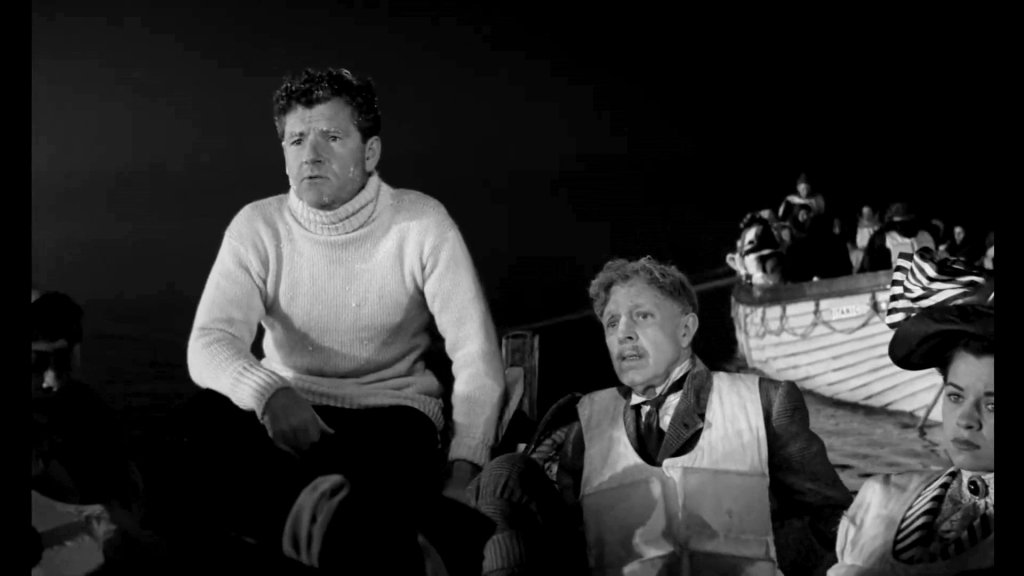
Alongside this, it’s a tribute to bravery and self-sacrifice, often expressed with that classic British reserve and dry humour in the face of imminent disaster. From Lightoller and the sailors who fight, up the final moment, to assemble two collapsible boats even as the deck sinks under water around them to the engineering crew who willingly agree to stay below deck to keep the power on – a certain death sentence (“And it’s my birthday today and all” someone good naturedly moans, while the others gather a water-logged cup of tea). Perhaps uniquely for Titanic films, there isn’t even a villain: it’s one of the few adaptations that doesn’t show Ismay (a never-the-less pompous and weasily Frank Lawton) ordering the ship to go faster. In fact Ismay is shown energetically throwing himself into the evacuation (even told to stop trying to help by Lightoller) who steps into a boat (self-loathing covering his face) only when no one else tries to take one of the available seats.

Despite which, the film doesn’t avoid the fundamental errors. The treatment of the second and third-class passengers is shockingly abrupt and impatient, as if the saving of their lives is an inconvenience on a busy night – by the time they are allowed on deck, one plaintively moans that the lifeboats have already left. A group of bellboys are ordered to remain where they are (and instructed to not smoke!) condemning them. As the scale of the disaster grows, several passengers in under-filled boats complain that they are ‘already too full’ to go back for survivors. Even Lightoller’s decisions (interpreting ‘women and children first’ as ‘women and children only’, a decision that led to half-full boats sent away) are criticised.

A Night to Remember also sprinkles itself with several touching personal stories that carry real impact. The first-class passenger who asks Andrews for a no-bullshit appraisal, then quietly ensures his wife and sleeping children board a lifeboat. The Stausses who refused to separate and go down with the ship. A lost child saved from trampling by a steward, who promises him it will all be over soon as they sink. The young couple crushed by a falling funnel. The heartless card sharp who turns out to have a capacity for calm self-sacrifice.

And it could all have been avoided. More than any other film A Night to Remember focuses on the unquestioning crew of the Californian who watch the sinking from ten miles distance (including the never-ending launch of emergency rockets) but having no instructions or initiative don’t do a thing (they switch their radio off rather than try and find out more). The rigid mindset of the system right there: disasters just don’t happen to British ships (Britannia rules the waves after all) so no reason to rock the boat. They are contrasted with the professional urgency of the Carpethia (who did leave their radio on) who race against hope to help.

A Night to Remember captures this all extremely effectively, remaining a powerful and documentary look at the simple facts of the world’s second most iconic (after Pompeii) disaster. Full of some very fine performances and shot with a pacey assurance by Roy Ward Baker, it remains one of the definitive studies of the diaster.

Richard III (1955)

Richard III (1955)

Olivier stamps his claim to Shakespeare’s greatest villain in this gorgeous theatrical epic

Director: Laurence Olivier

Cast: Laurence Olivier (Richard III), Cedric Hardwicke (Edward IV), John Gielgud (Clarence), Ralph Richardson (Buckingham), Claire Bloom (Lady Anne), Helen Haye (Duchess of York), Pamela Brown (Mistress Shore), Alec Clunes (Lord Hastings), Laurence Naismith (Lord Stanley), Norman Wooland (Catesby), Clive Morton (Lord Rivers), Douglas Wilmer (Dorset), Stanley Baker (Richmond), Mary Kerridge (Queen Elizabeth), Esmond Knight (Ratcliffe), John Laurie (Lovell), Patrick Troughton (Sir James Tyrell), Michael Gough (Murderer)

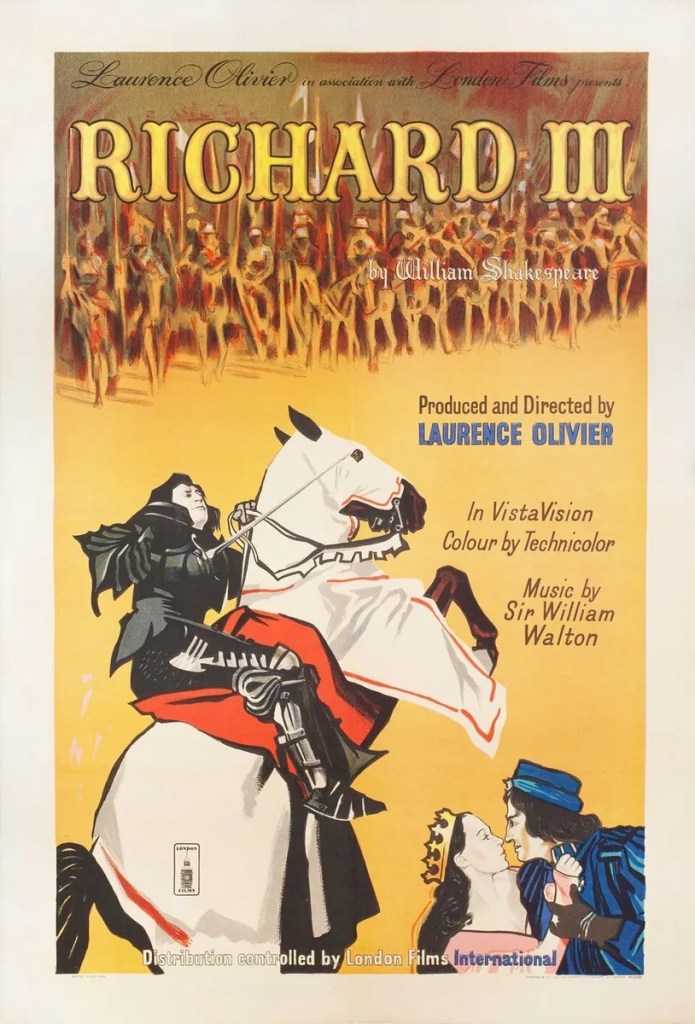
Olivier had played the greatest Shakespeare hero in Henry V and made Hamlet the most romantic princes of film. Having scaled those heights, did he also want to set the benchmark for Shakespearean villainy? Perhaps, with his vaulting ambition and competitiveness, he knew his clipped, precise tones and physical suppleness was perhaps best suited to playing the villain. What better role to prove it than the “poisonous, bunch-backed toad” himself, Richard III. Olivier bought to the screen a performance that would be as influential as his Hamlet (perhaps even more so), an embodiment of the role that all future Richards would be compared to.

I like to think of Richard IIII as a twisted inversion of Henry V. Like that film, the action is shot in lusciously beautiful technicolour, with beautiful costumes and a marvellously stirring, magnetic score by William Walton. It has courtly intrigues, a charismatic lead, the seduction of a young princess, many of the same actors and caps itself in a bravura battle shot on location. The only difference being that, instead of “the mirror of all Christian kings”, our lead is a twisted, remorseless killer who acts as his own Chorus to bring us on-side with his Machiavellian schemes. (There is a fun little opening message, stressing that this is a legend not the truth, that almost feels like an apology in advance to the Ricardian societies of today).

Olivier’s performance is the heart and soul of this film, and it’s possibly his finest cinematic (and certainly his finest screen Shakespeare) role. This Richard is openly – almost proudly – cruel and hypocritical, sociopathic in his amoral ease with the death and slaughter of his nearest and dearest (including his beloved wife, brother and nephews to whom he is sweetness and charm), overwhelmingly impressed with his own cunning and eagerly inviting us to share in his villainy. Olivier practically caresses the camera in his readiness to get close to us, forever turning towards it with a smile, quick aside or delighted breakdown of schemes to come. Olivier inverts his matinee idol looks into a stooped smugness (his costume, with its dangling sleeves, frequently makes him look like a spider) and his clipped vocal precision is dialled up to stress his heartless self-confidence.

Stare into Richard’s eyes and all we see is an uncaring blankness, the chill of a man who cares for nobody except himself. His sigil maybe a boar, but he resembles a wolf, devouring the Lords around him. Much of the first two thirds sees him keep a steady illusion of outward good fellowship. He comforts Gielgud’s Clarence with genuine care, greets Hastings like an old friend, is mortified and hurt by the suspicions cast on him by the Queen and her family, smiles with affection at his cousins. It means the moments where Olivier lets the mask slip even more shocking: the matter-of-fact abruptness he urges murderers not to take pity on Clarence, the whipped glare of pure loathing he shoots at the princes after an ill-advised joke about his hunched back or the imperious hand he shoots at Buckingham to kiss after being acclaimed by the crowds, harshly establishing the hierarchical nature of their ‘friendship’.

While the charisma of course is natural to a performer as magnetically assuring as Olivier – and this Richard is truly, outrageously, wicked in his charm – he also nails the moments of weakness. Having achieved the crown, Olivier allows not a moment of enjoyment of his feat, but his brow furrows into barely suppressed concern and anxiety that he may be removed by schemes exactly like his own. The threat of armies marching on him sees him first lose his temper publicly and then leap to cradle the throne in his arms like a possessive child. The morning of Bosworth, he even seems quietly shocked at the very idea that he could feel fear.

Richard III, despite its length, makes substantial cuts to the original play, including throwing in elements from Henry VI. Several characters – most notably Queen Margaret, whose major confrontation scene with Richard is lost altogether – are cut or removed all together. Olivier reshuffles the order of events, most notably shifting the arrest of Clarence to split up the seduction of Lady Anne. Richard’s late speech of remorse before the battle of Bosworth hits the cutting-room floor (Olivier’s Richard never seems like a man even remotely capable of being sorry for his deeds). Several small additions from the 18th century by Colley Cibber and David Garrick are kept in (most noticeably his whisper to his horse on the eve of battle that “Richard’s himself again”).

The film is deliberately shot with a sense of theatrical realism to it, Olivier favouring long takes so as to showcase the Shakespearean ease of the cast (much was made of the cast containing all four of the Great Theatrical Knights of the time in Olivier, Richardson, Gielgud and Hardwicke). The camera frequently roams and moves, most strikingly during the film’s first monologue from Olivier, where it flows from the coronation retinue outside the throne room, through a door, to find Richard himself waiting for us in the hall. It’s set is similarly theatrical, a sprawling interconnected building (with some very obvious painted backdrops) where the Palace of Westminster, the Tower of London and Westminster Abbey seem to be one massively interconnected building.

The film makes superb use of shadows, the camera frequently panning from our characters (especially Richard) to see their shadows stretch across floors and up walls. The claustrophobia of the interconnected set also helps here, making events seem incredibly telescoped (it feels like the film takes place in just a few days at most). It makes the court feel like a nightmare world completely under the control of Richard, who knows every corner to turn and can seemingly be in several different places at once. In that sense, filming Bosworth outside on location in Spain seems like a neat metaphor for Richard’s lack of control of events: suddenly he’s in a sprawling open field, where it’s possible to get lost and it takes genuine time to get from A to B.

Olivier may dominate the film with a performance of stunningly charismatic vileness, but he has assembled a superb cast. Ralph Richardson is superb as a supple, sly Buckingham, a medieval spin doctor whose ambitious amorality only goes so far. While I find Gielgud’s delivery of Clarence’s dream speech a little too poetic, there are strong performances from reliable players like Laurence Naismith’s uncomfortable Stanley and Norman Wooland’s arrogant Catesby while Stanley Baker makes a highly effective debut as a matinee idol Richmond. Claire Bloom superbly plays both Lady Anne’s fragility but also a dark sexual attraction she barely understands for this monster. Perhaps most striking though is Pamela Brown’s wordless performance as Mistress Shore (mistress first to Edward IV then Hastings), a character referred to in the play but here turned into a sultry, seductive figure who moves as easily (and untraceably) around the locations as Richard does.

Fittingly for a film obsessed with the quest for power, we return again and again to the image of the crown. It fills the first real shot of the film, bookmarking its beginning and end and frequently returns to fill the frame at key moments. With the films gorgeous cinematography, it’s a tour-de-force for its director-star and a strikingly influential landmark in ‘traditional’ Shakespeare film-making.

Jason and the Argonauts (1963)


The Argonauts take on dreadful monsters in Jason and the Argonauts. You gotta love it.

Director: Don Chaffey

Cast: Todd Armstrong (Jason), Nancy Kovack (Medea), Gary Raymond (Arcastus), Laurence Naismith (Argus), Niall MacGinnis (Zeus), Michael Gwynn (Hermes), Douglas Wilmer (Pelias), Jack Gwillim (King Aeëtes), Honor Blackman (Hera), John Cairney (Hylas), Patrick Troughton (Phineus), Nigel Green (Hercules)

Watching this film it’s impossible not to get swept up in childish glee. It’s one of the most gloriously entertaining, wonderfully imaginative and brilliantly enjoyable films ever made. Watch this at the right age and it’s got you for life. Its best remembered of course for its wonderful Ray Harryhausen stop-motion effects – but to be honest the whole film is a brilliantly assembled package from start to finish, full of thrills and spills. I love it, I’ll always love it, and it’s got to be one of the best adventure stories ever filmed. Not much point writing more is there? But I guess I will.

The plot hews fairly closely (give and take) to the mythology. Pelias (Douglas Wilmer) seizes the Kingdom of Thessaly. Terrified of a prophecy that says a child of King Aristo of Thessaly will take the throne from him, he kills Aristo’s daughter at the temple of Hera (Honor Blackman). Outraged, Hera becomes the protector of Aristo’s surviving son Jason (Todd Armstrong), and 20 years later he returns. Jason needs to prove himself if he is to re-take the throne, and decides to find the legendary Golden Fleece in the distant land of Colchius. He builds the greatest ship ever – the Argus – and holds games to find the finest crew in Greece. But danger awaits!

If any film is associated the most with Ray Harryhausen, it’s this one. So it’s almost a shock to realise he didn’t direct it, and that the monster moments are carefully placed only at key moments – and that a lot of the rest of the film relies on human action. Jason and the Argonauts is so good because all these elements are brilliantly put together and superbly staged, with an old-school, boys-own adventurousness. How can you not enjoy this film?

The Harryhausen effects are astonishingly good, and their stop-motion brilliance have a grounded reality to them. The staggering copper monster Talos is fabulous – grinding joints, groaning weight and size. The shrieking harpies that plague Patrick Troughton’s put-upon Phineas have an unpleasant, grasping dirtiness to them. The Hydra guarding the fleece is a rattlesnake-like vicious beast. All brilliant. I love them all – just sequences to dream of.

But the highlight is of course the skeletons’ battle. Oh wow. This sequence still holds up so well. It took Harryhausen years in the making and planning, but really paid off. The skeletons are terrifying in their cold-eyed ferocity. For skulls, Harryhausen gives their faces a lot of expressiveness. I just love this sequence – it speaks to the child in all of us. And there is something extra magical from knowing that the sequence was put together frame-by-frame and the live action shots carefully choreographed to match-up with it. Not for nothing did Tom Hanks namecheck this film when presenting Harryhausen with an honorary Oscar. 

These sequences really work though because the film has a wonderful Sunday-morning-serial briskness to it. Pacily directed by Don Chaffrey, the film motors so swiftly through its plot that you are surprised to find it’s only about an hour and a half. Its story structure is not always perfect: apart from Jason and Arcastus most of the rest of the Argonauts are so briefly introduced (despite the recruitment Olympics montage at the start) you’ll find them hard to tell apart. The arc of the story is often a little messy, and iIn fact it’s easy to forget the film ends on a cliffhanger (the sequel was never made) and that Douglas Wilmer’s sinister Pelias is totally forgotten after the first half an hour. But it’s so well done it doesn’t matter. 

But Chaffey keeps the events moving forward so well, the tone so perfectly balanced between heroics, gods debating and thigh slapping jokiness that the film’s tone and momentum never slackens, with the Harryhausen monster sequences as exciting tent-poles in the film’s action. A lot of this feeling is carried across from Bernard Herrmann’s excellent score, a hummable mixture of bombast and slightly eerie mysticism that reflects and compliments the action throughout.

The film is extremely well-made and put together. The Gods as these gigantic figures living in Olympus (Jason is not a lot bigger than the chess pieces they use to guide the wars of the humanity) are great fun: Niall MacGinnis is a very 1960s idea of Zeus (the gods would be hot younger guys today, not tubby Brits), but gives it a headmasterly briskness. Honor Blackman is very good as a proud but caring Hera – the use of the Argus’ headpiece as her voicepiece works really well. It’s quite something that all this interference from the Gods never feels silly at all.

Todd Armstrong and Nancy Kovacks are, to be honest, pretty wooden as the leads but that seems to be what the film needs. Armstrong does a very neat line in middle-distance staring. Gary Raymond has a lot more fun as a scheming Arcastus. The film also manages to shuffle some perceptions: Nigel Green’s Hercules is more of a roisterer than the great warrior (and, with his meat-headed over-confidence, causes more problem for the Argonauts than most). Other performances are perfect adventure-story ham: Jack Gwillim chews the scenery outrageously as King Aeëtes, which kind of matches up with the overblown hyper-reality of the skeleton fight.

Talking about this film, it’s hard not to treat it as a sequence of scenes that I really love. But every scene in it has something. I love the moment where Hylas proves his worth via clever stone-skimming. The approach to the clashing rocks – and the intervention of Poseidon to hold the rocks apart – is brilliant. Hermes’ disguise being unveiled. Hercules doing something decent by staying behind on an island to look for a missing Hylas. All those brilliant Harryhausen sequences.

There is something about this film that is just endlessly and constantly entertaining. No matter your age, it’s a film for every single generation of children (young and old!) to enjoy. It’s simply marvellous, and Chaffey and Harryhausen deliver it wonderfully. Every scene is exciting, the pace never slackens, the special effects are brilliant. But on top of that, it’s a brilliantly put together, well directed, beautifully scored film. It’s exciting, it’s gripping, it’s wonderfully entertaining. I’m gutted they never made that sequel (although since Jason and Medea’s story is literally all down-hill from here, it’s probably just as well).