Tag: Leslie Phillips

Empire of the Sun (1987)

Empire of the Sun (1987)

Beautifully shot version of Ballard’s semi-biographical novel with a superb lead performance

Director: Steven Spielberg

Cast: Christian Bale (Jim Graham), John Malkovich (Basie), Miranda Richardson (Mrs Victor), Nigel Havers (Dr Rawlins), Joe Pantoliano (Frank Demarest), Leslie Phillips (Mr Maxton), Masatō Ibu (Sergeant Nagata), Robert Stephens (Mr Lockwood), Takatarō Kataoka (Young pilot), Emily Richard (Mary Graham), Rupert Friend (John Graham), Ben Stiller (Dainty), Paul McGann (Lt Price)
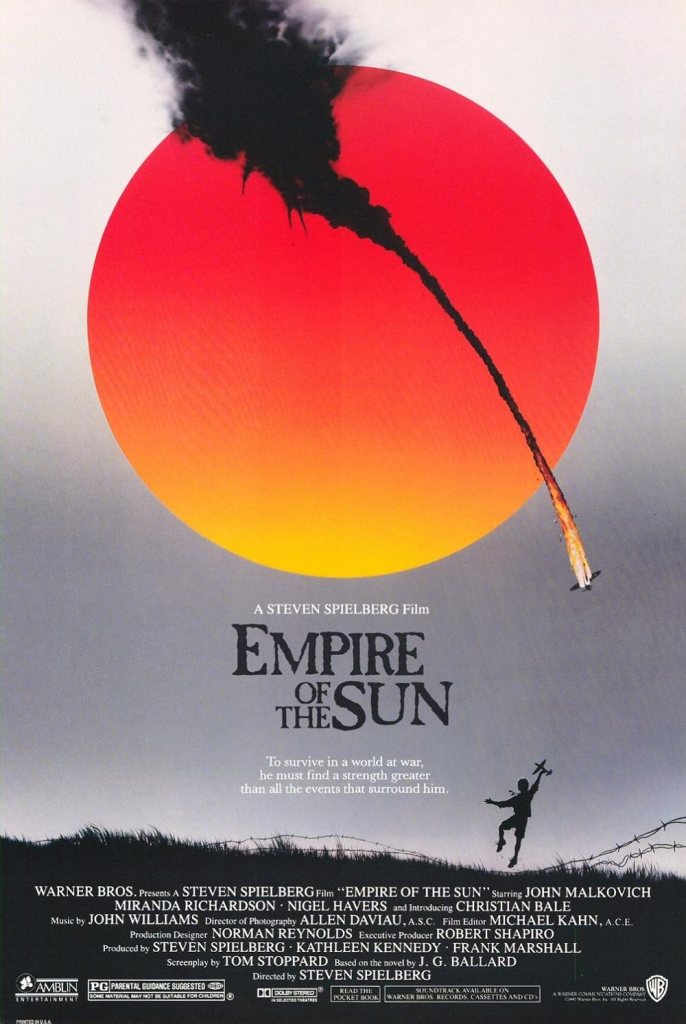
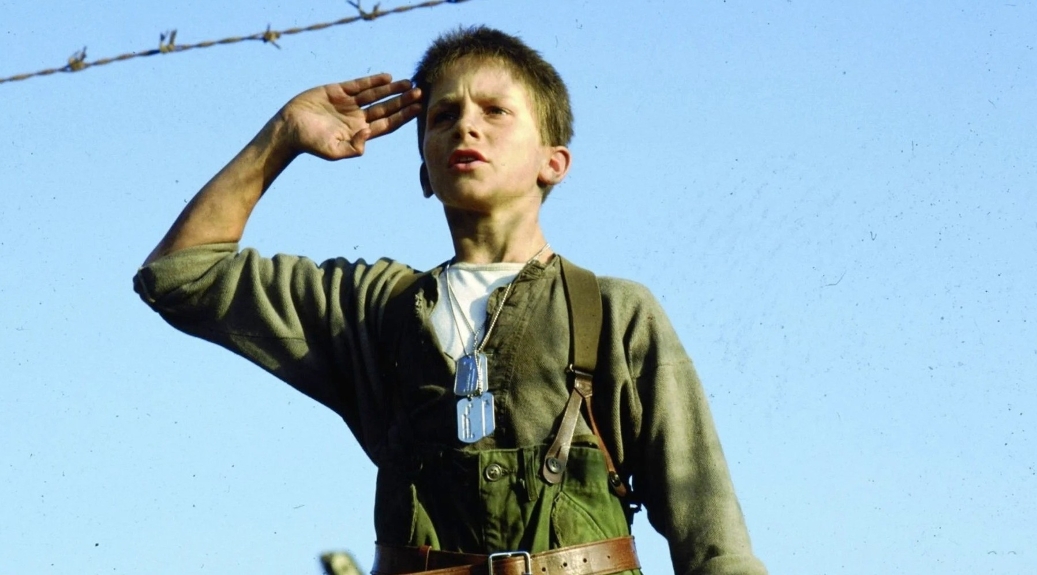
JG Ballard was 12 when he was sent from Shanghai to a Japanese internment camp in 1943 for the remainder of the Second World War. His experiences formed the basis for his novel, Empire of the Sun. The key difference being that, unlike him, young Jim Graham (an incredible Christian Bale) is separated from his parents, falling under the duelling influences of charmingly callous grifter Basie (John Malkovich) and compassionate Dr Rawlins (a very good Nigel Havers), switching between starving trauma and boyish excitement at the explosions of war around him.

Empire of the Sun was originally due to be a David Lean project, before he handed the reins to producer Steven Spielberg. Keen to echo one of his idol’s works – keen to make a film that could sit alongside The Bridge on the River Kwai – and clutching an excellent Tom Stoppard adaptation, Empire of the Sun becomes a grand epic, gorgeously filmed by Allen Daviau. But it also a strangely under-energised affair. It has flashes of powerful emotion, moments where it is profoundly sad and moving. But it’s also an overlong film that struggles to fully commit to a young boy’s emotionally confused reaction to war.

On its release, Empire of the Sun suffered in comparison to Hope and Glory. Unlike Spielberg, John Boorman’s presented a deeply personal, autobiographical view of war through his own memories. Boorman, remembering his own experiences, was not afraid to present war as a child might see it: the grandest game in the world. It’s something Empire of the Sun struggles to process, awkwardly struggling to fuse Jim’s romantic view of the camp as a home full of adventure and its neighbouring airstrip being lined with fighter planes he worships, with his understanding that the guards are dangerous temperamental bullies prone to violence. There is something in this difficult to manage balance between childish wide-eyed excitement and terror at war that Spielberg can’t quite master.

Which isn’t to say there’s not a lot to admire in Empire of the Sun. Visually it’s a wonder, from its early green fields and blue-sky framed shots of the Shanghai British community to the increasingly yellow-filtered bleakness of the punishing, drought packed prison camp and death march that is the eventual fate of the internees. If anything, the film is a little too strong on the desolate beauty of the POW camp, the grand visuals sometimes making an awkward fit with its tale of childhood trauma. John William’s overly grand score – too reminiscent of the adventures of previous Spielberg films – also doesn’t quite work, overpowering moments of the film that should feel more subtle.

This visual and aural grandness would work, if Spielberg could commit to Jim’s frequent view of war as a grand game. After all, separated from his parents in Shanghai he cycles anywhere he wants. In the camp, he cosplays as an American pilot and charges around with the breathless energy of a kid at summer camp. To him, an attack on the airfield becomes a glorious fireworks show. Spielberg is more comfortable with the scenes showcasing Jim unquestionable distress (in particular, a teary breakdown over his inability to remember his parent’s faces). It’s a film that wants to be a survivor’s story amongst suffering, but in which the lead spends a great deal of time enjoying his situation.

Empire of the Sun can’t quite wrap its head around Jim’s psychology, never quite willing to commit to the perspective of a naïve child who can’t quite understand the real horror of the situation he’s in, even while death piles up around him. It’s more comfortable with familiar coming-of-age tropes, such as the early stirring of Jim’s sexuality with Miranda Richardson’s alluringly distant Mrs Victor. (Richardson is very good as this society grand dame, fonder of Jim than she admits).

None of this though is to bring into any question the breathtakingly mature performance by future Oscar-winner Christian Bale (Spielberg’s greatest directorial feat is the unstudied naturalness he helps draw out of Bale). Bale’s performance does a lot to square the circle of Jim’s excitement with the fragile trauma under the surface, almost more than the film does. If there is one thing Spielberg’s film does get, thanks to Bale, it’s a child’s inexhaustible reboundability. Jim is never quite spoiled by his experiences: shaken yes, but still a kind, imaginative child with a relentless optimism. Bale’s performance is highly nuanced, the flashes of pain and panic very effective, the subtle hardening of his survival instinct very well judged.
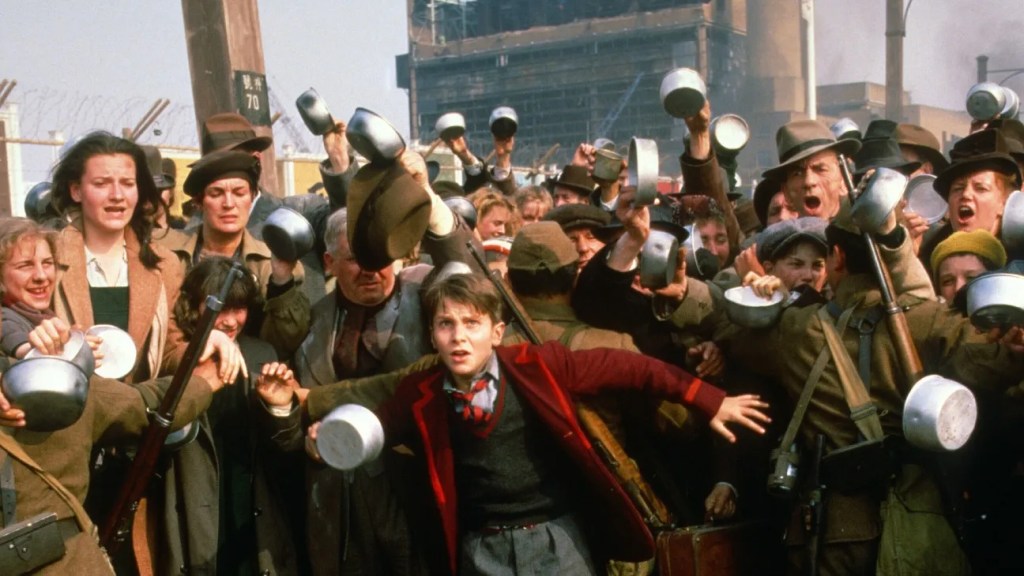
Bale’s stunningly mature performance powers one of Empire of the Sun’s strongest themes: Jim’s subconscious quest for substitute parents. Barely able to remember his real parents, Jim looks to other adults to fill the gap, while lacking the maturity to judge who is appropriate and who not (he even allows himself to be ‘renamed’ from Jamie to Jim). This brings out a strong Oliver Twist subplot, with Jim fixing himself onto an amoral American Fagin. John Malkovich gives a serpentine menace to the amoral Basie, the grifter who always comes out on top, demonstrating just enough affection for Jim while never leaving you in doubt he’d eat the boy alive if circumstances called for it.

With so many strengths, it makes it more of a shame Empire of the Sun doesn’t quite click. It’s at least twenty minutes too long, dedicating too much time to larger scale moments which, while impressively staged, distance us from the heart of the movie. It works best with smaller personal moments, even within its epic sequences. The Japanese army marching into Shanghai is masterfully staged, but it’s the terror of Jim as he loses his parents in a surging crowd that carries the real impact. Similarly, Jim watching the A-bomb explode, light flowing across the screen, has a silent power. Some moments capture the changing world in microcosm brilliantly: Jim’s discovery that his parent’s staff are looting his home, has the maid respond to his anger by calmly walking across the room and slapping him. This moment captures the fall of everything Jim has known perfectly.

You wish there was more of these smaller, more intimate moments in Empire of the Sun – just as you wish that the film was more slimmed down, more focused and better able to engage with the complex child’s perspective that could simultaneously love and hate the way. Spielberg’s film despite its many strengths and virtues, isn’t quite willing to do that.

Out of Africa (1985)

Robert Redford and Meryl Streep in this sweepingly empty romance Out of Africa

Director: Sydney Pollack

Cast: Robert Redford (Denys Finch Hatton), Meryl Streep (Karen von Blixen), Klaus Maria Brandauer (Bror von Blixen), Michael Kitchen (Berkeley Cole), Michael Gough (Lord Delamere), Suzanne Hamilton (Felicity Spurway), Rachel Kempson (Lady Belfield), Shane Rimmer (Belknap), Malick Bowens (Farah Aden), Joseph Thiaka (Kamante), Donal McCann (Doctor), Leslie Phillips (Sir Joseph Byrne)

In the 1980s Hollywood faced an identity crisis. Throughout the 1970s, the films the Oscars honoured and those that topped the box office were often one and the same. The industry saw itself as the purveyor of classy, intelligent, popular entertainment. But in the 1980s, people flocked to see the latest Rocky or Rambo film, instead of the likes of Kramer vs Kramer. Hollywood wanted to carry on feeling good about itself: so it honoured as “Best Picture” the sort of sumptuous, prestige products it wanted to shout from the rooftops about, even if people weren’t flocking to see them at the cinema in the same way. So something as mundane, average, tasteful and empty as Out of Africa hoovered up eight Oscars.

Based on Karen Blixen’s memoir of her 17 years (from 1913) owning and running a coffee farm among the British community in Kenya, the film reorganises a deliberately non-linear memoir (full of impressions and reflections, thematically arranged) into a simpler narrative, and throws in content from at least two biographies of Blixen (played by Meryl Streep). As such, the film charts her life, specifically her relationship with philandering and unreliable husband Bror (Klaus Maria Brandauer) and love affair with British game-hunter Denys Finch Hatton (Robert Redford).

Pollack directs this epic with a clean, smooth, professional and lifeless tastefulness that makes it a long film full of pretty things, but a fundamentally empty experience. At the film’s conclusion, Karen is invited into the Men Only club for a drink where she is toasted. It feels like it should be the culmination of plot threads running throughout the film. But instead, its under-explored and unfocused, struggling for any attention. Rather than a culmination of a nearly three-hour experience, the moment feels unearned.

That’s about par for the course for a film ticking all the boxes of “prestige” movie making, but which tells us nothing at all. It’s clear Pollack has only a limited understanding of the intricate rules of the British upper-class community. We learn nothing about Africa, or the role of Empire there or the impact this had on the Kenyan people. Instead, the Kenyan people are seen as exotics or charming superstitious eccentrics.

The film is only interested in how beautiful colonial Britain was – the lovely clothes, the sumptuous set-design, the detailed props – and the gorgeous scenery. There is some focus given to the Kenyans – particularly Karen’s relationship with her servant Farah, very well played by a stern but wise Malick Bowens – but it is always defined as Karen visiting them, encouraging their education and pleading for their rights. There is more than a touch of the white saviour, and the film fails to really give us a sense of Karen gaining an understanding of the Kenyan people on their own terms, rather than hers.

That might be because the film is determined to turn the story into a straight-forward romance, giving most of its focus to Karen’s relationship with Denys. This is the root cause of most of the film’s problems, as Pollack casts two fundamentally unconnected actors. Streep gives a performance of such technical detail, you find yourself admiring the work while never really connecting with the character. Her Danish accent is perfectly studied, she has clearly read everything on Blixen she can find, and every single beat is perfectly observed. You can’t miss she is acting in every frame: there is nothing relaxed or truly intimate in the performance. It’s the work of a master craftsman.

This detailed excellence literally feels like it is happening in a different movie to the one Redford is in. Redford looks like he just stepped off the plane and started shooting. Pollack was convinced no English actor could play Denys in the sweeping romance he had in mind (Charles Dance anyone? Michael Kitchen – very good as Denys’ best friend – is far closer to what the part actually required, and would have been excellent). Redford was parachuted in and encouraged to play the role with his natural accent (is he still meant to be British? No idea).

The two performances never click together, and Redford’s Californian approach feels totally wrong for the Houseman-quoting, Mozart-playing, Great White Hunter he is meant to be. Not for one second can you forget this is the Sundance Kid – making it nearly impossible to buy into this relationship the film is trying to sell you, as well as making Streep’s Danish accent sound out of place (I mean why is she going to so much trouble when Redford can’t be arsed?).

All the romantic hair washing in the world can’t make these two stop being a chemistry free, jarring couple. Take away the sort of epic romance the film needs – the sort of thing The English Patient would do so right 11 years later – and all you really have left are two handsome actors in a very picturesque setting. Out of Africa looks lovely – but in a National Geographic way. The African Plains look wonderful, you’d have to do a poor job to make them look bad. Really the film is visually dull.

Pollack’s limitations as a director are revealed – he can’t give this the sweep and sense of the epic it needs and he can’t find depth in this canvas. Instead, everything is painted in the broadest brush strokes and any sense of romance it gets is from John Barry’s exquisite, luscious score. The film crams in as many shots of Africa as possible – but is bored witless by the story-telling and poetry that are supposed to be at the heart of Denys and Karen’s relationship. It rips the heart out of these two characters and their romance.

Out of Africa won all those Oscars – but feels like a box-tick exercise. Like the voters just thought everything in it musthave been Oscar-worthy. 1985 was a poor year for movies – perhaps only Ran, Brazil and Back to the Future have really grown in stature – but Out of Africa feels like the emptiest, least interesting, least effective prestige picture that ever scooped the Oscar. Nothing sticks in the memory – other than the repeated “I had a farm in Africa” line in Streep’s tongue rolling accent. Kitchen, Suzanne Hamilton and Brandaurer (charming and likeable as Blixen’s husband, despite playing a complete shit) are good, but nearly nothing else really works beneath its surface impact. Middle-brow, tasteful and pointless.

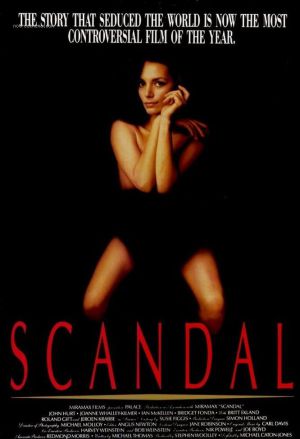
Scandal (1989)

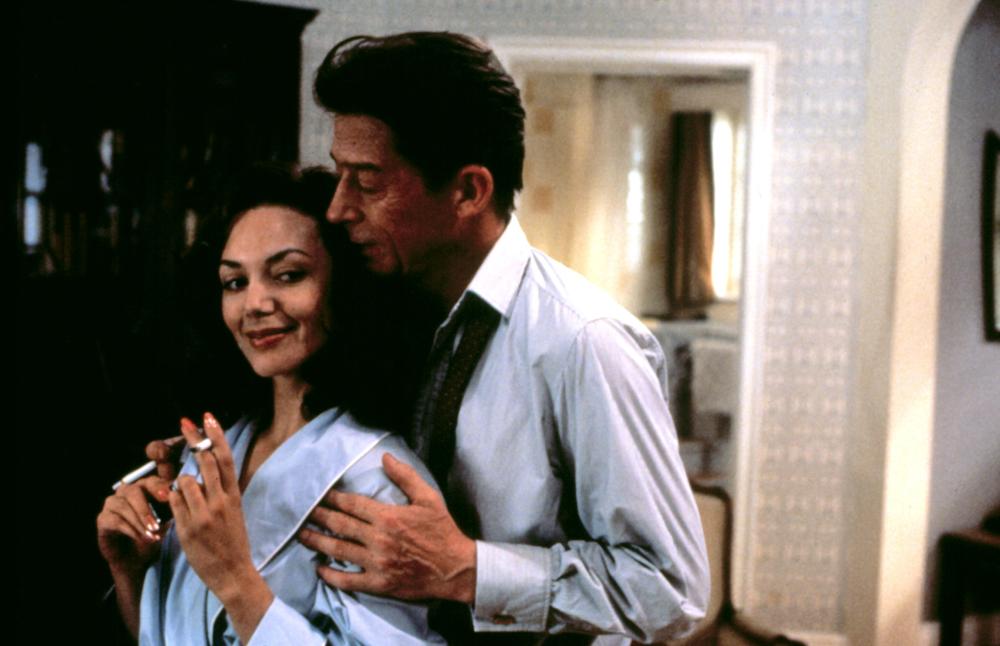
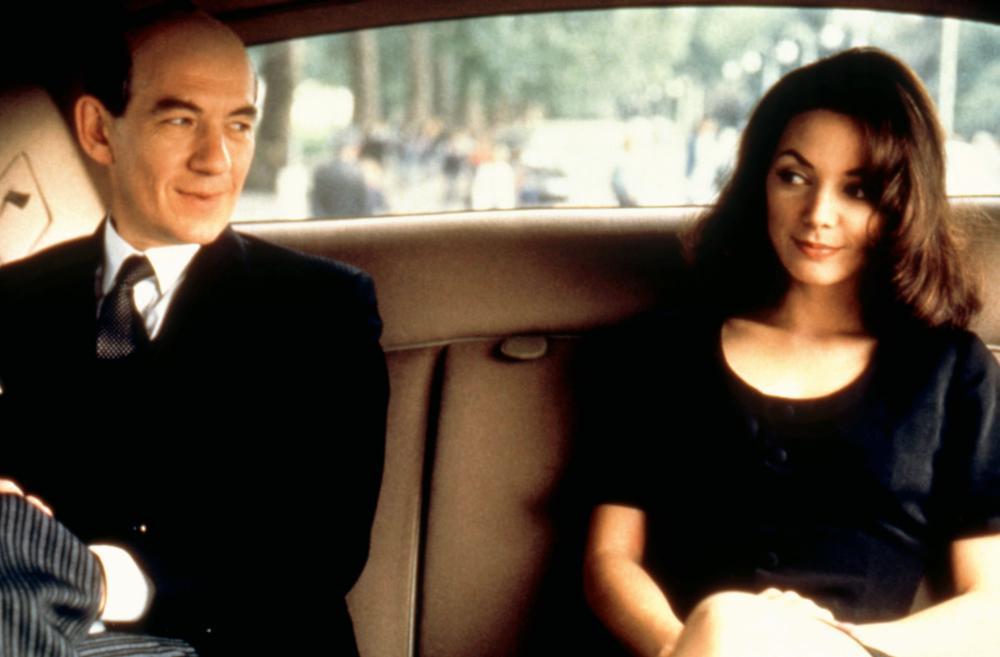
Joanne Whalley and John Hurt get unwisely wrapped up in the Profumo affair in Scandal

Director: Michael Caton-Jones

Cast: John Hurt (Stephen Ward), Joanne Whalley (Christine Keeler), Bridget Fonda (Mandy Rice-Davies), Ian McKellen (John Profumo), Leslie Phillips (Lord Astor), Britt Ekland (Mariella Novotny), Jeroen Krabbé (Eugene Ivanov), Daniel Massey (Mervyn Griffith-Jones), Roland Gift (Johnny Edgecombe), Jean Alexander (Mrs Keeler), Deborah Grant (Valerie Hobson), Alex Norton (Inspector), Ronald Fraser (Justice Marshall), Paul Brooke (Sergeant), Keith Allen (Reporter)

In 1963 the British Government was nearly destroyed by a sex scandal. John Profumo, Minister for War, was widely suspected of conducting an affair with Christine Keeler (a former show girl turned society figure) at the same time as she was sleeping with Russian naval attaché Eugene Ivanov. Profumo denied it to the House of Commons. A few weeks later he confessed he had lied and resigned from Parliament. The scandal shook the country to the core, and led to an exhausted Harold MacMillan’s resignation as PM. As the scandal span out to reveal sex parties in country homes, the country couldn’t get enough of the discovery that large numbers of the upper classes enjoyed nothing more than swinging, orgies and indiscriminate sex laced with sado-masochism. 

Scandal reconstructs the build-up to and eventual explosion of controversy around this affair, focusing on Keeler (Joanne Whalley) and Stephen Ward (John Hurt), the society osteopath and friend to the rich and famous who had worked out that if he found and coached attractive young girls, Henry Higgins-style, into engaging and fun companions, he could swiftly move up the social ladder by giving the rich and powerful people they could sleep with. When the Profumo affair blew up, it was Ward who was left holding the parcel: abandoned by his rich and powerful friends, Ward was placed on trial as a pimp, vilified in court and in the press, and eventually committed suicide the night before the court case finished (which convicted him in absentia of living off immoral earnings).

It’s this miscarriage of justice that Scandal zeroes in on – and the film does a good job of showing that Ward basically didn’t really do anything that wrong. He didn’t mistreat the girls, he thought he was helping them improve their lives and he didn’t attempt to blackmail his friends. His own sex drive seems curiously disconnected (he was clearly more of voyeur) and if anything, John Hurt (excellent as always) plays him as a slightly sad social-climber. A sort of Horace Slughorn of sex, far more excited by his bulging address book, access to the exclusive clubs of London and calling lords of the land by their matey nicknames, than by all the nooky.

Scandal however is a rather unemotional, unengaging and distant film. It’s hard to get too wrapped up in, as it too often goes for documentary checklist rather than real character engagement. On top of that, it’s often rather unclear – it’s tricky to tell the exact timelines, it’s hard to see often how some events relate to others, it’s unclear in particular how Christine Keeler’s relationship with jazz promoter and drug dealer Johnny Edgecombe led to exposure. It’s a film that’s both in love with telling the facts and so blinded by them that it doesn’t turn them into an engaging story.

But then perhaps part of this is because looking back today, it’s hard to see what all the fuss was about with the Profumo affair. After generations where government ministers have been accused of everything from toe-sucking to performing a sex act on a dead pig, it’s hard not to look at the Granddaddy of all government sex scandals and not think it rather quaint. Today it would barely merit more than few news cycles: and Profumo would certainly have been back in the cabinet within two years. Even the spy angle (was Profumo leaking secrets to Keeler, who in turn leaked them to Ivanov?) was widely (and almost immediately) discredited at the time. 

Not that the seismic impact really comes across anyway in the film. This is partly because the film focuses on Ward and Keeler in particular. For the two of them, there wasn’t much at stake – until their lives were destroyed. In fact, for most of these people at the various dodgy parties – other than embarrassing tittle-tattle – there wasn’t much at stake. A film that gave more space to Profumo – and really made-clear what he was running the risk of losing here, particularly after he lied to Parliament – might have made it clearer the dangers that all involved were inadvertently running.

But that would have been to dent the film’s purpose of showing Ward and Keeler as essentially innocents abroad. Joanne Whalley has a particularly difficult job as a Keeler so thoughtless, short-sighted and self-obsessed, she verges on the dim. Whalley makes her bright, engaging and fun-loving, but never with a whiff of sense. By the time Keeler is blurting out totally unconnected Profumo facts when speaking to the police about her relationship with Edgecombe, you can tell she doesn’t have a chance.

The film’s real strength though is John Hurt’s masterful performance as Stephen Ward. Hurt’s pock-marked face and ruddy complexion (going through a difficult divorce he allegedly spent most of the filming struggling with alcoholism) and slightly sweaty desperation are perfect for the role. A natural victim as an actor, he makes Ward always slightly desperate, always trying too hard, always the grammar-school boy pushing his nose up against society’s window. He’s a super creepy Henry Higgins grooming girls for a “better life” (his genuine belief!) and getting himself an entrée into posh society at the same time.  

Ward, the film argues, didn’t feel he was ever doing anything wrong – and he realises far too late that society, his posh friends and the government don’t agree. “It’ll blow over” he reassures Ivanov: totally wrong. Ward basically was a hedonist who wanted people to have a good time – and was thrilled to be invited to the party. When the shit hit the fan, he was dumped with the blame. It’s an angry note that the film – with its obsession with covering so much ground – fumbles slightly: it wants to be a searing indictment of the hypocrisy of the upper classes, but it fudges the emotional connection so much that you can’t feel it as much as you should.

Instead Scandal just sort of simmers rather than boils. It doesn’t communicate what a sea change this was in how Britain viewed its politicians and upper classes – from hereon they were always seen as men with feet of clay – and it doesn’t get the audience feeling as angry or engaged with things as you might expect. It has a lot of sex in it but (perhaps deliberately) it’s not sexy – the orgy scenes would make a great mood killer – and it seems to miss the hedonistic tone that dominated the class at the time. 

There is some decent directing – a scene of Mandy Rice-Davies and Christine Keeler preparing for a night on the town is particularly well done – and some strong acting, not least from Ian McKellen is a slimy Profumo (rumour has it a recently de-closted McKellen was keen on the role as it was the most hetrosexual role he could imagine playing!). But it never quite clicks together into something really emotionally engaging. And it isn’t quite as clear and easy to follow as you need. Structuring the story as a kind of love story between virtually the only people in the story who don’t have sex together is interesting – and Hurt and Whalley are good – but it’s just not quite a good enough film for what it wants to do.