Tag: Lewis Milestone

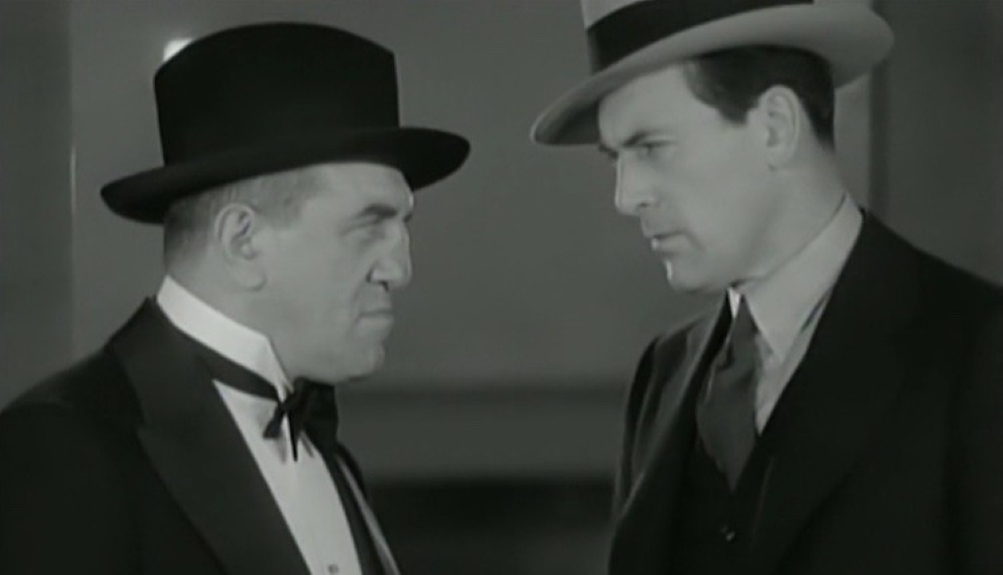
Of Mice and Men (1939)

Of Mice and Men (1939)

Well-made version of a story that has since become almost excessively familiar

Director: Lewis Milestone

Cast: Burgess Meredith (George), Lon Chaney Jnr (Lennie), Betty Field (Mae), Charles Bickford (Slim), Roman Bohnen (Candy), Bob Steele (Curley), Noah Beery Jnr (Whit), Oscar O’Shea (Jackson), Granville Bates (Carlson), Leigh Whipper (Crooks), Helen Lynd (Susie)

I suspect John Steinbecks’s powerful parable has been rather defanged for many people, after extensive over-exposure in schools across the world. Who hasn’t spent hours in an English class pouring over the struggles and dreams of permanently unlucky Depression-era drifters, scrawny George and muscular-but-childlike Lenny? It’s hard to not feel Of Mice and Men is very familiar the second the credits roll on Milestone’s film – or fail to notice some of its on-the-nose musings (sometimes the kindest thing you can do is kill a frightened, vulnerable dog, rather than let it suffer – I wonder what development plot is being alluded too here…) and while familiarity has stripped Of Mice and Men of some of its power, this is an effective, well-made, version.

George (Burgess Meredith) is the brains of a partnership with childlike muscle man Lenny (Lon Chaney Jnr) as they drift from job-to-job out West, constantly hired on the back of Lenny’s muscle, then escaping from the troubles his lack of understanding of the world causes, through George’s survivalist cunning. They dream of having their own place – and they get a shot at it when aged, one-handed farmhand Candy (Roman Bohnen) offers to chuck his accident-payout dollars into their pot. But Lenny’s inability to cope with the world keeps leading to danger: from his accidental rousing of the ire of small-of-statue rancher’s son Curley (Bob Steele) to his fascination with Curley’s pretty wife Mae (Betty Field). Some dreams are doomed.

Of Mice and Men stays very faithful to Steinbeck, playing out this smalltown tragedy under the low-key, persuasive eye of Milestone who avoids either overplaying the tear-jerking or smothering the story with flashy film-making (there is one dramatic pull-back after disaster strikes, and George flees a barn, the camera heading into a sudden wide-angle, but other than that this is restrained film-making). Instead, the focus is very much placed on the relationship between two very different men who, without even quite understanding it, are mutually dependent halves of a whole.

At first it seems George and Lenny are effectively in a marriage of convenience. The wirey George would struggle to be hired without the loaded-cart lifting Lenny as a sweetener, while Lenny can barely tie his own shoelaces without George’s guidance. Meredith’s snipy, wheedling George feels at first like he can only just master his frustration with Chaney Jnr’s lumberingly sweet Lenny. But Meredith gives full life to a character who, we slowly realise, has a brotherly protective regard for Lenny – and needs the purpose Lenny gives his life, just as much as they both need the reassurance of George’s constantly spun story of their dream farm. This mantra – with Lenny echoing lines like a child’s bedtime story – of the buildings and animals they’ll care for is delivered by Meredith with a careful repetition that constantly flowers into earnest true-belief. We realise George is as much a lost soul as Lenny, adrift and barely able to cope with the world.

Because Depression-era America is a place where dreams go to die. Curley, clutching a few hundred dollars hush money after a farming accident cost him his hand, knows his life is just a countdown until he is kicked off the farm for being unable to work. He’s facing a future not too dissimilar from his euthanised dog, eyed up by the other men as a feeble old-timer who’d be better off snuffing it. No wonder both he and the simple Lenny, living on the bottom rung of life’s ladder, find a companionship with segregated Black farmhand Crooks (a very sensitive performance from Leigh Whipper, a character treated respectfully by Milestone’s film).

George’s natural alliance is with these little guys. Meredith’s George is naïve in his own way, slightly off-the-pace in social situations, tolerated by others, a deep vein of anxiety and worry just under his skin that he is all-too-happy to repress while he focuses on being father-figure and big-brother to Lenny. Meredith makes him chippy but not quite as worldly as he thinks, shrewd but vulnerable and, for all his carefully performance self-confidence, insecure and intimidated by events. He’s a passenger in life who likes to kid himself he’s a driver.

Authority lies elsewhere. Curley, played with a little-man anger and stunted swagger by Bob Steele, makes up for his own (many) insecurities – about everything from his height to what his flirtatious wife gets up to – by treating everyone below him in the farm’s pecking order with contempt. Curley needs to proof his masculinity by beating Lenny – who has all the physical gifts he longs for but none of the gumption to use them. He can only dream of having the relaxed, natural authority of Charles Bickford’s Slim, a man completely confident about himself and his standing in life – this easy assurance stands out in a film full of the jittery, frightened and insecure.

Of Mice and Men’s weakness, as with the book (as even Steinbeck later acknowledged) is Curley’s wife. Betty – played with a shrill energy by Betty Field in a performance she’s not quite strong enough to pull off – is only faintly crafted into a vaguely three-dimensional figure from the sexually charged, selfish flirt she is in the book. Here she has moments of self-reflection – and Milestone’s film briefly explores the isolation of this girl who dreamed of Hollywood but ended up married to an inadequate, angry man on a crappy farm – but remains, at heart, a brassy, selfish woman who precipitates disaster through her actions. It’s a singular lack of empathy in a film that prides itself on its humanitarianism.

Disaster is the inevitable outcome of a Steinbeck Depression-era drama. Milestone’s film finds quiet emotional power – aided a great deal by both Meredith and Chaney Jnr effectively under-playing – in the film’s final moments. You can imagine if this was your first exposure to a very familiar story, being impressed by the effectiveness of so much here. This is particularly so in the film’s powerful ending, directed with admirable restraint and played with a highly effective (and underplayed) emotion by Meredith. If other parts of the film are more well-assembled than really inspired, delivering Steinbeck pretty much as it is on the tin, that still makes for a fine version of a now familiar tale.

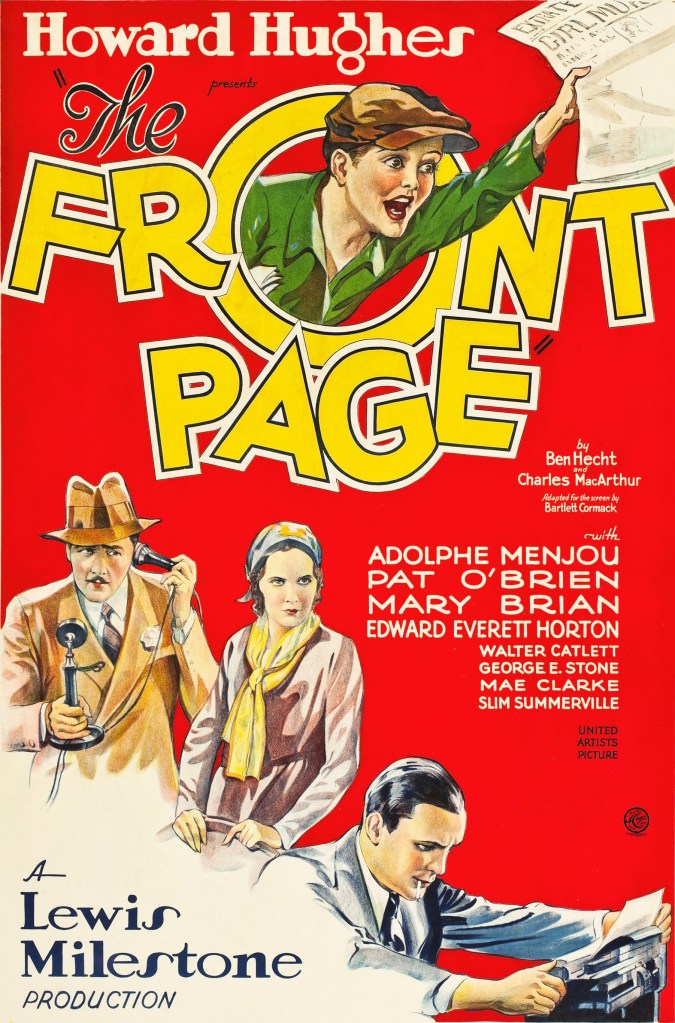
The Front Page (1931)

The Front Page (1931)

Original and (perhaps) best version of the pioneering cynical journalism story

Director: Lewis Milestone

Cast: Adolphe Menjou (Walter Burns), Pat O’Brien (Hildy Johnson), Mary Brian (Peggy Grant), Edward Everett Horton (Roy Bensinger), Walter Catlett (Jimmy Murphy), George E. Stone (Earl Williams), Mae Clarke (Molly Malloy), Slim Summerville (Irving Pincus), Matt Moore (Ernie Kruger), Frank McHugh (McCue), Clarence Wilson (Sheriff Pinky Hartman), Fred Howard (Schwartz)

Unscrupulous newspaper men fling fast-paced banter at each other, caring less about the truth and far more about how the copy sells. In many ways the deeply cynical The Front Page hasn’t really aged at all. Probably why it keeps coming back round again-and-again, in different forms for different eras (most famously of course, spiced up with a gender-swopped Hildy as the screwball romance His Girl Friday). I’ll make a confession – not a surprise for those who know my heretical views on His Girl Friday – it’s never been my favourite play and I’ve never found it as funny as others. But, despite my doubts, it’s hard to deny the flair and energy of Milestone’s early talkie.

Star-reported “Hildy” Johnson (Pat O’Brien) has decided the time is right to give up the newsprint game and find happiness with sweetheart Peggy Grant (Mary Brian). But his ruthless editor Walter Burns (Adolphe Menjou) doesn’t want to hear it from his star reporter. Burns is determined to drag Hildy back into the game, and the press-stopping story of an anarchist who escapes hours before his scheduled execution is just the thing to tempt Hildy away from those wedding bells.

And so we get the ultimate cynical press story, adapted from a play that practically invented the image of the newspaper man as a heartless adrenalin junkie more interested in the scoop than the truth. The Front Page is all about the process of collecting the news, and how easily and casually this can be spun into what an audience wants. If the truth does out eventually, it barely happens as a result of the journalists. In fact, our heroes largely end up pushing it because it will get them out of a tight spot and shift a hell of a lot of copies tomorrow morning.

Milestone’s film for years existed as only a bastardised version of the international print: made up of Milestone’s third choice takes and angles with re-edited lines. Restored into his original vision, it’s striking how dynamic and cinematic The Front Page is. While His Girl Friday has it beat on pace (giving us the same story and almost the same amount of dialogue in twelve fewer minutes), arguably Milestone’s film has the edge on cinematic technique. Milestone uses dynamic camera angles and set-ups to inject pace, from the long tracking shot of Burns prowling his newsprint rooms to the rotating camera that roves around the film’s primary location, the courthouse press-room.

It uses fast-cuts and zooms to great effect: the opening shot of a sack of flour, crash zooms out to reveal it’s being used to test a gallows; the ‘yo-yo’ effect as the camera bounces rapidly up-and-down to take us from one reporter’s face to another during a harried reporting scene. Milestone makes large chunks of otherwise single-location farce, come to life through witty angles and blocking, knowing when and when-not to include an actor in the frame to make a joke work. It’s fast-cutting gives it an early screwball style that further accelerates its sense of momentum. It’s a very astutely, very skilfully directed movie that feels several years ahead of its time, and certainly a whole other level above some of the stilted play adaptations Hollywood was churning out.

Even though the script has never been my favourite, it also picks up a lot of screwball dynamism (and healthy dose of pre-Wilder cynicism) in its bones. It’s chorus of newspapermen, all corrupted to various degrees, are finely delineated, each with their own clear characteristics. From Frank McHugh’s shallow cough to Fred Howard’s banjo, via Edward Everett Horton’s prissy germaphobia and half-hearted attempts at woeful poetry, they each have complementary personalities that helps the comedy spark even more. That’s even without their utter disinterest in the personal lives and tragedies of those they are reporting on, or their shameless gilding of the facts of every story (a lovely audio montage sees them all reporting wildly different versions of an arrest).

The Front Page has a strong performance from Adolphe Menjou as the debonair Burns, here embodied by Menjou as a heartlessly ambitious Mephistopheles-type, constantly throwing titbits of temptation in the way of Hildy. Milestone even films him with a Devilish-Murnau strength, popping up seemingly everywhere he needs to be at any moment in time. Add in Menjou’s suave delight in some ruthlessly amoral lines and you have a genuinely spot-on piece of casting. This is less of the case for Pat O’Brien, the sort of actor more familiar as the best friend to a real star, here showing he doesn’t quite have the charisma to carry a dynamic part like Hildy (in fact, O’Brien would have been perfect casting for the male-version of Peggy: dependable, sturdy, dull).

Nevertheless, he and Menjou bounce off each other well in a film that has more than a little homoerotic energy in it (surely the idea for the gender reverse spun from this!) Even Peggy points out Hildy seems as least as excited as the thought of inconveniencing Burns as he does in marrying her (“you’re going to marry me to spite Mr Burns?”). Hildy isn’t just a man fighting against his urge to report on any events happening around him (a potential fire sees him bemoaning he doesn’t have a camera to hand). There is a life and energy to him when riffing ideas with Burns, that he just doesn’t have with anyone else. The two of them burst into life like naughty kids in each other’s company, in a way they just don’t with anyone else.

Hildy may end the film heading into the sunset, but you suspect Burns’ scheme to bring him back (a witty typewriter ping covers a sensor banned piece of naughty language as Burns calls Hildy an SOB on the phone to an underling) is going to succeed with very little hinderance. Because these guys are made for each other and, just like the rest of the cast, they need the buzz of being in the room where it happens far more than the dull dependency of a job in advertising for Peggy’s Dad’s firm.

That The Front Page does very well and while I’m still not an admirer of a play I found overly cynical and glib, Milestone’s dynamically staged version of it may (ironically) be the best of many committed to the screen.

The Racket (1928)

The Racket (1928)

Silent crime drama has some real moments of interest, before it gets bogged down in stagy framing

Director: Lewis Milestone

Cast: Thomas Meighan (Captain James McQuigg), Louis Wolheim (Nick Scarsi), Lucien Proval (Chick), Marie Prevost (Helen Hayes), G. Pat Collins (Patrolman Johnson), Henry Sedley (Spike Corcoran), George E. Stone (Joe Scarsi), Sam De Grasse (DA Welch), John Darrow (Dave Ames)

In an unnamed city that-could-be-anywhere (but is definitely Chicago), the corrupt political machine is under the thumb of “The Big Man”. And he’s in cahoots with Caponeish gangster Nick Scarsi (Louis Wolheim), a kingpin pedalling Prohibition-breaking booze and knocking off opponents when and where he pleases. In this bent city, the only straight shooter is police Captain James McQuigg (Thomas Meighan) – and he’ll do everything within the law’s power (but no further) to bring down Scarsi. Banished to the sticks of the 28th Precinct, he gets his chance when Scarsi’s feckless kid brother Joe (George E. Stone) is arrested for a hit-and-run but leaves his girlfriend Helen Hayes (Marie Prevost) to take the rap. Can she help McQuigg bust the case?

Interestingly, The Racket only survives today because a copy was among the films in Howard Hughes’ personal collection. Hughes produced this late silent film – and also a talkie remake in 1951 starring Roberts Mitchum and Ryan. The Racket was adapted from a work-a-day Broadway play that gave Edward G. Robinson a big break as the snarling Scarsi and was one of the first Oscar nominees for Best Picture. Directed by Lewis Milestone it’s a strange mixture of the inventive and the mundane, surprisingly daring in its subtle cynicism about government, with intriguing opening half giving way to a final hour that feels trapped by its stage roots.

It starts with a (silent) bang – literally. Milestone’s camera tracks two assassins overlooking a deserted street, watching a target late at night. As thee unwitting figure walks along, they take their shot and miss, their target ducking for cover into a doorway – where he meets Scarsi and we discover this was (literally) a warning shot. We have to wait for the next scene to discover the target isn’t a gangster (as we assume), but a Police Captain called McQuigg. It’s a tense and intriguing opening, well shot and edited, that sets up a personal struggle between two men that the film doesn’t always deliver on (a Cagney-era film would have made these two childhood friends, turned rivals on different sides of the law).

The first act of The Racket follows in this vein, with a series of fast-paced, tense sequences which will culminate in Scarsi’s defiant murder of a rival in front of a roomful of witnesses and McQuigg’s being despatched to the sticks for rocking the boat far too much for “The Old Man’s” taste. Milestone throws in a large-scale street battle between Scarsi and a rival gang, with bullets (and bodies) flying, cars crashing and an army of McQuigg’s cops charging into settle the peace. A retaliatory hit attempt at Scarsi’s club may see Milestone fail to find the sort of sultry tone Sternberg found for nightclub scenes during Marie Prevost’s singing, but his quick cutting from Scarsi’s face to the various hitmen gathering at tables builds tension well and he introduces a truly imaginative shot, from under a table, focused in close-up, on Scarsi’s gun and his target in long-shot. The invention continues at the resultant funeral, where rows of gangsters face each other, a cross fade revealing their black hats all hide pistols.

It’s a shame the invention dies out as we arrive at McQuigg’s 28th Precinct over one-long-night, and the film hues extremely close to the one-location ins-and-outs of its Broadway roots. Exclusively taking place in the Precinct reception and McQuigg’s next-door office, the film turns becomes much less visually interesting, more stationary and theatrical as characters enter and exit and the world of the film shrinks with only the odd montage of newspaper headlines reminding us of the bigger picture. Considering the expansive world earlier, it also introduces logic gaps – McQuigg doesn’t recognise Scarsi’s brother despite having clearly seen him earlier and (even more baffling) half his cops don’t even recognise Scarsi himself. With just this second act, it’s hard to imagine The Racket would have stood out from the crowd at all, as the action becomes increasingly stunted and theatrical.

What helps is the performance of Louis Wolheim as the thuggish Scarsi. Wolheim had an excellent line in smug brutality – his looks really helped here, his broken nose (he was contractually banned from repairing it) giving him a thuggish look. Wolheim is full of simmering potential violence, something he exploits well when during a striking bit of business he fans his coat while talking with one of McQuigg’s cops (leading us to expect a gun) only to produce a wodge of cash for a bribe attempt. It’s a striking performance of menace and potential violence, far more interesting than Meighan’s strait-laced, formal playing as McQuigg.

Scarsi is also at the heart of the one of the film’s more interesting subtexts. He’s fixated on McQuigg (who he seems obsessed with as a worthy rival) and constantly talking about how women are ‘poison’ to him. With his closest confidante Chick (Lucien Proval) a fey figure, it’s hard not to read a homoerotic context into the macho Scarsi. I doubt any of that is intended, but it makes for interest today.

Just as its interesting to see The Racket be so subtly negative about elected officials. The authorities running the big city are utterly corrupt, everything managed for the benefit of the unseen “Old Man”. The DA lacks any scruples, elections are openly fixed (Scarsi owns half the precincts), and anyone inconvenient can be judicially murdered. The film concludes with a brief paean to the government by professional that on paper reads as praise, but after what we’ve seen is almost certainly intended as a subtle dig at how utterly corrupt all these professionals are.

It’s an interesting, surprisingly bitter and cynical ending – our hero even spends the last few moments mostly with his head in his hands – that restores interest in The Racket right at the final beat. Too much of the second act feels trapped by its stage roots, but Milestone creates several touches of visual and cinematic interest, Wolheim is great and it’s opening acts of gang violence may be dwarfed by the sort of action we’d see only a few years later in The Public Enemy but still provides excitement today.

Mutiny on the Bounty (1962)

Mutiny on the Bounty (1962)

Epic retelling that sticks with the same melodrama and nearly destroyed Brando’s career

Director: Lewis Milestone (Carol Reed)

Cast: Marlon Brando (Lt. Fletcher Christian), Trevor Howard (Captain William Bligh), Richard Harris (John Mills), Hugh Griffith (Alexander Smith), Richard Haydn (William Brown), Tarita Teriipaia (Princess Maimiti), Matahiarii Tama (Chief Hitihiti), Percy Herbert (Matthew Quintal), Duncan Lamont (John Williams), Gordon Jackson (Edward Birkett), Chips Rafferty (Michael Byrne), Noel Purcell (William McCoy), Tim Seely (Midshipman Ned Young), Henry Daniell (Admiral)

After the success of Ben-Hur, MGM thought it had cracked the mystery of making those cash-registers go ring-a-ding: massive historical pictures, with scale and run-time dialled up to “epic”. Mutiny on the Bounty was one of the most famous stories of all time and they’d had signed up Marlon Brando, universally seen as the greatest actor alive. It couldn’t go wrong, could it? Months of shooting and a disastrous box-office release later (despite a MGM campaign that landed this a Best Picture nomination), and Mutiny on the Bounty effectively destroyed Brando’s career for the next ten years and became a by-word for star excess.

Brando played mutineer Fletcher Christian – but in a manner completely different from Clark Gable (who, Brando disparagingly stated, only played himself minus the moustache). Brando’s Christian would be British and then-some: posh, foppish, a gentleman torn between the rules of society and those of fair play. Bligh – played with a constant sneer by Trevor Howard – would follow in the footsteps of Laughton, but Brando wanted to make something more serious, more historical. Less of a blood-and-thunder naval drama and more a character study that would give a fair crack of the whip (so to speak) to the Tahitian natives the mutineers lived among.

The film we ended up with though is no more historically accurate than the 1935 Best Picture winner. Part of the film’s disastrous reception might well be that this epic tells more-or-less exactly the same salacious story of a devilish sadist scowling as he whips men to death (far from the truth of the real Bligh, a poor leader but not a monster) until his noble number two steps up (the real Christian was a spoilt weakling) but in what feels like twice the time with half the fun. If you want to watch this version of the Bounty story, why would you want to choose this one? (We’d have to wait until the 1984 version for a more fair-handed telling.)

Not that Mutiny on the Bounty is as terrible as its reputation suggests. It touches – particularly in its thoughtful post-mutiny coda on Pitcairn island – on an interesting character study of the mixed motivations of Christian, filled with regrets and self-pitying sulking. It wants to explore where the balance lies between what is right by the letter of the law and by its spirit. Nothing Bligh does in the film is wrong as such, but his relish and zeal in doing it are. Christian isn’t a conventional hero, but a smirking, foppish character prone to snide remarks and affecting an air of disconnected duty for large chunks of the film. If the film had allowed Bligh more sympathy, rather than the two-dimensional monster he’s portrayed as here, it might have made for an interesting character clash.

Instead, it tends to be slow, self-important and pompous, not helped by Brando’s indulgent performance which sacrifices drama for portentousness. For all the film offers a cartoonish villain, it’s resolutely unfun and deathly serious. Shot with a professional, disengaged widescreen flatness by Milestone (called in from decades of retirement as a “safe-pair of hands”, after the sacking of Carol Reed), it’s uninspired and mistakes size for visual interest. The ship, in particular, is shot with a wide-angled spaciousness which feels completely wrong for a location supposed to be ripe with claustrophobic tension.

The drama attempts to make up for this with its parade of lashings, keel-haulings and bodies (or obvious dummies) tumbling to their death from the rigging. Trevor Howard delivers exactly what’s asked fork here, sneering and constantly in the wrong. It’s one of the film’s failings that it leans into psychological complexity in some places, while most of its events and its second lead are presented with cartoonish silliness. Its location shooting in Tahiti looks great (although the all-too-obvious intercutting of this with scenes on sound stages, sometimes from one cut to another, jars) but a widescreen image of glistening sea would look gorgeous in even the most workmanlike hands.

Perhaps the film is, at times, a chore because it all too clearly was for many involved. Reports of Mutiny on the Bounty have regularly focused on its disastrous making, with directors fired, location shoots awash with dysentery, shooting months over schedule. Above all, Brando rewriting the film on the fly, muscling a disinterested Milestone aside to direct certain scenes. Not a surprise that the studio decided all the blame would be dropped on him not them (they were also stung by the contract they gave him, at $5k a day overtime, Brando’s perfectionism becoming one of the main factors of the film going months over schedule), leaving him virtually unemployable for a decade.

But is that fair? Brando arguably become the awkward, unlikeable, misunderstood Bligh with the cast and crew as the mutineers, all of them intent on a voyage of mutual self-destruction. Put simply, this was a clash between Brando’s immersive, deep-dive acting style and Old Hollywood. To Brando “professional” meant something very different to the “hit-your-marks-say-your-words” attitude of Milestone and the crew: it meant searching over time for the heart of a character. The sort of psychological depth Brando was aiming for was just anathema to many of those he was working with, coming across as the unprofessional self-indulgence of a spoilt star. Combine that with Brando’s stand-offish shyness and professional selfishness and you had a recipe for disaster.

Severed from any director he respected (he made it all too clear he considered Milestone a hack studio Yes-Man) and with no-one having either the power or inclination to restrain him, Brando threw every idea he had at the screen, no matter how awful. So we got Christian with a ludicrous, giggle-inducing accent, a performance stuffed with foppish eccentric touches (and awful costume choices) that aims at thoughtful re-invention but comes across as a camp, bizarre mess. The tragic thing is Brando is clearly passionate about the project, putting more thought and commitment into this performance than he ever offered in barely-bothered turns in films like Sayonara.

Brando was also working with a group of Reed-recruited actors with no sympathy for him. This group of macho British and Irish heavy-drinkers (Hugh Griffith, in a crucial role, frequently disappears for no reason as his alcoholism eventually became such a burden he was fired mid-shoot) had no sympathy for the fey Brando or his acting style. Richard Harris’ loathing of his co-star – who responded to their open dislike with petty on-set power-plays, only making the whole problem grow – in particular is all too-clear. Brando looks most comfortable working with the Tahitian actors (he had long been a passionate anti-racist campaigner) and later married Tarita Teriipaia. It’s one of the few times where he makes Christian feel fully human rather than a mixed bag of conflicting actorly tricks.

Mutiny on the Bounty has its moments: unfortunately it’s all the wrong ones. For a film that wanted to be a more serious, historical exploration of the mutiny, its best parts revolve around Howard’s lip-smacking villainy, combined with flashes of its on-location shooting. Problem is, that’s not dissimilar from what we got in the 1935 original – and really you’d just be better off watching that.

All Quiet on the Western Front (1930)

All Quiet on the Western Front (1930)

War is hell in one of the greatest and most influential war films ever made

Director: Lewis Milestone

Cast: Lew Ayres (Paul Baumer), Louis Wolheim (Stanislaud Katczinsky), John Wray (Himmelstoss), Slim Summerville (Tjaden), Arnold Lucy (Professor Kantorek), Ben Alexander (Franz Kemmerich), Scott Kolk (Leer), Owen Davis Jnr (Peter), William Bakewell (Albert Kropp), Russell Gleason (Muller)

Franklin Roosevelt once said “War is young men dying and old men talking”. Perhaps no film shows that more truly than All Quiet on the Western Front. The first truly great film to win Best Picture at the Oscars, it’s a profoundly influential and unflinching look at the horrific cost of war. Specifically, it looks at how a younger generation buys into dreams of glory and destiny, only to arrive at the front lines and discover they’ve been sold a pup. A sense of glorious purpose collapses into death, mud and misery. War, it turns out, is hell.

All Quiet on the Western Front follows a company of German soldiers during the First World War, plucked from their college to lay down life and limb for the Kaiser. Their unofficial leader is Paul Baumer (Lew Ayres), an intelligent and thoughtful young man. They soon find the frontline is a world away from what they expected, and death moves through the boys like a flu. Over time Paul, with the mentorship of experienced soldier Stanislaud Katczinsky (Louis Wolheim), finds his naïve view of the world torn away with each bullet and failed attack.

In many ways it was brave to make such a large-scale Hollywood epic that placed the side America had actually fought against in the sympathetic role (on the other hand, much easier to look at the losing side and say “you’re fighting for a hopeless cause”). But that makes the film’s message even stronger: it doesn’t matter about sides, war claims young men regardless. The deaths come thick and fast on the Western front – and the gains are negligent. While the boys’ Professor (a pompous Arnold Lacy) sings a familiar hymn of glory and success by Christmas, life on the front line is actually continual terror. Mud, rats, debris and the constant chance the next step you take could be your last. Shelling is non-stop and every inch of the rickety, ramshackle trenches shakes with each explosion. Never mind going over the top, just being there shreds the nerves.

When the attacks come, the film is striking in its modernism and visual invention. Milestone frequently uses intriguing angles and long tracking shots to present an uninterrupted vision of hellish conflict. The film is full of crane shots, urgent camera movements and judicious cutting. The horrors are shown clearly – at one point a soldier literally explodes while cutting through barbed wire, his hands left clinging to the wire, the rest of his body gone. Milestone intercut shots of machine guns firing an arc with the camera moving in a smooth tracking shot as men run towards it and collapse in death. The film is literally shredding its soldiers.

The debris filled, fox-hole spotted no-man’s land the film presents is hellish. It’s a literal minefield of death, with bodies charging backwards and forwards depending on the tide of battle, the camera moving alongside them. For hand-to-hand fighting in the trenches, Milestone shoots the action with a tracking crane shot above the trenches, which stretch like a jagged flesh wound in nature, overflowing with people trying desperately to kill each other. During one charge, Paul lands in a fox hole with a French soldier, who he mercilessly wounds with his bayonet – then spends a dreadful night watching him slowly die. There isn’t any glory here and attack and retreat are both equally pointless. All that really happens is the body count ticking slowly up.

Most of the company are dead well before the film hits the half-way point. After the first big attack, the company goes behind the lines for a meal. Their meal is almost denied them as it was made for a company twice the size of the one that actually reports. It’s a sign of the suffering and hardening to death, that the reaction of the survivors is joy at the unexpected double rations. Later Milestone follows the fate of a single pair of boots, in a beautifully edited sequence that constantly visually focuses on a pair of good boots, while their successive owners meet their deaths.

It’s all so different from how we started, with an Eisenstein-inspired series of cuts to cheering faces as the students sign up. The horseplay at the training camp – where they deal with an officious postman turned corporal Himmelstoss (a puffed up and preening John Wray), overly aware of his own rank and determined to rub the boys faces in it – in no way prepares them for what is to come. This is all too clear from their confused faces at the staging post, a chaos of mud, soldiers and shelling. No wonder no one at home understands what’s happening here – as Paul discovers on leave, when he is repeatedly shocked and disgusted by the casual triumphalism of old-armchair-Generals utterly ignorant of the realities at the front.

All Quiet on the Western Front is so beautifully shot and edited – you can see its influence on so many war films to come – that it’s a shame some of its dialogue and ‘acting’ scenes are now either a little too on-the-nose or overstay their welcome. There are some big themes handled in the dialogue: why are we fighting, what is the point of war, how do we live our lives when they could end at any time – but the dialogue is sometimes a little stilted. It’s also where the film reverts to something more stagey and theatrical and less cinematic and visual. It’s also a slightly overlong film – already a sign that Hollywood had a tendency to equate “important” with “long”. Most of the films’ points are well made by the first hour, and the second hour or so often repeats them.

However, those concerns are outweighed by how much there is admire. Lew Ayres is very good as the noble Paul – the film had such a profound effect on him he became a life-long pacifist, a conscientious objector in WW2 who served as a front-line medic. Louis Wolheim is superb as the rough-edged but decent and kind Kat, a senior soldier taking the new company members under his wing and teaching them nothing is more important than the next meal and no unnecessary risks.

All Quiet on the Western Front takes place in a naturalistic quiet, with no hint of music to interrupt the mood. It is an overwhelmingly powerful movie about the pointlessness and cruelty of war – and the lies that young men are told to fight it. When Paul returns to the homefront – and sees another class of boys being inspired to die for their country by his Professor – he denounces the whole thing (and is promptly branded a coward). War is a cycle that eats everyone it comes into contact with and has no logic behind it. Directed with verve and imaginative modernism by Milestone, this is a brilliant picture, one of the first sound masterpieces – and still one of the greatest war films ever made.