Tag: Liam Cunningham

The Wind That Shakes the Barley (2006)

Cillian Murphy and Padraic Delaney take on the British in The Wind That Shakes the Barley

Director: Ken Loach

Cast: Cillian Murphy (Damien O’Donovan), Pádraic Delaney (Teddy O’Donovan), Liam Cunningham (Dan), Orla Fitzgerald (Sinéad Ní Shúilleabháin), Laurence Barry (Micheál Ó Súilleabháin), Mary Murphy (Bernadette), Mary O’Riordan (Peggy), Myles Horgan (Rory), Martin Lucey (Congo), Roger Allam (Sir John Hamilton), John Crean (Chris Reilly)
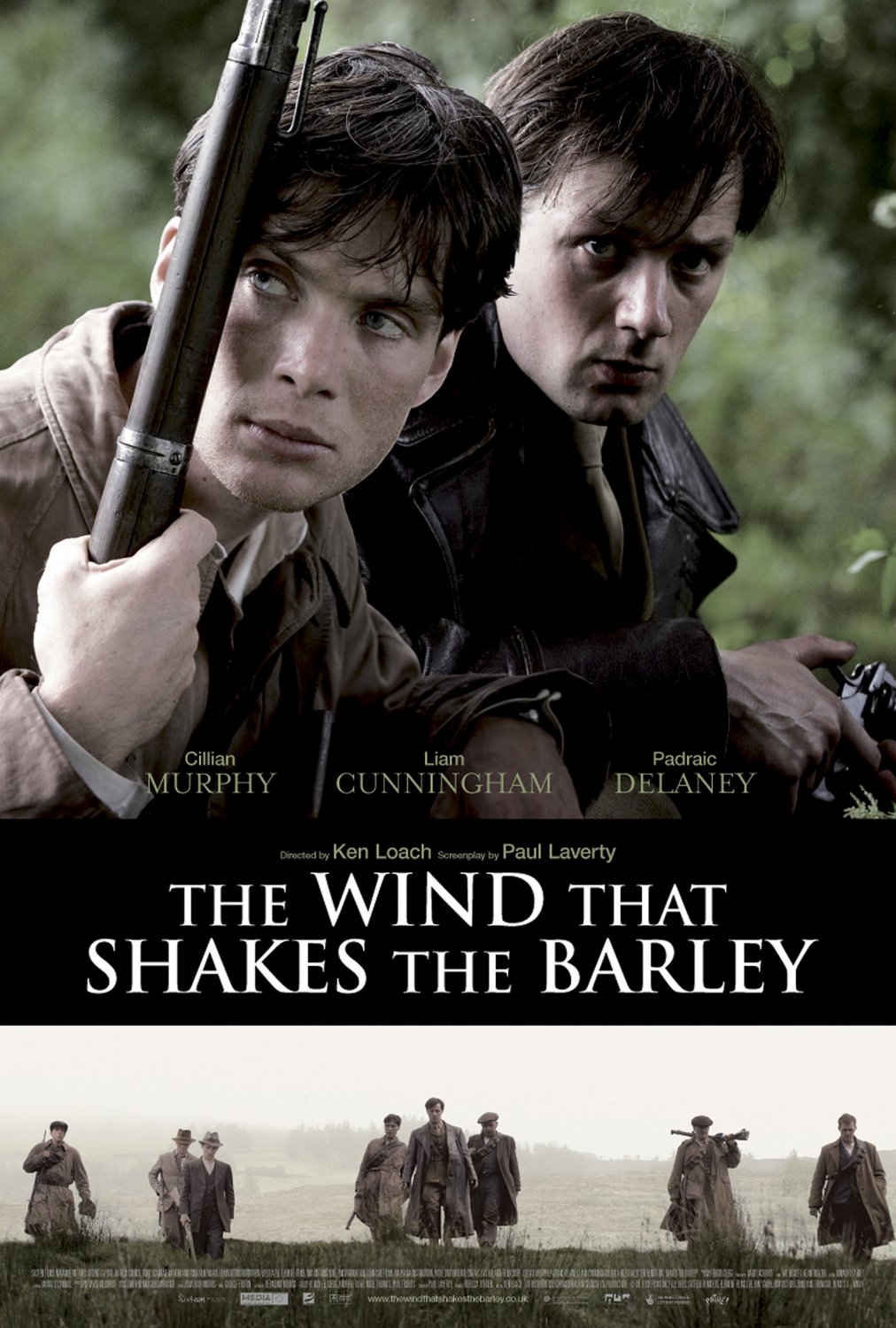
There are few directors in British cinema who have such impeccable left-wing credentials as Ken Loach. Each of his films is powered by a social and political conscience and chronicles the travails of those on the left, those struggling for the down-trodden and unfortunate, or those on the bottom rungs of society’s ladder. It was perhaps only a matter of time before he made a film about that blistering sore on the British conscience, Ireland (just as he is surely destined to eventually make a film about Palestine). It’s not a surprise that Loach’s film, with its vicious denunciation of British policy in Ireland, was met with a vitriolic response by much of the UK media, just as it was scooping Loach the first of his two Palme d’Ors at Cannes.

The film opens in the immediate aftermath of the First World War. Many of the Irish are in open revolt for independence, with Teddy O’Donovan (Pádraic Delaney) a leading IRA figure in Cork. His younger brother Damien (Cillian Murphy), a doctor, is persuaded to join the cause by his horror at the actions of the British “Black and Tan” troops in Ireland, vicious flying squads empowered to act with impunity. When the war eventually leads to a negotiated peace and the Anglo-Irish Treaty of 1922 that divides Ireland in two as a Dominion in the British Empire, the two brothers are divided. Teddy sees this as a stepping stone to peace for further gains later; Damien sees it as betrayal of the socialist message he and many others fought for, which will change only “the accents of the powerful and the colour of the flag”. A civil war across Ireland is inevitable between the government “pro-treaty” troops (supported by the British) and anti-treaty former-IRA members.

The history of Ireland is one of tragically missed opportunities, of poor British policy decisions throughout the nineteenth century (including delaying emancipation for Catholics, and a refusal to grant any level of Home Rule to Ireland for over 70 years, despite three votes on the issue in Parliament) eventually leading to many “peaceful” political movements in Ireland becoming completely discredited and the bullet seen as the only way to self-government. There is no doubt at all – as the film is not shy showing – that British policy in Ireland was often shameful, brutal, repressive, and helped enforce lasting bitterness and resentment, the impact of which is still felt today.

So, despite the furious backlash against the film as being anti-British in the press, it’s clear that The Wind That Shakes the Barley tells hard truths of the violence on both sides – of ransacked homes, murders, shootings and repression. Loach’s film unquestionably favours the Irish perspective and places their actions within a heroic context, while the British soldiers are nearly to a man foul-mouthed, arrogant, violent louts (although an officer does get a speech saying what do they expect since the black and tans are all bitter ex-front liners from France who have nothing else in their lives to come home to). But it makes a legitimate point, and it’s hard not to agree that British occupation of Ireland was, at best, a mistake and worst case a crime.

Loach’s film is harrowingly well-made, expertly shot by Barry Ackroyd, a testament once again to what a vivid and engrossing director Loach can be. Shoot-outs and violence are shot with icy-cold camerawork, mixed with handheld confusion. Political debates (of which there are many) are shot with passionate intimacy, the camera roving between the faces of those on both sides. The film’s reconstruction of Ireland in the 1920s is brilliantly done, and its engrossing recreation of the guerrilla warfare tactics of the IRA is fabulous. The acting is very good, with Cillian Murphy excellent and passionate in the lead role. Loach’s earnestness, married to his cinematic skill, is clear.

The real problem with the film is Loach’s left-wing politics, not his anti-British-establishmentism. To Loach the real tragedy in Ireland was not the civil war, but the compromise that large parts of the country made to sign the treaty with Britain and turn their back on aiming to turn a poor country into something closer to a socialist one, with collectivised industry, less power to the church and a greater equality between the rich and the poor. Loach’s film is squarely stacked in favour of the left-wing firebrands who continue the fight with the IRA, and firmly against those who support the treaty and look to gradually build a lasting peace.

To Loach, it feels like there is little real difference between the British and the pro-treaty forces. The They are both moral cowards and bullies who are fighting to maintain a status quo. There is no legitimate case made for the treaty. Those who support it in the film – like the increasingly nervous, twitchy pro-Treaty Teddy (as if Loach wanted to show him physically weighted down with guilt) – are either mealy-mouthed and guiltily shifty or hectoring bullies (like the priest who preaches pro-treaty/anti-socialism from the pulpit).

Loach is right that independence was a cause that bought everyone together, and in his argument that that the lack of a unifying idea of what the country would become next would inevitably lead to fracture and collapse. But never once in the film do we hear the voice of the ordinary Irish people, and what they wanted. Inconveniently, when put to the ballot, pro-treaty parties won the election of 1921, so the film has to have Damien (as is often the case with those on the extreme of both ends of politics I find) claim that the people didn’t understand what they were voting for, and if they did they would have agreed with him. The film’s final scene ends at a ruined house, but never once does the film (or Loach) reflect on how this embodies the catastrophic harm simple, everyday people were suffering over this period – and that they may have wanted a chance for the fighting to stop and a shift to peaceful progress towards greater independence rather than die in a ditch for nebulous political goals.

The film’s main enemy is actually compromise. Compromise is what Teddy and his gang accept when they plead for the chance for the fighting to stop, and for the country to settle for 80% of their demands now, and the rest later. Compromise is what Damien won’t settle for, and why he’ll restart a war to the death for his beliefs. Maybe it’s just me, but the art of living seems to be one of compromise and peace is built on agreements and a statesman-like acceptance that complete victory is often impossible without unacceptable loss. It’s a belief the film has no time for, and Loach seems to be advocating that the IRA should have completely rejected the treaty and instead fought to the bitter end (an action that would have probably turned Ireland into a wasteland) in the name of the socialist dream, rather than deal with reality.

It’s that which is the real problem with the film: its hard-headed clinging to the belief that any form of compromise is anathema, that death is preferable to altering your beliefs one iota, that prolonging a bloody civil war is the right thing to do rather than accept any agenda that doesn’t completely match your initial dream. Loach’s faith in his politics is admirable, but The Wind That Shakes the Barley sets out a didactic vision of Irish politics that gives no legitimate argument to the pro-treaty side, and only listens to the socialist wing of the anti-treaty group. It’s a one-sided view of history and, increasingly, a dangerous one.
Centurion (2010)

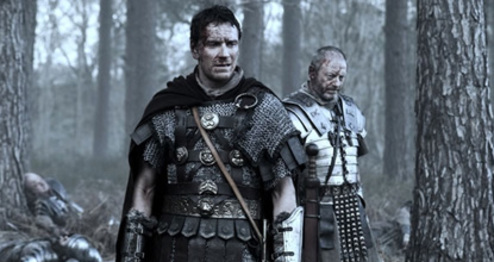
Michael Fassbender surveys the devastation that is Centurion

Director: Neil Marshall

Cast: Michael Fassbender (Quintus Dias), Olga Kurylenko (Etain), Dominic West (General Titus Flavius Virilus), Liam Cunningham (Brick), David Morrissey (Bothos), JJ Feild (Thax), Noel Clarke (Macros), Riz Ahmed (Tarak), Dimitri Leonidas (Leonidas), Ulrich Thomsen (Gorlacon), Imogen Poots (Arianne), Paul Freeman (Gnaeus Julius Agricola), Rachael Stirling (Drusilla), Less Ross (Septus)

It’s an old fable: the “missing” Roman legion, the 9thLegion that allegedly marched to Scotland around 120 AD. We don’t know what happened (if anything) but it usually gets tied into Hadrian’s decision to build his famous wall. Anyway, Neil Marshall’s film tries to plug the gap, with the Legion eradicated on an ill-judged expedition north to settle affairs there once for all. A “ragtag bunch” of survivors (all of whom match expected character tropes) have to run over hostile countryside, led by surviving senior officer Centurion Quintus Dias (Michael Fassbender) to get back to safety and Roman lines.

It’s a Neil Marshall film, so you can expect blood-letting aplenty and high-octane action on a budget. And you more or less get it, mixed with his love for accelerator-hitting chases and against-the-odds action. It’s entertaining enough, but its main problem is that it feels a little too by-the-numbers, as if all the thought about how to make it original and exciting went straight into the look and style of the film – all drained out colours and serious claret – and none at all into storytelling or character.

You sort of end up caring for the characters in a functional way – largely because they are all such familiar types – but their personalities seem to have been designed entirely around the various deaths that have been invented for them. So the enthusiastic meet unjust ends, the likeable fall to cruel chance, the world-weary give their lives for one more stand, the selfish meet justice. At the end, the characters you would basically expect to stumble to the finish line do. It’s a film that lacks any uniqueness.

In fact, what gives the characters life is the professional character actors playing them, all of whom can do what they are doing here standing on their heads and look like they were largely there with an eye on pleasant after-shooting hours in a series of local pubs. It’s hard otherwise to think what attracted them to these cardboard cut-outs and pretty familiar structure.

Not that there is anything wrong with what Marshall does with his film here – it’s a lot of fun when stuff is happening, it’s just that nothing feels like it carries enough weight or originality to survive in the memory. Everything is fine but nothing is really inspired. There is very little sense of Ancient Rome or any other place. The Romans are basically squaddies, an idea that sounds interesting until you remember turning period warriors into versions of modern soldiers is hardly new, while the Brits chasing them are woad-covered psycho stereotypes.

So while it passes the time, Centurion does nothing special with it. It feels like a wasted opportunity – that with a cast this good and a decent premise, plus a nice little historical mystery to pin it onto in order to give it depth, Marshall could have come up with something that was more than the sum of its parts rather than less. Perhaps it needed more time with its ragtag group so they actually became characters rather than plot devices. Perhaps it needed to take more of a rest from its constant chasing to allow quieter moments of reflection and character. Perhaps it’s just a chase film that is never quite compelling enough to make you overlook these things. Either way, Centurion isn’t an all-conquering empire of  film.

First Knight (1995)


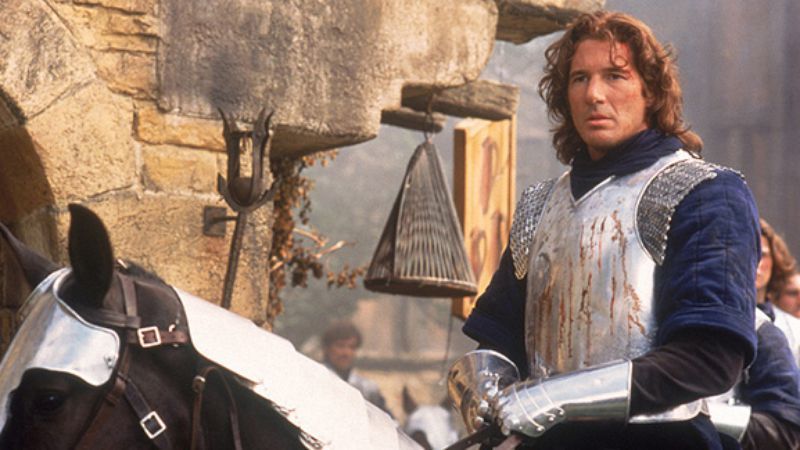
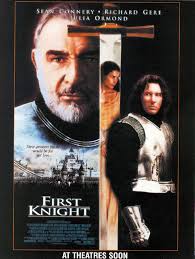
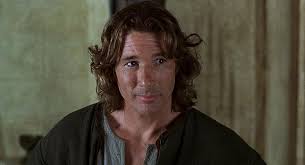
Casting choices only Hollywood producers could make #473: Richard Gere IS Lancelot du Lac

Director: Jerry Zucker

Cast: Sean Connery (King Arthur), Richard Gere (Lancelot), Julia Ormond (Guinevere), Ben Cross (Prince Malagant), John Gielgud (oswald), Liam Cunningham (Sir Agravaine), Christopher Villiers (Sir Kay), Valentine Pelka (Sir Patrise), Colin McCormack (Sir Mador), Alexis Denisof (Sir Gaheris), Ralph Ineson (Ralf), Stuart Bunce (Peter)

First Knight continues a proud tradition of Hollywood adaptations of British legends, with full-blown action and romance mixed with an anachronistic modern-ish vibe which clashes completely with the design of the rest of the film. Think anything from Ivanhoe to Robin Hood: Prince of Thieves. At heart these films are ridiculous, but to be a success they need to embrace this and create something with a bit of heart. First Knight is almost wholly absurd from start to finish – but it’s still remarkably good fun. Even when you laugh at the bizarre sequences that pepper the film, it’s still somehow entertaining. It doesn’t take itself seriously – so I feel people who lambast it are missing the point.

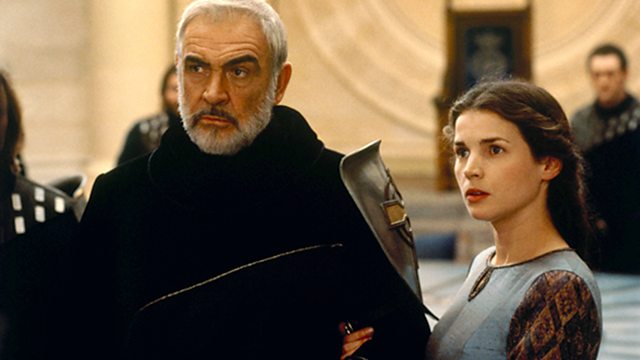
Anyway, it retreads the story of King Arthur (Sean Connery) with a modern mix. Here Arthur is an old man, marrying Guinevere (Julia Ormond) to seal a truce between Camelot and Guinevere’s home of Lyonesse. While being escorted to Camelot, an attempt is made by the villainous Malagant (Ben Cross) to kidnap Guinevere, but she is saved by charismatic chancer and expert swordsman Lancelot (Richard Gere). Returning to Camelot, she marries Arthur while Lancelot finds himself inducted into the Knights of Camelot. But their adventure together has led to a deep romantic bond between Lancelot and Guinevere – one that threatens to tear apart the harmony of Camelot.

Something stupid or horrendously anachronistic happens in every scene of First Knight. Many of these moments are thanks to Richard Gere. Gere is at his most smirky here as Lancelot, an American Gigolo in King Arthur’s Court. There are few more modern actors than Gere – so seeing him in armour and cod-medieval garb jumps straight out as completely incongruous. Rather like Costner in Robin Hood, he makes no concessions to period whatsoever, and behaves more or less as he does in Pretty Woman. Every event in the film is met with his trademarked smirk-cum-grin and a twinkle in his eye. And while he clearly spent a lot of time on his sword work for this film, you literally never forget you are watching Julia Robert’s sugar daddy pretend to be a knight.

But then why should be really have made an effort to adjust his manner, accent or style for this film? After all this is a film where Lancelot takes part in a Total Wipeout competition – and on the basis of his performance in it is basically offered a spot at the round table. As a travelling entertainer, Lancelot woos the crowd with the sort of patter not out of place on a New York street corner. Later, the baddies hook up a boat with a pulley system that turns it into a super-fast speedboat. The baddies are all armed with pistol sized cross bows. It’s the sort of film where the lead villain rides into Camelot and shouts “Nobody move! Or Arthur DIES!”. Anyone watching this expecting a faithful exploration of Thomas Mallory seriously needs to change the channel.

So instead embrace the film for what it is. And enjoy the production values! The music score is swellingly impressive (now hugely familiar to any fans of Sky’s Ryder Cup coverage). The Camelot location looks brilliant. The costumes are wonderful – even if the knight’s armour (basically little more than a shield on the shoulder) looks horrendously inefficient. There is a very effective night-time battle excitingly filmed. The photography looks luscious. It’s shot with an old school, chocolate box, romance that makes everything look like a grand renaissance painting. The final battle between Malagrant and Lancelot is terrific.

I’ve also got to say that it offers an actually fairly interesting role to Sean Connery as Arthur. Considering that four years after this film he made Entrapment, a film in which he boffed Catherine Zeta-Jones, in a way it’s fairly daring for him to make a film that puts so much prominence on his age making him an unsuitable lover for Guinevere. His age is prominent in every scene (especially when counter poised with the modern vibrance of Gere). Half the time he’s with Guinevere he reminds her that he knew her as a child (yuck). He takes no part in any of the action – it’s Lancelot who (twice) rescue Guinevere, while Arthur commands from the rear. His relationship with Guinevere is almost devoid of sex and passion (they share only one remotely passionate snog). He even plays the poor cuckold, the man unable to excite his wife. Has Connery ever played such an unflattering part?


Julia Ormond – an actress who achieved a certain run of prominent roles in the 1990s – plays Guinevere. Despite the fact she seems to frequently find herself in distress, Ormond does manage to make Guinevere not feel like a damsel in distress. She’s proactive, she saves others, she’s defiant and (by and large) she knows what she wants and tries to get it. She also is an effective leader of her people. Ormond is also a fine, generous actress – she manages to convey a lot of chemistry with both Gere and Connery, two actors very different in style.

The film remains charged through with silliness. Ben Cross’ snarling villain has big speeches about how he wishes to escape from “the tyranny of Arthur’s Law”. The LAW is a major theme throughout the film – the characters bang on about it with an earnest insistence. Arthur falls back on it to make sense of his life. Lancelot struggles to understand and embrace the values it brings. Guinevere is determined to match law and duty together. Sure there are some silly grandstanding speeches about it – and the film runs with gleeful pride of Camelot as some sort of Socialist Utopia – but I suppose there’s a kernel of an idea at the centre here about justice and its importance in the world. It might mean we get a scene where Camelot is left totally undefended while everyone gathers for an open trial of Guinevere (guess what happens!), but at least it’s got an idea.

Of course that doesn’t get in the way of the silliness, the high blown acting, the silly events and the overblown dialogue. The heroes are all clean cut, and chiselled of jaw with perfect teeth, the villains all dressed in black, forever scowling and rugged of shave. It never for one minute feels remotely like it is happening in a truly medieval world. Richard Gere is, frankly, completely wrong as a medieval knight. But he’s strangely completely right for a film that is a chocolate box entertainment, a soufflé of a romance with swords and passion, that provides a few stirring moments and an interestingly different part for Connery. Gere is a perfect measure for the film – it’s a silly entertainment for those with an affection for Mills and Boon not Henry V. And there’s nothing wrong with that – it knows what it is, and knows what it wants to be taken as. Enjoy it. After all Camelot Lives!