Tag: Linda Hamilton

The Terminator (1984)

The Terminator (1984)

Schwarzenegger becomes an icon in Cameron’s masterpiece, a darkly gripping sci-fi chase-thriller

Director: James Cameron

Cast: Arnold Schwarzenegger (The Terminator), Michael Biehn (Kyle Reese), Linda Hamilton (Sarah Connor), Paul Winfield (Ed Traxler), Lance Henriksen (Hal Vukovich), Bess Motta (Ginger), Rick Rossovich (Matt), Eal Boen (Dr Peter Silberman), Bill Paxton (Punk)

“It can’t be bargained with. It can’t be reasoned with. It doesn’t feel pity, or remorse, or fear. And it absolutely will not stop… ever, until you are dead!”

If that description doesn’t grab your attention, I don’t know what will. James Cameron cemented his place in cult-film history with The Terminator, such a pure shot-to-the-heart of filmic adrenalin, its hard to think it’s been bettered since. Cameron takes a fairly simple story – essentially a long, relentless chase – and fills it with energy, black humour and a genuine sense of unstoppable menace, in a film that barely draws breath until it’s over an hour in and then promptly throws you straight into a final action set-piece. It uses its low budget effectively to create a world of mystery and dark suggestion and leaves you gagging for more. So much so, they’ve tried to recapture the thrill ride six times since (and only Cameron did it right, with Terminator 2).

It’s 1984 and two naked people arrive in Los Angeles in a ball of light. They’re both from 2029, time-travellers looking for the same woman. One of them nicks a tramp’s piss-stained trousers and runs from the police. The other is a stoic, impassive mountain of muscle who offs a few violent punks after they refuse his blunt instruction to hand over their clothes. Which one do you wish you were eh? Unfortunately, the second one is a Terminator (Arnold Schwarzenegger), a machine in the skin of a man sent to eliminate Sarah Connor (Linda Hamilton), mother of the future leader of the post-apocalyptic human resistance to the machines. The first is Kyle Reese (Michael Biehn), the man sent to save her. Tough gig, since the Terminator is relentless, almost invulnerable and holds all the cards.

The Terminator is pulpy, dirty, punchy film-making – and its huge success became James Cameron’s calling card for a lifetime of success. Set in a neon-lit, dingy Los Angeles (it never seems to be daytime in The Terminator), it taps into the core of a million nightmares, the fear of being chased and nothing you do ever sees to get you further away. It’s a really elemental fear which The Terminator brilliantly exploits, as impassive and impossible to negotiate with as your deepest, darkest dreads. Throw into that Cameron’s gift for tension and you’ve got the almost perfect thrill-ride.

It’s also a film that gives us the perfect level of information we need. Unlike the cops (and Sarah Connor) who can’t believe this story Reese is peddling them that they are up against an unstoppable metal killing machine, we know from the start the whole story. It’s enough for us to feel a cheeky frustration as they bend over backwards to fit logical explanations to the things they’ve seen and for us to feel the sneaking dread that storing Sarah away in a police precinct crammed full of heavily armed cops isn’t going to make a jot of difference. He won’t let anything stop him.

Is it any wonder quite a few people came out of the film sympathising with Sarah and Kyle – but feeling a sort of guilty admiration for the Terminator? This is the foundation stone of the Schwarzenegger cult, his role as the monosyllabic machine sending him into the upper echelons of Hollywood stardom. Cameron’s original idea was the Terminator should be a perfect infiltration unit, the sort of guy who wouldn’t stand out in a crowd (the original choice was Lance Henriksen, relegated instead to the second-banana cop behind Paul Winfield’s folksily doomed decent guy, fundamentally out of his depth). That went out of the window when Schwarzenegger came on board: say what you like about the Austrian Oak, but he stands out in a crowd.

Why is the Terminator darkly cool? (After all literally no one ever pretended to be Kyle Reese, but everyone has put on a pair of shades and said “I’ll be BACH”.) Because he embodies all the qualities we’ve been taught by films to respect. He’s strong and silent, calm and confident, never complains, doesn’t need help and never gives up. He’s exactly the sort of guy Hollywood has cast admiring eyes at since film spooled through a camera. We can’t help ourselves.

The film becomes about Schwarzenegger (even if he’s not in the last set piece, replaced by a budget-busting CGI android). Cameron knew how to get the best out him, his tiny number of lines (17 in total) delivered in his emotionless, euro-accent make him seem mysterious, different and cool, frequently responding with either deadpan seriousness or sudden violence. His under-statement lines are funny because we anticipate already the bloodbath that will follow. And, unlike despicable villains, he’s not motivated by greed, jealousy or wickedness: he’s almost the quintessential American hero, taking care of business – it just so happens his business is killing people.

Reese should be someone we admire more: he’s a plucky, resourceful underdog. But, unlike the actions-rather-than-words Terminator, he’s got to speak all the time – while the Terminator is a killing machine, Reese is the exposition machine. Biehn does a terrific job with a difficult role, a decoy protagonist who spends much of the movie alternating between gunplay and spitting out reams and reams of exposition explaining to anyone and everyone the future and terminators. On top of that, while his opponent gets on with, Reese’s constant refrain of how scared he is and everyone else should be (who wants to hear a hero say how terrified he is eh?) and his frustrated whining at no-one listening to his fantastic story marks him as weak. Charismatic heroes persuade their audiences: no one believes Reese until they are literally watching Arnie shrug off a whole clip of ammo.

Reese is, in any case, a decoy protagonist of sorts. His romantic longing for Sarah (having fallen in love with her photo in the future) and nurturing personality actually mark him out as the more conventional ‘female lead’. In the first of several films where Cameron would show-case heroic female characters, the actual ideal rival for the machine is Sarah. One of the most interesting things about The Terminator is watching Linda Hamilton skilfully develop this character from ordinary young woman into the sort of archetypal Western hero the film ends with her as (she even gets the sort of badass kiss-off line “You’re terminated FUCKER” you can’t imagine the less imaginative Reese saying).

On top of this The Terminator is a triumph of atmosphere. With its synth-score, it has an unsettling quality from the off helping to build the sense of grim inevitability that is its stock-in-trade. Just like the Terminator’s never-ending pursuit, the whole film is a well-judged, inevitable, time-loop. Sending people back in time turns out to be the very thing that guarantees that future will happen. Throughout, Cameron’s little titbits about the future (partly constrained by budget) are perfect in giving us just enough information to understand the stakes but leave enough mystery for us to be so desperate to know more, we fill in the gaps from our imagination.

But the reason The Terminator works best is that it’s an undeniably tense thrill ride, an extended chase sequence that rarely eases off and never loses its sense of menace. You never feel relaxed or safe while watching The Terminator and never for a moment that its heroes are on a level playing field with their opponent. Atmospheric, tense and terrifying, it walks a brilliantly fine line (so much so, the Terminator methodically massacring a precinct full of cops is both unnerving and the most popular scene in the film) and never once let’s go of your gut. It’s not only possibly the best, most perfect, Terminator film made also still one of Cameron’s finest hours.
Terminator: Dark Fate (2019)

Terminator: Dark Fate (2019)

Even re-uniting Hamilton and Arnie couldn’t save this from an (undeserved) Dark Fate

Director: Tim Miller

Cast: Linda Hamilton (Sarah Connor), Arnold Schwarzenegger (Carl), Mackenzie Davis (Grace), Natalia Reyes (Dani Ramos), Gabriel Luna (Rev-9), Diego Boneta (Diego Ramos), Tristan Ulloa (Felipe Gandal)

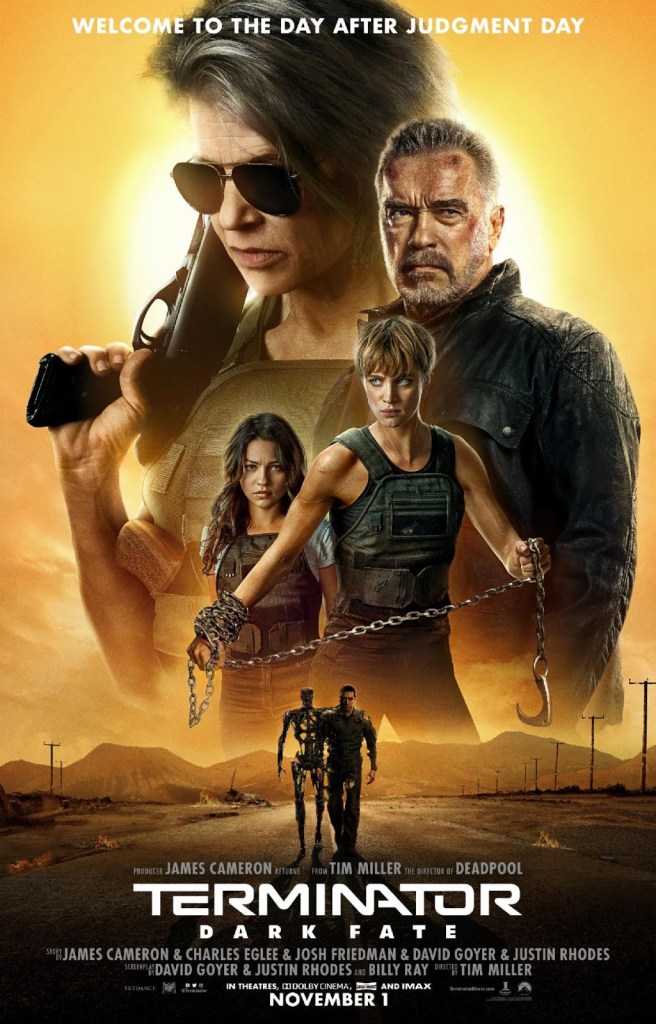
It should have been a hit. The third attempt in the last ten years to restart the Terminator franchise, after no less than two cancelled planned trilogies, this one bought back James Cameron in a producing and story capacity, pulled in Linda Hamilton to return as Sarah Connor for the first time in nearly thirty years and finally seemed to be the “true” Terminator 3. But it bombed anyway, worse than either Salvation or Genysis and finally put paid (probably) once and all for the franchise. How did it come to this?

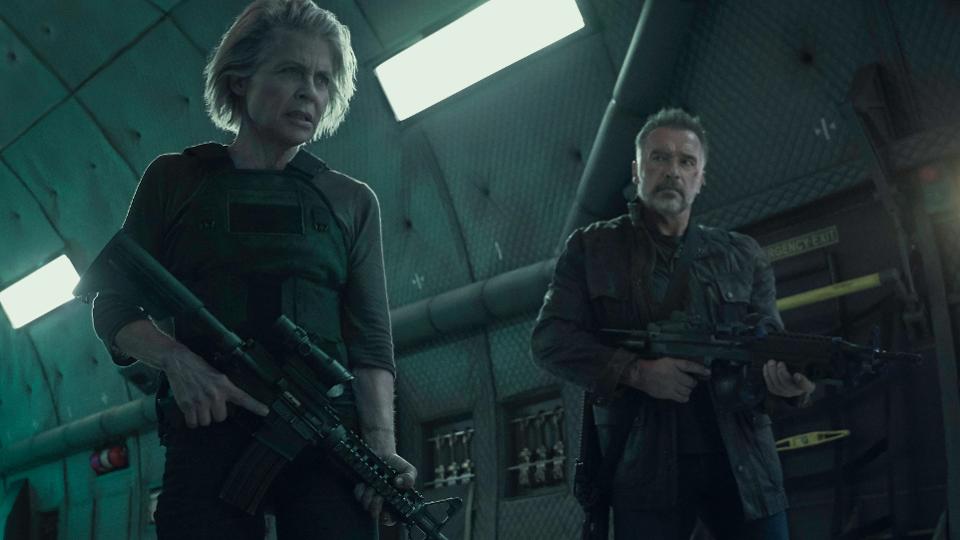
In 1998 a T-800 Terminator (Arnold Schwarzenegger) – one of a number sent back in time by Skynet before erased from history by our heroes in Terminator 2 – finally succeeds in killing John Connor (a CGI recreation of Edward Furlong from T2), leaving Sarah Connor (Linda Hamilton) distraught. Twenty-two years later and a new artificial intelligence from the future, Legion, has sent back a Terminator (Gabriel Luna) to wipe out a pivotal future figure for the human resistance Dani Ramos (Natalia Reyes), with the resistance once again sending back its own champion Grace (Mackenzie Davis), an artificially enhanced human. The inevitable combat between man and machine is on again, with Grace and Dani joining forces with Sarah Connor, as well as other unexpected allies.

That paragraph probably gives you a sense of what’s good and what’s bad about the film. Starting with a twist that seems to finally try and send the franchise off in a new direction – the eradication of John Connor, the person every film has been about protecting – is a brave decision. The confirmation that eternal enemy Skynet has indeed been erased from history finally changes the enemy. Arnie’s T-800 is confirmed as literally the last in existence – a killer sent from a future that now no longer exists. It looks like we are set for something entirely different.

And then of course we aren’t. Because it seems man’s reach will inevitably exceed his grasp, just as would-be Terminator film producers will always overreach themselves. Even with Skynet gone, there must always be some artificial intelligence super-computer that destroys the future, there must always be some sort of special one who must be protected at all costs, always a hero sent from the future who knows more than they can say and always an Arnie Terminator on hand for good or bad. Just as Genysis tried to re-set the table, but only reminded us what a small world is, this film tries to shake up the pieces but then replaces most of them with like-for-like and throws us into a film that has effectively exactly the same structure as the first two films.

So, after that opening scene twist, we get the arrival and meet up of the two future warriors, a scrap at an everyday setting for her hero, a series of shocked reveals about the future, some gonzo chases (this one does at least up the anti – literally – by setting one of them in a plane), a lull in proceedings while our on-the-run heroes work out whether they can trust each other, then a final smackdown in a factory where self-sacrifice is all the rage. For a film that tries to do something new, it is remarkably conservative and shows that for all the time-travel inspired gymnastics of the universe it operates in, the series is strictly tied to a set number of rules and plot mechanics.

But it’s all really confidently told. That’s almost the tragedy. This is a pretty good film. Easily the third best Terminator film made. I actually pretty enjoyed it. It has a simple narrative drive to it, an old-fashioned world where the characters throw each other about and punch each other really hard into things rather than engage in balletic, choreographed fight scenes. Tim Miller directs the whole thing with a pace and drive and if Cameron feels like he may have only really been happy to attach his name to the whole thing in return for a few story ideas and a paycheque, at least it can boast it has his definite seal of approval.

The acting is also pretty good. Linda Hamilton is a welcome return, getting some fascinating beats of intense drive mixed with deep grief. It’s a great to see an action film like this front-and-centre female characters so much. It’s a shame that this is such a franchise with such a masculine reputation, as this realignment has probably not had the impact it could have had in bringing new people in. Mackenzie Davis is impressive as Grace, Natalie Reyes growing in confidence and strength as the new messiah. Even Arnie gets to do something very different with his T-800 characterisation (after 22 years of living as human, the robot has changed beyond all recognition from the remorseless killer), not least seeing him successfully terminate a target for the first time in the franchise. 

It’s just a shame that this energetic re-telling of an old story probably suffered above all from franchise exhaustion. After reboots and restarts from Salvation to Genysis have seen their plotlines, developments and future sequels sent to the scrap heap (certainly the last two) it really seems a case that once bitten, twice bitten makes us not just shy, but running scared. At the end of the day any interest and affection the franchise had from the first two films has been burned up beyond all recognition – and this film, in the end, doesn’t reinvent the wheel enough to encourage you to come back and see what’s different. It’s a shame that this sprightly entertaining film has been terminated not by its future, but by its weary, error-strewn, past.

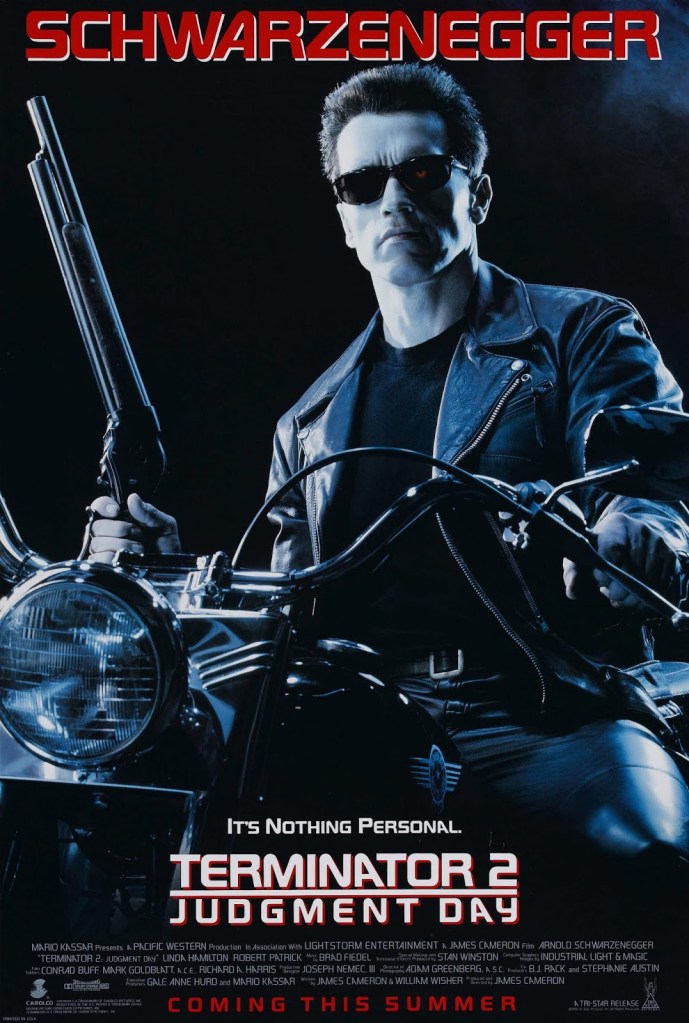
Terminator 2: Judgment Day (1991)

Terminator 2: Judgment Day (1991)

Cameron’s action masterpiece, a film Arnie possibly owes his whole life too

Director: James Cameron

Cast: Arnold Schwarzenegger (T-800), Edward Furlong (John Connor), Linda Hamilton (Sarah Connor), Robert Patrick (T-1000), Joe Morton (Miles Bennett Dyson). Earl Boen (Dr Silberman), S Epatha Merkerson (Tarissa Dyson), Jenette Goldstein (Janelle Voight), Xander Berkeley (Todd Voight)

Schwarzenegger always said he’d be back. And if there’s one film that perhaps explains the, otherwise fairly inexplicable, success of this former body-builder who can’t really act as one of the greatest film stars of the early 1990s, it’s Terminator 2. And this film makes quite the calling card, as it can make a strong claim to being one of the greatest action films and one of the greatest science fiction films of all time. Its influence permeated Western culture – quotes from it are recognised all over the world – and its brilliant mixture of Armageddon-tinged high-brow time thinking with truck chases and lots of shooting has led to increasingly feeble attempts to recapture the magic with innumerable crappy sequels.

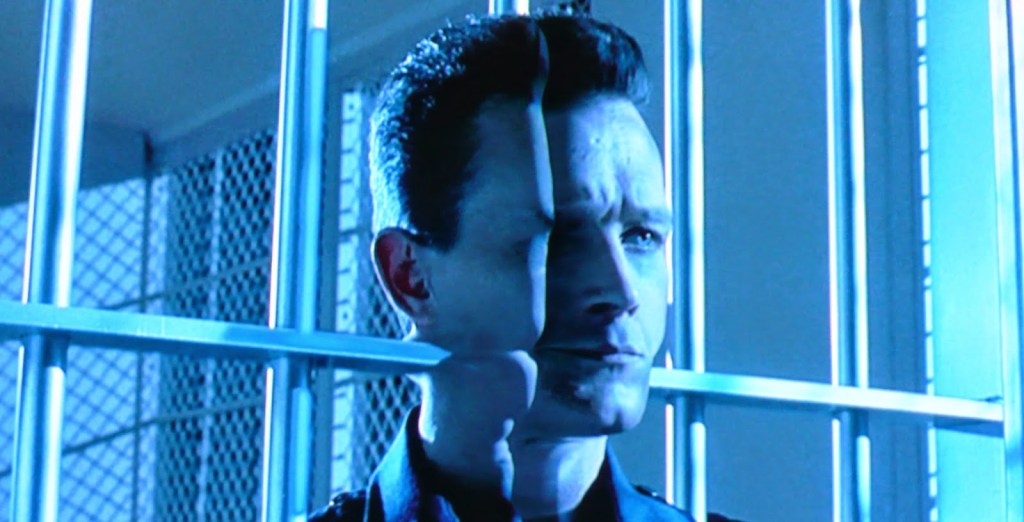
After the events of the first film, John Connor (Edward Furlong) is now a tearaway teenager while his mother Sarah (Linda Hamilton) is in an institution. So: perfect time for Skynet to send back another Terminator to take out the future leader of the resistance. The resistance sends back its own champion. But, handy-dandy, which is which? Is Arnie playing the baddie once more? Or is Robert Patrick’s unnaturally still non-descript looking fella really an evil Terminator? The answer is only a shock to anyone who has been living under a rock since 1991 (even the film’s original publicity gave the answer away). Soon Arnie’s reprogrammed good Terminator and the two Connors are on the run from Patrick’s liquid metal shape-shifter – and hatching a plan to prevent original Skynet inventor Miles Dyson (Joe Morton) from finishing his life’s work.

Terminator 2 hasn’t dated a bit. It’s still one of the very best rip-roaring, balls to the wall, action films ever made. It is essentially set piece after set piece – but with the set pieces strung together with intelligently written scenes that juggle interesting themes with sharply drawn, realistic characters. Cameron’s direction is, I might almost say, faultless. The film balances bangs and shoot-outs with such impressive zeal and imagination that you will wear out the edge of your seat. But the main reason these sequences work so well is because you care so deeply for the characters in the film, you invest so much in the story of the movie.

I think it’s possible no one does this sort of thing better than James Cameron. Certainly no-one ever gets more out of Schwarzenegger than his directing Svengali. Perhaps because only someone as dementedly determined as Cameron would never feel intimidated by an ego as large as Arnie’s. Cameron gets here, hands down, Arnie’s greatest ever performance. No wonder Arnie has tried to re-launch the franchise so many times, he’s never been able to recapture the magic from this film. Gifted with the ability to learn, here the Terminator becomes (within its robotic programming, perfect for the stiffness of Arnie’s skill with dialogue) a surrogate father figure for John, a creature increasingly capable of caring for and emulating human behaviour. And Cameron draws out of Schwarzenegger a performance striking for its growing mellowness and gentleness, its slowly developing emotional openness and humanity. 

It should, by rights, be corny as hell – the saga of a drifting boy given some shape and purpose in life by a father figure who showers him with love and attention. But it really works. Cameron understands perfectly when to throttle back on any possible schmaltz, and instead keep the characters strikingly real. Connor is a surly teenager, but also someone looking for love. The Terminator understands humanity more and more, but is still a machine. The barriers make the moments when emotions force their way through genuinely moving. And it also means that you deeply invest in this rag tag group of people staying together and saving each other.

And the stakes are against them when they are up against an opponent as fearsome as Robert Patrick’s shape shifting T-1000. Cameron’s initial concept for the Terminators – before the studio suits pushed the fortunate casting of Schwarzenegger on him – had been for them to be non-descript looking, average types. Patrick, with all due respect, fits that exactly – and has the additional dark sting of being disguised as a cop almost throughout. He gives the part a cold, mechanical chill, a total lack of empathy or any emotion that contrasts with the growth of those abilities in our hero Terminator.

The special effects used to create the liquid, shape shifting T-1000 were ground breaking at the time (and contributed to this being the most expensive film ever made) and they are still bloody impressive today. The T-1000 effortlessly shifts between states and skilfully reforms its body to become new people. When under attack, it convincingly has holes blasted into it from shot guns, becoming strange Thing-like abominations before restoring its original shape. It looks extraordinary – helped as well by the steel-like chill of the film’s cinematography that covers every shot in the cities and much of the film’s second half in an icy blue.

Cameron’s film has that icy feel to it, as we never allowed to lose the dread of the future apocalypse. In fact, Sarah Connor is herself a constant physical reminder of it. Played by Linda Hamilton with the sort of fire and determination that turned her into a cult figure, Sarah Connor has pumped herself up to the Nth degree for the wars to come. However, she is a damaged, tragic figure, lost in grief, whose every dream is haunted by visions of dreadful nuclear Armageddon. How could you forget what is at stake, when it’s in every shot of Linda Hamilton’s eyes?

That’s even before the high-stakes action Cameron throws at the screen. The film is built structurally around four, equally different, action sequences and, while each of them has dim echoes of events we saw in the previous Terminator film, they are delivered with such panache and aplomb that it doesn’t really matter. Cameron of course manifestly understands that these sort of sequences mean nothing at all anyway unless we care about the characters involved, so the narrative focus of the film is tightly concentrated on no more than five characters, each of whom we see learn, grow and develop as the film progresses (even the evil T-1000 excels himself by becoming more smarmy, vile and even sadistic as the film progresses).

Because, much as you might want to mock some of the comedic buddy play between John and the Terminator, it adds an emotional heart and heft to the film. It’s two characters who have no real emotional connections at the start of the film, learning over the course of the film to love each other. Yes it allows for some wonky, dorky comedy from Schwarzenegger – a well the series would drain dry in future films – but it works an absolute treat here. Throw in Linda Hamilton as the archetypal cold warrior (wisely she passed on most of the future sequels that were to follow) and you had a pretty much perfect family unit to invest in.

Cameron also manages to give the film a gloomy but not domineering sense of dread, but punctures it with hope. It’s a film that is all about the future impacting the past – but also keen for us to understand that the future is not written, that our fates are not set, that both can be what we make of them. The film’s conclusion (changed from the original ending) of an empty road, heading we know not where, is a neat visual metaphor for our unknown futures. It may be a dark, forbidding, road – but we don’t know where it’s going for sure.

Terminator 2 is one of those cast iron classics that never gets old. It’s also the last Terminator film you ever need to see. All other entries are little more than superfluous retreads after this. It’s a pitch perfect balance of action and emotion and it’s always a treat and never a chore to watch it.