Tag: Lois Chiles

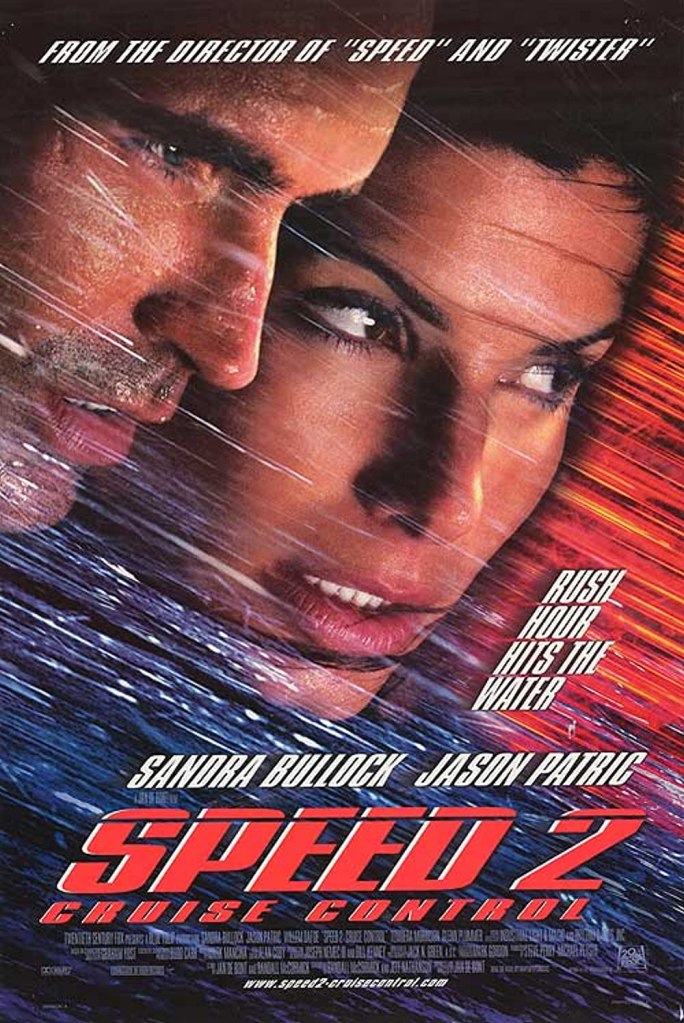
Speed 2: Cruise Control (1997)

Speed 2: Cruise Control (1997)

It seemed like such a good idea at the time… Keanu Reeves wisely passed on Speed 2 – so should you

Director: Jan de Bont

Cast: Sandra Bullock (Annie Porter), Jason Patric (Alex Shaw), Willem Dafoe (John Geiger), Temuera Morrison (Officer Juliano), Glenn Plummer (Maurice), Brian McCardie (Merced), Christine Firkins (Drew), Mike Hagerty (Harvey), Colleen Camp (Debbie), Lois Chiles (Celeste), Royale Watkins (Dante)
In 1996 Keanu Reeves turned down a huge salary for Speed 2. Everyone in Hollywood thought he was mad. On June 13th 1997, Speed 2 was released. On June 14th everyone thought Keanu Reeves was a genius. It’s quite something when one of your best ever career moves was not doing a movie. But God almighty Keanu was right: time has not been kind to Speed 2 – and even when it was released it was hailed as one of the worst sequels ever made. It’s like de Bont and co sold their souls for Speed and in 1997 the Devil came to collect.

Keanu’s Jack Traven is clumsily replaced by Jason Patric’s Alex Shaw – although the dialogue has clearly only had the mildest tweak as Shaw has inherited Traven’s job, friends, personality and girlfriend Annie (Sandra Bullock – elevated to top billing but even more of a damsel-in-distress than in the original). Alex and Annie are wrestling with making a long-term commitment – see what I mean about this script only be mildly tweaked? – when they decide to take an all-or-nothing cruise. Shame the cruise liner is hijacked by deranged computer programmer turned bomber Geiger (Willem Dafoe). With the boat powering through the water towards a collision on shore, can Alex save the day?

You’ve probably noticed the disparity between the title Speed and the setting: a slow-moving cruise liner. At one point, Alex asks how long it would take an oil tanker to move out of a collision course with the liner – “At least half hour – that’s not enough time!” he’s told. The very fact that a debate whether 30 minutes will be enough time in a flipping film about speed shows how far this sequel has fallen. How did anyone not notice this?

Pace is missing from the whole thing. The script is truly dreadful. Paper-thin characters populate the cruise liner, none of whom make even the slightest impression. At one point a character breaks an arm and then immediately shrugs off the injury to steer the ship. The script is crammed with deeply, desperately unfunny “comedy” beats. Bullock’s character seems to have transformed into a ditzy rom-com wisecracker – with a “hilarious” running joke that she’s a terrible driver (geddit!??!) – and, instead of the charming pluck she showed in the first film, is now an irritating egotist. She still fares better than poor Patric, who completely lacks the movie star charisma of Reeves and utterly fails to find anything that doesn’t feel like a low-rent McClane rip-off in his character.

It’s like de Bont forgot everything he knew about directing in the three years between the two films. If anything, this feels like a well below average effort from a novice director. The humour is dialled up with feeble sight gags and the film takes a turgid 45 minutes to really get going (most of which is given over to derivative romantic will-they-commit banter between Patric and Bullock).

de Bont basically flunks everything. He fails the basic directing test of confined-spaces thrillers like this by never making the geography clear to the viewer. I challenge anyone to really understand how characters get from A to C on this boat. The long introductions are supposed to establish these basics (see Die Hard for a masterclass in this), but here you haven’t got a clue about what’s where or why some locations are more risky than others. There is a spectacular lack of tension about the whole thing – it’s not really clear what Dafeo’s lip-smacking, giggling, leech-using (yes seriously) villain actually wants or how his scheme works, and the momentum of the boat towards unspecified destruction is (a) hard to see on the open water with no fixed point to compare the speed with and (b) even when we get that, not exactly adrenalin fuelled anyway.

de Bont’s comedic approach to much of the material might have worked if he had any sense of wit or comic timing in his direction. Or if Patric had been more comfortable with the wit the part requires. Bullock instead feels like she has to joke for all three of them, to disastrous effect. There are a couple of semi-comic sidekicks sprinkled among the supporting players, but none of them raises so much as a grin. The film can’t resist implausible in-jokes, like bringing back Glenn Plummer’s luckless character to have his boat swiped by Alex (they even leave in a mildly altered “what are you doing here?” line, as if they didn’t realise until shooting it that Keanu wasn’t going to be there).

It ends with a loud crash of a boat into the shore which cost tens of millions of dollars (at the time one of the most costly stunts ever) but just looks like a fake boat ripping through a load of backlot buildings. It’s a big, loud, dull, slow ending to a film that looks like it was made by people who had no idea what they were doing but enough power to ignore anyone who might have been able to point out what they were doing wrong. Speed 2 remains the worst sequel ever. Reeves went off to make The Matrix. Who’s the idiot?
Broadcast News (1987)

Broadcast News header
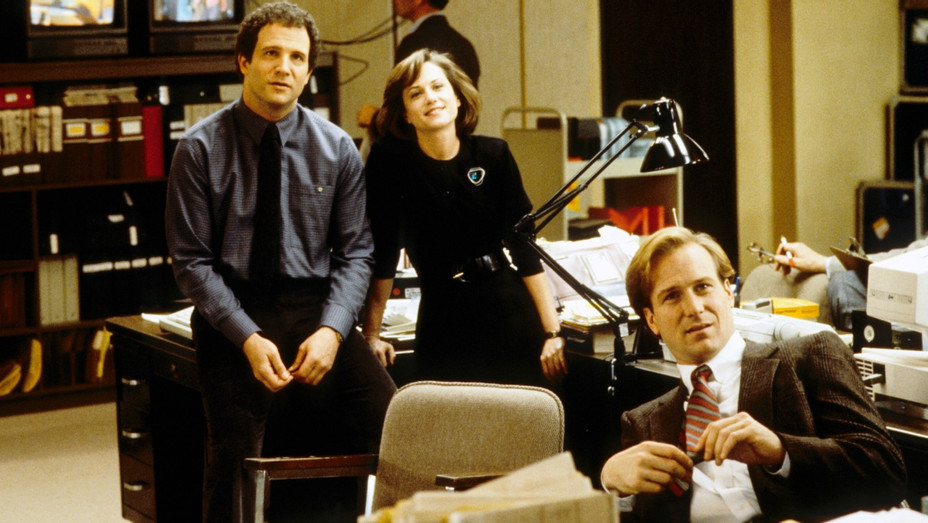
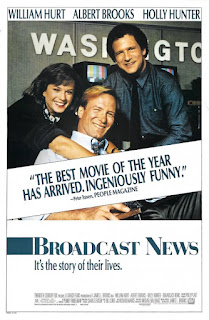
Albert Brooks, Holly Hunter and William Hurt struggle with the news and love in James L Brooks not very funny or insightful romantic media satire

Director: James L Brooks

Cast: William Hurt (Tom Grunick), Holly Hunter (Jane Craig), Albert Brooks (Aaron Altman), Robert Prosky (Ernie Merriman), Lois Chiles (Jennifer Mack), Joan Cusack (Blair Litton), Peter Hackes (Paul Moore), Christian Clemenson (Bobby), Jack Nicholson (Bill Rorish)

TV news – what is it for? To inform or entertain? It’s a debate James L Brooks tries to explore in his inconsistently toned hybrid rom-com and satire. At the end you very much intended to come out with the view that it should be about one, but is more about the other.

In the Washington branch of an unnamed network, Jane Craig (Holly Hunter) is a rising star producer, prone to daily emotional breakdowns. Her best friend is brilliant, committed reporter Aaron Altman (Albert Brooks), who longs to be the anchorman but lacks social skills. Arriving in their branch is Tom Grunick (William Hurt), handsome and full of TV savvy, set to become an anchor but lacking any real knowledge of either journalism or current affairs. Naturally a romantic triangle develops between these three, along with all sorts of debate about the purpose of TV news.

The film stacks the deck firmly in favour of the view that news should be a comment-free recitation of facts. Brooks’ film bemoans – often in heavy-handed ways – the intrusion of human interest, soft stories and puff pieces in place of hard-hitting questions and challenging coverage. Tom Grunick is the embodiment of this: charming, friendly, reassuring – and totally uninformed, interested in “selling” a story rather than telling it. Meanwhile, to the film’s disgust, the higher-ups at the network frequently value appearances and popularity over tough analysis, and looking good on TV counts for more than journalistic skills. Pity the film: if it feels this network is bad, imagine how it’d feel about Fox News today.

Of course what the film isn’t interested in is acknowledging a certain level of showmanship is an important tool in making the news accessible, engaging and interesting for the audience – making them more likely to pick up the important things in the content. It also overlooks that purists Aaron and Jane may avoid stage-manging their stories as overtly as others – but they’re more than happy to fill them with heart-string-tugging references and shots to get the audience reactions they want. In fact, you can see Tom’s point – what’s really wrong with him interjecting a shot of his own teary face while interviewing a rape victim (a moment he recreates)? Isn’t that basically the same?

Broadcast News tries to outline the difference, but I’m not sure it goes the full distance – or makes the debate accessible or interesting. That might be partly because the film can’t decide whether to give more attention to the satire or the romance – Jane is attracted to Tom (who returns her feelings), but is extremely close with Aaron, who carries a not-even-concealed passion for her. Both plots sit awkwardly side-by-side, getting in each other’s way and not adding insight to each other.

But then the film is fairly shrill. That partly stems from the two characters we are meant to relate to being tough to like. Holly Hunter is dynamic as the forceful, passionate Jane, but she’s also a rather tiresome character. Her purist demands are slightly holier-than-thou and while there are nice touches of humanity (on a date with Tom, she doesn’t want her handbag opened at a security check because she’s put a pack of condoms in it)  the film doesn’t manage to warm this control freak (so domineering she can’t get in a taxi without dictating the route). Jane also has a tendency to burst into tears – a suggestion of some underlying emotional problems the film instead treats as a joke.

That’s nothing compared to Albert Brooks’ Aaron Altman. This is exactly the sort of character beloved by film-makers, but who if you met in real life would come across an an unbearable creep. Like Jane, he’s an uncompromising idealist whose pious self-importance quickly grates. The film doesn’t appreciate the irony that its champion of professional reporting yearns to be the pretty-boy face of the network and resents that he’s neverbeen the popular kid.

His tantrums and rudeness are meant to be signs of his genuineness and the film leaves no doubt that his love for Jane should be requited because he knows what’s best for her. He’s the Nice Guy who doesn’t get the girls even though he really deserves them.  A scene where he furiously berates Jane when she confesses her feelings for Tom, then demands she leaves, then demands she stays so he can lecture her on his pain and why her feelings are wrong smacks of a thousand male script writers who didn’t get the girl they wanted and it was so unfair.

The film’s view of women is often questionable. Today, Aaron looks more like a Proto-Incel, one emotional snap away from strangling Jane because she won’t love him when she SHOULD. The film sees him as a relatable, principled hero. Jane may be smart and principled, but she’s hysterically over-emotional for no given reason (Women! They’re so crazy!), domineering and controlling. The film’s only other female character is Joan Cusack’s production assistant who spends her time either shrieking in shrill panic or talking with nervous incoherence.

So, it might be a fault of the film that the character I related to most was the one we were meant to condemn. William Hurt’s Tom is nice-but-dim, superficial but polite, supportive, hard-working and honest, self-aware enough to feel guilty that he’s not really qualified to do the job. He tolerates being mucked around by Jane far more than many others would and despite being constantly abused by Aaron, offers him no end of support. If Tom is the nightmare shape of TV news, you end up thinking “well heck, is it really that bad?”

Broadcast News overall is an underwhelming experience, not funny or romantic enough to be a comedy, or insightful enough about journalism to be thought-provoking. Brooks directs with his usual televisual lack of flair, but there are some decent comedic set pieces: Cusack has a mad-cap dash through a TV studio to deliver a taped report for a deadline that is a masterclass in physical comedy, while the film’s best set-piece is Aaron’s sweat-laden anchor appearance on a weekend news bulletin. But the film gives too many characters a pass and avoids asking itself the tough questions. It ends up a bit of a slog that probably has more appeal to insiders than audiences.

Death on the Nile (1978)

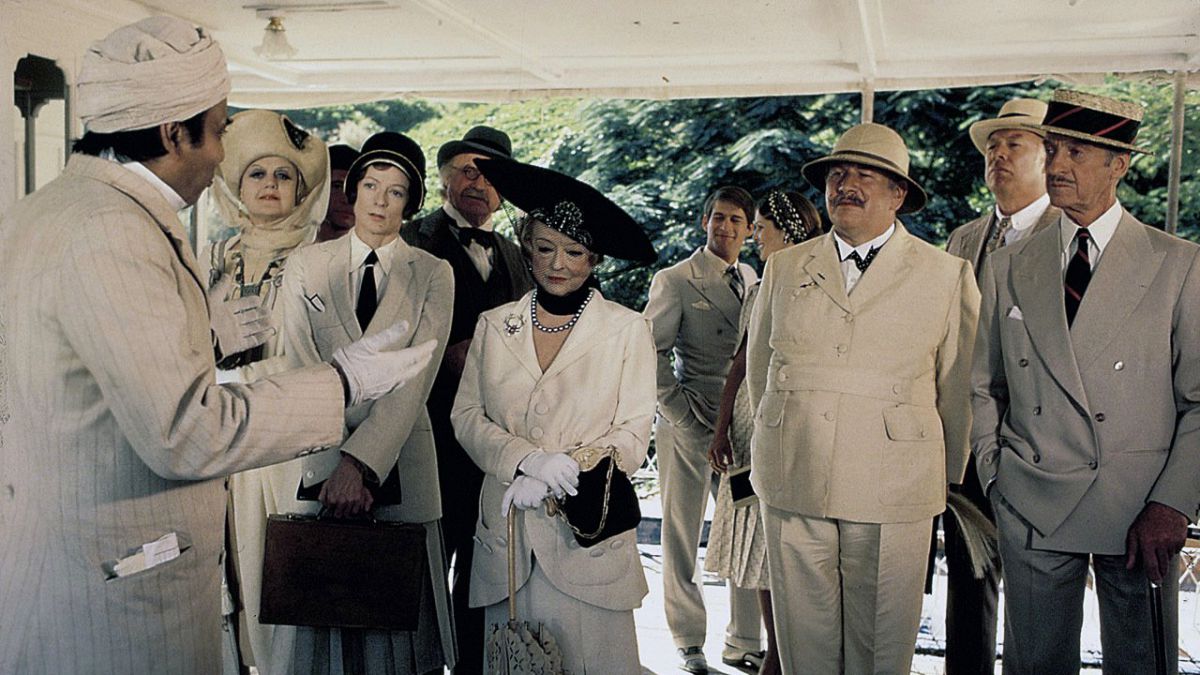
The all-star cast line-up for murder and mayhem in Death on the Nile

Director: John Guillermin

Cast: Peter Ustinov (Hercule Poirot), Jane Birkin (Louise Bourget), Lois Chiles (Linnet Ridgeway Doyle), Bette Davis (Marie van Schuyler), Mia Farrow (Jacqueline de Bellefort), Jon Finch (James Ferguson), Olivia Hussey (Rosalie Otterbourne), George Kennedy (Andrew Pennington), Angela Lansbury (Salome Otterbourne), Simon MacCorkindale (Simon Doyle), David Niven (Colonel Race), Maggie Smith (Miss Bowers), Jack Warden (Dr Bessner), IS Johar (Mr Choudhury), Harry Andrews (Barnstaple)

Is there anything more perfect for a Bank Holiday afternoon than an all-star Agatha Christie adaptation? Take a look at the TV schedules on those days and sure enough one of them will pop up. So on New Year’s Day, I took my place on the sofa for a welcome revisit to dastardly goings-on aboard a luxury cruise ship sailing down the Nile. 

Simon Doyle (Simon MacCorkindale) has jilted his lover Jacqueline de Bellefort (Mia Farrow) in order to marry the fabulously wealthy Linnet Ridgeway (Lois Chiles). It’s a tricky love triangle – so you can imagine the newly-married Doyles are far from pleased to find Jacqueline popping up on their Nile cruise holiday. Things eventually explode into a confrontation between Simon and Jacqueline that leaves him shot in the leg and her sedated. While they are both out of the picture, Linnet is murdered in her bed. With the two obvious suspects out of the picture, who among the (all-star) passenger line-up did the deed? Just as well Hercule Poirot (Peter Ustinov) is on the ship to solve the puzzle.

Following on the heels of the smash hit success of 1974’s Murder on the Orient Express, the producers of that film didn’t really shake up the formula too much. Hire a load of star actors, pick one of Agatha Christie’s most picturesque-set novels and then watch the money come pouring in. Albert Finney wasn’t available to come back (rumour had it he wasn’t keen in any case on the huge amount of make-up involved) so instead Peter Ustinov came on board and away we went.

Death on the Nile feels very much like a film following a formula. Perhaps it struggles to live up to the first film because it is a slightly less compelling mystery than the first film (although still a damn good puzzle with a real twist of a solution). Perhaps it was more difficult to recapture the magic? Or perhaps it’s because it lacks the quality of direction that Sidney Lumet brought to the first film. Lumet managed to create something that always felt more than a vehicle for star turns – the more plodding John Guillermin instead feels like the sort of guy brought in to manage the day-to-day realisation of a producer’s vision (essentially the same role he fulfilled on The Towering Inferno). Death on the Nile feels very comfortable on the television perhaps because it is filmed in a very straightforward, unobtrusive style with less visual panache than many of the David Suchet series Poirots (even the earlier ones).

But the film does a good job in hiring Peter Ustinov. Ustinov has the comedic chops – matched with the acting prowess – to walk a fine line between the drama and the slight air of comedy that underpins the film. The sort of performance that tells everyone that this is essentially a Christmas treat and shouldn’t be treated too seriously – but still conveys enough of the character’s humanistic shock and anger at violence and murder. Poirot can very easily become a slightly ridiculous character, and Ustinov is canny enough to realise that (relative) underplaying of the character actually works rather well to make him engaging and entertaining, but not too heavy.

Not that heavy is the film’s problem, as this is a pretty light soufflé. The all-star actors happily go through their paces, although you can pretty much tell most of them are in this for the free holiday and the pay cheque. Most of them have fun with their parts – none more so than Angela Lansbury who goes way way way over the top as a bohemian novelist – but they pretty much go through the motions. Shaffer’s decent screenplay doesn’t do much in any case to sketch these characters out – and you suspect much of the bitchy duelling between Bette Davis’ selfish rich widow and Maggie Smith’s put-upon companion was spun out post casting. 

Saying that, I was rather taken with Olivia Hussey’s performance as a fundamentally decent person in the middle of the madness, while Lois Chiles is good enough that you regret her career didn’t really go anywhere after this film. Simon MacCorkindale and Mia Farrow also do well with tricky parts. But it’s all pretty much paint-by-numbers stuff.

Visually the film looks lovely on the Nile. The costumes and designs are great – even if some of them look pretty much straight out of the 1970s rather than the 1930s – and you can tell that the money has been lavished on it to make a pure, old-fashioned entertainment. Shaffer’s script does a decent job of adapting one of Christie’s most twisty tales – even if it does give us what feels now a pretty racist portrait of the meek and crawling ship manager played by IS Johar.

But this is safe and comfortable entertainment – and it definitely is entertaining – rather than something that feels truly filmic. You could argue that this film more than any other set the tone for what we expect from an Agatha Christie adaptation – and its mixture of light comedy and grisly murder set in a lush 1930s location is pretty much de rigeur for everything else that follows. And you know what, I don’t think that’s a bad thing.

Moonraker (1979)


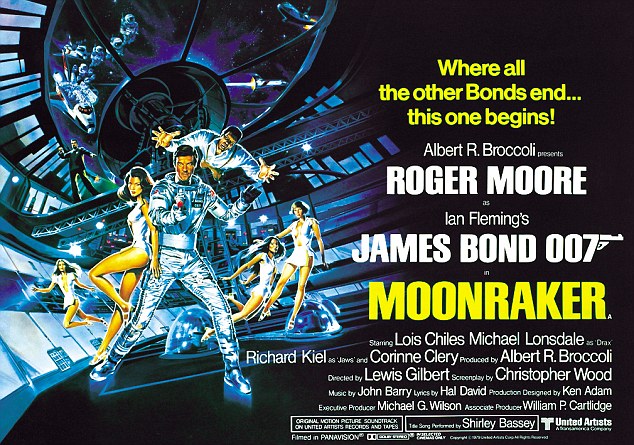
Roger Moore is James Bond…IN SPACE!!!!

Director: Lewis Gilbert

Cast: Roger Moore (James Bond), Lois Chiles (Holly Goodhead), Michael Lonsdale (Hugo Drax), Richard Kiel (Jaws), Corinne Clery (Corinne Dufour), Bernard Lee (M), Geoffrey Keen (Defence Minister), Desmond Llewelyn (Q), Lois Maxwell (Miss Moneypenny), Emily Bolton (Manuela)

After The Spy Who Loved Me, the Bond producers had finally found a format that suited Roger Moore’s take on the role:  a comedic, tongue-in-cheek style, with Moore leaning on the fourth wall, winking at the audience. In fact, SWLM made so much money that this one feels almost like a remake rather than a new film – it’s got the same basic concept, the final sequence is pretty similar, the opening sequence again revolves around a daring parachute stunt, even Jaws pops up again. For a film that heads into truly unchartered physical territory for Bond (space!), it’s as familiar and derivative as Bond gets.

Bond (Roger Moore) investigates Hugo Drax (Michael Lonsdale), a shady businessman whose operations are expanding into space. After a string of exotic locales (a chateau in France! Venice! Mexico City! Brazil!) an evil scheme to destroy the world from space clicks into place. Bond has to take to the stars to take down Drax. Despite the criticism that will follow, this is probably near the end of Moore’s high point in the role – and in none of his future films was he quite as debonair and dashing as he is here.

If you ever needed evidence that the James Bond franchise looked at whatever was popular in the cinema at that moment in time and then ripped it off as quickly as possible in their next film, then it’s Moonraker. Surely never in anyone’s lifetime would they expect to see a film that could be tagged “James Bond…in SPACE!” but after the success of Star Wars that is exactly what they were served up. The idea is so completely silly that people wonder if you’ve made it up.

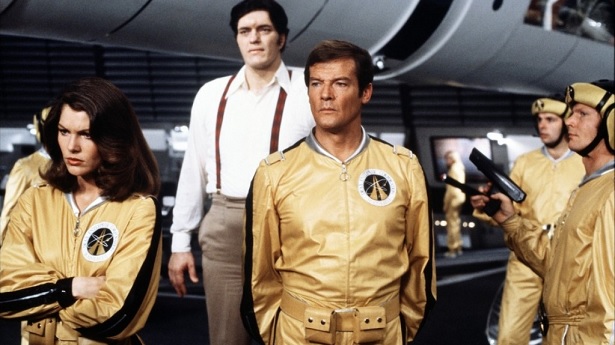
But, sigh, that’s what we get here. And it is beyond silly. The film climaxes in a space battle between the NASA Marines (don’t ask) armed with laser cannons (yes you read that right), duking it out with Drax’s own personal guard also armed with cannons (it really is as silly as it sounds). All this against a backdrop of Drax’s own personal Death Star. Afterwards, Bond has to shoot down three deadly missiles that will wipe out the population of the Earth. Naturally, his targeting computer doesn’t work for the final one, so Bond has to basically “use the force” to target and shoot it down. Star Wars in all but name right? Had the producers no shame?

It doesn’t help that Moonraker amps up the already jokey tone of SWLM to an overbearing degree. At least it was a formula that works with Moore, but so little is treated seriously that when they do something violent it sticks out tonally like a sore thumb. This is probably the only film I can think of in which a woman is ripped apart (off screen) by a horde of hounds, followed shortly afterwards by a pigeon performing a comic double take after an amphibious gondola sails through the middle of St Mark’s Square (don’t even ask). It’s a film that has no discipline, no control and no real consistency. It dances all over the place with no logic at all. It gets the balance wrong and instead of being tongue-in-cheek often comes across as overblown, heavy-handed and ludicrous.

In fact the plot, such as it is, is hard to follow because it’s almost an afterthought. It’s effectively a reheat of SWLM (repopulate the planet with a chosen elite), while the space battles are similar to the slow motion fights of Thunderball. Bond moves from location to location with only the barest logical links. Drax identifies Bond as a threat early on – but then continues to pull out a series of bizarre and unreliable schemes to eliminate him. The action sequences feel like versions of previous films in the series – and don’t get me started on the fact Bond still hasn’t learned that punching Jaws in his metal mouth is a bad idea (he does it three or four times in this movie). Everything moves forward with a restless momentum that never allows us to connect with anything that happens.

There is some decent potential here. The fight on the ski lift is pretty good. Michael Lonsdale has a psychotic chill about him that, in a better film, might have made him a memorable villain. In fact, Lonsdale is so grounded as a villain he feels wrong for a film that’s so silly. And it’s all the more surprising he has such an outlandish scheme – or that he hangs around with such a pantomime villain as Jaws. Jaws clearly returns due to popularity – and has been thoroughly neutered as a threat here. Even before he falls in love with a girl with pigtails and switches sides, he’s already an almost comic buffoon – even bashful about knocking off a Bond aide in front of witnesses.

It’s a film that can’t decide if it’s a thriller or a comedy. It probably leans more towards comedy – which is a shame as it’s not that funny. The hideously overplayed gondola sequence tells you everything you need to know about the film’s lack of wit. Its comedy is as overplayed and heavy-handed as some of the action can be – more likely to get you rolling your eyes than holding your sides. Saying that, it does have possibly the best final punchline of any of the films (“I think he’s attempting re-entry sir”) – the sort of joke you probably didn’t get when you first watched the film aged about 10. Other than that it’s like a series of gags told by people who aren’t really that funny.

Moonraker is the sort of bizarre freak of nature that you almost can’t believe exists. Leaving aside its amping up of the tongue-in-cheek formula into the realms of the bizarre, it’s basically a bit too stupid and unbelievable for even this franchise to pull off. Lasers? Space-stations? Space marines? Bond in space? I mean really? As a rip off of Star Wars it leaves a lot to be desired – and so long as these films take place in a world that is even vaguely linked to our own, plots like this just have the stench of bullshit.