Tag: Lon Chaney Jnr

Of Mice and Men (1939)

Of Mice and Men (1939)

Well-made version of a story that has since become almost excessively familiar

Director: Lewis Milestone

Cast: Burgess Meredith (George), Lon Chaney Jnr (Lennie), Betty Field (Mae), Charles Bickford (Slim), Roman Bohnen (Candy), Bob Steele (Curley), Noah Beery Jnr (Whit), Oscar O’Shea (Jackson), Granville Bates (Carlson), Leigh Whipper (Crooks), Helen Lynd (Susie)

I suspect John Steinbecks’s powerful parable has been rather defanged for many people, after extensive over-exposure in schools across the world. Who hasn’t spent hours in an English class pouring over the struggles and dreams of permanently unlucky Depression-era drifters, scrawny George and muscular-but-childlike Lenny? It’s hard to not feel Of Mice and Men is very familiar the second the credits roll on Milestone’s film – or fail to notice some of its on-the-nose musings (sometimes the kindest thing you can do is kill a frightened, vulnerable dog, rather than let it suffer – I wonder what development plot is being alluded too here…) and while familiarity has stripped Of Mice and Men of some of its power, this is an effective, well-made, version.

George (Burgess Meredith) is the brains of a partnership with childlike muscle man Lenny (Lon Chaney Jnr) as they drift from job-to-job out West, constantly hired on the back of Lenny’s muscle, then escaping from the troubles his lack of understanding of the world causes, through George’s survivalist cunning. They dream of having their own place – and they get a shot at it when aged, one-handed farmhand Candy (Roman Bohnen) offers to chuck his accident-payout dollars into their pot. But Lenny’s inability to cope with the world keeps leading to danger: from his accidental rousing of the ire of small-of-statue rancher’s son Curley (Bob Steele) to his fascination with Curley’s pretty wife Mae (Betty Field). Some dreams are doomed.

Of Mice and Men stays very faithful to Steinbeck, playing out this smalltown tragedy under the low-key, persuasive eye of Milestone who avoids either overplaying the tear-jerking or smothering the story with flashy film-making (there is one dramatic pull-back after disaster strikes, and George flees a barn, the camera heading into a sudden wide-angle, but other than that this is restrained film-making). Instead, the focus is very much placed on the relationship between two very different men who, without even quite understanding it, are mutually dependent halves of a whole.

At first it seems George and Lenny are effectively in a marriage of convenience. The wirey George would struggle to be hired without the loaded-cart lifting Lenny as a sweetener, while Lenny can barely tie his own shoelaces without George’s guidance. Meredith’s snipy, wheedling George feels at first like he can only just master his frustration with Chaney Jnr’s lumberingly sweet Lenny. But Meredith gives full life to a character who, we slowly realise, has a brotherly protective regard for Lenny – and needs the purpose Lenny gives his life, just as much as they both need the reassurance of George’s constantly spun story of their dream farm. This mantra – with Lenny echoing lines like a child’s bedtime story – of the buildings and animals they’ll care for is delivered by Meredith with a careful repetition that constantly flowers into earnest true-belief. We realise George is as much a lost soul as Lenny, adrift and barely able to cope with the world.

Because Depression-era America is a place where dreams go to die. Curley, clutching a few hundred dollars hush money after a farming accident cost him his hand, knows his life is just a countdown until he is kicked off the farm for being unable to work. He’s facing a future not too dissimilar from his euthanised dog, eyed up by the other men as a feeble old-timer who’d be better off snuffing it. No wonder both he and the simple Lenny, living on the bottom rung of life’s ladder, find a companionship with segregated Black farmhand Crooks (a very sensitive performance from Leigh Whipper, a character treated respectfully by Milestone’s film).

George’s natural alliance is with these little guys. Meredith’s George is naïve in his own way, slightly off-the-pace in social situations, tolerated by others, a deep vein of anxiety and worry just under his skin that he is all-too-happy to repress while he focuses on being father-figure and big-brother to Lenny. Meredith makes him chippy but not quite as worldly as he thinks, shrewd but vulnerable and, for all his carefully performance self-confidence, insecure and intimidated by events. He’s a passenger in life who likes to kid himself he’s a driver.

Authority lies elsewhere. Curley, played with a little-man anger and stunted swagger by Bob Steele, makes up for his own (many) insecurities – about everything from his height to what his flirtatious wife gets up to – by treating everyone below him in the farm’s pecking order with contempt. Curley needs to proof his masculinity by beating Lenny – who has all the physical gifts he longs for but none of the gumption to use them. He can only dream of having the relaxed, natural authority of Charles Bickford’s Slim, a man completely confident about himself and his standing in life – this easy assurance stands out in a film full of the jittery, frightened and insecure.

Of Mice and Men’s weakness, as with the book (as even Steinbeck later acknowledged) is Curley’s wife. Betty – played with a shrill energy by Betty Field in a performance she’s not quite strong enough to pull off – is only faintly crafted into a vaguely three-dimensional figure from the sexually charged, selfish flirt she is in the book. Here she has moments of self-reflection – and Milestone’s film briefly explores the isolation of this girl who dreamed of Hollywood but ended up married to an inadequate, angry man on a crappy farm – but remains, at heart, a brassy, selfish woman who precipitates disaster through her actions. It’s a singular lack of empathy in a film that prides itself on its humanitarianism.

Disaster is the inevitable outcome of a Steinbeck Depression-era drama. Milestone’s film finds quiet emotional power – aided a great deal by both Meredith and Chaney Jnr effectively under-playing – in the film’s final moments. You can imagine if this was your first exposure to a very familiar story, being impressed by the effectiveness of so much here. This is particularly so in the film’s powerful ending, directed with admirable restraint and played with a highly effective (and underplayed) emotion by Meredith. If other parts of the film are more well-assembled than really inspired, delivering Steinbeck pretty much as it is on the tin, that still makes for a fine version of a now familiar tale.

High Noon (1952)

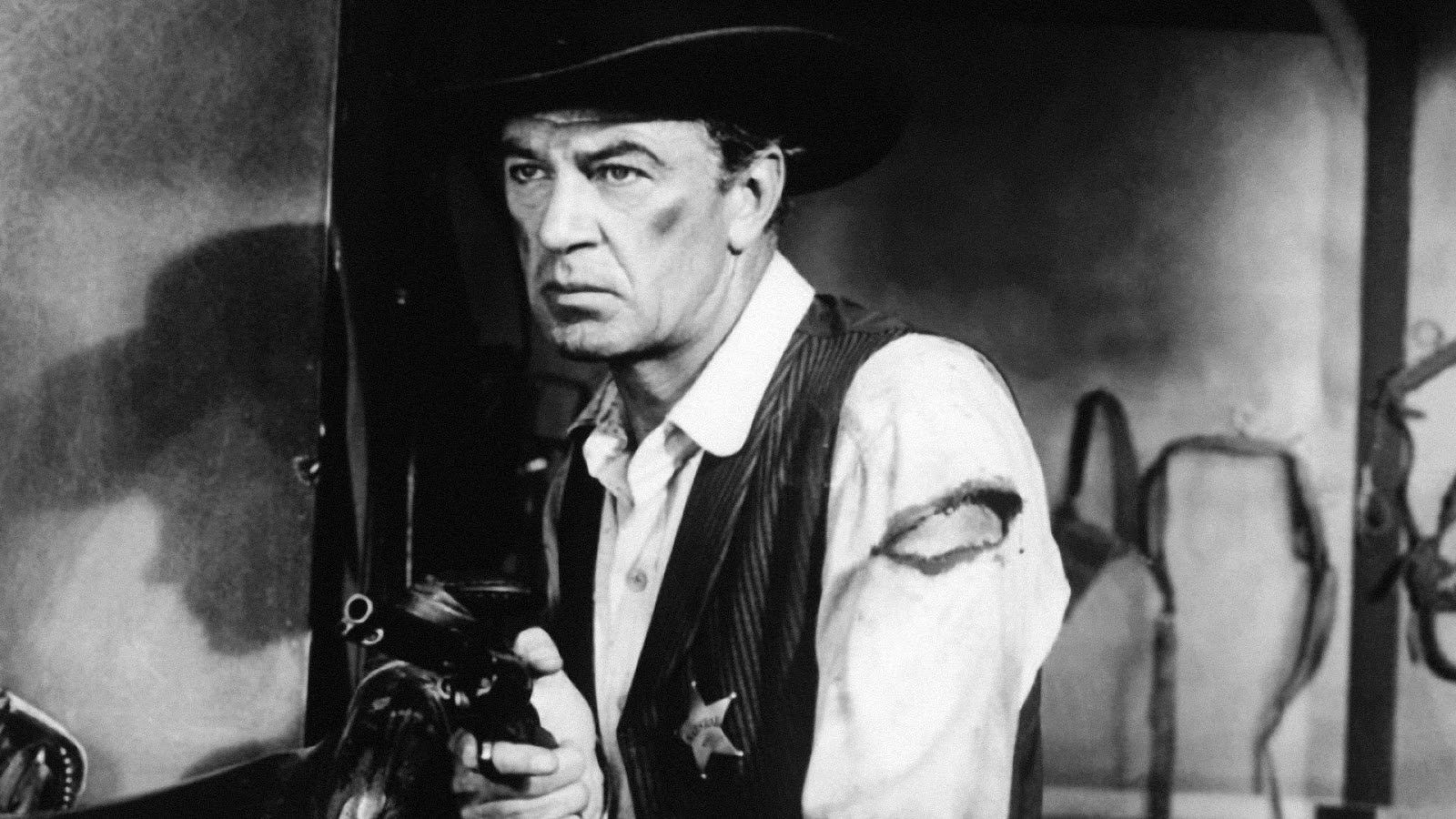
Gary Cooper stands alone in High Noon

Director: Fred Zinnemann

Cast: Gary Cooper (Marshal Will Kane), Grace Kelly (Amy Fowler Kane), Thomas Mitchell (Mayor Jonas Henderson), Lloyd Bridges (Deputy Marshal Harvey Pell), Katy Jurado (Helen Ramirez), Otto Kruger (Judge Percy Mettrick), Lon Chaney Jny (Marshal Martin Howe), Eve McVeagh (Mildred Fuller), Harry Morgan (Sam Fuller), Morgan Farley (Minister Mahin), Ian MacDonald (Frank Miller), Lee Van Cleef (Jack Colby)

It’s 10:35 am on the day of the wedding of retiring Marshal Will Kane (Gary Cooper) to Quaker Amy Fowler (Grace Kelly). It should be the happiest day of his life – but events are interrupted by news that Frank Miller (Ian MacDonald), a killer Kane put away, has been released and will arrive on the midday train with his gang to kill Kane. Kane’s first instinct – and the town’s – is for Kane to flee the town: but Kane doesn’t want to spend his life looking over his shoulder, and besides his friends and colleagues in the town will stand with him right? He decides to make his stand – to the outrage of his pacifist wife – only to find one-by-one the citizens of the town excuse themselves from helping Kane. After all, who wants to die?

Playing out like a Western 24, Kane has got a little under 90 minutes to put together a posse to give himself a fighting chance against these hardened killers. Zinnemann’s film is full of carefully placed shots of clocks that hammer home the ominous approach of Kane’s seemingly inevitable death. In a brilliant use of contrasts, Kane walks with growing desperation in virtually every shot through the increasingly abandoned town, mixed with clever cut-backs to the Miller gang waiting patiently at the train station (with deep focus shots of the train lines stretching on forever) for Miller to arrive and kick off the killing. Using a wonderful combination of low-angles, tracking shots and one superb crane shot that pulls out and away to show Kane stranded alone in the abandoned town, Zinnemann’s film stresses Kane’s isolation, anxiety and growing desperation.

Because Kane is scared. And why shouldn’t he be? He’s past-his-best and over-the-hill, a long-serving hero on his last day in the job, outmatched by his opponent. Why on earth wouldn’t he be desperate for help? John Wayne and Howard Hawks hated the film, loathed its perceived anti-American-spirit and, most of all, couldn’t stand the idea of a Western hero being scared and desperate for help. They even made a twist on the film, Rio Bravo, where Wayne played a marshal turning down any and all help in order to do what a man needs to do alone. For them that was a Western hero, and this self-doubting, anxious pussy Kane – the man even cries at one point! – was an abomination.

Cooper seemed to be no-one’s choice for the film – Heston, Brando, Fonda, Douglas, Clift and Lancaster all turned it down – but scooped the Oscar as Kane. Then 51, his obvious age and vulnerability – at one point Lloyd Bridges almost beats the crap out of him – make him feel even more at risk from this threat. In a performance devoid of vanity – other than perhaps Kane landing the radiant (and thirty years younger) Grace Kelly as his wife – Cooper is sweaty, nervous, twitchy and a mix of All-American duty and genuine nerves, resentment and terror at what feels almost certain to be his end. Kane knows why he must do it, but to Wayne’s disgust, he still doesn’t like it.

Carl Foreman, the screenwriter, was to be pulled before the House of Un-American Activities for his communist sympathies. And the entire film is pretty clearly a commentary on the McCarthyite era, specifically the abandonment of those pulled before the house by those who seemed to be their friends. Like the blacklisted Hollywood writers and actors, Kane opens the film with admirers and friends all of whom eulogise his greatness and decency: and all of them turn their back on him as the chips go crumbling down.

Most of the film is given over to Kane desperately going from ally to ally, only to find that he is offered only platitudes, excuses and outright cowardice. His deputy demands a recommendation for Kane’s job, and chucks in his star when Kane refuses. Old friends hide in their houses and refuse to come out when Kane comes calling. Lon Chaney Jnr’s retired marshal pleads illness. The judge rides straight out of town and suggests Kane does the same. At a town meeting in the church, the voices calling to help Kane are few and far between, and Mayor Thomas Mitchell praises Kane to the skies, before concluding the town would be better off if he could ride away and not come back. The one man who volunteers backs down when he finds out no one else has volunteered, and the only person eager to fight is a 14 year old boy. 

So much for loyalty and the American way. When the chips are down, words mean nothing and it’s the actions that show the man. Customers in the saloon talk about how life wasn’t that bad when the Millers ruled the town (to show how wrong this is, literally their first action when riding into town is to steal something from a milliners). Others moan that all this law enforcement from Kane has actually made business a bit worse for the town. Why do the hard thing, why make the stand, when it’s so much easier to just look down, keep quiet and let the just suffer while your life ticks on.

Cooper’s Kane is masterfully low-key, subtle, using only the slightest gestures to show deep-rooted, only barely hidden resentment and bitterness, covering fear. What he’s doing he’d give anything not to do, but he sees no choice. There is no other Western where the hero writes a will, and quietly weeps with his head on his hands on his desk. There is no other Western where the hero spends so long trying to make a manly task easier to do. There is no other Western where the self-serving cowardice and hypocrisy of the townsfolk are more blatant. No wonder Cooper – in the final insult for Wayne – drops his tin star in the dirt at the film’s end, as the townsfolk rush out to congratulate him on winning the duel. This is a film that looks at America as it really is – and many people didn’t like that one little bit.

Zinnemann’s direction is spot on, a perfect blend of tension build and technical mastery, mixed with superb dialogue from Carl Foreman. Not a word or shot is wasted, and every single character and event is carefully sketched in, established and build up with no effort at all. Cooper is superb, Grace Kelly just as good in a thankless role as the humourless Quaker wife who struggles with her life-long principles against her love for her husband. Beautifully filmed, with a wonderful score with Dimitri Tiomkin, High Noon is a classic for a reason, a masterpiece of slow-build and enlightened social commentary.