
Tag: Loretta Young

The Bishop’s Wife (1947)

The Bishop’s Wife (1947)

Charming Christmas enjoyment in this rather odd angel comedy that wins you over

Director: Henry Koster

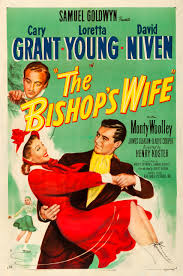
Cast: Cary Grant (Dudley), Loretta Young (Julia Brougham), David Niven (Bishop Henry Brougham), Monty Woolley (Professor Wutheridge), James Gleason (Sylvester), Gladys Cooper (Mrs Agnes Hamilton), Elsa Lanchester (Matilda), Sara Haden (Mildred Cassaway), Karolyn Grimes (Debby Brougham)
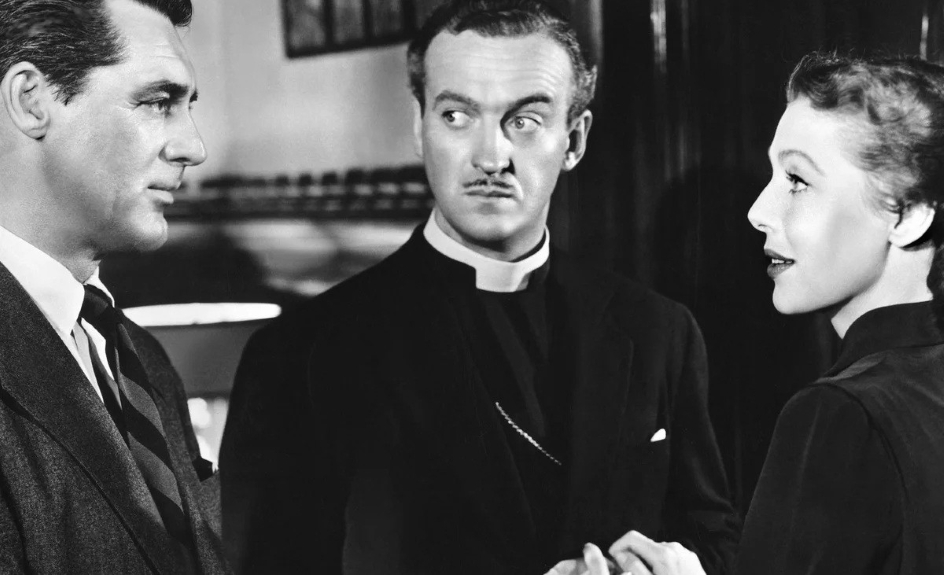
Newly appointed Bishop Henry Brougham (David Niven) is forgetting who he is. Now spending all his time with the hoi-polloi (led by Gladys Cooper’s grande dame Mrs Hamilton) trying to secure funding for a new cathedral he’s rather lost sight of things at home with his devoted wife Julia (Loretta Young). Enter, seemingly in answer to his prayers, angel Dudley (Cary Grant). Taking up a role as Henry’s new assistant – with only Henry knowing the Heavenly background of his guest – Dudley sets about helping those around Henry rediscover their spiritual joy in life.

The Bishop’s Wife is a gentle, unassuming film, all taking place in the week before Christmas. It’s heart-warming, seasonal stuff, competently directed by Henry Koster, who efficiently juggles gentle character conflicts with a reassuring moral message. There are some rather charmingly done magical special effects sprinkled across the film: Dudley uses his angelic powers to instantly sort reference cards, fly decorations onto a chair, dictate to a self-operating typewriter and guide a snowball through the air with all the dexterity of Oliver Stone’s magic bullet. As a gentle piece of seasonal viewing, it gives you everything you could want.

Such is its easy charm and seasonal sweetness, it almost doesn’t matter that it’s quite an odd film. It’s no real surprise Dudley isn’t on Earth to help Henry secure mega-bucks he to build a grand cathedral (especially since principle doner Mrs Hamilton is more interested in making it a tribute to her late-husband rather God) but to help Henry work out his real focus should be the ordinary joes of his community and his marriage. That he should make sure he prioritises a humble choir at small local church St Sylvester’s and keep in touch with the parishioners he used to dedicate his time to. And, above all, that he should find time in his bustling calendar to keep the love in his marriage.

But the methods used by Dudley – away from angelic magic over inanimate objects and his ability to know everyone’s names before they even open their mouths and cross roads in bustling traffic without fear – are a little odd. Aside from shoring up a few people’s spiritual strength, he essentially begins a campaign of seduction, giving Julia the sort of loving attention Henry hasn’t given her in ages. It’s a slightly bizarre holy campaign – the angel who uses the temptations of the flesh to save a marriage – but it’s done with such innocence a viewer almost forgets the odd idea.

It also just about makes a virtue of casting of Cary Grant as Dudley. In a part that feels tailor-made for Bing Crosby, surely Cary Grant is no-one’s idea of an angel (a slightly abashed, heart-of-gold, demon perhaps). Grant, to be honest, slightly struggles with the role – at times the complete decency of Dudley leaves him rather stiff and the Grant twinkle gets one of its most subdued outings in cinematic history. However, Grant’s naughty charm does make us accept a little bit more that Dudley might just feel a little more than he’s saying with his attraction to Julia (even if, the rules of films, tell us there is zero chance of an angel being a seducer).

It still manages to get the goat of Niven’s Bishop, who increasingly resents this overly efficient new presence in his life more focused on charming his wife than getting on with what he presumes he’s there for – securing funds for the Cathedral. Niven (originally cast as the Angel – but his raffish charm would have been as unnatural a fit as Grant’s), does rather well as a decent man crushed under expectations and duty who has forgotten the things that really matter. Niven has a very neat line in quietly exasperated fury, so buttoned-up and English (despite being American!) he can’t give vent to his real feelings but hides it under genteel passive aggression. He also sells a neat joke that he is constantly rendered literally incapable of saying out loud that Dudley is an angel.

Loretta Young, between these two, has the least interesting part, trickly written. It goes without saying that a feel-good product of 1940s Hollywood is not going to have the wife of a Bishop actually, genuinely considering straying from her husband (just as, I suppose, it can only go so far in suggesting Grant’s Dudley is sorely tempted to leave his wings behind). Young’s role leans a little too much into the patient housewife, just eager for her husband to embrace day-to-day joys at home and not lose himself so much in work, but she manages to make it work.

These three lead a cast made up of experienced pros who know exactly how to pitch a fairly gentle comedy like this. Monty Woolley is great fun as a slightly over-the-hill professor, who needs to be befuddled by a never-emptying glass to stop him wondering why he doesn’t remember Dudley from the lectures he claims to have attended all those years ago. James Gleason offers cheeky, down-to-earth humour and sensibility as a friendly taxi-driver, while Gladys Cooper once again proves she can give austere grande dames more depth than anyone else in the business.

It all makes for a gentle, rather sweet and charming film despite that fact that almost nothing in it really make sense. In fact, it frequently falters as soon as you consider any of the plot at all or any of the actions and motivations of its characters. But then, this is basically a sort of Christmas Carol where the Angel arrives to re-focus the (not particularly imperilled) soul of one man, with wit, charm and warmth – and if it feels odd that also involves inspiring envy and jealousy (deadly sins right?!) in a Bishop, I suppose we should go with it. After all, it’s Christmas.

The House of Rothschild (1934)

The House of Rothschild (1934)

Old-fashioned historical melodrama with a well-meaning, earnest political message

Director: Alfred L Werker

Cast: George Arliss (Nathan Rothschild/Mayer Rothschild), Boris Karloff (Count Ledrantz), Loretta Young (Julie Rothschild), Robert Young (Captain Fitztoy), C. Aubrey Smith (Duke of Wellington), Arthur Byron (Baring), Helen Westley (Gudula Rothschild), Reginald Owen (JC Herries), Florence Arliss (Hannah Rothschild), Alan Mowbray (Prince Metternich), Holmes Herbert (Roweth)

It’s 1814 and things are looking tight for the international banking house of Rothschild. With the Napoleonic Wars over, partly thanks to Rothshild financial support of Wellington’s armies, Nathan Rothschild (George Arliss) is pitching to underwrite the loans to help restore France. Problem is, now the merde is out of the European fan, many of the Powers-That-Be don’t want to continue working with a Jewish bank. Led by scowling antisemitic Prussian Count Ledrantz (Boris Karloff), the Rothschilds bid is unjustly rejected. Rothschild outmanoeuvres his enemies to win the contract back, but it leads to a series of revenge pogroms in Prussia. Things change though, when Napoleon escapes from Elba. As all roads lead to Waterloo, will Rothschild back the Allied powers or throw in his lot with Napoleon?

The House of Rothschild is a very well-meaning, old-fashioned historical melodrama, that takes a strong stance against antisemitism. It clearly has more than half-an-eye on events in Germany in the 1930s. As the film’s Prussia of 1814 sinks into mobs hurling stones through windows, smashing up shops and chanting for the expulsion of Jewish people, while families flee across the body leaving their possessions behind (all while the self-satisfied, archly cold Ledrantz pushes his agents to provoke the people to yet more outbursts), surely many people would have seen parallels with Hitler’s Germany.

Throughout the film, the accusations of antisemites are pointedly broken down and strongly rebutted or placed into context. Why do the Rothschilds work in money? Because they are literally banned from any other profession. And money is the only tool they have to defend themselves against 2000 years of persecution; persecution that has made the Rothschilds feel a true affinity for their fellow Jewish people. Indeed, Nathan Rothschild feels a duty to stand firm and do anything he can to help his people: and if that means a bit of financial chicanery or applying heavy pressure to the European powers, then so be it. There is a greater good here when lives are at stake.

The scourge of racism is strongly displayed throughout the film. It opens with a prologue as Nathan’s father Mayer (George Arliss pulling double duty, under a pile of make-up and a wig) struggles to hide his justly-earned fortune from being stolen by corrupt tax collectors who call him ‘Jew’ and smugly tell him the amount he owes to the government is whatever they say it is. It’s a ferocious piece of open antisemitism, but it has genteel echoes when Nathan is later snubbed for an invite to a ball to celebrate Wellington’s victory (a victory he largely paid for) since Jewish people aren’t welcome at such events.

The House of Rothschild places its laudable anti-persecution aim into a very traditional, old-fashioned, costume drama that wouldn’t look out of place on the Victorian stage. It was a passion project of George Arliss’ (who cared deeply about its message), but also fit wonderfully well inside his wheelhouse. You can see its deep similarities to Arliss’ Oscar-winning vehicle Disraeli. Just as there, he plays a twinkly elder statesman, with a touch of the rogue but overflowing with decency and honour. Despite being seen as a suspicious outsider, he out-plays his rivals in an international conspiracy while casting an avuncular eye over a love affair in the family: in this case between his daughter (Loretta Young) and gentile British cavalry officer Captain Fitzroy (a fairly wooden Robert Young). Both films end with our hero celebrated by royalty at a grand ball, while cementing a loving marriage with his wife (played again by Arliss’ wife Florence).

Arliss is, of course, very good in a role tailor made for his mix of playful charm and speechifying. Much of the film is essentially dominated by Arliss, who delivers with his customary skill (even if his performance as Mayer is more than a little ripe) and if his performance feels more than a little like Disraeli #2, his comfort in front of the camera and the naturalness he brings to the role help enormously. Under the playful exterior, Arliss also finds a strength and determination, powered by a real moral fury at the injustices, slights and (eventual) violence perpetuated upon his people.

Few other actors get much to play with here. House of Rothschild is heavily fictionalised, from its invented nemesis in Count Ledrantz (Karloff is good value as the scowling racist) to the build-up to the Waterloo campaign. However, for history buffs like me, there is a fair bit of delight in seeing a parade of great European statesmen pop up in cameos. From Tallyrand to Metternich to Lord Liverpool, these powerhouses of politics fill out the margins, even if they barely come to life as characters. If there is an exception, it’s the customary gruff no-nonsense military bearing C. Aubrey Smith gives Wellington (here a man firmly on the side of decency and honour).

The romantic sub-plot is very disposable, despite the best efforts of all involved. It briefly overlaps with the film’s main themes – Rothschild is less than happy with his daughter marrying a gentile, while he suffers a parade of humiliations from Fitzroy’s compatriots – but otherwise provides little real drama. The various conspiracies are largely resolved through some ingenious Rothschild speeches. The film’s main success is always the creeping dread of antisemitic violence, a candle it keeps alive throughout its old-school, costume-drama melodrama, with just small drops of directorial and cinematic invention. It’s the main reason for remembering a film that’s entertaining enough, in a gentle, classic Hollywood biopic way. It never reinvents the wheel, but it’s passionate about the people who find themselves ground beneath it.

Note: Considering all that, it’s particularly sickening to note that footage from The House of Rothschild of Arliss in full Mayer Rothschild make-up was pinched and repurposed for Joseph Goebbels’ vile antisemitic epic, The Eternal Jew.