
Tag: Louis Wolheim

The Racket (1928)

The Racket (1928)

Silent crime drama has some real moments of interest, before it gets bogged down in stagy framing

Director: Lewis Milestone

Cast: Thomas Meighan (Captain James McQuigg), Louis Wolheim (Nick Scarsi), Lucien Proval (Chick), Marie Prevost (Helen Hayes), G. Pat Collins (Patrolman Johnson), Henry Sedley (Spike Corcoran), George E. Stone (Joe Scarsi), Sam De Grasse (DA Welch), John Darrow (Dave Ames)

In an unnamed city that-could-be-anywhere (but is definitely Chicago), the corrupt political machine is under the thumb of “The Big Man”. And he’s in cahoots with Caponeish gangster Nick Scarsi (Louis Wolheim), a kingpin pedalling Prohibition-breaking booze and knocking off opponents when and where he pleases. In this bent city, the only straight shooter is police Captain James McQuigg (Thomas Meighan) – and he’ll do everything within the law’s power (but no further) to bring down Scarsi. Banished to the sticks of the 28th Precinct, he gets his chance when Scarsi’s feckless kid brother Joe (George E. Stone) is arrested for a hit-and-run but leaves his girlfriend Helen Hayes (Marie Prevost) to take the rap. Can she help McQuigg bust the case?

Interestingly, The Racket only survives today because a copy was among the films in Howard Hughes’ personal collection. Hughes produced this late silent film – and also a talkie remake in 1951 starring Roberts Mitchum and Ryan. The Racket was adapted from a work-a-day Broadway play that gave Edward G. Robinson a big break as the snarling Scarsi and was one of the first Oscar nominees for Best Picture. Directed by Lewis Milestone it’s a strange mixture of the inventive and the mundane, surprisingly daring in its subtle cynicism about government, with intriguing opening half giving way to a final hour that feels trapped by its stage roots.

It starts with a (silent) bang – literally. Milestone’s camera tracks two assassins overlooking a deserted street, watching a target late at night. As thee unwitting figure walks along, they take their shot and miss, their target ducking for cover into a doorway – where he meets Scarsi and we discover this was (literally) a warning shot. We have to wait for the next scene to discover the target isn’t a gangster (as we assume), but a Police Captain called McQuigg. It’s a tense and intriguing opening, well shot and edited, that sets up a personal struggle between two men that the film doesn’t always deliver on (a Cagney-era film would have made these two childhood friends, turned rivals on different sides of the law).

The first act of The Racket follows in this vein, with a series of fast-paced, tense sequences which will culminate in Scarsi’s defiant murder of a rival in front of a roomful of witnesses and McQuigg’s being despatched to the sticks for rocking the boat far too much for “The Old Man’s” taste. Milestone throws in a large-scale street battle between Scarsi and a rival gang, with bullets (and bodies) flying, cars crashing and an army of McQuigg’s cops charging into settle the peace. A retaliatory hit attempt at Scarsi’s club may see Milestone fail to find the sort of sultry tone Sternberg found for nightclub scenes during Marie Prevost’s singing, but his quick cutting from Scarsi’s face to the various hitmen gathering at tables builds tension well and he introduces a truly imaginative shot, from under a table, focused in close-up, on Scarsi’s gun and his target in long-shot. The invention continues at the resultant funeral, where rows of gangsters face each other, a cross fade revealing their black hats all hide pistols.

It’s a shame the invention dies out as we arrive at McQuigg’s 28th Precinct over one-long-night, and the film hues extremely close to the one-location ins-and-outs of its Broadway roots. Exclusively taking place in the Precinct reception and McQuigg’s next-door office, the film turns becomes much less visually interesting, more stationary and theatrical as characters enter and exit and the world of the film shrinks with only the odd montage of newspaper headlines reminding us of the bigger picture. Considering the expansive world earlier, it also introduces logic gaps – McQuigg doesn’t recognise Scarsi’s brother despite having clearly seen him earlier and (even more baffling) half his cops don’t even recognise Scarsi himself. With just this second act, it’s hard to imagine The Racket would have stood out from the crowd at all, as the action becomes increasingly stunted and theatrical.

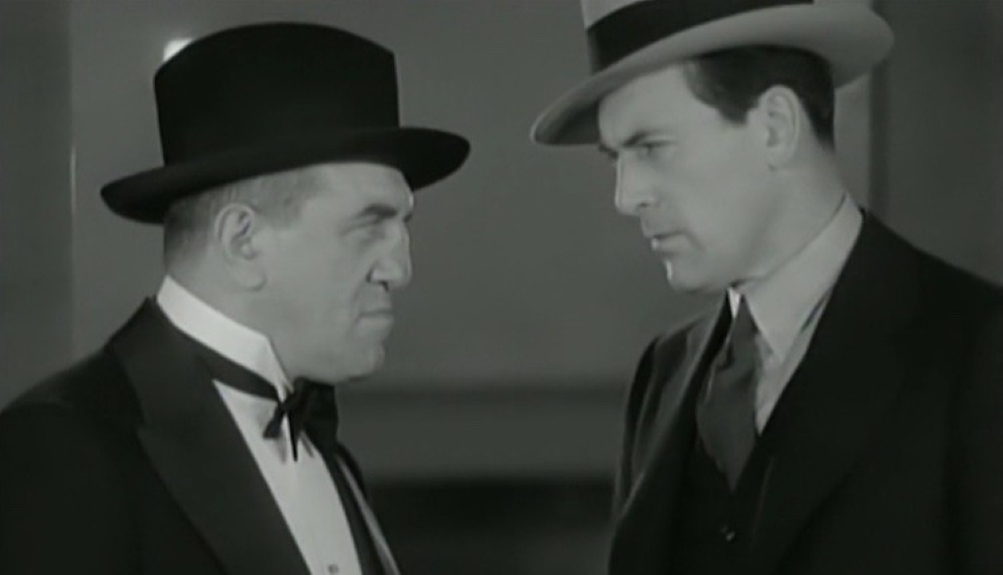
What helps is the performance of Louis Wolheim as the thuggish Scarsi. Wolheim had an excellent line in smug brutality – his looks really helped here, his broken nose (he was contractually banned from repairing it) giving him a thuggish look. Wolheim is full of simmering potential violence, something he exploits well when during a striking bit of business he fans his coat while talking with one of McQuigg’s cops (leading us to expect a gun) only to produce a wodge of cash for a bribe attempt. It’s a striking performance of menace and potential violence, far more interesting than Meighan’s strait-laced, formal playing as McQuigg.

Scarsi is also at the heart of the one of the film’s more interesting subtexts. He’s fixated on McQuigg (who he seems obsessed with as a worthy rival) and constantly talking about how women are ‘poison’ to him. With his closest confidante Chick (Lucien Proval) a fey figure, it’s hard not to read a homoerotic context into the macho Scarsi. I doubt any of that is intended, but it makes for interest today.

Just as its interesting to see The Racket be so subtly negative about elected officials. The authorities running the big city are utterly corrupt, everything managed for the benefit of the unseen “Old Man”. The DA lacks any scruples, elections are openly fixed (Scarsi owns half the precincts), and anyone inconvenient can be judicially murdered. The film concludes with a brief paean to the government by professional that on paper reads as praise, but after what we’ve seen is almost certainly intended as a subtle dig at how utterly corrupt all these professionals are.

It’s an interesting, surprisingly bitter and cynical ending – our hero even spends the last few moments mostly with his head in his hands – that restores interest in The Racket right at the final beat. Too much of the second act feels trapped by its stage roots, but Milestone creates several touches of visual and cinematic interest, Wolheim is great and it’s opening acts of gang violence may be dwarfed by the sort of action we’d see only a few years later in The Public Enemy but still provides excitement today.

All Quiet on the Western Front (1930)

All Quiet on the Western Front (1930)

War is hell in one of the greatest and most influential war films ever made

Director: Lewis Milestone

Cast: Lew Ayres (Paul Baumer), Louis Wolheim (Stanislaud Katczinsky), John Wray (Himmelstoss), Slim Summerville (Tjaden), Arnold Lucy (Professor Kantorek), Ben Alexander (Franz Kemmerich), Scott Kolk (Leer), Owen Davis Jnr (Peter), William Bakewell (Albert Kropp), Russell Gleason (Muller)

Franklin Roosevelt once said “War is young men dying and old men talking”. Perhaps no film shows that more truly than All Quiet on the Western Front. The first truly great film to win Best Picture at the Oscars, it’s a profoundly influential and unflinching look at the horrific cost of war. Specifically, it looks at how a younger generation buys into dreams of glory and destiny, only to arrive at the front lines and discover they’ve been sold a pup. A sense of glorious purpose collapses into death, mud and misery. War, it turns out, is hell.

All Quiet on the Western Front follows a company of German soldiers during the First World War, plucked from their college to lay down life and limb for the Kaiser. Their unofficial leader is Paul Baumer (Lew Ayres), an intelligent and thoughtful young man. They soon find the frontline is a world away from what they expected, and death moves through the boys like a flu. Over time Paul, with the mentorship of experienced soldier Stanislaud Katczinsky (Louis Wolheim), finds his naïve view of the world torn away with each bullet and failed attack.

In many ways it was brave to make such a large-scale Hollywood epic that placed the side America had actually fought against in the sympathetic role (on the other hand, much easier to look at the losing side and say “you’re fighting for a hopeless cause”). But that makes the film’s message even stronger: it doesn’t matter about sides, war claims young men regardless. The deaths come thick and fast on the Western front – and the gains are negligent. While the boys’ Professor (a pompous Arnold Lacy) sings a familiar hymn of glory and success by Christmas, life on the front line is actually continual terror. Mud, rats, debris and the constant chance the next step you take could be your last. Shelling is non-stop and every inch of the rickety, ramshackle trenches shakes with each explosion. Never mind going over the top, just being there shreds the nerves.

When the attacks come, the film is striking in its modernism and visual invention. Milestone frequently uses intriguing angles and long tracking shots to present an uninterrupted vision of hellish conflict. The film is full of crane shots, urgent camera movements and judicious cutting. The horrors are shown clearly – at one point a soldier literally explodes while cutting through barbed wire, his hands left clinging to the wire, the rest of his body gone. Milestone intercut shots of machine guns firing an arc with the camera moving in a smooth tracking shot as men run towards it and collapse in death. The film is literally shredding its soldiers.

The debris filled, fox-hole spotted no-man’s land the film presents is hellish. It’s a literal minefield of death, with bodies charging backwards and forwards depending on the tide of battle, the camera moving alongside them. For hand-to-hand fighting in the trenches, Milestone shoots the action with a tracking crane shot above the trenches, which stretch like a jagged flesh wound in nature, overflowing with people trying desperately to kill each other. During one charge, Paul lands in a fox hole with a French soldier, who he mercilessly wounds with his bayonet – then spends a dreadful night watching him slowly die. There isn’t any glory here and attack and retreat are both equally pointless. All that really happens is the body count ticking slowly up.

Most of the company are dead well before the film hits the half-way point. After the first big attack, the company goes behind the lines for a meal. Their meal is almost denied them as it was made for a company twice the size of the one that actually reports. It’s a sign of the suffering and hardening to death, that the reaction of the survivors is joy at the unexpected double rations. Later Milestone follows the fate of a single pair of boots, in a beautifully edited sequence that constantly visually focuses on a pair of good boots, while their successive owners meet their deaths.

It’s all so different from how we started, with an Eisenstein-inspired series of cuts to cheering faces as the students sign up. The horseplay at the training camp – where they deal with an officious postman turned corporal Himmelstoss (a puffed up and preening John Wray), overly aware of his own rank and determined to rub the boys faces in it – in no way prepares them for what is to come. This is all too clear from their confused faces at the staging post, a chaos of mud, soldiers and shelling. No wonder no one at home understands what’s happening here – as Paul discovers on leave, when he is repeatedly shocked and disgusted by the casual triumphalism of old-armchair-Generals utterly ignorant of the realities at the front.

All Quiet on the Western Front is so beautifully shot and edited – you can see its influence on so many war films to come – that it’s a shame some of its dialogue and ‘acting’ scenes are now either a little too on-the-nose or overstay their welcome. There are some big themes handled in the dialogue: why are we fighting, what is the point of war, how do we live our lives when they could end at any time – but the dialogue is sometimes a little stilted. It’s also where the film reverts to something more stagey and theatrical and less cinematic and visual. It’s also a slightly overlong film – already a sign that Hollywood had a tendency to equate “important” with “long”. Most of the films’ points are well made by the first hour, and the second hour or so often repeats them.

However, those concerns are outweighed by how much there is admire. Lew Ayres is very good as the noble Paul – the film had such a profound effect on him he became a life-long pacifist, a conscientious objector in WW2 who served as a front-line medic. Louis Wolheim is superb as the rough-edged but decent and kind Kat, a senior soldier taking the new company members under his wing and teaching them nothing is more important than the next meal and no unnecessary risks.

All Quiet on the Western Front takes place in a naturalistic quiet, with no hint of music to interrupt the mood. It is an overwhelmingly powerful movie about the pointlessness and cruelty of war – and the lies that young men are told to fight it. When Paul returns to the homefront – and sees another class of boys being inspired to die for their country by his Professor – he denounces the whole thing (and is promptly branded a coward). War is a cycle that eats everyone it comes into contact with and has no logic behind it. Directed with verve and imaginative modernism by Milestone, this is a brilliant picture, one of the first sound masterpieces – and still one of the greatest war films ever made.